

P0340 on 2017 Chevrolet Silverado: Camshaft Sensor Circuit Causes and Fixes
P0340 on a 2017 Silverado indicates a fault in the camshaft position sensor 'A' circuit. This is most often caused by a faulty sensor or, more commonly on this platform, damaged wiring. A thorough visual inspection of the wiring harness for chafing near the A/C compressor, cylinder heads, and corrosion in the X154 connector is critical before replacing parts.
- P0340 on a 2017 Silverado means the engine computer has lost the signal from the camshaft position sensor.
- Before replacing the sensor, always inspect the wiring harness thoroughly for damage, as this is a known weak point on these trucks.
- Symptoms typically include a check engine light, difficulty starting, rough idle, and potential stalling.
- The most common fixes are repairing a damaged wire/connector or replacing the camshaft position sensor itself.
- This is a DIY-friendly repair for many, with the sensor being relatively accessible and inexpensive.
What's Unique About the 2017-2017 Chevrolet SILVERADO
For this generation of Silverado (K2XX platform, 2014-2019), General Motors has issued multiple Technical Service Bulletins (TSBs) that highlight specific wiring harness issues as a frequent cause for P0340. TSB #PIP5335C/D specifically points to water intrusion causing green-colored corrosion in the X154 engine harness connector, a 16-pin plug on the front driver's side of the engine. Another bulletin, #PIP5724, warns of a wiring jumper harness getting pinched between the X154 connector bracket and the front engine cover. These known weak points suggest that the wiring circuit is a particularly vulnerable area on these trucks and should be inspected meticulously.
Diagnostic Flowchart
Tap your situation to follow the diagnostic path that matches what you're seeing on this vehicle.
Symptoms You May Notice
- Check Engine Light is on
- Engine is hard to start or has a long crank time
- Engine runs rough or misfires
- Stalling or dying while driving
- Poor acceleration and loss of power
- Increased fuel consumption
- Transmission may not shift properly as a protective measure
- Replacing the camshaft position sensor without first thoroughly inspecting the wiring harness. Given the known TSBs for wiring issues on this platform, a wiring fault is a very high probability.
- Replacing the wrong sensor. The camshaft and crankshaft position sensors can look similar and are sometimes confused. The P0340 code specifically refers to the camshaft sensor on Bank 1.
Most Likely Causes
- Damaged Wiring or Connectors 🔴 High Probability Multiple GM TSBs (#PIP5335D, #PIP5724) point to specific wiring chafe points and connector corrosion issues on this truck platform as a common problem. Rodent damage to the soy-based wiring insulation is also a frequent cause.
How to confirm: Visually inspect the entire wiring harness from the ECM to the camshaft position sensor. Pay close attention to the harness where it passes the A/C compressor, generator bracket, and sharp corners of the cylinder head. Disconnect the X154 connector (front driver's side of the engine) and inspect the pins for any green or white corrosion. Check the connector at the sensor for damage or corrosion.
Typical fix: Repair the damaged section of wire. If the connector is corroded or damaged, it should be replaced with a new pigtail. Secure the harness away from sharp edges or moving parts. If corrosion is found in the X154 connector, it needs to be cleaned or replaced.
Est. part cost: $10-$50 - Failed Camshaft Position Sensor 🔴 High Probability While wiring is a major issue, the sensor itself is a common failure item due to heat and vibration.
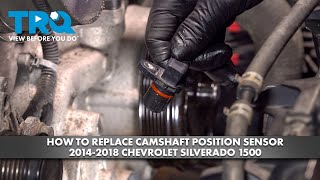
How to confirm: After confirming the wiring is intact and has proper voltage/ground, the sensor is the next likely culprit. It is located on the front of the driver's side cylinder head, just below the valve cover, and is typically held in by a single 10mm bolt. A diagnostic scan tool can be used to observe the sensor's output, or it can be tested with a multimeter.
Typical fix: Replace the camshaft position sensor. It is typically held in by a single 10mm bolt.
Est. part cost: $35-$75 - Weak Battery or Poor Ground Connection ⚪ Low Probability
How to confirm: Test the battery voltage and check the main engine and chassis ground connections for tightness and corrosion. A weak battery or failing alternator can cause electrical noise and trigger a P0340 code. Key ground points on GM V8s include G103 (front passenger side cylinder head) and G104 (front driver's side cylinder head). A poor ground can introduce electrical noise and disrupt the sensor signal.
Typical fix: Charge or replace the battery. Clean and tighten all ground connections.
Est. part cost: $0-$250
Rare But Worth Checking
- Failed Crankshaft Position Sensor: A failing crankshaft position sensor can sometimes cause the ECM to incorrectly flag the camshaft sensor. TSB #PIP5724 links P0340 with the crank sensor code P0335, indicating they can be caused by the same pinched harness. If P0335 is also present, investigate the crankshaft sensor circuit as well.
- Timing Chain or Cam Phaser Issue: If the timing chain has stretched or a cam phaser has failed, the correlation between the cam and crank sensors will be incorrect, which can trigger circuit codes. This is a more serious mechanical issue, often accompanied by rattling noises from the front of the engine.
- Failed Engine Control Module (ECM): This is very rare, but if all other possibilities have been exhausted, the ECM itself could be faulty. This should be the last item to consider. 🎬 Watch: A deep dive into common P0340 causes and fixes.
Diagnosis Steps
- Scan the ECM for any other stored trouble codes to see if P0340 appears with others like P0341 or P0335.
- Perform a thorough visual inspection of the camshaft position sensor wiring harness and its connector. Look for any signs of chafing, melting, corrosion, or rodent damage. Pay special attention to the harness near the A/C compressor and the X154 connector bracket.
- Disconnect and inspect the 16-pin X154 connector on the front driver's side of the engine for any signs of green or white corrosion from water intrusion, as per TSB #PIP5335.
- If the wiring looks good, use a multimeter to check for the correct voltage (typically a 5-volt reference) and a good ground at the sensor connector with the key on.
- If voltage and ground are present, test the sensor's signal wire. Using an oscilloscope is best to view the waveform, but a multimeter can sometimes show a changing voltage as the engine is cranked.
- If the wiring is confirmed to be good but there is no signal from the sensor, replace the camshaft position sensor.
- After replacement, a crankshaft position variation relearn procedure may be required using a capable scan tool.
- If a new sensor does not fix the issue, the problem may be more complex, such as a mechanical timing issue (stretched chain, phaser problem) or, rarely, a faulty ECM.
Parts You'll Likely Need
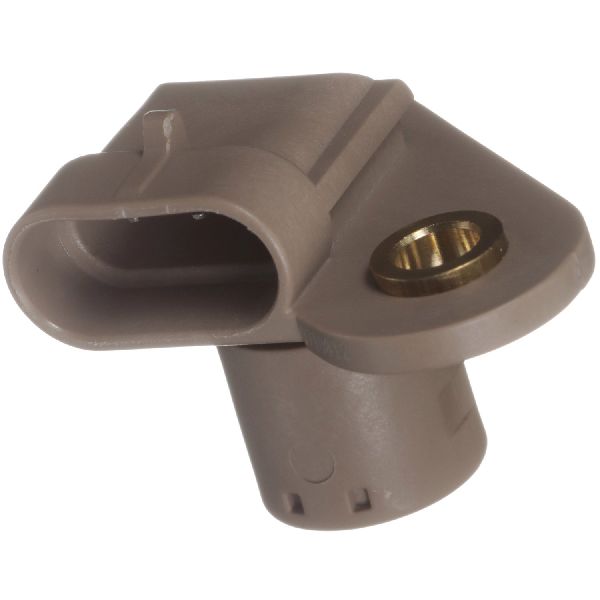
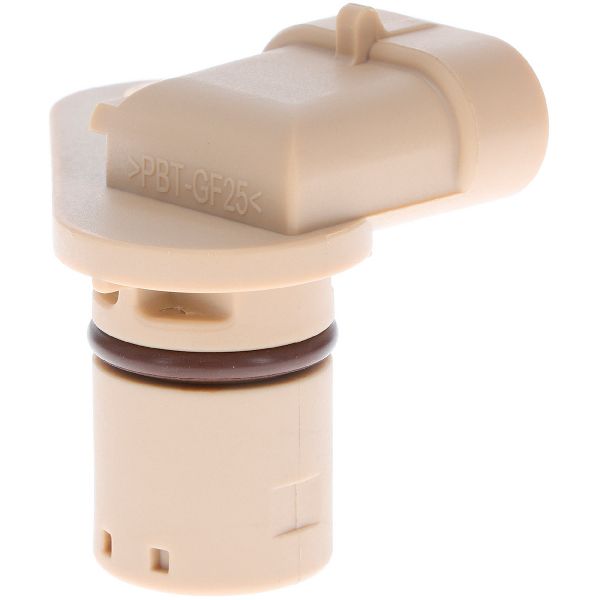
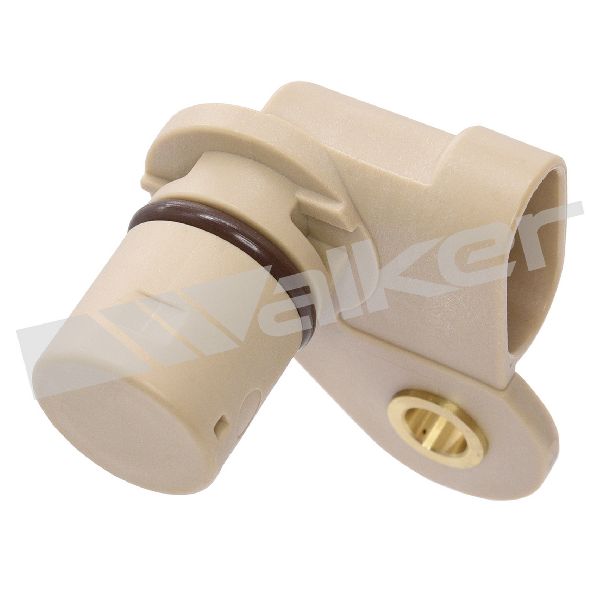
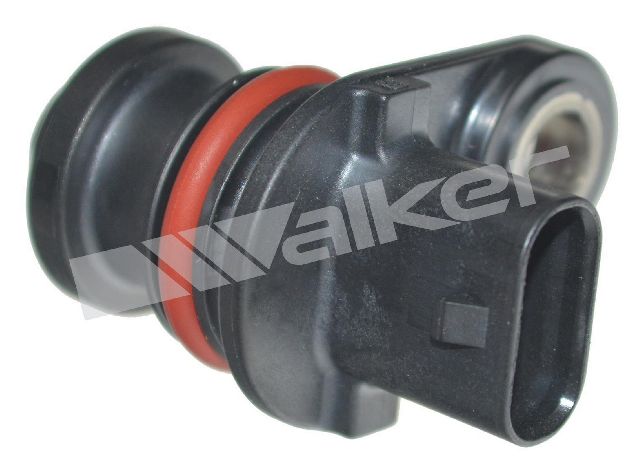
- Camshaft Position Sensor
(OEM #12690675 (Verify with VIN))— This sensor is the most commonly replaced part to fix a P0340 code after wiring issues have been ruled out. Note: Part number 12674703, often cited, is typically for the CRANKshaft sensor. Always verify the correct cam sensor part number for your specific vehicle.
Trusted brands: ACDelco (OEM), Delphi, Bosch, Standard Motor Products
OEM price range: $40-$60
Aftermarket price range: $25-$45 - Camshaft Position Sensor Connector Pigtail
(OEM #ACDelco PT2649 (Verify))— If the connector or wiring right at the sensor is damaged, corroded, or broken, replacing the pigtail is the proper repair.
Trusted brands: ACDelco, Dorman
OEM price range: $20-$40
Aftermarket price range: $10-$25
Related Codes That Often Appear With This One
- P0341 — This code for 'Camshaft Position Sensor 'A' Circuit Range/Performance' is often set along with P0340, as they both relate to the same sensor's signal integrity. TSB #PIP5335D notes them appearing together.
- P0335 — This code for the 'Crankshaft Position Sensor 'A' Circuit' can appear with P0340, sometimes due to a shared wiring harness issue as mentioned in TSB #PIP5724. A pinched harness can affect both circuits simultaneously.
Technical Service Bulletins (TSBs) & Recalls
- PIP5335D: Service Engine Soon Malfunction Indicator Lamp on with DTC P0340 and P0341.
- PIE0416A: Malfunction Indicator Lamp Illuminated with DTCs P0335, P0340, or P0365 Set.
- PIP5724: SES Lamp With Camshaft or Oil Pump System Related DTCs.
- 21-NA-149: Check Engine Light Illuminated with Various DTCs, Engine Runs Rough, No Start, or Stalls
Platform-Specific Known Issues
- TSB #PIP5335D: Notes that DTCs P0340 and P0341 may set and advises technicians to inspect connector X154 for corrosion on 2014-2019 models.
- TSB #PIE0416A: Indicates that GM was collecting field information on DTCs P0335, P0340, and P0365, showing that this group of sensor codes was under investigation by the manufacturer.
- TSB #PIP5724: Warns of a possible crank/no-start or stall on 2020 models with P0340 due to a wiring jumper harness getting pinched between the X154 connector bracket and the front engine cover.
- TSB #21-NA-149: While for slightly newer models (2019+), it details multiple engine harness chafing locations that can cause P0340, including near the ECM bracket and upper control arm, which may be relevant to earlier K2XX trucks as well.
Mechanic-Grade Diagnostic Values
- 5-Volt Reference Circuit Voltage — expected: 4.8-5.2 Volts DC with key on, engine off, measured between the 5V reference wire at the sensor connector and a known good ground.. Failure: Voltage below 4.8V or above 5.2V points to a wiring issue or a problem with the ECM.
- Low Reference (Ground) Circuit Resistance — expected: Less than 1.0 Ohm between the ground circuit terminal at the sensor connector and a known good ground (like the negative battery terminal).. Failure: Resistance greater than 1.0 Ohm indicates a poor ground connection, which can cause an erratic signal.
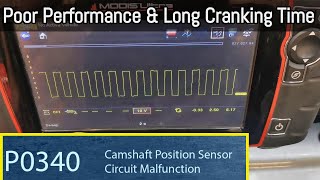
- Signal Circuit Waveform — expected: A clean digital square wave that toggles between approximately 0V and 5V when viewed on an oscilloscope while the engine is cranking or running.. Failure: A missing signal, a signal that does not switch, or a distorted waveform (e.g., 'shark fin' or noisy) indicates a failed sensor, wiring problem, or mechanical issue with the reluctor wheel.
Scan Tool Commands That Help
- GDS2 / Professional Scan Tool: Crankshaft Position Variation Learn (CASE Relearn) — This procedure may be required after replacing the camshaft or crankshaft position sensor. It synchronizes the sensors with the ECM to ensure accurate timing calculations. Failure to perform this when required can lead to persistent running issues even after the part is replaced.
Wiring & Ground Locations
- G104 — On the front of the driver's side cylinder head.. This is a primary engine ground. A loose or corroded connection here can disrupt the low reference circuit for multiple sensors, including the camshaft position sensor, causing erratic signals and fault codes.
- G103 — On the front of the passenger's side cylinder head.. This is another critical engine ground. While G104 is more directly related to the Bank 1 cam sensor, ensuring all major engine grounds are clean and tight is a crucial step in diagnosing any electrical fault.
- X154 Connector — A 16-pin connector located on the front engine cover, near the vacuum pump on applicable models.. TSB #PIP5335D specifically calls out this connector as a common point for water intrusion and corrosion, which directly interrupts the camshaft position sensor circuits passing through it, leading to P0340 and P0341.
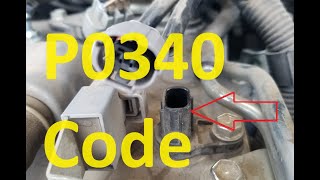
- Camshaft Position Sensor Connector (Bank 1) — On the front of the driver's side cylinder head, connecting directly to the sensor.. The three pins are typically: Pin 1 - Signal, Pin 2 - Low Reference (Ground), Pin 3 - 5V Reference. These are the primary test points for voltage and ground checks with a multimeter.
Real Owner Repair Stories
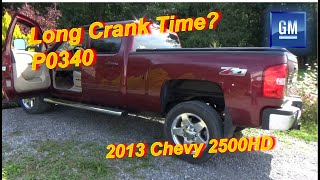
- Pine Hollow Auto Diagnostics (YouTube) (2013 Chevrolet Silverado 2500HD (Similar platform/engine design)) — Long crank time; starter would continue to crank until the engine finally started. P0340 was the only code stored.
❌ Tried (didn't work) The technician prepared to perform advanced diagnostics with an oscilloscope and wiring diagrams.
✅ What actually fixed it A simple visual inspection revealed that rodents (a groundhog) had chewed through the wiring harness leading to the camshaft position sensor. The wires were visibly damaged. The final fix was to solder and repair the chewed wires and protect the harness. The code was cleared and did not return. - Reddit user in r/MechanicAdvice (2017 Chevrolet Silverado 1500) — After replacing the battery and starter, the truck made one quiet click and then would not crank at all. This occurred after a P0340 code was present.
❌ Tried (didn't work) Replacing the camshaft position sensor., Replacing the battery., Replacing the starter.
✅ What actually fixed it The thread suggests a strong link between starter/battery issues and the P0340 code. While the final resolution isn't posted, the user's experience highlights that a failing starter can cause voltage drops or electrical noise that may trigger a P0340 code, leading to a misdiagnosis of the sensor itself.
OEM Part Supersession History
12686928→12716200— Standard part revision for improved reliability or manufacturing process change.
Helpful Videos
We Have This Part in Stock


The information in this article is provided for general reference and educational purposes only. Vehicle specifications, procedures, and part compatibility can vary by production date, trim level, and region. Always consult your vehicle's factory service manual and verify part numbers before purchasing or performing repairs. Safety-critical components such as airbags, seat belts, and braking systems should be installed by a qualified professional.
- Chevrolet SILVERADO:
- 🎬 Helpful Videos
- 🛍️ Shop This Part
- What's Unique About the 2017-2017 Chevrolet SILVERADO
- Diagnostic Flowchart
- Symptoms You May Notice
- Most Likely Causes
- Rare But Worth Checking
- Diagnosis Steps
- Parts You'll Likely Need
- Related Codes That Often Appear With This One
- Technical Service Bulletins (TSBs) & Recalls
- Platform-Specific Known Issues
- Mechanic-Grade Diagnostic Values
- Scan Tool Commands That Help
- Wiring & Ground Locations
- Real Owner Repair Stories
- OEM Part Supersession History
- 🎟️ Get 5% Off