

P0335 on 2004-2011 Toyota RAV4: Crankshaft Sensor Causes and Fixes
P0335 on a Toyota RAV4 usually means a failed crankshaft position sensor, which is a critical part for engine timing, often leading to a no-start or stalling condition. On 2.4L 2AZ-FE engines, a known issue with the intake camshaft gear can also trigger this code, so it's not always the crank sensor itself. Wiring issues are also a common culprit.
- P0335 is a critical code that can cause a no-start or stalling condition; do not drive the vehicle.
- The most common fix is replacing the crankshaft position sensor, but wiring issues are also frequent.
- Always check battery health and charging system first, as low voltage can trigger this code on a RAV4.
- If you have a 2006-2008 RAV4 with the 2.4L 2AZ-FE engine, be aware that a faulty intake camshaft gear is a known, documented cause of this code.
What's Unique About the 2004-2011 Toyota RAV4

For the 2004-2011 RAV4, this code has some unique platform-specific quirks. The vehicle range covers two generations and multiple engines, with the 2.4L 2AZ-FE engine being particularly notable. Toyota issued a Technical Service Bulletin (T-SB-0192-12) indicating that a faulty intake camshaft gear assembly can surprisingly cause a P0335 code on these engines, often when the engine is warm and at idle. Another TSB (T-TT-0010-10 Rev) points out that low battery voltage can also be a cause, leading to misdiagnosis if not checked first. These issues mean you shouldn't immediately assume the crankshaft sensor has failed without further diagnosis, especially on the 2AZ-FE engine.
Diagnostic Flowchart

Tap your situation to follow the diagnostic path that matches what you're seeing on this vehicle.
Generation note: The 2004-2011 period covers two RAV4 generations: - 2nd Gen (XA20): 2004-2005 models in this range 🎬 Watch: How to replace the sensor on a 2.4L engine primarily used the 2.4L 2AZ-FE 4-cylinder engine. - 3rd Gen (XA30): 2006-2011 models used the 2.4L 2AZ-FE (until 2008), the 2.5L 2AR-FE 4-cylinder (from 2009), and the 3.5L 2GR-FE V6. The TSB regarding the camshaft gear specifically applies to the 2AZ-FE engine found in 2006-2008 models, but also affects other Toyota vehicles with this engine.
Symptoms You May Notice
- Check Engine Light is on
- Engine will crank but not start
- Engine stalls unexpectedly, sometimes when warm
- Rough idling or stumbling
- Hesitation or bucking during acceleration
- Reduced engine power and poor fuel economy
- For 4WD models, the 'Check 4x4 System' light may also illuminate
- Replacing the crankshaft sensor when the actual cause is a wiring issue or, on 2AZ-FE engines, the camshaft gear per the TSB.
- Replacing the battery or starter motor for a no-start condition without first checking for diagnostic trouble codes.
- Confusing the crankshaft position sensor with the camshaft position sensor (which triggers codes like P0340). A mechanic on YouTube noted that on the 2.4L, a fault with the camshaft can illogically throw a P0335 for the crankshaft.
Most Likely Causes

- Faulty Crankshaft Position Sensor 🔴 High Probability Sensors can fail over time due to exposure to heat and vibration at the bottom of the engine. It's the most common point of failure for this code.
How to confirm: Use a multimeter to test the sensor's internal resistance and compare it to the manufacturer's specification (typically between 985-1,600 Ω when cold for the 2AZ-FE). You can also monitor the RPM signal on a scan tool while cranking the engine; a reading of zero indicates a likely sensor or circuit problem. An oscilloscope provides the most definitive test by visualizing the sensor's output waveform.
Typical fix: Replace the crankshaft position sensor. Using an OEM Denso sensor is highly recommended as some aftermarket sensors may not perform correctly.
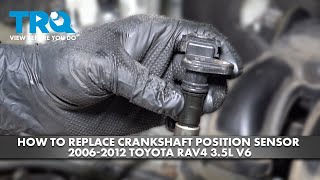
Est. part cost: $25-$90 - Wiring or Connector Issue 🟡 Medium Probability The sensor is located at the bottom front of the engine (near the main pulley), exposing its wiring to road debris, oil, and heat, which can cause damage, corrosion, or melting over time. In one documented case on a 2007 V6, the wires were ripped out of the connector during an alternator replacement. 🎬 See this walkthrough for replacing the sensor on V6 models
How to confirm: Visually inspect the wiring harness and connector for any signs of damage, corrosion, or loose pins. Wiggle the harness with the engine running (if it starts) to see if it triggers the stall or code. A user on Reddit with a 2010 RAV4 noted the code would appear when hitting bumps, strongly suggesting a wiring issue.
Typical fix: Repair the damaged section of the wiring harness or clean/replace the connector. Ensure the harness is properly routed and secured away from heat sources and moving parts.
Est. part cost: $10-$50 - Faulty Intake Camshaft Gear Assembly (2AZ-FE Engine Only) 🟡 Medium Probability As per Toyota TSB T-SB-0192-12, an internal fault in the intake camshaft gear assembly (VVT gear) can cause an intermittent P0335 code, specifically when the engine is warm and at idle. This is a well-documented issue across multiple Toyota models using the 2AZ-FE engine.
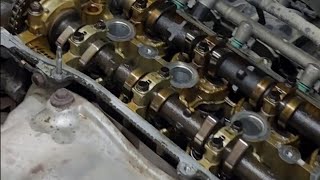
How to confirm: This is often a diagnosis of exclusion. If the crank sensor and wiring are confirmed good, and the freeze frame data shows the code was set at operating temperature (approx. 185°F) and below 1000 RPM, this TSB should be investigated. A mechanic on YouTube diagnosed a similar issue by finding a broken piece of the camshaft reluctor inside the valve cover, which caused the cam to 'walk' away from its own sensor under load, confusing the ECM into setting a P0335.
Typical fix: Replace the intake camshaft timing gear assembly with the updated part (PN 13050-28021).
Est. part cost: $150-$300 - Low Battery Voltage ⚪ Low Probability According to Toyota TSB T-TT-0010-10 Rev, low battery voltage can cause inconsistent crankshaft rotational speed during startup, which the ECM may interpret as a sensor fault, triggering a P0335 code.
How to confirm: Test the battery voltage with a multimeter. It should be above 12.4V with the engine off. Perform a load test on the battery and check the alternator's output (typically 13.5-14.5V when running).
Typical fix: Charge or replace the weak battery. Diagnose and repair any charging system issues.
Est. part cost: $100-$250
Rare But Worth Checking
- Damaged Reluctor Ring: The reluctor ring (or tone ring) on the crankshaft has teeth that the sensor reads. If the ring is cracked, bent, has missing teeth, or has sheared its keyway, it can cause an erratic signal. This is uncommon but can happen, especially if there has been other internal engine work or a severe impact to the crankshaft pulley.
- Stretched Timing Chain: While rare, a significantly stretched timing chain can cause the crankshaft and camshaft timing to become desynchronized enough to trigger correlation issues, which can sometimes manifest as a P0335, as noted by a user on Boards.ie. This would typically be accompanied by other symptoms like rattling noises on startup.
- Faulty Engine Control Module (ECM): This is extremely rare. The ECM is the last thing to suspect. All other possibilities, including sensor, wiring, and mechanical causes, must be ruled out before considering a faulty ECM.
Diagnosis Steps
- Check and confirm battery voltage is sufficient (above 12.4V). Charge or replace if necessary.
- Connect an OBD-II scanner and check for any other codes. Note the freeze frame data for P0335 to see the conditions when the code was set (e.g., engine speed, temperature, load).
- Visually inspect the crankshaft position sensor's connector and wiring harness for any obvious damage, corrosion, or oil contamination. The sensor is located on the front of the engine near the crankshaft pulley.
- Using the live data function on a scan tool, monitor the Engine RPM while cranking. If it remains at 0, the ECM is not seeing a signal from the crank sensor or its circuit.
- If the engine won't start, a simple DIY test is to wave a magnet in front of the sensor while an assistant cranks the engine. If the engine sputters or tries to start, it strongly suggests the sensor itself has failed.
- Disconnect the sensor and measure its internal resistance with a multimeter. Compare the reading to the manufacturer's specification (e.g., 985-1,600 Ohms cold for 2AZ-FE).
- If the sensor tests good, check for continuity, shorts, and proper voltage at the connector pins leading back to the ECM.
- If the vehicle has a 2.4L 2AZ-FE engine and the problem is intermittent (especially at warm idle), consult Toyota TSB T-SB-0192-12 regarding the intake camshaft gear assembly.
- If all else fails, inspect the crankshaft reluctor ring for damage, although this may require significant disassembly (e.g., removing the crankshaft pulley).
Parts You'll Likely Need
- Crankshaft Position Sensor
(OEM #90919-05043 (for 2.4L 2AZ-FE), 90919-A5002 (for 2.5L 2AR-FE), 90919-A5001 (for 3.5L 2GR-FE))— This is the most frequent failure point for a P0335 code. Part numbers can vary and get superseded, so always verify with VIN.
Trusted brands: Denso (OEM), Hitachi
Related Codes That Often Appear With This One
- P0339 — This code indicates an intermittent signal from the crankshaft sensor, which is often a precursor or companion to a complete circuit failure (P0335).
- P0340 — This is the code for the Camshaft Position Sensor. As noted in TSB T-TT-0010-10 Rev, low battery voltage can cause both codes to appear simultaneously. They can also appear together if there is a significant timing issue.
- C1201 — On some models, a P0335 can trigger a C1201 (Engine Control System Malfunction) in the ABS/VSC module, as the stability control system relies on engine data to function correctly.
Technical Service Bulletins (TSBs) & Recalls
- T-SB-0192-12: Intermittent MIL "ON" DTC P0335
- T-TT-0010-10 Rev: Low Battery Voltage Can Contribute to P0335/P0340
Platform-Specific Known Issues
- TSB T-SB-0192-12: Affects 2006-2008 RAV4 models with the 2.4L 2AZ-FE engine. An intermittent P0335 code may be set due to a fault in the intake camshaft gear assembly, not the crankshaft sensor itself. The fix involves replacing the gear with an improved part (13050-28021).
- TSB T-TT-0010-10 Rev: Notes that low battery voltage can lead to the ECM setting P0335 and/or P0340 codes due to inconsistent engine rotational speed during cranking. This highlights the importance of checking the battery and charging system before replacing sensors.
- Wiring Harness Vulnerability: On the 2.5L 2AR-FE, owners have reported intermittent P0335 codes that trigger on bumps or at high RPM, pointing to a chafed or loose wire in the harness between the sensor and the ECM.
Mechanic-Grade Diagnostic Values
- Crankshaft Position Sensor Resistance (2.4L 2AZ-FE) — expected: 985 to 1,600 Ω (Cold), 1,265 to 1,890 Ω (Hot). Failure: Readings outside of these ranges, or an open/short circuit.
- Crankshaft Position Sensor Resistance (3.5L 2GR-FE) — expected: 1,630 to 2,740 Ω (Cold), 2,090 to 3,260 Ω (Hot). Failure: Readings outside of these ranges.
- Scan Tool Live Data: Engine RPM (cranking) — expected: Approx. 200+ RPM. Failure: A value of 0 RPM while the engine is cranking indicates the ECM is not receiving a signal from the CKP sensor or its circuit.
Scan Tool Commands That Help
- Techstream: Data List -> Primary -> ENGINE SPD — This is a primary step to confirm if the ECM is receiving any RPM signal from the crankshaft sensor. While cranking, if the value remains at 0, it strongly points to a fault in the sensor or its circuit.
Wiring & Ground Locations
- EB — Intake side of the cylinder block (for 1AZ-FE, similar on 2AZ-FE).. A poor engine block ground can introduce noise into the crankshaft position sensor circuit, as the sensor relies on a clean ground reference. This ground point is critical for many engine sensors.
- EC — Left side of the cylinder head (for 1AZ-FE, similar on 2AZ-FE).. Similar to the block ground, this cylinder head ground ensures that all sensors mounted on the head have a stable ground path, preventing potential voltage offsets that could affect sensor readings.
- 2GR-FE Sensor Ground Bundle — On the Camry, a sensor ground bundle attaches to the front valve cover. The RAV4 with the same engine does not have a ground in this specific position, using a different spot in the harness.. This variation is critical for technicians familiar with other Toyota V6 models. Assuming a ground point exists where it doesn't on the RAV4 can lead to wasted diagnostic time. It highlights the importance of vehicle-specific wiring diagrams.
Real Owner Repair Stories
- Reddit user u/pobody-nerfect (2010 Toyota RAV4 2.5L 2AR-FE) — Intermittent P0335 code that appears when flooring the engine at high RPM or when going over a big bump. Car runs fine otherwise.
❌ Tried (didn't work) Replacing the crankshaft sensor, Spraying contact cleaner on the ECU connector
✅ What actually fixed it The user suspected a wiring harness issue due to the code triggering on bumps. While the final fix was not posted by the original author, this behavior is a classic symptom of a chafed or loose wire in the sensor's circuit. - Boards.ie user podgesax (2008 Toyota RAV4) — P0335 code appears after about 10 minutes of driving. The 'Check 4x4 system' message comes on first. Car runs perfectly. The code only reappears when making a left turn at ~15km/hr or faster.
❌ Tried (didn't work) Replacing the crankshaft sensor, Checking the wiring and reluctor ring
✅ What actually fixed it The resolution was not posted, but the symptoms (triggering only on a turn in one direction) strongly point to a wiring harness issue. The harness is likely being stretched or pinched during the turn, causing a momentary loss of signal. - YouTube channel 'Pine Hollow Auto Diagnostics' (2006 Toyota RAV4 2.4L) — Persistent P0335 code with no drivability issues. Code would set under hard acceleration.
❌ Tried (didn't work) The sensor had already been replaced by another shop.
✅ What actually fixed it A broken piece of the camshaft reluctor was found inside the valve cover. Under load, the camshaft would 'walk' slightly, causing the cam sensor to lose its signal. The ECM misinterpreted this loss of cam signal as a crankshaft circuit fault, illogically setting P0335.
OEM Part Supersession History
13050-0H010→13050-28020, then 13050-28021— Improvement to prevent intermittent P0335 code as described in TSB T-SB-0192-12.
Heads up: Using the older part number for a repair will likely result in the same P0335 fault returning.
Model Year Variations Within This Range
- 2006-2008 (with 2.4L 2AZ-FE): These model years are specifically called out in TSB T-SB-0192-12 for the potential of a faulty intake camshaft gear causing P0335. While the sensor itself can still fail, this TSB provides a critical alternative diagnosis path that does not apply to the V6 or the later 2.5L engine.
- 2009-2011 (with 2.5L 2AR-FE): The sensor location and part number (90919-A5002) are different from the earlier 2.4L engine. While wiring issues are still possible, a Reddit post about a 2010 model suggests these issues can manifest as codes being thrown when hitting bumps or at high RPM.
Helpful Videos

We Have This Part in Stock



The information in this article is provided for general reference and educational purposes only. Vehicle specifications, procedures, and part compatibility can vary by production date, trim level, and region. Always consult your vehicle's factory service manual and verify part numbers before purchasing or performing repairs. Safety-critical components such as airbags, seat belts, and braking systems should be installed by a qualified professional.
- Toyota RAV4:
- 🎬 Helpful Videos
- 🛍️ Shop This Part
- What's Unique About the 2004-2011 Toyota RAV4
- Diagnostic Flowchart
- Symptoms You May Notice
- Most Likely Causes
- Rare But Worth Checking
- Diagnosis Steps
- Parts You'll Likely Need
- Related Codes That Often Appear With This One
- Technical Service Bulletins (TSBs) & Recalls
- Platform-Specific Known Issues
- Mechanic-Grade Diagnostic Values
- Scan Tool Commands That Help
- Wiring & Ground Locations
- Real Owner Repair Stories
- OEM Part Supersession History
- Model Year Variations Within This Range
- 🎟️ Get 5% Off