

P0335 on 2004-2011 Toyota 4Runner: Crank Sensor Causes and Fixes
P0335 on a Toyota 4Runner usually means the crankshaft position sensor has failed or its wiring is damaged. The engine may crank but not start, or stall unexpectedly, especially when hot. Replacing the sensor is the most common fix. An OEM Denso part is highly recommended over aftermarket alternatives. The cost to replace is typically $40-$90 for an aftermarket part or $120-$200 for an OEM Denso part.
- P0335 means the engine's computer has lost the signal from the crankshaft sensor, which will likely cause a no-start or stalling condition.
- The most common fix is replacing the crankshaft position sensor itself. Using a quality OEM (Denso) part is recommended.
- Before replacing parts, always check the battery voltage and inspect the sensor's wiring and connector for damage or oil contamination.
- The sensor is in a different location on the V6 (driver's side, front) versus the V8 (passenger's side, front).
- If the code appeared after a recent engine repair (like a timing belt/chain replacement), suspect an issue with the reluctor ring or balancer bolt torque.
What's Unique About the 2004-2011 Toyota 4RUNNER

For the 4th and 5th generation 4Runner, the P0335 code is a straightforward issue with platform-specific quirks. On the 4.0L V6 (1GR-FE), the sensor is on the front timing cover, passenger side, while on the 4.7L V8 (2UZ-FE), it's on the lower driver's side of the block, making it slightly easier to access. Oil leaks from components like valve cover gaskets can drip onto the sensor and its connector, leading to premature failure. Additionally, Toyota issued a technical note (TSB T-TT-0010-10 Rev) pointing out that low battery voltage (below 11 volts) during cranking can trigger this code, a simple check that can prevent a misdiagnosis.
Diagnostic Flowchart

Tap your situation to follow the diagnostic path that matches what you're seeing on this vehicle.
Generation note: The 2004-2011 range covers two 4Runner generations. The 4th Gen (2004-2009) was available with a 4.0L V6 (1GR-FE) or a 4.7L V8 (2UZ-FE). The 5th Gen (2010-2011) came only with the 4.0L V6. 🎬 Watch: 5th Gen 4Runner crankshaft sensor replacement walkthrough The crankshaft sensor location and part number differ between the V6 and V8 engines. The V6 sensor is on the front timing cover, while the V8 sensor is on the lower driver's side of the block. The 1GR-FE engine itself was significantly updated in 2009 for the 2010 model year, receiving Dual VVT-i, roller rockers, and other internal changes, though the P0335 diagnostic principles remain similar.
Symptoms You May Notice
- Check Engine Light is on
- Engine cranks but will not start
- Engine is difficult to start, especially when warm (heat soak failure)
- Engine stalls intermittently, sometimes while driving
- Rough or unstable idle
- Noticeable loss of engine power and acceleration
- Reduced fuel economy
- Tachometer reads 0 RPM during cranking
- Replacing the camshaft position sensors. While related to timing, P0335 is specific to the crankshaft sensor circuit.
- Replacing fuel system components like the fuel pump or filter, when the no-start issue is actually due to a lack of spark and injection timing from the missing crank signal.
- Assuming the new aftermarket sensor is good. Multiple forum threads mention that cheap aftermarket sensors can be faulty out of the box, leading to wasted diagnostic time.
Most Likely Causes

- Faulty Crankshaft Position Sensor 🔴 High Probability The sensor is located at the bottom of the engine where it is exposed to intense heat and potential oil leaks, which can degrade the sensor's internal components over time. Heat soak can cause the sensor to fail when hot but work when cold.
How to confirm: Test the sensor's internal resistance with a multimeter. For the 1GR-FE (V6), the spec is 1,630-2,740 Ω when cold and 2,065-3,225 Ω when hot. For the 2UZ-FE (V8), the spec is 1,850-2,450 Ω when cold and 2,400-3,000 Ω when hot. A reading outside this range indicates a faulty sensor. An oscilloscope can also be used to view the sensor's output waveform while cranking; a missing or erratic signal confirms failure.
Typical fix: Replace the crankshaft position sensor. It is highly recommended to use an OEM (Denso) or high-quality aftermarket part, as some aftermarket sensors have been reported to fail prematurely or be dead on arrival.
Est. part cost: $40-$200 - Wiring Harness or Connector Damage 🟡 Medium Probability The wiring runs close to hot engine components and is subject to vibration, which can cause wires to become brittle, frayed, or shorted. The connector itself can also be damaged by oil contamination or become loose.
How to confirm: Visually inspect the wiring harness from the sensor to the ECM for any signs of melting, chafing, or rodent damage. Check that the connector is securely plugged in and free of oil and corrosion. Use a multimeter to check for continuity and for shorts to ground on each wire in the circuit. In one documented case, an aftermarket pigtail had its wires colored incorrectly, requiring them to be swapped to fix the issue.
Typical fix: Repair the damaged section of wire or replace the pigtail connector. Ensure the repaired wiring is properly secured away from heat sources.
Est. part cost: $15-$50 - Low Battery Voltage ⚪ Low Probability A Toyota Technical Service Bulletin (T-TT-0010-10 Rev) states that low battery voltage (below 11V) can cause inconsistent engine cranking speed, which the ECM may misinterpret as a fault in the crankshaft position sensor circuit. There are multiple owner reports of this code appearing after a dead battery and disappearing once a new, healthy battery is installed. 🎬 See this breakdown of P0335 causes and common fixes
How to confirm: Test the battery voltage with a multimeter. A healthy battery should read approximately 12.6 volts with the engine off and 13.7-14.7 volts with the engine running. Check the freeze frame data, which may show low battery voltage at the time the code was set.
Typical fix: Charge or replace the weak battery. If the alternator is failing, it will also need to be replaced.
Est. part cost: $150-$400
Rare But Worth Checking
- Damaged Reluctor Ring: The toothed ring on the crankshaft that the sensor reads can get damaged, have bent teeth, or have a sheared keyway. This is especially noted on the 4.0L V6 if the harmonic balancer bolt was not torqued correctly during a previous repair, causing the trigger wheel to wobble or become misaligned.
- Faulty Starter Motor: A failing starter can create excessive electrical noise (AC voltage) or a significant voltage drop during cranking, which may interfere with the crank sensor signal and trigger a false code.
- Faulty Engine Control Module (ECM): While rare, the ECM itself can fail. This should only be considered after all other possibilities (sensor, wiring, reluctor ring) have been exhaustively ruled out.
- Weak Key Fob Battery: In a rare case on a ClubLexus forum, a user reported that a weak key fob battery prevented the immobilizer from properly communicating, which led to a no-start and a P0335 code. Replacing the fob battery resolved the issue.
Diagnosis Steps
- Scan for Codes: Read the trouble codes with an OBD-II scanner. Note any other codes that are present and check the freeze frame data for clues like battery voltage at the time of the fault.
- Check Battery and Charging System: Test the battery voltage with the engine off and running to rule out low voltage as a cause, per TSB T-TT-0010-10 Rev. A voltage below 11V during cranking is a red flag.
- Visual Inspection: Inspect the crankshaft position sensor and its wiring harness. Look for loose connections, oil contamination, or physical damage to the wires.
- Check for RPM Signal: Use a scan tool with live data capability. Monitor the engine RPM while cranking. If the RPM reads 0, it strongly suggests a problem in the crank sensor circuit.
- Test the Sensor: Disconnect the sensor and measure its internal resistance with a multimeter. For the 1GR-FE (V6), the specification is 1,630-2,740 Ω when cold. For the 2UZ-FE (V8), the spec is 1,850-2,450 Ω when cold. Compare the reading to your vehicle's service manual. An out-of-spec reading means the sensor is bad. 🎬 Watch: How to test and replace a crankshaft position sensor
- Test the Circuit: Check for proper voltage and ground at the sensor's connector with the key on. Check for continuity on the signal wire between the sensor connector and the ECM.
- Inspect the Reluctor Ring: If the sensor and wiring are good, the issue may be mechanical. Visually inspect the reluctor ring on the crankshaft pulley for damaged, bent, or missing teeth. On V6 models, check for wobble in the harmonic balancer, which indicates a potential issue with the balancer bolt torque.
Parts You'll Likely Need
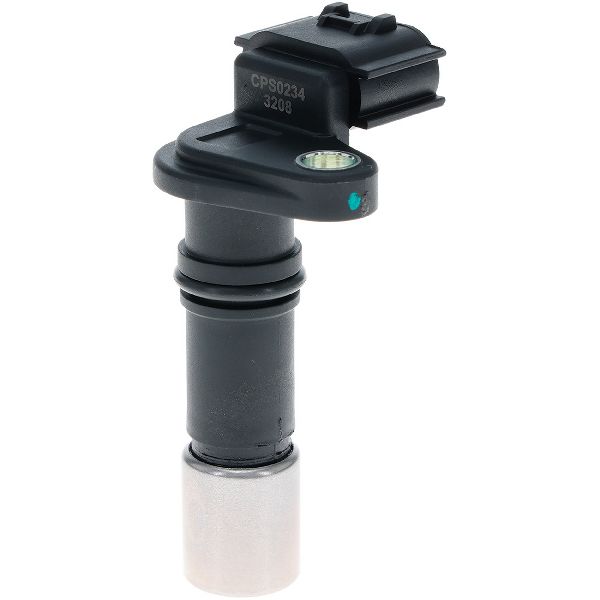
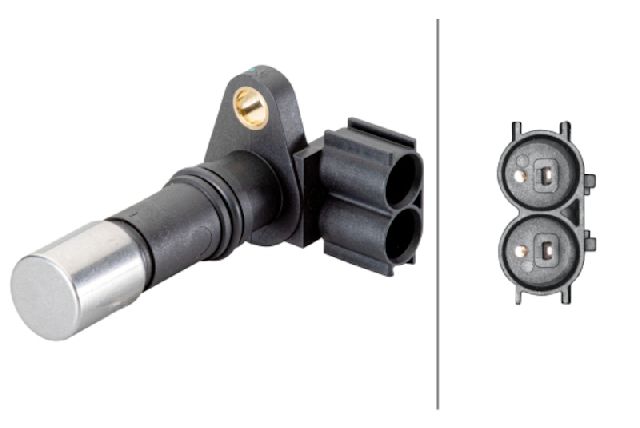
- Crankshaft Position Sensor (4.0L V6, 1GR-FE)
(OEM #90919-A5003 (replaces 90919-05057))— This sensor is the most frequent point of failure for the P0335 code due to its operating environment. This part is specific to the V6 engine.
Trusted brands: Denso (OEM - Part #196-1116), NGK/NTK, Bosch
OEM price range: $120-$200
Aftermarket price range: $40-$90 - Crankshaft Position Sensor (4.7L V8, 2UZ-FE)
(OEM #90919-05035)— This sensor is the most frequent point of failure for the P0335 code on V8 models. This part is specific to the V8 engine.
Trusted brands: Denso (OEM - Part #196-1114), A-Premium, Walker Products
OEM price range: $70-$150
Aftermarket price range: $25-$60
Related Codes That Often Appear With This One
- P0340 — This code is for the Camshaft Position Sensor. The TSB T-TT-0010-10 Rev notes that low battery voltage can cause both P0335 and P0340 to appear together.
- P0300-P0308 — These are random or specific cylinder misfire codes. If the ECM receives an erratic crank signal, it can lead to incorrect ignition timing and cause misfires.
Technical Service Bulletins (TSBs) & Recalls
- T-TT-0010-10 Rev: Notes that low battery voltage (below 11V) can contribute to a MIL ON for P0335 and/or P0340 due to inconsistent engine rotational speed during cranking.
- S-SB-0025-12: While for the 2AZ-FE engine, this TSB shows a pattern of Toyota addressing P0335 caused by mechanical timing components (in this case, a camshaft gear), reinforcing that mechanical issues can trigger this electrical code.
Platform-Specific Known Issues
- A known issue documented in TSB T-TT-0010-10 Rev is that low battery voltage can trigger a P0335 code. Always check battery health first.
- On the 4.0L V6 (1GR-FE), an improperly torqued harmonic balancer bolt (often after a timing chain service) can cause the reluctor ring to wobble or shear its keyway, triggering this code.
- Oil leaks from valve covers or other gaskets are common and can saturate the sensor and its connector, causing failure.
- On the 4.7L V8 (2UZ-FE), the sensor is located on the lower driver's side, just to the right of the harmonic balancer, and is held by a single 10mm bolt, making replacement relatively accessible from underneath after removing a splash shield.
Mechanic-Grade Diagnostic Values
- Crankshaft Position Sensor Resistance (4.7L 2UZ-FE) — expected: 1,850 - 2,450 Ω (Cold), 2,400 - 3,000 Ω (Hot). Failure: Resistance is outside the specified range, or infinite (open circuit).
- Crankshaft Position Sensor Resistance (4.0L 1GR-FE) — expected: 1,630 - 2,740 Ω (Cold), 2,065 - 3,225 Ω (Hot). Failure: Resistance is outside the specified range.
- Scan Tool Live Data - Engine Speed (RPM) during cranking — expected: 100 - 500 RPM. Failure: Reading is 0 RPM, indicating no signal from the crank sensor is reaching the ECM.
- Sensor Air Gap — expected: Not specified for this application, but must be consistent and free of debris.. Failure: An incorrect air gap, often caused by an unseated sensor or damaged reluctor wheel, can cause a weak or non-existent signal.
Scan Tool Commands That Help
- Toyota Techstream: Data List -> Primary -> Engine Spd — Use this function to monitor engine RPM while cranking. If the value remains at zero while the engine is physically turning over, it confirms the ECM is not receiving a signal from the crankshaft position sensor circuit.
- Toyota Techstream: DTC Info -> Freeze Frame Data — Review the freeze frame data stored when the P0335 code was set. This provides a snapshot of engine conditions (RPM, coolant temp, vehicle speed, and crucially, battery voltage) at the moment of the fault, which can help determine if low voltage was the trigger.
Wiring & Ground Locations
- E1 / E3 (V6) or Ed / Ee (V8) — Main engine ground points. On the 4.0L V6, E1 is near the right front of the engine compartment and E3 is near the rear of the engine. On the 4.7L V8, Ed is on the left cylinder head and Ee is on the rear of the right cylinder head.. A poor engine ground can cause a host of electrical issues and signal interference, potentially triggering a false P0335. The sensor's shielded wire relies on a good ground to prevent noise.
- Crankshaft Position Sensor Shield Wire — This is a shielded wire within the harness running from the sensor to the ECM.. The sensor produces a low voltage AC signal that is susceptible to electrical noise from other components like the alternator or ignition coils. The shield wire, which must be properly grounded at the ECM, protects this signal. A failure in the shield's ground can lead to an erratic signal and a P0335 code.
Real Owner Repair Stories
- Reddit user on r/4Runner (2016 Toyota 4Runner) — Vehicle had a dead battery. After jump-starting, the Check Engine Light came on with code P0335.
❌ Tried (didn't work) Jump-starting the vehicle only provided a temporary start.
✅ What actually fixed it Replacing the old, weak battery with a new one resolved the P0335 code, which cleared on its own. This confirms the TSB's warning that low voltage can trigger a false code. - ScannerDanner Forum user (2007 Toyota 4Runner) — Persistent P0335 code that sets on startup, with no drivability issues. The code became constant after replacing an aftermarket sensor with an OEM one.
❌ Tried (didn't work) Replacing timing set, tensioners, VVT sprockets, cam sensors, and crank sensor (aftermarket and OEM)., Verifying wiring resistance and checking for shorts., Confirming a good signal waveform at the ECM with a lab scope.
✅ What actually fixed it The suggested root cause, based on similar experiences, was an improperly torqued harmonic balancer bolt from a previous repair. This can cause the reluctor wheel to wobble or damage its keyway, creating a signal discrepancy that the ECM flags on startup, even if the waveform appears normal.
OEM Part Supersession History
90919-05057→90919-A5003— Standard part update/revision by Toyota for the 1GR-FE (4.0L V6) engine.
Heads up: The new part number (90919-A5003) is the correct replacement for the original.
Model Year Variations Within This Range
- 2010-2011: For the 2010 model year, the 4.0L 1GR-FE V6 was updated with Dual VVT-i. This engine uses roller-rocker arms instead of shimless lifters and has other internal changes. While the P0335 code's meaning is the same, internal diagnostic logic in the ECM may differ slightly from the earlier single VVT-i version (2004-2009).
Helpful Videos

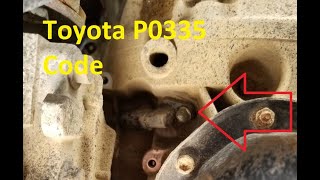
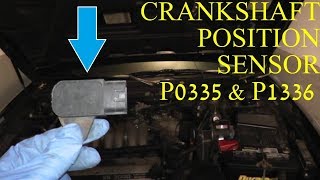
We Have This Part in Stock



The information in this article is provided for general reference and educational purposes only. Vehicle specifications, procedures, and part compatibility can vary by production date, trim level, and region. Always consult your vehicle's factory service manual and verify part numbers before purchasing or performing repairs. Safety-critical components such as airbags, seat belts, and braking systems should be installed by a qualified professional.
- Toyota 4RUNNER:
- 🎬 Helpful Videos
- 🛍️ Shop This Part
- What's Unique About the 2004-2011 Toyota 4RUNNER
- Diagnostic Flowchart
- Symptoms You May Notice
- Most Likely Causes
- Rare But Worth Checking
- Diagnosis Steps
- Parts You'll Likely Need
- Related Codes That Often Appear With This One
- Technical Service Bulletins (TSBs) & Recalls
- Platform-Specific Known Issues
- Mechanic-Grade Diagnostic Values
- Scan Tool Commands That Help
- Wiring & Ground Locations
- Real Owner Repair Stories
- OEM Part Supersession History
- Model Year Variations Within This Range
- 🎟️ Get 5% Off