

P0335 on 2011-2018 Ram 1500 5.7L Hemi: Crankshaft Sensor Circuit Causes and Fixes
P0335 on a 2011-2018 Ram 1500 with the 5.7L Hemi engine indicates a problem with the crankshaft position sensor circuit. The most common fix is replacing the sensor itself, but damaged wiring is a very close second. Expect to pay $20-$60 for an aftermarket sensor or $80-$170 for an OEM Mopar part (P/N: 5149167AF). Before replacing parts, check for TSBs, as a PCM software update is a known fix for 2014-2016 models.
- P0335 is a critical code that should be addressed immediately, as it can cause the engine to stall without warning or fail to start.
- The most likely cause is a failed crankshaft position sensor, but you must inspect the wiring harness for heat damage or chafing before replacing parts.
- For 2014-2015 models, check with a dealer for any available PCM software updates, as several TSBs address this code.
- The sensor is located on the lower passenger side of the 5.7L Hemi engine block and is held by a single 10mm bolt.
- Using a quality Mopar or reputable aftermarket (like NTK) sensor is recommended to avoid repeat failures.
What's Unique About the 2011-2018 Ram 1500

On this generation of Ram 1500, the P0335 code is frequently more than just a bad sensor. Several Technical Service Bulletins (TSBs) link this code to other seemingly unrelated codes, like P2299 (Brake Pedal Position / Accelerator Pedal Position Incompatible), suggesting that PCM software glitches or complex wiring harness issues can be the root cause. TSB 18-103-16 REV. B specifically addresses P0335 on 2014-2015 models, recommending a software flash. 🎬 Watch: How this owner fixed a P0335 on a 2014 Ram. In some cases, Ram even asked technicians to contact engineering before replacing the sensor, indicating a deeper known issue. Therefore, a thorough inspection of the wiring harness for heat damage or chafing is just as important as checking the sensor itself.
Symptoms You May Notice
- Check Engine Light is on
- Engine cranks but will not start
- Engine stalls unexpectedly, sometimes when hitting bumps or braking hard
- Rough idle or sputtering
- Engine misfires (may be accompanied by code P0300)
- Reduced engine power or 'limp mode'
- Long crank time before the engine starts
- Tachometer needle drops to zero while the engine is stumbling or stalling.
- Replacing the Camshaft Position Sensor. P0335 specifically points to the crankshaft sensor circuit. The camshaft sensor is a different part (Mopar P/N 5149054AC for the 5.7L) with its own codes (e.g., P0340, P0390).
- Ignoring the wiring. Many owners replace the sensor only to have the code return because the underlying issue was a chafed or melted wire that was not properly inspected.
- Replacing the PCM prematurely. Before condemning the expensive computer, it is critical to rule out the sensor, wiring, and any available software updates.
Most Likely Causes

- Failed Crankshaft Position Sensor 🔴 High Probability The sensor is a sensitive electronic component exposed to high heat and vibration at the lower rear of the engine block, leading to eventual failure. Many owners and mechanics strongly recommend using the OEM Mopar sensor, as aftermarket versions are known to cause compatibility issues or fail prematurely.
How to confirm: After ruling out wiring issues, test the sensor's output with a multimeter or oscilloscope. A key diagnostic check is to monitor Engine RPM on a scan tool while cranking; a reading of '0' strongly points to a bad sensor or circuit issue. Given the low part cost, replacement is a common primary diagnostic step.
Typical fix: Replace the crankshaft position sensor. It is held in by a single 10mm bolt. Applying a small amount of engine oil to the new sensor's O-ring can ease installation. 🎬 See this walkthrough for replacing the sensor on a 2018 Hemi. After replacement, a 'crankshaft variation relearn' procedure with a capable scan tool may be required.
Est. part cost: $20-$170 - Wiring Harness or Connector Damage 🟡 Medium Probability The wiring harness runs near hot exhaust and transmission components, making it susceptible to melting, chafing against the engine block, or becoming brittle and cracking. Rodent damage has also been reported by owners. Forum users frequently report that fixing a wiring issue resolved the code after a new sensor did not, especially when symptoms appear after hitting a bump.
How to confirm: Visually inspect the entire harness from the sensor to the PCM. Pay close attention to the pigtail connector at the sensor. Wiggle the harness with the engine running (if possible) to see if the fault can be triggered. Check for 5-volt reference (F855 circuit), ground (K900 circuit), and signal (K24 circuit) at the connector.
Typical fix: Repair the damaged section of wire or replace the connector pigtail. In severe cases, a portion of the engine harness may need replacement, which can be costly; one owner was quoted $927 by a dealer for this repair. Use heat-reflective tape or zip ties to secure the new harness away from heat sources.
Est. part cost: $15-$300 - PCM Software Glitch ⚪ Low Probability Multiple TSBs have been issued for 2014-2016 models that recommend a PCM software update (reflash) to correct issues where P0335 is set incorrectly. TSB #18-103-16 REV. B is for 2014-2015 models and TSB #18-006-16 REV. B is for 2016 models. These flashes often resolve P0335 when it appears with other codes like P2299 or P2610.
How to confirm: A Ram dealership or a properly equipped independent shop can check your vehicle's VIN against available TSBs to see if a software update is required. This should be a primary check for 2014-2016 model years.
Typical fix: The dealer performs a PCM reflash to install the updated software using a wiTECH scan tool. This typically costs between $150-$350 if the vehicle is out of warranty.
Est. part cost: $0-$350
Rare But Worth Checking
- Damaged Reluctor Ring: The reluctor ring (or tone wheel) on the crankshaft is what the sensor reads. While very rare on the Hemi, damage to its teeth from debris or improper engine service can cause an erratic signal and trigger P0335. This is typically only suspected after sensor and wiring issues have been ruled out, as inspection requires significant labor. This issue is much more common on the 3.0L EcoDiesel engine, which had a recall (W58 / NHTSA 20V-475) for delaminating tone wheels.
- Faulty Powertrain Control Module (PCM): This should be the last consideration after all other possibilities are exhausted. A PCM failure can cause a P0335 code, but misdiagnosing a bad PCM is a common and costly mistake.
Diagnosis Steps
- Check for Technical Service Bulletins (TSBs). Especially for 2014-2016 models, a PCM software update may be the required fix. A dealer can check your VIN for applicability.
- Scan for other DTCs. Note if codes like P0300, P2299, P0339, or P0642 are present, as they can provide critical diagnostic clues.
- Check Live Data. Use a scan tool to monitor the 'Engine RPM' PID while cranking the engine. If the reading is '0' or erratic, it confirms a fault in the CKP sensor circuit.
- Perform a thorough visual inspection. Carefully examine the crankshaft position sensor's wiring harness for any signs of melting, chafing, or corrosion, particularly where it runs near the exhaust or transmission.
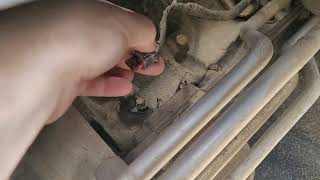
- Inspect the connector. Unplug the sensor and check for corrosion, oil contamination, or bent pins. Ensure the red locking tab is secure.
- Test the circuit. Using a multimeter with the key on, check for a 5-volt reference (F855 circuit) and a good ground (K900 circuit) at the connector.
- Test or Replace the Sensor. If the wiring and power/ground are good, the sensor itself is the most likely culprit. Given its relatively low cost, many DIYers will replace it at this stage. A more advanced test involves using an oscilloscope to view the sensor's square wave pattern while cranking 🎬 Watch: A step-by-step guide to replacing the crankshaft position sensor. the engine.
- Perform Crankshaft Variation Relearn. After replacing the sensor, it may be necessary to perform a relearn procedure using a capable scan tool to sync the new sensor with the PCM.
- Inspect the Reluctor Ring. If a new sensor and verified good wiring do not solve the problem, the issue may be with the reluctor ring on the crankshaft, though this is rare and requires significant disassembly to inspect.
Parts You'll Likely Need

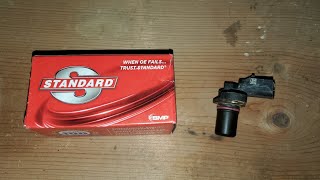
- Crankshaft Position Sensor
(OEM #5149167AF)— This sensor is the most common component to fail in the circuit, triggering the P0335 code.
Trusted brands: Mopar, NTK, Delphi
OEM price range: $83-$172
Aftermarket price range: $20-$60
Related Codes That Often Appear With This One
- P0300 — A faulty crankshaft position sensor can disrupt timing enough to cause random engine misfires as the PCM loses its primary reference for spark timing.
- P2299 — TSB #18-103-16 REV. B and #18-006-16 REV. B link P0335 with P2299 ('Brake Pedal Position / Accelerator Pedal Position Incompatible') on 2014-2016 models, indicating a PCM software update is the specified fix to resolve both codes simultaneously.
- P0339 — This code for 'Crankshaft Position Sensor 'A' Circuit Intermittent' often appears with P0335. It strongly suggests a wiring or connector issue that causes the signal to drop out, rather than a complete failure.
- P0642 — This code for 'Sensor Reference Voltage 1 Circuit Low' can appear with P0335 because the crankshaft position sensor shares its 5-volt reference circuit with other sensors. A short in another sensor on the same circuit, like the engine oil pressure sensor, can drag the voltage down and cause multiple codes.
Technical Service Bulletins (TSBs) & Recalls
- 18-103-16 REV. B: For 2014-2015 models, recommends a PCM flash to fix P0335, P2299, P0116, and U1424-00.
- 18-006-16 REV. B: For 2016 models, recommends a PCM flash to address power
Platform-Specific Known Issues
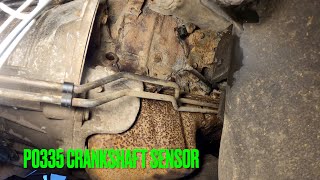
- The crankshaft position sensor is located on the passenger side of the engine block, near the rear, just above the transmission cooler lines, making access tight.
- The sensor can become seized in the engine block due to corrosion or a swollen O-ring, making removal difficult. In some cases, it may break apart during removal, requiring careful extraction of the remaining pieces.
- Several TSBs (e.g., 18-103-16 REV. B for 2014-15, 18-006-16 REV. B for 2016) exist that require a PCM software update to fix erroneous P0335 codes, often set with P2299.
Mechanic-Grade Diagnostic Values
- Crankshaft Sensor 5V Reference — expected: Approximately 5.0 Volts DC at the sensor connector with key on, engine off.. Failure: Voltage below 4.5V or absent suggests an open/short in the supply wire or a PCM fault.
- Crankshaft Sensor Ground Circuit Resistance — expected: Below 5.0 Ohms between the ground pin at the sensor connector and the chassis ground.. Failure: Resistance above 5.0 Ohms indicates an open or high resistance in the ground circuit (K900).
- Crankshaft Sensor Signal (Oscilloscope) — expected: A digital square wave pattern that switches between approximately 0V and 5V as the engine is cranked.. Failure: A flat line (stuck high or low) or an erratic/misshapen waveform indicates a faulty sensor, wiring issue, or damaged reluctor ring.
- Crankshaft Sensor Signal (Multimeter - Average Voltage) — expected: A low DC voltage reading, often around 350-600 millivolts (0.35V - 0.6V), while cranking. This is the meter's attempt to average a square wave signal.. Failure: A reading of 0V or a steady 5V indicates a lack of signal. Note: This method is less reliable than an oscilloscope but can confirm a complete lack of signal.
Scan Tool Commands That Help
- wiTECH or capable aftermarket scan tool: Crankshaft Position Relearn / Cam/Crank Relearn — This function is recommended after replacing the crankshaft sensor or any timing components. It calibrates the PCM to the precise position of the sensor relative to the reluctor ring to ensure accurate timing, which can prevent rough running or a return of the code.
Wiring & Ground Locations

- G905A — On the rear of the left (driver's side) cylinder head. Another source places a key engine ground on the passenger side, connecting the rear of the cylinder head to the frame, accessible from the wheel well.. This is a primary ground point for the ignition system and other engine sensors. A loose or corroded ground here can cause erratic signals and multiple electrical faults, including a false P0335 code.
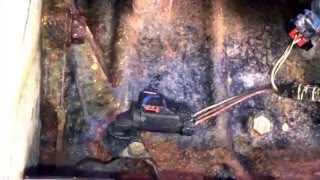
- CKP Sensor Connector — On the passenger side of the engine block, near the rear, just above the transmission cooler lines.. This is the direct connection to the sensor. The three pins to test are the 5-volt reference (often on an F855 circuit), the sensor ground (K900 circuit), and the signal wire (K24 circuit).
Real Owner Repair Stories
- ALLDATA Tech-Assist Case (2006 Dodge Ram 1500 5.7L V8 (similar 5V reference circuit design)) — Limp mode/no power, codes P0335, P0642 (Sensor Reference Voltage 1 Circuit Low), and P2122 (APP Sensor Circuit).
❌ Tried (didn't work) Testing the CKP sensor circuit in isolation.
✅ What actually fixed it A shorted engine oil pressure sensor, which was on the same 5-volt reference circuit, was dragging the voltage down from 5V to 1.6V for all sensors on that circuit. Replacing the oil pressure sensor restored the 5V reference and cleared all codes. - RamForum.com user 'zeddy' (2012 Ram 1500) — Sputtering and stalling, 'service electronic throttle' message, P0335 code.
❌ Tried (didn't work) Owner diagnosis
✅ What actually fixed it A dealership diagnosed and replaced both a failed crankshaft sensor and a damaged section of the wiring harness. The total repair cost was $927, illustrating how wiring damage can significantly increase the cost over a simple sensor swap. - YouTube video (2014 Dodge Ram 1500 5.7L Hemi) — Engine would crank but not start, P0335 code present.
✅ What actually fixed it The crankshaft position sensor had failed and broke into pieces during removal. Replacing the sensor and clearing the codes resolved the no-start condition.
OEM Part Supersession History
5149167AD, 5149167AE→5149167AF— Standard part revision and update by the manufacturer.
Heads up: The part is listed for both 3.6L and 5.7L engines, indicating broad compatibility within the platform.
Model Year Variations Within This Range
- 2014-2016: These model years are specifically called out in multiple Technical Service Bulletins (TSBs) where a PCM software update is the prescribed fix for erroneously set P0335 codes, often appearing with P2299 or P2610.
- 2011-2018: While the 5.7L Hemi engine remained fundamentally the same throughout this generation, there were no major internal changes that would affect the diagnosis of P0335. The body style also remained consistent from 2009-2018. The eTorque mild-hybrid system was not introduced on the 5.7L Hemi until the fifth generation in 2019.
Diagnostic Flowchart
Real Owner Stories
Aggregated from forums and TSBs cited above. Mileages and costs reflect what owners reported in those sources.
2011 Ram 1500 5.7L Hemi
Symptoms: Received code P0335 and went into limp mode after hard braking or hitting a rough railroad crossing.
What fixed it: A shop initially replaced the sensor, but the problem returned under the same conditions, strongly indicating a wiring harness issue rather than a sensor failure.
Source hint: DodgeForum.com thread titled 'P0335' (User 'Spacenerd')
Ram 1500 5.7L Hemi
Symptoms: Check engine light with code P0335.
What fixed it: Dealer diagnosed a bad crankshaft sensor and wiring harness. The repair was not covered under the powertrain warranty as it was deemed a 'wear and tear' item.
Cost: $927-$927
Source hint: RamForum.com thread titled 'P0335 HELP' (User 'zeddy')
2014 Ram 1500 5.7L Hemi
Symptoms: Crank/no-start condition accompanied by code P0335.
What fixed it: Replaced the crankshaft position sensor. The old sensor had failed and was seized in the block, coming out in pieces during removal.
Source hint: YouTube video titled 'Dodge Ram 1500 5.7 Hemi P0335 Crankshaft Sensor Fixed! 2014'
Related OBD-II Codes
Frequently Asked Questions
Is there a TSB for code P0335 on my 2014-2016 Ram 1500?
Will my powertrain warranty cover the crankshaft position sensor replacement?
Why does my Ram 1500 stall and throw P0335 only when I hit a bump or brake hard?
Should I use an aftermarket crankshaft position sensor for my 5.7L Hemi?
Where is the crankshaft position sensor located on the 5.7L Hemi?
Do I need to do anything special after replacing the sensor?
Helpful Videos
We Have This Part in Stock




The information in this article is provided for general reference and educational purposes only. Vehicle specifications, procedures, and part compatibility can vary by production date, trim level, and region. Always consult your vehicle's factory service manual and verify part numbers before purchasing or performing repairs. Safety-critical components such as airbags, seat belts, and braking systems should be installed by a qualified professional.
- Ram 1500:
- 🎬 Helpful Videos
- 🛍️ Shop This Part
- What's Unique About the 2011-2018 Ram 1500
- Symptoms You May Notice
- Most Likely Causes
- Rare But Worth Checking
- Diagnosis Steps
- Parts You'll Likely Need
- Related Codes That Often Appear With This One
- Technical Service Bulletins (TSBs) & Recalls
- Platform-Specific Known Issues
- Mechanic-Grade Diagnostic Values
- Scan Tool Commands That Help
- Wiring & Ground Locations
- Real Owner Repair Stories
- OEM Part Supersession History
- Model Year Variations Within This Range
- Diagnostic Flowchart
- Real Owner Stories
- 2011 Ram 1500 5.7L Hemi
- Ram 1500 5.7L Hemi
- 2014 Ram 1500 5.7L Hemi
- Related OBD-II Codes
- Frequently Asked Questions
- 🎟️ Get 5% Off