

P0335 on 2012-2015 Jeep Patriot: Crankshaft Sensor Causes, Stalling, and Fixes
P0335 on a 2012-2015 Jeep Patriot almost always means the crankshaft position sensor has failed. This is a critical fault causing engine stalling and no-start conditions. The most common fix is replacing the sensor, which costs about $25-$50 for an aftermarket part or $60-$100 for an OEM Mopar part. Using an OEM part is highly recommended to avoid repeat failures.
- P0335 on a 2012-2015 Jeep Patriot is a critical code that makes the vehicle unsafe to drive due to the high risk of stalling.
- The most likely cause is a failed crankshaft position sensor. Replacing it is the most common fix.
- It is strongly recommended to use a high-quality OEM (Mopar) sensor, as aftermarket versions are known to cause problems.
- Before replacing parts, visually inspect the wiring harness near the sensor for heat damage, as this is also a common point of failure.
- Be aware that a PCM software update might be required, as indicated by manufacturer TSBs.
What's Unique About the 2012-2015 Jeep PATRIOT

The Jeep Patriot, along with its platform mates the Compass and Dodge Caliber, is known for this specific failure. The most alarming symptom reported by numerous owners to the NHTSA is the engine suddenly shutting off while driving, creating a significant safety hazard. While the sensor itself is the usual culprit, Jeep has also issued Technical Service Bulletins (TSBs) that include P0335, sometimes pointing to a needed software update for the PCM, which complicates the diagnosis slightly. The sensor's location on the back of the engine block, tucked behind a heat shield near the exhaust, makes replacement more difficult than on many other vehicles, though it can be done from underneath the car.
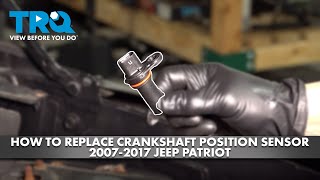
🎬 Watch this DIY guide for replacing the sensor on a Patriot.Diagnostic Flowchart
Tap your situation to follow the diagnostic path that matches what you're seeing on this vehicle.
Symptoms You May Notice
- Engine shuts off while driving, often without warning.
- Engine cranks but will not start ('crank-no-start').
- Engine dies when hot, but restarts after cooling down for a period.
- Vehicle refuses to restart after being turned off.
- Check Engine Light (Malfunction Indicator Lamp) is on.
- Extended crank time before the engine starts.
- Rough or unstable idle.
- Hesitation, misfires, or reduced acceleration.
- Intermittent problem (light turns on and off).
- Replacing the camshaft position sensor(s). P0335 specifically points to the crankshaft sensor circuit. While related, a bad cam sensor typically throws its own distinct codes (e.g., P0340, P0344).
- Replacing the starter motor. A no-start condition can be mistaken for a bad starter, but if the engine is cranking normally without firing, the issue is more likely related to spark or fuel, which depends on the crank sensor signal.
- Replacing the fuel pump. Symptoms of stalling and no-start can be similar, but diagnosing the lack of an RPM signal via a scan tool will point away from the fuel system.
Most Likely Causes

- Failed Crankshaft Position Sensor 🔴 High Probability The sensor is a widely documented failure item on this platform, often failing due to heat cycles from its location near the exhaust and engine block. The failure is often internal and heat-related, causing the sensor to stop sending a signal once the engine reaches operating temperature.
How to confirm: Use a scan tool to monitor RPM during cranking. If the RPM reads 0 while the engine is turning over, the sensor or its circuit is the primary suspect. If the wiring checks out, the sensor is faulty.
Typical fix: Replace the crankshaft position sensor and its O-ring. It is strongly recommended to use an OEM Mopar part, as many owners report immediate or premature failure from aftermarket sensors. 🎬 See why using the wrong sensor can cause persistent codes.
Est. part cost: $25-$100 - Damaged Wiring or Connector 🟡 Medium Probability The sensor's wiring harness is routed near the hot exhaust manifold and catalytic converter, making it susceptible to melting, chafing, or heat-related brittleness and corrosion over time.
How to confirm: Visually inspect the wiring harness leading to the crankshaft position sensor for any signs of melting, chafing, corrosion, or loose connections at the pigtail. Check for oil contamination inside the connector, which indicates an internal sensor leak.
Typical fix: Repair the damaged section of the wiring harness or replace the sensor connector pigtail. Secure the new wiring away from the heat source.
Est. part cost: $15-$30 - Powertrain Control Module (PCM) Software Issue ⚪ Low Probability Jeep issued TSBs #18-044-16 and #18-064-16 REV. A, which indicate that a group of DTCs, including P0335, could be falsely triggered. The fix is a PCM software update to improve diagnostic logic.
How to confirm: A Jeep dealership or a properly equipped independent shop using a wiTECH scan tool can check the current software version of the PCM and determine if an update is available per the TSBs.
Typical fix: Flash the PCM with the latest manufacturer software. This is typically a dealer service.
Est. part cost: $0-$200
Rare But Worth Checking
- Failed Powertrain Control Module (PCM): While rare, if a known-good OEM sensor and confirmed-good wiring do not resolve the code, the PCM itself could be faulty. This is a last resort after all other possibilities are exhausted. One technician noted that a key symptom can be the car starting immediately after cycling the key off and on, suggesting a computer reset issue.
- Damaged Reluctor Ring: The reluctor ring (or tone wheel) is what the crankshaft sensor reads. If it is damaged, cracked, has broken teeth, or has sheared its keyway, it can cause a P0335 code. This is uncommon and typically requires more significant engine work to inspect and repair.
Diagnosis Steps
- Connect an OBD-II scanner and confirm P0335 is present. Note any other codes, especially P0339.
- Using the scanner's live data function, monitor Engine RPM while cranking the engine. A reading of '0' strongly suggests a fault in the CKP circuit.
- Lift the vehicle safely using ramps or jack stands. The sensor is best accessed from underneath.
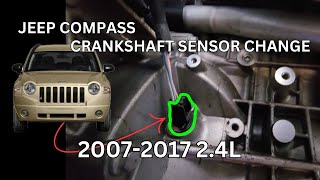
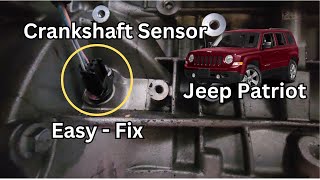
- Locate the sensor on the rear of the engine block, near the transmission bell housing. It is behind a metal heat shield held on by 10mm and 13mm bolts. 🎬 Watch this walkthrough to see how to access the heat shield.
- Perform a thorough visual inspection of the sensor's wiring harness and connector. Look for any signs of melting, chafing, or corrosion, as it is routed near the exhaust.
- If wiring appears intact, test the circuit. Check for a 5-volt reference signal, a good ground, and the integrity of the signal wire between the sensor and the PCM.
- If the wiring and circuit are confirmed to be good, the crankshaft position sensor itself is the most likely culprit.
- Replace the crankshaft position sensor. It is held in by a single 10mm bolt. It is highly recommended to use an OEM Mopar part (Part # 05033307AE), as some aftermarket sensors are known to be faulty out of the box or fail prematurely on this platform.
- After replacement, clear the codes with the scanner and perform a test drive to ensure the problem is resolved.
Parts You'll Likely Need

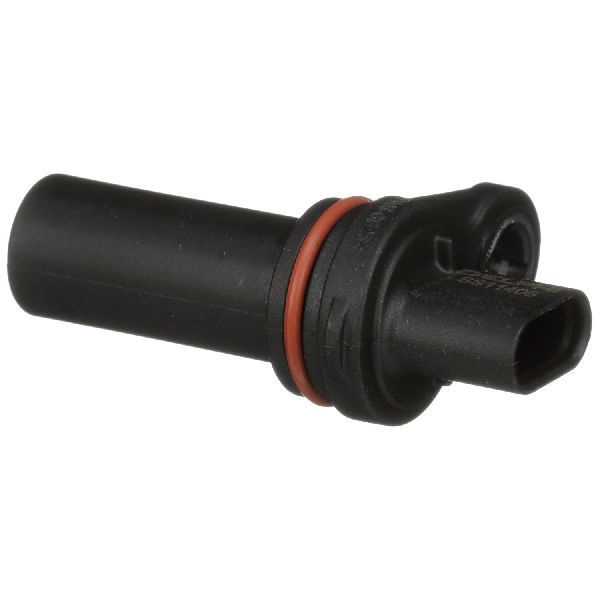
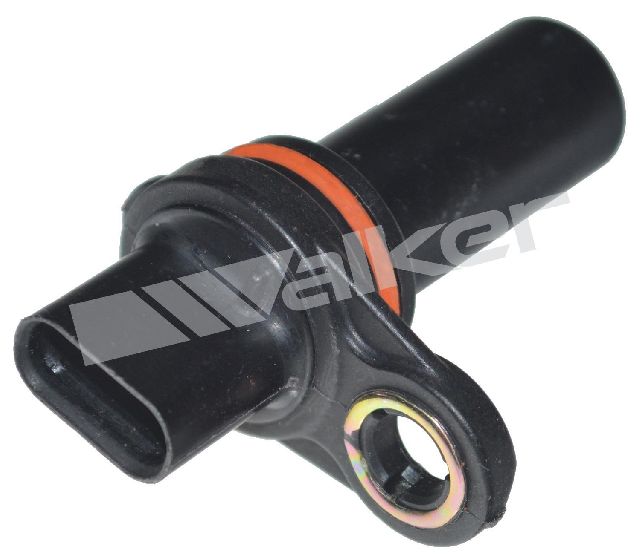
- Crankshaft Position Sensor
(OEM #05033307AE)— This sensor is the most common point of failure for the P0335 code on the Jeep Patriot, often failing due to heat and age. Owner and technician consensus strongly advises using the OEM Mopar part to avoid repeat repairs.
Trusted brands: Mopar (OEM - Recommended), NTK, Delphi, Duralast
OEM price range: $60-$100
Aftermarket price range: $22-$50
Related Codes That Often Appear With This One
- P0339 — This code for 'Crankshaft Position Sensor 'A' Circuit Intermittent' often appears with P0335, indicating the signal isn't just lost, but is dropping out, which is typical of a failing sensor or wiring.
- P219A — Mentioned in TSBs #18-044-16 and #18-064-16 REV. A alongside P0335. A faulty crank signal can disrupt ignition and injection timing, leading to an air-fuel ratio imbalance on one bank of the engine.
- U0140 — Listed in TSB #18-064-16 REV. A. This code for 'Lost Communication With Body Control Module' can indicate a broader electrical issue, possibly related to the Totally Integrated Power Module (TIPM), a known weak point on these vehicles that can cause various seemingly unrelated codes.
Technical Service Bulletins (TSBs) & Recalls
- 18-044-16: For 2015 models, lists P0335 among a group of DTCs (including P0456, P219A, P050B) that may be resolved with a PCM software update to improve diagnostics.
- 18-064-16 REV. A: For 2012-2014 models, lists P0335 with other codes (U0140, P219A) that may indicate the need for a PCM software update for diagnostic and system improvements.
Platform-Specific Known Issues
- Engine stalling while driving is a widely reported safety concern for this code, as documented in NHTSA owner complaints ODI #11240663 and #11207184.
- A PCM software update may be required to fully resolve the issue, as noted in Jeep TSBs #18-044-16 and #18-064-16 REV. A.
- Using aftermarket (non-OEM) crankshaft sensors can sometimes lead to persistent or new codes. A Reddit user on r/JeepPatriot noted their issues persisted with an Autozone sensor but were resolved after installing an OEM Mopar sensor. Another user spent $2,000 on a new throttle body and starter before discovering the P0335 code, highlighting a common misdiagnosis path.
- Accessing the sensor requires removing a heat shield on the back of the engine, typically held by 10mm and 13mm bolts. Most DIY guides recommend accessing it from underneath the vehicle for the easiest approach.
Mechanic-Grade Diagnostic Values
- 5V Supply Circuit Voltage — expected: Approximately 5.0 volts with key on, engine off.. Failure: No voltage or significantly lower voltage indicates a problem with the PCM or wiring.
- Sensor Ground Circuit Resistance — expected: Less than 5.0 ohms between the sensor connector ground pin and the PCM connector.. Failure: Resistance above 5.0 ohms indicates an open or high resistance in the ground circuit (K900).
- Signal Circuit Resistance to Ground — expected: Above 100 ohms between the signal circuit (K24) and the ground circuit (K900) at the sensor connector.. Failure: Resistance below 100 ohms indicates a short to ground in the signal wire.
- Signal Circuit Voltage (Static/Key On) — expected: The Jeep Patriot uses a pull-down design, so with the sensor connected and key on, the signal wire should show a static voltage (either 5V or 0V depending on crankshaft position).. Failure: A voltage that does not match the expected state or is erratic suggests a sensor or wiring issue. A professional technician noted that on this design, an open signal wire would result in 0V at the sensor and a high voltage reading at the computer.
Scan Tool Commands That Help
- wiTECH or equivalent professional scanner: Cam/Crank Relearn — After replacing the crankshaft position sensor, this procedure must be performed. It allows the PCM to adapt to the new sensor's signal characteristics for accurate misfire detection. The engine will run without it, but it may cause other diagnostic issues or a future check engine light.
Wiring & Ground Locations

- G104 — Located on the right front of the engine compartment.. This is a primary engine compartment ground point. A loose or corroded G104 can cause floating grounds for multiple sensors, including the crankshaft position sensor, leading to erratic behavior and circuit codes.
- CKP Sensor Connector — On the sensor, at the back of the engine block near the transmission bell housing.. The connector has three pins: Pin 1 is the (F855) 5-volt supply, Pin 2 is the (K24) CKP signal, and Pin 3 is the (K900) sensor ground. All voltage and resistance tests are performed at this connector to isolate the fault between the sensor, wiring, and PCM.
- S108 — A splice located in the engine harness at the left rear of the engine.. This splice point connects the ground circuits for multiple sensors. Corrosion or a break in this splice can cause a loss of ground for the CKP sensor and others, resulting in multiple seemingly unrelated codes.
Real Owner Repair Stories
- ScannerDanner YouTube Channel (Jeep Patriot (year not specified, but within platform range)) — Intermittent stalling while driving. No-start condition that is resolved by cycling the key off and back on. P0335 and P0339 codes present.
❌ Tried (didn't work) Replacing the crankshaft position sensor with an aftermarket part., Replacing the aftermarket sensor with a second, different aftermarket sensor.
✅ What actually fixed it The diagnosis pointed to a faulty Powertrain Control Module (PCM). The fact that a key cycle (turning the car off and on) would temporarily fix the no-start condition was a key symptom. The technician explained this indicates the PCM is getting into a fault mode it cannot exit until it is power-cycled, which is not normal behavior and points away from a simple sensor or wiring failure. - WeakestOfWeeks YouTube Channel (Jeep Patriot (year not specified, within platform range) with 2.0L/2.4L engine) — Hard start, no-start, or shutting off while driving, particularly when the engine is hot. The car would crank but not start until it cooled down. P0335 code was present.
❌ Tried (didn't work) The video strongly advises against using aftermarket sensors from major parts stores ('autodomes', 'okay autos', 'aurelis'), implying these are common failed fixes.
✅ What actually fixed it Replacing the failed crankshaft position sensor with an OEM Mopar part (Part # 05033307AE). The failure was described as internal to the sensor and heat-related, with no visible external damage.
OEM Part Supersession History
5033307AA, 5033307AB, 5033307AC, 5033307AD→05033307AE— Standard part revision and consolidation by the manufacturer.
Heads up: The latest part number, 05033307AE, is the correct service replacement for all previous versions and is used across a wide range of Chrysler/Dodge/Jeep vehicles with 2.0L and 2.4L engines.
Model Year Variations Within This Range
- 2012-2014 vs 2015: Jeep issued separate TSBs for this code based on model year. TSB #18-064-16 REV. A applies to 2012-2014 models and groups P0335 with U0140 and P219A. TSB #18-044-16 applies to 2015 models and groups P0335 with P0456, P219A, and P050B. While the fix in both cases is a potential PCM software update, the specific software and associated codes differ slightly.
Helpful Videos


We Have This Part in Stock



The information in this article is provided for general reference and educational purposes only. Vehicle specifications, procedures, and part compatibility can vary by production date, trim level, and region. Always consult your vehicle's factory service manual and verify part numbers before purchasing or performing repairs. Safety-critical components such as airbags, seat belts, and braking systems should be installed by a qualified professional.
- Jeep PATRIOT:
- 🎬 Helpful Videos
- 🛍️ Shop This Part
- What's Unique About the 2012-2015 Jeep PATRIOT
- Diagnostic Flowchart
- Symptoms You May Notice
- Most Likely Causes
- Rare But Worth Checking
- Diagnosis Steps
- Parts You'll Likely Need
- Related Codes That Often Appear With This One
- Technical Service Bulletins (TSBs) & Recalls
- Platform-Specific Known Issues
- Mechanic-Grade Diagnostic Values
- Scan Tool Commands That Help
- Wiring & Ground Locations
- Real Owner Repair Stories
- OEM Part Supersession History
- Model Year Variations Within This Range
- 🎟️ Get 5% Off