

P0335 on 2012-2018 Jeep Compass: Crankshaft Sensor Circuit Failure Causes & Fixes
P0335 on a Jeep Compass almost always means the crankshaft position sensor or its wiring has failed, causing the engine to stall (often when hot) or not start. Replacing the sensor is the most common fix. Before replacing, inspect the wiring harness near the exhaust for melting and check for any available PCM software updates via TSBs. An OEM Mopar sensor is strongly recommended over aftermarket.
- P0335 on a Jeep Compass indicates a loss of signal from the crankshaft position sensor, which is critical for engine operation.
- The most common symptom is the engine stalling without warning, which is a major safety risk. Do not drive the vehicle if you have this code.
- In the vast majority of cases, the fix is to replace the crankshaft position sensor, which is a moderately difficult DIY job.
- Before replacing the sensor, inspect its wiring and connector for heat damage, as it is located near the exhaust.
- If a new sensor doesn't fix the code, check for available PCM software updates with a dealer, as indicated by several TSBs.
What's Unique About the 2012-2018 Jeep COMPASS

The 2012-2018 year range covers two distinct Compass generations, both of which can experience this code. The first generation (MK) and second generation (MP) use different 2.4L engines ('World' vs 'Tigershark'), but the cause of P0335 is consistently a failed sensor or its related wiring. Multiple Technical Service Bulletins (TSBs) from Jeep also mention this code, often pointing towards a needed software update. This indicates the problem isn't always a hard part failure, but can be a PCM software sensitivity issue where the computer is too quick to flag a fault from a minor signal disruption.
Diagnostic Flowchart

Tap your situation to follow the diagnostic path that matches what you're seeing on this vehicle.
Generation note: Yes, this range spans two generations. The first generation (MK) ran from 2007-2017, and the second generation (MP) began with the 2017 model year. For 2017, both generations were sold, so owners should verify which version they have. The first generation used the 2.0L and 2.4L 'World' engines, while the second generation uses the 2.4L 'Tigershark' engine. The cause and symptoms of P0335 are similar across both generations, though the specific part number for the sensor differs.
Symptoms You May Notice
- Engine stalls unexpectedly, often after warming up, and may restart after cooling down.
- Engine cranks but will not start. 🎬 Watch: Diagnosing a 2012 Compass that cranks but won't start.
- Check Engine Light is on.
- Rough or unstable idle.
- Hesitation or loss of power during acceleration.
- Reduced fuel economy.
- Flashing check engine light and engine shaking during acceleration.
- Replacing the camshaft position sensor. While related to engine timing, P0335 specifically points to the crankshaft sensor circuit.
- Assuming a bad fuel pump due to similar crank-no-start or stalling symptoms.
- Replacing the throttle body or starter when the root cause is the crank sensor signal, as one owner experienced before getting the correct P0335 diagnosis.
Most Likely Causes

- Failed Crankshaft Position Sensor 🔴 High Probability The sensor is a Hall-effect type located on the back of the engine block, exposed to significant heat from the exhaust manifold. This thermal stress causes the sensor's internal electronics to fail, leading to an intermittent signal when hot before failing completely.
How to confirm: Test the sensor's output signal with a multimeter or oscilloscope during cranking. A lack of signal or an erratic signal points to a failed sensor. Many owners report that aftermarket sensors can be problematic or fail quickly, so using an OEM Mopar sensor is highly recommended.
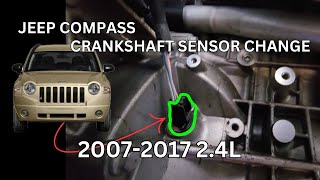
Typical fix: Replace the crankshaft position sensor. This is a common DIY repair accessible from underneath the vehicle. 🎬 See this DIY guide for replacing the sensor and fixing stalls.
Est. part cost: $25-$100 - Damaged Wiring or Connector 🟡 Medium Probability The sensor's wiring harness is routed very close to the hot exhaust manifold. The factory heat shielding is often insufficient, leading to the wiring's protective loom and insulation melting, causing a short circuit. The connector pins can also become corroded or worn, causing a poor connection.
How to confirm: Visually inspect the wiring harness and connector leading to the crankshaft sensor for any signs of melting, chafing, corrosion, or loose pins. Wiggle the harness with the engine running (if possible) to see if it induces a stall. One NHTSA complaint specifically cited "PINS WORN OUTS" as the cause, requiring replacement of the connector.
Typical fix: Repair the damaged section of the wiring harness or replace the connector pigtail. Secure the new wiring away from the exhaust with high-temp loom and zip ties.
Est. part cost: $15-$50 - Faulty Powertrain Control Module (PCM) or Outdated Software ⚪ Low Probability Jeep has issued TSBs (e.g., 18-048-16 REV. A, 18-075-20) that fix P0335 with a PCM software update. This indicates the original software logic can be overly sensitive, misinterpreting minor signal variations as a circuit malfunction, especially when other codes are present.
How to confirm: This is diagnosed by a dealer after ruling out the sensor and wiring. They can use a wiTECH scan tool to check the vehicle's current software calibration and see if an update is available per the TSBs.
Typical fix: Reprogramming the PCM with the latest software at a dealership or a properly equipped independent shop.
Est. part cost: $0-$200
Rare But Worth Checking
- Damaged Reluctor Ring: The reluctor ring (or tone wheel) on the crankshaft has teeth that the sensor reads. If this ring is damaged, cracked, or has broken teeth, the signal will be incorrect, triggering P0335. This is an uncommon but severe issue that requires significant engine disassembly to repair.
Diagnosis Steps
- Scan for any other trouble codes to see if P0335 appears with others, which might provide more context (e.g., P0339, P0340).
- Perform a thorough visual inspection of the crankshaft position sensor's wiring harness and connector. It is located on the rear of the engine block, near the exhaust. Look for melting, corrosion, or damage.
- If possible, use a scan tool to observe live data for an RPM signal while cranking the engine. No RPM signal strongly suggests a CKP circuit problem.
- If the wiring appears intact, test the sensor connector. It is a three-wire connector; you should find a 5V reference, a ground, and a signal wire. Wiggle the harness while testing to check for intermittent connections.
- For a definitive test, use an oscilloscope to check for a proper square wave pattern from the sensor's signal wire while the engine is running or cranking. A missing or erratic pattern confirms a bad sensor.
- If the sensor and wiring test good, check with a dealer for any available PCM software updates related to TSBs 18-075-20 or 18-048-16.
- If all else fails, the issue may be a damaged reluctor ring or a faulty PCM, which may require professional diagnosis.
Parts You'll Likely Need
- Crankshaft Position Sensor (2.0L/2.4L 'World' Engine)
(OEM #05033307AE)— This sensor is the most frequent point of failure for the P0335 code on 2012-2017 models, typically due to heat and age. This part number supersedes 5033307AD, 5033307AC, and 5033307AB.
Trusted brands: Mopar, NTK/NGK, Delphi, Standard Motor Products
OEM price range: $50-$100
Aftermarket price range: $25-$75 - Crankshaft Position Sensor (2.4L 'Tigershark' Engine)
(OEM #68243239AA)— This is the correct sensor for the second-generation (MP) Compass with the Tigershark engine (2017-2018). It fails for the same heat-related reasons.
Trusted brands: Mopar, NTK/NGK
OEM price range: $40-$80
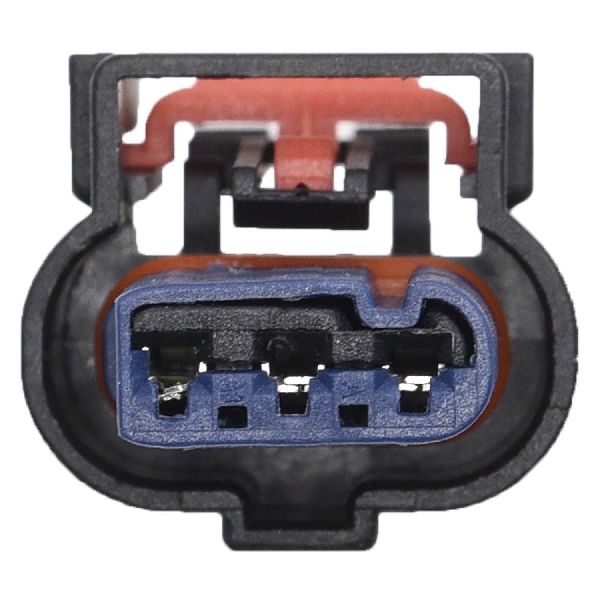
Aftermarket price range: $20-$60 - Crankshaft Sensor Connector Pigtail — Needed if the original connector or wiring is melted, corroded, or damaged from heat exposure near the exhaust, a common issue on this platform.
Trusted brands: Dorman, Standard Motor Products (e.g., S2316), Walker Products
OEM price range: N/A
Aftermarket price range: $15-$40
Related Codes That Often Appear With This One
- P0339 — This code is for 'Crankshaft Position Sensor Intermittent,' which is often a precursor to the complete failure indicated by P0335. It's common to see both, as noted in TSB #18-075-20 and multiple owner complaints.
- P0340 — This code relates to the Camshaft Position Sensor. Since the crank and cam sensors work together for engine timing, a fault in one can sometimes cause the PCM to flag an issue with the other, as seen in TSB #18-075-20.
- U0140 — This code means 'Lost Communication With Body Control Module'. Its appearance with P0335 in TSB #1806416 suggests a potential underlying electrical or network issue on some vehicles.
- P219A — This code for 'Air-Fuel Ratio Imbalance' was noted alongside P0335 in two separate TSBs (#18-048-16 REV. A and #1806416), often pointing to a PCM software update being required to fix the root cause.
Technical Service Bulletins (TSBs) & Recalls
- 18-075-20: Notes that P0335 may appear with camshaft (P0340) and intermittent crank sensor (P0339) codes on 2018 models and recommends a PCM software update.
- 18-048-16 REV. A: Groups P0335 with EVAP (P0456) and air-fuel ratio (P219A) codes for 2015-2016 models, suggesting a PCM software update is needed to correct diagnostic sensitivity.
- 1806416: Links P0335 with a communication code (U0140) and an air-fuel ratio code (P219A) on 2012 models, indicating a potential software or electrical issue.
Platform-Specific Known Issues
- Sudden engine stalling is a major safety concern reported by owners. One 2018 Compass owner reported the engine stopping without warning, triggering both P0335 and P0339 codes.
- A 2015 Compass owner experienced a vehicle stall that required a tow, with the diagnosis being a crankshaft sensor failure (P0335) that was subsequently repaired.
- A 2015 Compass owner reported a stall where the diagnosis was not just a failed sensor, but also worn pins in the connector, requiring the replacement of the sensor, connector, and wiring.
Mechanic-Grade Diagnostic Values
- CKP Sensor Connector Voltage Test (Key On, Engine Off) — expected: One outer pin should have 4.5-5.5V (5V supply), the middle pin should be ground (test by connecting test light to battery positive), and the other outer pin is the signal wire, which may also show ~5V.. Failure: Missing 5V supply, bad ground, or incorrect voltage on the signal wire points to a wiring or PCM issue, not a sensor failure.
- CKP Sensor Circuit Resistance Test (Key Off) — expected: With the sensor unplugged, measure resistance between the 5V supply and signal wire terminals on the harness connector. The reading should be over 100 ohms.. Failure: A low resistance value indicates a short between the supply and signal circuits in the wiring harness.
- Live Data Scan Tool - Engine Speed (Cranking) — expected: Should show a positive RPM reading while the engine is being cranked.. Failure: An RPM reading that remains at zero during cranking is a strong indicator that the PCM is not receiving a signal from the crankshaft position sensor.
Scan Tool Commands That Help
- wiTECH or capable aftermarket scanner (e.g., Autel, Appcar DiagFCA): Cam/Crank Relearn (or CKP Pattern Learn) — After replacing the crankshaft position sensor, this procedure may be required to synchronize the new sensor's signal with the camshaft position sensor signal in the PCM's memory. Failure to perform this relearn can sometimes cause the code to persist even with a new, functional sensor.
Wiring & Ground Locations
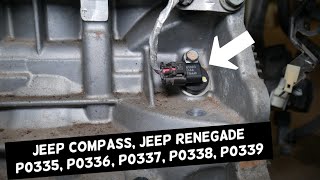
- CKP Sensor Connector — On the rear of the engine block, accessible from underneath the vehicle, often behind a small heat shield.. This is the primary connection point. The three pins are 5V Supply, Signal, and Ground. Testing voltage and continuity here is the first step in diagnosing the circuit.
- G100 — Located on the left front frame rail.. This is a major ground distribution point for the engine compartment. A corroded or loose G100 ground can cause a variety of electrical issues, including intermittent sensor signals that could trigger a P0335.
- Harness routing path — The wiring harness for the CKP sensor runs from the back of the engine block up towards the main engine harness, in close proximity to the exhaust manifold.. This is a common chafe and melt point. The heat from the exhaust can degrade the protective loom and wire insulation, causing shorts to ground or between wires, which directly causes a P0335 circuit malfunction code.
Real Owner Repair Stories
- Reddit user in /r/AskAMechanic (Jeep Compass (year not specified, but within range)) — Intermittent rough idle when stopped in drive, followed by a P0335 code. Stalled completely on one occasion.
❌ Tried (didn't work) A mechanic replaced the crankshaft position sensor with an aftermarket part, replaced spark plugs, cleaned the throttle body, and replaced a battery connector. The fix only lasted for four months before the symptoms returned.
✅ What actually fixed it The user was advised that the aftermarket crankshaft sensor was the likely cause of the recurring problem, as they are known to fail prematurely. The final resolution was not posted, but the strong implication was to replace it with an OEM Mopar sensor. - YouTube video by 'youfixnsave garage' (2005 Jeep Grand Cherokee 4.7L (Note: Different vehicle, but demonstrates identical P0335 wiring failure pattern)) — Hard starting, flashing check engine light, codes P0335 and P0315.
❌ Tried (didn't work) The sensor itself was suspected, and noted to be an aftermarket replacement that could be faulty.
✅ What actually fixed it A detailed inspection of the wiring harness revealed a broken 5-volt supply wire (pink/yellow) further up the loom. Repairing this broken wire restored the correct voltage to the sensor and resolved the code.
OEM Part Supersession History
5033307AB, 5033307AC, 5033307AD→05033307AE— Standard part revision and improvement by the manufacturer.
Heads up: The older part numbers have been fully replaced by 05033307AE for the 2.0L/2.4L World Engine. Using old stock is not recommended.
Model Year Variations Within This Range
- 2012-2017 (MK Generation): These models use the 2.0L or 2.4L 'World' engine and require crankshaft position sensor Mopar P/N 05033307AE.
- 2017-2018 (MP Generation): These models use the 2.4L 'Tigershark' engine and require a different crankshaft position sensor, Mopar P/N 68243239AA.
Helpful Videos
We Have This Part in Stock


The information in this article is provided for general reference and educational purposes only. Vehicle specifications, procedures, and part compatibility can vary by production date, trim level, and region. Always consult your vehicle's factory service manual and verify part numbers before purchasing or performing repairs. Safety-critical components such as airbags, seat belts, and braking systems should be installed by a qualified professional.
- Jeep COMPASS:
- 🎬 Helpful Videos
- 🛍️ Shop This Part
- What's Unique About the 2012-2018 Jeep COMPASS
- Diagnostic Flowchart
- Symptoms You May Notice
- Most Likely Causes
- Rare But Worth Checking
- Diagnosis Steps
- Parts You'll Likely Need
- Related Codes That Often Appear With This One
- Technical Service Bulletins (TSBs) & Recalls
- Platform-Specific Known Issues
- Mechanic-Grade Diagnostic Values
- Scan Tool Commands That Help
- Wiring & Ground Locations
- Real Owner Repair Stories
- OEM Part Supersession History
- Model Year Variations Within This Range
- 🎟️ Get 5% Off