

P0335 on 2014-2016 Jeep Cherokee: Crankshaft Position Sensor Circuit Fixes
P0335 on a 2014-2016 Jeep Cherokee indicates a fault in the crankshaft position sensor circuit. The most common fix is replacing the sensor itself, which can fail due to heat, causing stalling or a no-start condition. A PCM software update is also a common, manufacturer-recommended fix. Expect to pay between $73-$137 for an OEM part, but labor costs are high due to the sensor's difficult location, especially on the 3.2L V6.
- P0335 means the engine computer has lost the signal from the crankshaft position sensor, which is critical for engine operation.
- The most common symptoms are the engine cranking but not starting, or stalling unexpectedly while driving, especially once warm.
- The primary cause is a failed sensor, but faulty wiring or the need for a PCM software update are also possibilities.
- Do not drive the vehicle. The risk of stalling in traffic is high and poses a significant safety hazard.
- Due to the sensor's difficult location, repair costs are higher than average for this part. Professional installation is recommended.
What's Unique About the 2014-2016 Jeep CHEROKEE

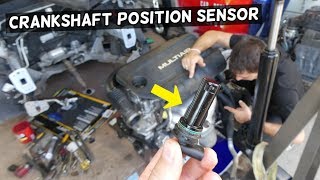
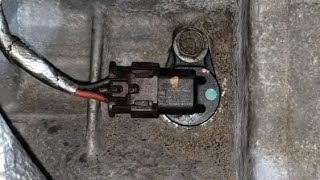
For the 2014-2016 Jeep Cherokee (KL generation), the P0335 code is frequently documented in manufacturer Technical Service Bulletins (TSBs). These bulletins often link the code to software glitches that require a PCM update, in addition to the more common physical sensor failure. The sensor's location is notoriously difficult to access, leading to higher-than-average labor costs. 🎬 Watch: Overview of P0335 codes for 2014-2016 Cherokees On the 2.4L engine, it is located on the back of the engine block near the hot exhaust manifold. 🎬 See this walkthrough for the 2.4L sensor location On the 3.2L V6, it is on the lower passenger side toward the back, typically requiring removal of the front wheel and splash shield for access.
Diagnostic Flowchart
Tap your situation to follow the diagnostic path that matches what you're seeing on this vehicle.
Symptoms You May Notice
- Engine will crank but not start
- Engine stalls unexpectedly, especially when warm
- Check Engine Light is on
- Rough or unstable idle
- Hesitation or poor acceleration
- Reduced fuel economy
- Extended crank time before engine starts
- Replacing the camshaft position sensor. While related, the camshaft sensor has its own set of codes (e.g., P0340, P0344). It's best practice to replace both sensors at the same time on older vehicles, but the camshaft sensor will not fix a P0335 code.
- Confusing the Crankshaft Position Sensor part number with the Camshaft Position Sensor part number. For example, Mopar part 68080819AC is a CAM sensor, not the CRANK sensor, though they may look similar.
Most Likely Causes

- Failed Crankshaft Position Sensor 🔴 High Probability The sensor is exposed to high engine heat, which can cause internal electronics to fail over time, leading to an intermittent or complete loss of signal, especially when the engine is hot. This is a well-documented failure mode for many Chrysler/Jeep products.
How to confirm: Use a scan tool to monitor the RPM signal while cranking the engine. If there is no RPM reading, the sensor or its circuit is the primary suspect. A mechanic can also use an oscilloscope to test the sensor's signal output directly for a definitive diagnosis; it should be a clean 5V square wave pattern.
Typical fix: Replace the crankshaft position sensor. It is highly recommended to use an OEM Mopar part, as budget aftermarket sensors are known for premature failure. After replacement, a crankshaft position sensor relearn procedure is required.
Est. part cost: $73-$137 - Wiring Harness or Connector Issue 🟡 Medium Probability The wiring harness runs close to hot exhaust components and can become brittle, melted, or corroded over time, causing a short or open circuit. The connector itself can also fail.
How to confirm: Visually inspect the wiring harness and connector leading to the crankshaft position sensor for any signs of damage, melting, or corrosion. Perform a continuity test on the wires between the sensor and the PCM to check for breaks. Wiggling the harness while monitoring the signal can also reveal intermittent faults.
Typical fix: Repair the damaged section of wiring or replace the connector pigtail. Ensure the repaired harness is secured away from the exhaust manifold to prevent repeat failure.
Est. part cost: $15-$50 - Powertrain Control Module (PCM) Software Update Needed 🟡 Medium Probability Multiple TSBs (e.g., #18-093-16 REV. A, #18-085-17, #18-035-16 REV.A) from Jeep explicitly state that the P0335 code can be falsely triggered by software glitches and that a PCM reflash is the prescribed fix. This is a very common first step at the dealership.
How to confirm: A Jeep dealership or a qualified shop with a wiTECH scan tool can check the current PCM software version against the latest available version from the manufacturer. If an update related to P0335 is available for your VIN, this is the likely cause.
Typical fix: Reprogram the PCM with the latest software. This is often referred to as 'flashing' the module and must be done by a dealer or a properly equipped independent shop.
Est. part cost: $0 (if under warranty) - $200
Rare But Worth Checking
- Damaged Reluctor Ring: The reluctor ring (or tone wheel) is what the crankshaft sensor reads. If it's damaged, cracked, or has broken teeth, the sensor will produce an erratic or no signal. This is uncommon but can happen, and requires more intensive labor to inspect and replace as it is internal to the engine.
- Faulty Powertrain Control Module (PCM): In rare cases, the internal circuitry of the PCM itself can fail. This should only be considered after all other possibilities, including the sensor, wiring, and software, have been definitively ruled out.
Diagnosis Steps
- Scan for Codes: Use an OBD-II scanner to confirm P0335 is present and check for any other related codes, such as U1424 or U0402.
- Check for TSBs: This is a critical step for this vehicle. Ask a dealer or use a professional database to see if any TSBs apply to your vehicle's VIN for this code. A software update may be the required first step before replacing parts.
- Live Data Scan: Use a scan tool to monitor engine RPM while cranking. No RPM reading points directly to a problem in the CKP sensor circuit (sensor, wiring, or PCM).
- Visual Inspection: Carefully inspect the crankshaft position sensor connector and its wiring for any signs of melting, corrosion, or physical damage, paying close attention to areas near the exhaust.
- Circuit Test: If the wiring looks good, use a multimeter to check for the correct voltage (typically 5V reference) and ground at the sensor connector with the key on. Test for continuity between the PCM and the sensor connector to rule out a wire break. Referencing a wiring diagram with circuit IDs like (F855) 5V Supply, (K24) CKP Signal, and (K900) Sensor Ground is ideal.
- Sensor Replacement: If the wiring and power/ground are good, and a PCM update is not required or has already been performed, the sensor itself is the most likely culprit. Replace it with a quality OEM Mopar part.
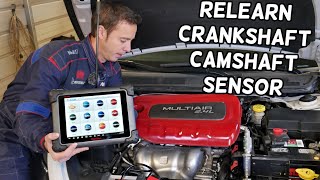
- Relearn Procedure: After replacement, a 'Cam/Crank Relearn' must be performed. This requires a capable scan tool and is necessary to ensure the PCM correctly interprets the new sensor's signal and prevents codes like P0315.
Parts You'll Likely Need

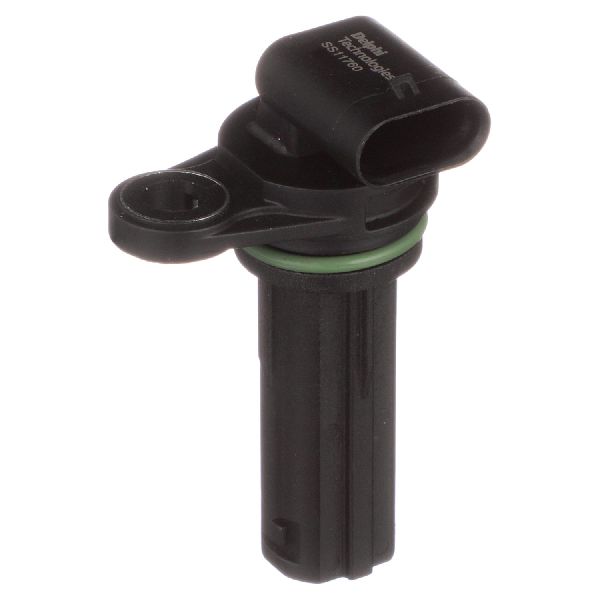
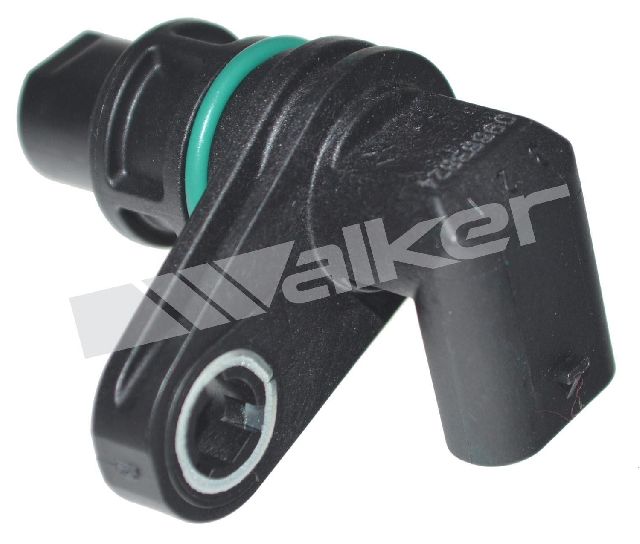
- Crankshaft Position Sensor
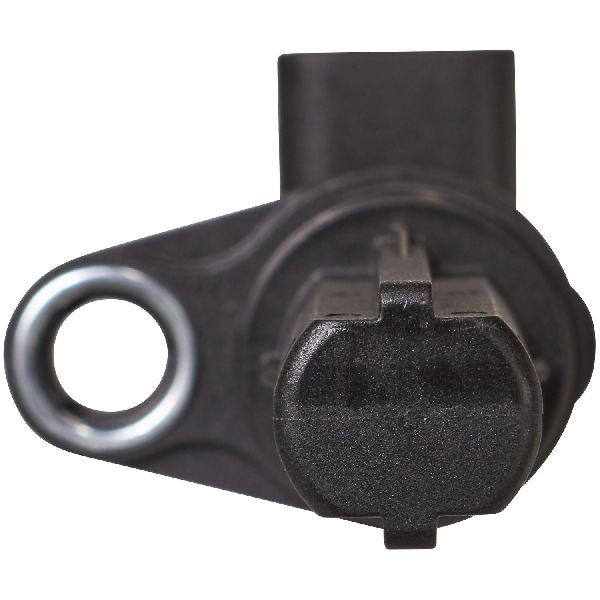
(OEM #68243243AA (3.2L V6) or 68102341AD (2.4L I4). Note: Part numbers can vary. The commonly confused CAMshaft sensor is 68080819AC. Always verify with VIN.)— This sensor is the most common failure point for code P0335, typically failing from heat stress over time.
Trusted brands: Mopar, NTK, NGK, Delphi
OEM price range: $100-$137
Aftermarket price range: $73-$110
Related Codes That Often Appear With This One
- U1424 — This code for 'Implausible Engine Torque Signal Received' is frequently cited alongside P0335 in Jeep TSBs, suggesting a related software or data communication issue that can often be resolved with a PCM flash.
- U0402 — Meaning 'Implausible Data Received From TCM', this code often appears with P0335, indicating the loss of a valid engine speed signal is affecting communication with the transmission control module.
- P2610 — 'PCM Internal Engine Off Timer Performance' is another code mentioned in TSBs with P0335, pointing towards internal PCM logic and software conflicts that are addressed by a software update.
- P0315 — This code for 'Crankshaft Position System Variation Not Learned' can appear after a sensor replacement if the mandatory relearn procedure is not performed.
Technical Service Bulletins (TSBs) & Recalls
- 18-032-17: Mentions P0335-00 - Crankshaft Position Sensor Circuit.
- 18-085-17: Lists P0335 - Crankshaft Position Sensor Circuit among other DTCs that can be fixed with a PCM flash for 2015 models.
- 18-093-16 REV. A: Cites P0335 as a code that may be fixed by a PCM software update for 2014 3.2L models.
- 18-076-16: Notes P0335 - CRANKSHAFT POSITION SENSOR CIRCUIT as a possible DTC for 2016 models.
- 18-035-16 REV.A: Includes P0335 - CRANKSHAFT POSITION SENSOR CIRCUIT in a list of potential codes for 2015 3.2L models fixed by a PCM flash.
- 18-004-16 REV. A: Lists P0335 as a potential DTC for 2015 models.
Platform-Specific Known Issues
- Multiple Technical Service Bulletins (#18-032-17, #18-085-17, #18-093-16 REV. A, #18-076-16, #18-035-16 REV.A) have been issued by Jeep for the 2014-2016 Cherokee that list P0335 as a potential trouble code that can be resolved with a PCM software update.
- The sensor location on the 3.2L V6 is particularly difficult, requiring removal of the passenger wheel and fender liner, contributing to high labor costs.
- The sensor on the 2.4L is located behind the engine near the exhaust, making it susceptible to heat damage on both the sensor and its wiring.
Mechanic-Grade Diagnostic Values
- Sensor Type — expected: 3-wire Hall Effect sensor with a 5-volt pull-down design.. Failure: N/A
- Sensor Connector Voltage (Key On, Engine Off) — expected: Pin 1: 5V reference; Pin 2: Signal (should also read near 5V); Pin 3: Ground (near 0V).. Failure: Voltage outside the 4.5-5.5V range on the reference/signal wire, or lack of a solid ground, indicates a wiring or PCM issue.
- Oscilloscope Pattern (Engine Cranking/Running) — expected: A clean, repeating square wave pattern switching between approximately 0V and 5V.. Failure: A flat line, a noisy signal, or missing/erratic square waves indicates a faulty sensor, wiring, or reluctor ring issue.
Scan Tool Commands That Help

- wiTECH or capable aftermarket scanner (e.g., Autel): Cam/Crank Relearn — This function is mandatory after replacing the crankshaft sensor, camshaft sensor, or any timing components. It synchronizes the PCM to the new sensor's signal profile. Failure to perform this can result in a persistent P0335, a new P0315 code, poor running conditions, or an inability to pass emissions tests. The engine must be warmed to operating temperature (approx. 70°C / 158°F) for the command to execute.
Wiring & Ground Locations
- (K24) CKP Signal Circuit — The wire that carries the crankshaft position signal from the sensor to the PCM.. This is the primary signal wire. A short to ground or an open circuit on this wire will directly cause a P0335 code.
- (F855) 5 Volt Supply Circuit — The wire that provides the 5-volt reference power from the PCM to the sensor.. Without this 5V supply, the Hall Effect sensor cannot operate and will not produce a signal.
- (K900) Sensor Ground Circuit — The dedicated ground wire for the sensor, which runs back to the PCM.. A poor ground connection will cause erratic or no signal from the sensor.
- G102 / G103 Engine Block Grounds — Studs on the side of the engine block, typically on the passenger side.. These are main grounds for the PCM. While not the direct sensor ground, a poor main PCM ground can cause a wide range of sensor codes, including P0335, due to floating ground reference voltages.
Real Owner Repair Stories
- Nelson Performance YouTube Channel (Jeep (Wrangler with 3.8L V6, but principle applies)) — P0335 code present. Customer had already replaced the crankshaft sensor without success.
❌ Tried (didn't work) Replacing the crankshaft position sensor.
✅ What actually fixed it The wiring harness pigtail for the sensor had melted due to its proximity to the exhaust manifold. Replacing the pigtail connector and re-routing it away from the heat source resolved the code.
OEM Part Supersession History
68080819AB→68080819AC— Revision update by manufacturer.
Heads up: CRITICAL: This entire part number family (68080819xx) is for the CAMSHAFT position sensor, not the crankshaft sensor. They are frequently confused online and by parts suppliers. Ordering this part will not fix a P0335 code.
Model Year Variations Within This Range
- 2014-2016: The specific PCM software updates (reflashes) intended to fix false P0335 codes are often specific to a single model year. For example, TSB #18-093-16 REV. A is for 2014 models, while TSB #18-085-17 is for 2015 models, indicating different software patches for different years.
Helpful Videos


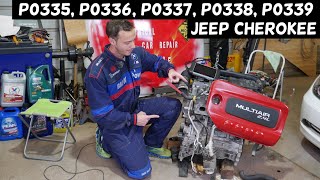
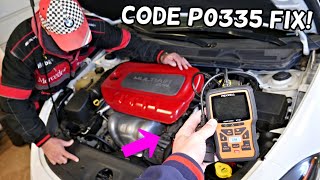

We Have This Part in Stock


The information in this article is provided for general reference and educational purposes only. Vehicle specifications, procedures, and part compatibility can vary by production date, trim level, and region. Always consult your vehicle's factory service manual and verify part numbers before purchasing or performing repairs. Safety-critical components such as airbags, seat belts, and braking systems should be installed by a qualified professional.
- Jeep CHEROKEE:
- 🎬 Helpful Videos
- 🛍️ Shop This Part
- What's Unique About the 2014-2016 Jeep CHEROKEE
- Diagnostic Flowchart
- Symptoms You May Notice
- Most Likely Causes
- Rare But Worth Checking
- Diagnosis Steps
- Parts You'll Likely Need
- Related Codes That Often Appear With This One
- Technical Service Bulletins (TSBs) & Recalls
- Platform-Specific Known Issues
- Mechanic-Grade Diagnostic Values
- Scan Tool Commands That Help
- Wiring & Ground Locations
- Real Owner Repair Stories
- OEM Part Supersession History
- Model Year Variations Within This Range
- 🎟️ Get 5% Off