

P0335 on 2013-2016 Dodge Challenger: Crank Sensor Causes and Fixes
P0335 on a 2013-2016 Dodge Challenger most often means the crankshaft position sensor has failed. This can cause a no-start or stalling condition, sometimes specifically when the engine is hot. Replacing the sensor is the most common fix. For V8 models, this may require removing the starter for access, though some later models may have better access. The part costs around $30-$80 and is a manageable DIY job for many. In some cases, a PCM software update is the required fix per a TSB.
- P0335 on a 2013-2016 Challenger indicates a problem with the crankshaft position sensor circuit, which can cause a no-start or stalling.
- The most common fix is to replace the crankshaft position sensor, a relatively inexpensive part.
- Before replacing parts, inspect the sensor's wiring and connector for damage, as this is another common cause.
- Check for Technical Service Bulletins (TSBs), as your vehicle may need a PCM software update, especially if the code appears with P2610 in hot weather.
What's Unique About the 2013-2016 Dodge CHALLENGER

For the 2013-2016 Challenger, the P0335 code is specifically called out in several Technical Service Bulletins (TSBs). TSB #18-088-16 REV. A explicitly states that customers may experience this code along with a poor powertrain response when operating in high ambient temperatures. It's often accompanied by code P2610 (PCM Internal Engine Off Timer Performance), suggesting that in some cases, the root cause is a PCM software logic issue under heat-soak conditions, which can be resolved with a software update rather than a part replacement.
Diagnostic Flowchart
Tap your situation to follow the diagnostic path that matches what you're seeing on this vehicle.
Symptoms You May Notice
- Engine cranks but will not start.
- Engine stalls, sometimes when it gets hot or comes to a stop.
- Rough idling or engine misfires.
- Hesitation or reduced engine power.
- Check Engine Light is on.
- Tachometer (RPM gauge) reads zero while cranking the engine.
- Replacing the camshaft position sensor. While similar in function, the camshaft sensor is a different part and will typically set different codes (e.g., P0340, P0344).
- Replacing the starter motor when the engine cranks but won't start. On V8 models, the starter is removed to access the crank sensor, but the starter itself is rarely the cause of the P0335 code.
- Replacing the sensor without checking the wiring. A user on DodgeForum.com with a P0335 code was advised to perform continuity and wiggle tests on the wiring harness after a new sensor didn't fix the problem, highlighting the possibility of an intermittent wiring issue.
Most Likely Causes

- Faulty Crankshaft Position Sensor 🔴 High Probability The sensor is a Hall-effect type exposed to extreme heat and vibration at the lower part of the engine block, which can cause internal electronics to fail over time, especially when hot. Oil leaking onto the sensor's connector can also cause it to short out.
How to confirm: Use a scan tool with live data to monitor RPMs while cranking the engine. If the RPM reading is zero or erratic, the sensor is likely bad. You can also test the sensor's 3-wire circuit for 5-volt reference, ground, and a fluctuating signal with a multimeter or oscilloscope. 🎬 Watch: How to test a crankshaft sensor to confirm it's faulty.
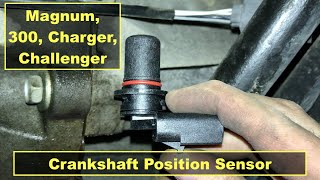
Typical fix: Replace the crankshaft position sensor. On V8 models (5.7L/6.4L), the sensor is located on the passenger side of the block, wedged between the engine and the starter motor, requiring the starter to be removed for access. 🎬 Watch: Step-by-step guide to replacing the sensor on a 5.7 Hemi. On the 3.6L V6, it is located on the back of the engine, near the transmission bell housing. 🎬 See this walkthrough for replacing the sensor on a 3.6L V6. The sensor is typically held in by a single 10mm bolt.
Est. part cost: $30-$85 - Wiring Harness or Connector Damage 🟡 Medium Probability The sensor's wiring is routed low on the engine and can be damaged by heat from the exhaust manifold, road debris, or oil contamination which degrades the insulation. Wires can become chafed, melted, or brittle, leading to an open or short circuit.
How to confirm: Visually inspect the wiring harness and connector from the sensor to the PCM for any signs of melting, chafing, corrosion, or loose pins. Perform a "wiggle test" on the harness while the engine is running (if possible) or while monitoring the circuit with a meter to see if the signal drops out.
Typical fix: Repair the damaged section of wire or replace the connector pigtail. Ensure the repaired harness is properly secured away from heat sources.
Est. part cost: $15-$40 - Powertrain Control Module (PCM) Issue ⚪ Low Probability Multiple TSBs link P0335 with other PCM-related codes (like P2610) and recommend a software update as the fix, especially for issues that occur in high heat. This indicates a known software calibration issue rather than a hardware failure.
How to confirm: This is difficult to confirm without a dealer-level scan tool (wiTECH). If the sensor and wiring are confirmed to be good, and TSB #18-088-16 REV. A applies to your vehicle's symptoms (stalling in high heat), a PCM issue is likely. Check with a dealer for applicable software updates.
Typical fix: Reprogramming (reflashing) the PCM with updated software is the specified fix in the TSB. This service costs approximately $100-$250 at a dealer or independent shop. In rare cases, the PCM itself may need repair or replacement, which can cost $200-$1000+.
Est. part cost: $100-$1000+
Rare But Worth Checking
- Damaged Reluctor Ring: The reluctor ring (or tone wheel) is what the sensor reads. If it has broken or bent teeth, or has slipped on the crankshaft, it will cause an erratic signal and a P0335 code. This is uncommon but can happen, especially if other major engine work has been performed recently. Diagnosis requires visual inspection, which can be labor-intensive.
- Blown Fuse: The crankshaft position sensor circuit is often powered by a fuse that may be shared with other engine sensors. A video for later model Challengers identifies fuses in the front (F31, F34, F35, F37) and rear (R29) fuse boxes that are related to the powertrain control and sensor circuits. While less common, it's a simple check worth performing.
Diagnosis Steps
- Connect an OBD-II scanner and check for P0335 and any other stored codes. Note any codes that appear alongside P0335, like P2610 or P0339.
- Use the scanner's live data feature to monitor Engine RPM while cranking the engine. A reading of 0 RPM strongly indicates no signal from the crank sensor.
- Perform a thorough visual inspection of the crankshaft position sensor and its wiring harness. Look for melted plastic, frayed wires, oil contamination, or corrosion on the connector pins.
- Test the circuit. The sensor uses a three-wire connector. With the key on, you should find a 5-volt reference wire, a good ground wire, and a signal wire. The signal wire's voltage should change as the engine is manually rotated.
- If the wiring, power, and ground are good, the crankshaft position sensor itself is the most likely culprit.
- If a new sensor does not fix the issue, check for applicable TSBs. If your symptoms match TSB #18-088-16 REV. A (stalling in high heat with code P2610), a PCM reflash is the next logical step.
- In rare cases, if all else fails, inspect the reluctor ring for damage. This may require significant disassembly to access.
Parts You'll Likely Need

- Crankshaft Position Sensor (5.7L / 6.4L V8)
(OEM #68477925AB)— This is the sensor for the V8 HEMI engines. It is the most common failure point for the P0335 code due to its operating environment. This part number supersedes 68140678AB and 68140678AC.
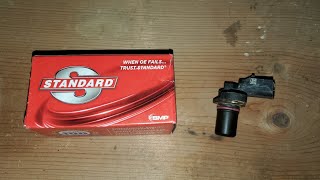
Trusted brands: Mopar, NGK, Standard Motor Products (SMP), Delphi
OEM price range: $75-$112
Aftermarket price range: $30-$50 - Crankshaft Position Sensor (3.6L V6)
(OEM #5149169AA)— This is the correct sensor for the 3.6L Pentastar V6 engine. Like the V8 version, it is the primary failure point for this code.
Trusted brands: Mopar, NTK, Bosch
OEM price range: $45-$70
Aftermarket price range: $25-$45
Related Codes That Often Appear With This One
- P2610 — As cited in TSB #18-088-16 REV. A, 'PCM Internal Engine Off Timer Performance' often appears with P0335, pointing towards a potential PCM software issue that needs a reflash, especially in high ambient heat.
- P0339 — This code for 'Crankshaft Position Sensor Intermittent' is closely related and indicates the signal is dropping out, rather than being completely absent. It often points to the same root causes like a failing sensor or bad wiring. [Bulletin #1807517, #18-061-17]
- P0016 — 'Crankshaft/Camshaft Timing Misalignment' can appear with P0335 if there is a base mechanical timing issue, causing the signals from the two sensors to be out of sync. [Bulletin #1807517]
Technical Service Bulletins (TSBs) & Recalls
- 18-070-20: Mentions P0335 as a possible DTC.
- 18-073-20: Lists P0335 as a possible DTC for 2014-2015 models.
- 1808816: Links P0335 to high ambient temperatures.
- 18-088-16 REV. A: Details a fix for high-temp stalling via PCM reflash.
- 1807517: Lists P0335 with other timing-related codes.
- 18-061-17: Mentions P0335 and intermittent variant P0339.
- 18-088-16: Links P0335 to high ambient temperatures.
- 1807617: Lists P0335 as a possible DTC.
- 18-062-17: Lists P0335 and P0339 as possible DTCs.
Platform-Specific Known Issues
- High Temperature Stalling & PCM Update: TSB #18-088-16 REV. A specifically addresses an issue where 2013-2014 Challengers (among others) may stall or have poor response in high ambient temperatures, setting codes P0335 and P2610. The official fix is to reprogram the PCM with updated software, not to replace the sensor.
- V8 Sensor Accessibility: On Challengers with the 5.7L or 6.4L HEMI V8, the crankshaft position sensor is located behind the starter motor on the passenger side of the engine block. This makes replacement more involved, as the starter must be disconnected and removed to gain access to the sensor's single mounting bolt.
Mechanic-Grade Diagnostic Values
- 5-Volt Supply Circuit Voltage (Key On, Engine Off) — expected: 4.7 - 5.1 volts. Failure: Voltage below 4.7V or above 5.1V indicates an issue with the PCM or wiring.
- CKP Signal Circuit Voltage (Key On, Engine Off) — expected: 4.7 - 5.1 volts. Failure: Voltage outside this range suggests a short to voltage or ground in the signal wire.
- Sensor Ground Circuit Integrity — expected: Test light illuminates brightly. Failure: A dim or non-illuminated test light indicates high resistance or an open in the ground circuit.
Scan Tool Commands That Help
- wiTECH or capable aftermarket scanner (e.g., Autel): Cam/Crank Relearn (or Crankshaft Position System Variation Learn) — This procedure is required after replacing the crankshaft sensor, camshaft sensor, or PCM to synchronize the components and prevent codes like P0315. Failure to perform this can result in rough running or continued CEL illumination.
- wiTECH: Reprogram PCM (Flash) — This is the specific fix called for in TSBs #18-088-16 and #18-080-17 for vehicles experiencing stalling in high ambient temperatures accompanied by codes P0335 and P2610.
Wiring & Ground Locations

- Crankshaft Position Sensor Connector (3-wire) — On the sensor body, located low on the engine block.. This is the primary point for circuit testing. A 2015 V6 wiring diagram shows Pin 1: 5V Supply (F855 circuit), Pin 2: CKP Signal, Pin 3: Sensor Ground (K900 circuit). The V8 has similar functions: (F855) 5-volt Supply, (K24) CKP Signal, and (K925) Sensor Ground.
- PCM Connector C2 (V6 Engine) — The larger of the connectors on the Powertrain Control Module.. This is the termination point for the sensor harness. For a 2015 3.6L, the 5V supply (F855) is at pin 67 and the sensor ground (K900) is at pin 66, allowing for end-to-end continuity checks.
- Engine Management Fuses (2015+) — Underhood fuse box (passenger side) and trunk fuse box (behind liner, passenger side).. Power for the PCM and related sensors runs through these fuses. Check underhood fuses F31, F34, F35, F37 and trunk relay R29, as a failure here will kill power to the circuit.
- Engine Ground Strap — A braided metal strap connecting the engine block to the vehicle's chassis/frame.. A corroded or broken ground strap can cause electrical noise and unstable sensor readings, as the sensor's ground reference becomes unreliable. This can mimic a sensor failure.
Real Owner Repair Stories
- YouTube user Marty09933 (2016 Dodge Challenger 5.7L Shaker) — Diagnosing a crank/no-start condition, investigating P0335.
❌ Tried (didn't work) Relying on forum information which was confusing and contradictory regarding sensor location.
✅ What actually fixed it The user clarified a major point of confusion for 2015+ models. On his 2016 5.7L, the starter was on the driver's side, but the crankshaft position sensor was on the passenger side of the block near the bell housing. He was able to access and replace it by simply removing the passenger-side front tire, without needing to remove the starter motor, which is a significant labor savings compared to the common procedure on earlier models.
When the Usual Fixes Don't Work
- While many online guides and even the Pass 2 information state that replacing the crank sensor on a V8 requires removing the starter, a real-world example on a 2016 5.7L showed it was accessible from the passenger wheel well without removing the starter. This suggests a potential change in the 2015+ refresh models that makes the job significantly easier than on earlier third-generation Challengers. Owners of 2015+ V8 models should inspect the passenger side of the block near the bell housing before committing to starter removal.
Model Year Variations Within This Range
- 2015-2016: The PCM connectors were changed for the 2015 model year refresh. They use a gray and tan connector instead of the earlier brown connector. The keying is different, preventing older harnesses from plugging into newer PCMs without swapping the Terminal Position Assurance (TPA) plastic covers and potentially re-pinning some wires.
- 2016 (and possibly 2015+): On at least some 2016 5.7L V8 models, the crankshaft position sensor may be accessible from the passenger side wheel well without removing the starter motor, contrary to the procedure for earlier V8 models.
Helpful Videos
We Have This Part in Stock


The information in this article is provided for general reference and educational purposes only. Vehicle specifications, procedures, and part compatibility can vary by production date, trim level, and region. Always consult your vehicle's factory service manual and verify part numbers before purchasing or performing repairs. Safety-critical components such as airbags, seat belts, and braking systems should be installed by a qualified professional.
- Dodge CHALLENGER:
- 🎬 Helpful Videos
- 🛍️ Shop This Part
- What's Unique About the 2013-2016 Dodge CHALLENGER
- Diagnostic Flowchart
- Symptoms You May Notice
- Most Likely Causes
- Rare But Worth Checking
- Diagnosis Steps
- Parts You'll Likely Need
- Related Codes That Often Appear With This One
- Technical Service Bulletins (TSBs) & Recalls
- Platform-Specific Known Issues
- Mechanic-Grade Diagnostic Values
- Scan Tool Commands That Help
- Wiring & Ground Locations
- Real Owner Repair Stories
- When the Usual Fixes Don't Work
- Model Year Variations Within This Range
- 🎟️ Get 5% Off