

OBD-II Code P0328: Knock Sensor Circuit High Voltage
What P0328 means, why it triggers, and how to fix it
- P0328 indicates the knock sensor circuit voltage is stuck above 4.5V, usually caused by a failed sensor, chewed wiring, or a brittle sub-harness.
- The engine computer forces a protective 'limp mode' that retards ignition timing, reducing engine power and dropping fuel economy by 10-20%.
- Repair costs range from $150 for an accessible 4-cylinder sensor to over $1,000 for V6/V8 engines requiring intake manifold removal.
- Always test the sensor's resistance and wiring before replacing it, and strictly use OEM parts (like Denso or Bosch) to prevent the code from returning.
- You can drive short distances, but ignoring P0328 for more than a few months risks $800+ in catalytic converter damage from inefficient combustion.
What Does P0328 Mean?

The Engine Control Module (ECM) is receiving a voltage signal from the knock sensor that is consistently too high (typically above 4.5V). The knock sensor acts like a microphone, listening for harmful engine 'knock' or 'pinging' caused by premature fuel detonation. This specific code indicates an electrical fault within the sensor or its wiring circuit, not necessarily that your engine is actively knocking.
Technical definition: The Powertrain Control Module (PCM) detects that the voltage from knock sensor 1 (Bank 1) exceeds the manufacturer's specified maximum threshold (usually 4.5 to 5.0 volts) for a continuous period. This high-voltage state typically represents an open circuit or a short to power.
Can I Drive With P0328?
Yes, But With Caution. Yes, for short trips, but avoid heavy acceleration. The engine computer reduces power and adjusts timing to protect the engine, making the vehicle feel sluggish. Continuing to drive under heavy load risks severe internal engine damage to pistons and rods. Ignoring the code for months leads to catalytic converter damage from inefficient combustion, a repair costing $800 to $2500.
Common Causes

- Faulty Knock Sensor (Very Common) — The sensor's internal piezoelectric crystal fails from heat and vibration, cracking or shorting internally to send a constant, invalid high-voltage signal.
- Wiring or Connector Damage (Common) — The wiring harness frays, melts, suffers rodent damage, or shorts to power. Connectors corrode or fill with moisture, especially after pressure washing the engine bay.
- Defective Knock Sensor Sub-Harness (Common) — On many V6 engines (especially Nissan), the short sub-harness under the intake manifold bakes in high heat, becoming brittle and causing an open circuit.
- Poor Quality Aftermarket Sensor (Common) — Cheap aftermarket knock sensors frequently fail to meet precise OEM resistance specifications, triggering the code immediately after installation.
- Engine Overheating or Cooling System Faults (Less Common) — An overheating engine causes actual pre-ignition (knock). The sensor correctly reports this, but the root cause is mechanical, not electrical.
- Lean Air/Fuel Ratio (Less Common) — A vacuum leak, weak fuel pump, or faulty oxygen sensor creates a lean mixture, raising combustion temperatures and causing detonation.
- Excessive Mechanical Engine Noise (Less Common) — Loud rattling from a loose timing chain or failing lifters is sometimes misinterpreted by the sensor as engine knock.
- Incorrectly Installed/Torqued Sensor (Rare) — Sensors must be torqued to exact specifications (e.g., 15 ft-lbs). Over-tightening damages them; under-tightening prevents accurate vibration detection.
- Engine Control Module (ECM/PCM) Fault (Rare) — Rarely, the ECM's internal processing circuit fails, reading a false high voltage even with a perfect sensor and wiring.
Symptoms

- Check Engine Light On — The primary and often only noticeable symptom for most drivers.
- Reduced Engine Power and Acceleration — The ECM enters a protective 'limp mode,' retarding ignition timing to prevent damage. The vehicle feels sluggish and hesitant.
- Worse Gas Mileage — Retarded ignition timing destroys combustion efficiency, dropping fuel economy by 10-20%.
- Audible Engine Pinging or Knocking — A metallic pinging or tapping sound during acceleration, caused by the ECM failing to properly adjust timing due to the faulty sensor signal.
- Engine Hesitation or Rough Idle — The engine stumbles or surges as the ECM struggles to compensate for the invalid sensor data.
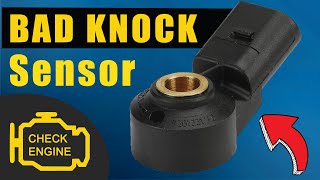
- Engine Running Hotter Than Normal — Inefficient combustion and retarded timing elevate engine operating temperatures. 🎬 Watch: A breakdown of common bad knock sensor symptoms
Diagnostic Flowchart
Tap your situation to follow the diagnostic path that matches what you're seeing on this code.
Common Fixes & Costs
- Replace Knock Sensor — Parts: $40-$150, Labor: $150-$600, ~0.8-5.0 hr book time (Intermediate)
- Replace Knock Sensor Sub-Harness — Parts: $20-$70, Labor: $350-$750, ~4.0-6.0 hr book time (Professional)
- Repair Wiring or Replace Connector — Parts: $10-$50, Labor: $150-$400, ~1.0-3.0 hr book time (Intermediate)
- Address Underlying Mechanical/Fueling Issues — Parts: $50-$500, Labor: $150-$800, ~1.0-5.0 hr book time (Professional)
- Replace Engine Control Module (ECM) — Parts: $300-$1000, Labor: $100-$250, ~1.0-2.0 hr book time (Professional)
Used vs. New Parts: Buying Guide
When a used part is worth it: Buying a used knock sensor is never recommended. It is an inexpensive electronic component that fails from heat and age. The high labor cost for replacement makes installing a part with an unknown history unwise.
Donor-vehicle mileage cap: roughly under 20000 miles for the part to have meaningful remaining life.
Donor quality checklist:
- Only consider a used sensor if it is from a very low-mileage wrecked vehicle.
- Ensure the part number matches exactly.
- Never buy a used sensor if the labor to install it is more than 1 hour.
Decision logic:
- If The sensor is accessible on the side of the engine (labor < 1.5 hours). → Buy a new, high-quality OEM or reputable aftermarket sensor (Denso, Bosch, ACDelco). The part cost is low enough that savings are negligible.
- If The sensor is under the intake manifold (labor > 3 hours). → Absolutely buy a new OEM sensor and replace the wiring sub-harness simultaneously. The risk of repeat failure with a used part is too high.
Warranty tradeoff: Used parts typically have a 30-day warranty. New aftermarket parts offer 1-year to lifetime warranties. New OEM parts offer a 1-year warranty. Warranties cover the part only, not the expensive labor to reinstall it.
Worst-case if a used part fails: $500-$1500 if a used or cheap sensor fails after installation, requiring a full repeat of the labor-intensive repair.
What Happens If You Wait — Timeline
- 0-1 month: Code P0328 is stored. Check Engine Light is on. The ECM enters a 'fail-safe' mode, retarding ignition timing. The driver notices sluggish acceleration and a drop in fuel economy. (MPG impact: 10-20%% · Added cost: $20-$60 in wasted fuel)
- 1-4 months: Continued driving with retarded timing and inefficient combustion causes higher exhaust gas temperatures, stressing the catalytic converter. (MPG impact: 15-25%% · Added cost: $50-$150 in wasted fuel)
- 4-8 months: The catalytic converter substrate begins to melt or clog from sustained high temperatures. If P0328 masks real knock, minor mechanical damage to piston ring lands begins. (MPG impact: 20-30%% · Added cost: $800-$2500 (catalytic converter replacement needed))
- 8+ months: If the fault masks severe detonation, catastrophic engine damage occurs, including cracked pistons, damaged connecting rod bearings, and scored cylinder walls. (MPG impact: N/A (severe drivability issues)% · Added cost: $3,000-$8,000+ (engine rebuild or replacement))
Cost of Not Fixing It
- 0-1 month: Reduced fuel economy (10-20% drop) and poor acceleration. Vehicle remains in a protective 'limp mode'. (Added cost: $20-$60 per month in extra fuel costs.)
- 1-6 months: Risk of catalytic converter damage from inefficient combustion and potential overheating. (Added cost: $800-$2500 for catalytic converter replacement.)
- 6+ months: If the faulty signal masks real, severe engine knock, prolonged driving causes catastrophic internal engine damage to pistons, rings, and bearings. (Added cost: $3000-$8000+ for engine rebuild or replacement.)
Diagnosis Steps

- Read Codes and Live Data
Use an OBD-II scanner to confirm P0328. Check freeze frame data for engine conditions when the fault occurred. View live data for the 'Knock Sensor Signal' PID; if it is stuck at maximum voltage (e.g., 5.0V), it confirms a circuit high condition.
Tools: Advanced OBD-II Scanner (Beginner) - Visually Inspect Sensor and Wiring
Locate the knock sensor. Inspect the sensor, connector, and wiring harness for burnt wires, rodent chew marks, or corroded pins.
Tools: Flashlight, Inspection Mirror (Beginner) - Check for TSBs
Search for Technical Service Bulletins (TSBs) for your specific make and model. Manufacturers frequently issue bulletins for known P0328 wiring or water intrusion issues.
Tools: Internet Access (Beginner) - Check Sensor Resistance
Disconnect the sensor. Measure resistance (Ohms) between the signal pin and ground using a multimeter. Compare to the repair manual spec (e.g., GM V8s require 93-107 kΩ). A reading of 'OL' (infinity) means the sensor is dead.
Tools: Digital Multimeter, Repair Manual (Intermediate) - Test Circuit for Short to Voltage
With the sensor disconnected and key on/engine off, measure voltage on the harness signal wire. If it reads 12V, there is a short to power in the wiring that requires repair.
Tools: Digital Multimeter, Wiring Diagram (Advanced) - Test Bias Voltage (Pro Tip)
Reconnect the sensor. Backprobe the signal wire at the ECM. A healthy sensor pulls the ECM's 5V reference down to around 2.5V. A reading near 5V confirms an open circuit in the sensor or sub-harness.
Tools: Digital Multimeter, Backprobe Pins (Advanced) - Check for Mechanical Issues
Listen for abnormal mechanical noises (rattling heat shields, timing chain slap) that falsely trigger the sensor. Verify the engine is not overheating.
Tools: Mechanic's Stethoscope (Intermediate) - Check Fuel Pressure
Connect a fuel pressure gauge. Low pressure indicates a weak fuel pump, causing a lean condition and actual engine knock.
Tools: Fuel Pressure Gauge (Advanced) - Analyze with an Oscilloscope
Connect a scope to the signal wire. With the engine running, tap the engine block near the sensor with a wrench. A healthy sensor produces a sharp AC voltage spike. A flat line means it is defective.
Tools: Oscilloscope (Professional)
When This Code Triggers (Freeze-Frame Conditions)
- Engine Coolant Temp: 180-210°F (Engine at normal operating temperature.)
- RPM: 1500-3000 (Under light to moderate acceleration or steady cruise.)
- Engine Load: 25-60% (The engine is working, but not under heavy strain.)
- Vehicle Speed: 30-60 mph (City or highway driving, not usually at idle.)
Related Codes
- P0327 — The direct opposite code, indicating 'Knock Sensor Circuit Low Input'. P0328 is a high-voltage fault (open circuit/short to power), while P0327 is a low-voltage fault (short to ground/internal failure).
- P0325 — A general 'Knock Sensor 1 Circuit Malfunction' code. A P0328 fault is often accompanied by or eventually leads to a P0325.
- P0330 — The identical 'Circuit High' code but for 'Knock Sensor 2' on Bank 2. The diagnostic process is identical to P0328 but performed on the second bank of cylinders.
- P0329 — Indicates 'Knock Sensor 1 Circuit Intermittent'. It triggers when the signal is erratic or dropping out, rather than stuck consistently high. Often points to a loose connection.
Climate & Environmental Factors
- Rodent Infestation: Rodents chew on the soy-based wire insulation used in modern cars. Chewed knock sensor wires are a primary cause of P0328, especially in vehicles parked outdoors.
- Water Intrusion / High Humidity: On GM Gen III/IV V8s, knock sensors sit in engine valley wells that collect water from rain or engine washing. This moisture corrodes the sensors and connectors, requiring RTV silicone to create a water-tight seal upon reassembly (TSB 05-06-04-026).
How to Talk to a Mechanic About This Code
Say this: "I have a P0328 code. Please test the knock sensor circuit—including the wiring and connectors—before recommending a sensor replacement. I'd also like to know if there are any related TSBs for my vehicle, especially for the wiring harness."
Signals you understand the problem could be the wiring, preventing a shop from simply replacing the most obvious part without a full diagnosis. This is crucial if the sensor is hard to access and labor is expensive.
Avoid saying:
- 'Just fix whatever's wrong'
- 'My check engine light is on, can you look at it?'
- 'Whatever you recommend'
Questions to ask before authorizing the repair:
- Did you test the sensor's resistance and check the wiring for an open circuit or a short to voltage?
- If the sensor is under the intake manifold, do you recommend replacing the sub-harness at the same time, and are new gaskets included in the quote?
- What brand of knock sensor will you be using (OEM, Denso, Bosch, etc.)?
- What is the warranty on the parts and labor for this specific repair?
Where to Take It: Dealer vs Independent vs Chain
- Dealer:
Recommended for warranty claims or specific TSB-related repairs. A good, but expensive, choice for complex jobs.
Best for: Vehicles under warranty (powertrain or emissions)., Vehicles with known TSBs for this issue (e.g., Hyundai/Kia KSDS update, GM water intrusion fix)., Complex jobs under the intake manifold on newer or European models.
Downsides: Highest labor rates, typically 1.5-2x more than an independent shop., May recommend replacing related parts that are not strictly necessary. (Typical cost: +50% vs. baseline) - Independent Shop:
Best overall fit for most situations. Find a well-regarded local shop with strong diagnostic credentials.
Best for: Most out-of-warranty P0328 repairs., Vehicles where the sensor is accessible or on common engines (e.g., Toyota V6, GM V8) that experienced technicians know well., Owners who are cost-sensitive but want a quality repair.
Downsides: Shop quality and diagnostic skill vary widely. Vet shops based on reviews and ASE certifications. (Typical cost: +0% vs. baseline) - Chain Shop:
Use with caution. Acceptable only for straightforward, accessible sensor replacements. AVOID for any P0328 involving wiring issues or intake manifold removal.
Best for: Simple, accessible knock sensor replacements on common 4-cylinder engines.
Downsides: High pressure to upsell services., Technician skill varies dramatically; may lack experience for complex diagnoses or intake manifold removal., High risk of replacing the sensor without diagnosing a wiring issue, leading to the code returning. (Typical cost: -10% vs. baseline)
When to Walk Away From the Repair
If the estimated repair cost exceeds 40-50% of the car's private-party value, seriously consider selling or trading in the vehicle instead of repairing it.
- Car worth $4000, fix is $1200: Borderline. The repair is 30% of the car's value. Get a second opinion before authorizing, but fixing it is reasonable if the rest of the car is in good shape.
- Car worth $15000, fix is $800: Fix it. The repair cost is a small fraction of the vehicle's value and is a necessary repair.
- Car worth $2500, fix is $900: Walk away. At 36% of the car's value, this expensive repair is likely not a good investment on an older, low-value vehicle.
What Scan Tool You Need for This Code
Minimum: A scanner that reads and clears codes, displays Freeze Frame data, and shows Live Data for the knock sensor PID.
A sub-$20 reader only gives the code number. You need Freeze Frame data to know engine conditions when the fault occurred, and Live Data to see if the sensor voltage is stuck high while the engine runs.
Budget: BlueDriver Pro or Ancel BD310 (~$60-100) — Connects to a smartphone app to display and graph live data, read freeze frame data, and provide repair suggestions. Enough for a skilled DIYer to confirm the high voltage signal.
Mid-range: Foxwell NT510 Elite or Innova 5610 (~$150-350) — Provides detailed manufacturer-specific data and graphing with better resolution. The Innova 5610 offers diagnostic guidance and advanced tests to rule out other system faults.
Professional: Autel MaxiCOM MK808 / MX808S or XTool D7 (~$400-600) — Provides full bidirectional control, all-system scanning, and detailed live data graphing. Overkill for just this code, but a great investment for serious DIYers working on multiple vehicles.
Rent vs buy: If this is a one-time repair, auto parts stores scan codes for free. For diagnosis, you need live data, making a budget-friendly scanner a good investment for future DIY work.
How to Clear the Code After You Fix It
- Use an OBD-II scan tool to clear the P0328 code.
- Perform a complete OBD-II drive cycle to allow readiness monitors to run.
- Rescan the vehicle to ensure the code does not return.
Drive cycle (~30 minutes): A generic drive cycle includes a cold start (sit for 8+ hours), 2-3 minutes of idling, 10-15 minutes of mixed city and highway driving (reaching speeds of 55 mph), and several decelerations without using the brake.
Readiness monitors affected: Comprehensive Component Monitor, Misfire Monitor, Catalyst Monitor
Before emissions retest: drive at least 50 miles to fully set monitors.
Watch out for:
- Disconnecting the battery clears the code but resets all readiness monitors, causing an immediate emissions test failure.
- The code returns immediately if the underlying electrical fault was not properly fixed.
- Not driving long enough or under the right conditions to complete the drive cycle.
Will This Fail Emissions / State Inspection?
Yes — this code typically fails an OBD-II emissions inspection.
- California: An active P0328 code is an automatic failure. After repair, a complete OBD-II drive cycle must be performed to set all readiness monitors before a re-test.
- New York: The NYS inspection includes an OBD-II scan. A Check Engine Light on for P0328 causes an automatic failure.
- Texas: In the 17 counties requiring emissions testing, an illuminated Check Engine Light from a P0328 code results in an automatic test failure.
Most Commonly Affected Vehicles

- Toyota Camry, Highlander, Sienna, Tacoma (V6) (2002-2017) — Extremely common issue. On V6 engines, the sensors and harness are under the intake manifold, making replacement a labor-intensive job often costing $700-$1200. Rodent damage to this harness is frequent.
- Honda Accord, Odyssey, Pilot, Ridgeline (V6) (2003-2015) — V6 models have the knock sensor located in the engine valley under the intake manifold, leading to higher repair costs ($400-$800). The sensor itself or its connector are the typical failure points.
- Nissan Altima, Maxima, Frontier, Xterra (VQ-series V6) (2002-2015) — Known for failure of the knock sensor sub-harness, which becomes brittle from heat (TSB NTB11-035). Always replace both the sensor and the sub-harness at the same time.
- Chevrolet / GM Silverado, Tahoe, Suburban, Sierra (V8) (2004-2014) — The two knock sensors are located under the intake manifold in wells that collect water, causing corrosion. GM TSB 05-06-04-026 requires applying a bead of RTV silicone to form a water-tight seal during reassembly.
- Subaru Forester, Outback, Legacy, Crosstrek (2013-2017) — Subaru issued TSB 11-174-17R announcing a design change for the knock sensor to improve durability. The updated part number is 22060AA18A for US-built models.
- Hyundai / Kia Sonata, Elantra, Accent, Optima, Sorento (2005-2018) — As part of a major engine defect settlement, many models are eligible for a free Knock Sensor Detection System (KSDS) software update and a potential lifetime engine warranty. Check dealer coverage before paying for repairs.
- Ford F-150, Explorer, Mustang (2004-2014) — On the 4.6L/5.4L V8s, the sensor is under the intake manifold, increasing labor costs significantly.
- Volkswagen / Audi GTI, Jetta, A4 (2.0T Engine) (2008-2015) — These engines are known for timing chain tensioner issues. The resulting chain rattle is often misinterpreted by the knock sensor, falsely setting a P0328 code.
Manufacturer-Specific Notes
- Nissan: On VQ-series V6 engines, replace the knock sensor sub-harness whenever replacing the knock sensor. The original harness becomes extremely brittle from heat and is the primary cause of failure (TSB NTB11-035).
- Toyota/Lexus: On V6 engines (e.g., 2GR-FE), the knock sensors and harness are buried deep beneath the intake manifold. This turns a simple sensor replacement into a 4-6 hour job, making rodent damage exceptionally costly.
- Chevrolet/GM: On Gen III/IV V8 engines, knock sensors sit in wells under the intake manifold that collect water and debris. TSB 05-06-04-026 requires creating a dam with RTV silicone around the sensor holes upon reassembly to prevent future water intrusion.
- Hyundai/Kia: Many vehicles are eligible for a free Knock Sensor Detection System (KSDS) software update due to class-action lawsuits. Owners experiencing P0328 should contact a dealer to check for eligibility before authorizing repairs.
Real Owner Stories
2004 Nissan Frontier 3.3L V6
Check Engine Light on with code P0328, causing poor MPG and loss of power. The knock sensor and sub-harness are notoriously difficult to access under the intake manifold.
What they tried:
- Owner attempted to bypass the sub-harness by cutting the old connector and running a new wire to a relocated sensor, which failed.
- A shop later removed the intake manifold to access the original location.
Outcome: The sub-harness was brittle and damaged from heat. Replacing the knock sensor and the sub-harness resolved the P0328 code.
Lesson: On Nissan V6 engines, the sub-harness is a primary suspect. Attempting a bypass is difficult and often fails; plan for intake manifold removal and replace both the sensor and harness.
2015 Honda Civic Si, 55K miles
Owner noticed a significant loss of power, especially with the A/C on, followed by a Check Engine Light for P0328.
What they tried:
- Based on forum research suggesting a simple sensor failure, the owner replaced the knock sensor.
Outcome: Replacing the knock sensor resolved the power loss and cleared the code.
Lesson: For modern 4-cylinder engines where the sensor is accessible, P0328 is often a straightforward sensor failure. Power loss is a direct symptom as the ECU retards timing.
2004 Infiniti G35 Coupe
After replacing a burnt knock sensor harness (causing a P0327 'low circuit' code), a new P0328 'high circuit' code appeared immediately.
What they tried:
- The owner replaced the original burnt harness with a steel-braided aftermarket harness and a new NTK knock sensor.
Outcome: The problem was traced to the non-OEM harness creating an open circuit. Replacing it with an OEM harness fixed the issue.
Lesson: Switching from a P0327 to a P0328 after a repair points directly to the new parts or installation. Using non-OEM wiring introduces new problems.
2011 Chevy Silverado 5.3L V8
P0328 code appeared after the owner washed the engine bay. The knock sensors are located in a valley under the intake manifold.
What they tried:
- The initial problem was water intrusion from the engine wash, which corroded the sensor and connector.
Outcome: The fix required removing the intake manifold, replacing both knock sensors and the harness, and applying a bead of RTV silicone to create a dam around the sensor holes (GM TSB 05-06-04-026).
Lesson: For GM V8s, P0328 appearing after engine washing is a classic sign of water intrusion. The repair requires implementing the RTV sealant fix to prevent recurrence.
How to Prevent This Code From Triggering
- Use TOP TIER™ certified gasoline (Every fill-up) — Higher levels of detergents prevent carbon buildup in the combustion chamber. Carbon deposits create hot spots and increase compression, leading to engine knock.
- Perform regular cooling system maintenance (Every 3-5 years) — Replacing engine coolant prevents overheating. An engine running hotter than designed is prone to detonation, which triggers P0328 if the sensor correctly reports the mechanical issue.
- Protect wiring from rodents (Ongoing, especially if parked outdoors) — Rodents chewing on soy-based insulation is a primary cause of circuit faults. Use deterrents like peppermint oil spray or rodent-repellent tape on harnesses.
- Address engine oil leaks promptly (As needed) — Oil leaking from valve covers saturates the knock sensor's wiring, degrading insulation and causing corrosion on connector pins.
- Perform periodic fuel system cleaning (Every 20,000-30,000 miles) — Removes carbon deposits from injectors and intake valves, ensuring a proper air/fuel mixture and preventing lean conditions that cause engine knock.
Frequently Asked Questions
I replaced the knock sensor, but the P0328 code came back. What now?
If the code returns, the issue is likely in the wiring, connector, or sub-harness. Verify you used a high-quality OEM sensor, as cheap aftermarket parts frequently fail out of the box. In rare cases, the ECM itself is faulty.
How much does it cost to fix a P0328 code?
Costs vary dramatically based on sensor location. Accessible 4-cylinder sensors cost $150-$300 to replace. V6 or V8 engines requiring intake manifold removal (common on Toyota, GM, Nissan) cost $600-$1,200+.
Will a P0328 code cause me to fail an emissions test?
Yes. An active P0328 code illuminates the Check Engine Light, resulting in an automatic emissions test failure.
What are the most common mistakes when diagnosing P0328?
The biggest mistake is replacing the sensor without testing the wiring for an open or short circuit. Using cheap aftermarket sensors is another frequent error. Finally, overlooking underlying mechanical problems like overheating leads to misdiagnosis.
Can I replace the knock sensor myself?
If the sensor is accessible on the engine block, it is a straightforward DIY job. If it sits under the intake manifold, the repair requires significant disassembly and is best left to a professional.
What does a bad knock sensor sound like?
A faulty knock sensor makes no sound itself. However, it causes the engine to produce a metallic pinging or knocking noise during acceleration because the ECM cannot properly adjust ignition timing.
Can a bad oxygen sensor cause a P0328 code?
Indirectly, yes. A failing oxygen sensor creates a lean air-fuel mixture, raising combustion temperatures and causing real engine knock. The knock sensor correctly reports this, but the O2 sensor is the root cause.
Key Takeaways
- P0328 indicates the knock sensor circuit voltage is stuck above 4.5V, usually caused by a failed sensor, chewed wiring, or a brittle sub-harness.
- The engine computer forces a protective 'limp mode' that retards ignition timing, reducing engine power and dropping fuel economy by 10-20%.
- Repair costs range from $150 for an accessible 4-cylinder sensor to over $1,000 for V6/V8 engines requiring intake manifold removal.
- Always test the sensor's resistance and wiring before replacing it, and strictly use OEM parts (like Denso or Bosch) to prevent the code from returning.
- You can drive short distances, but ignoring P0328 for more than a few months risks $800+ in catalytic converter damage from inefficient combustion.
Helpful Videos

The information in this article is provided for general reference and educational purposes only. Vehicle specifications, procedures, and part compatibility can vary by production date, trim level, and region. Always consult your vehicle's factory service manual and verify part numbers before purchasing or performing repairs. Safety-critical components such as airbags, seat belts, and braking systems should be installed by a qualified professional.
- 🎬 Helpful Videos
- What Does P0328 Mean?
- Can I Drive With P0328?
- Common Causes
- Symptoms
- Diagnostic Flowchart
- Common Fixes & Costs
- Used vs. New Parts: Buying Guide
- What Happens If You Wait — Timeline
- Cost of Not Fixing It
- Diagnosis Steps
- When This Code Triggers (Freeze-Frame Conditions)
- Related Codes
- Climate & Environmental Factors
- How to Talk to a Mechanic About This Code
- Where to Take It: Dealer vs Independent vs Chain
- When to Walk Away From the Repair
- What Scan Tool You Need for This Code
- How to Clear the Code After You Fix It
- Will This Fail Emissions / State Inspection?
- Most Commonly Affected Vehicles
- Manufacturer-Specific Notes
- Real Owner Stories
- 2004 Nissan Frontier 3.3L V6
- 2015 Honda Civic Si, 55K miles
- 2004 Infiniti G35 Coupe
- 2011 Chevy Silverado 5.3L V8
- How to Prevent This Code From Triggering
- Frequently Asked Questions
- I replaced the knock sensor, but the P0328 code came back. What now?
- How much does it cost to fix a P0328 code?
- Will a P0328 code cause me to fail an emissions test?
- What are the most common mistakes when diagnosing P0328?
- Can I replace the knock sensor myself?
- What does a bad knock sensor sound like?
- Can a bad oxygen sensor cause a P0328 code?
- Key Takeaways
- 🎟️ Get 5% Off