

P0324 on 2016-2017 Buick Envision: Knock Control Error Causes and Fixes
On a 2016-2017 Envision, code P0324 is most often caused by loose intake manifold bolts creating a vacuum leak, not a bad knock sensor. Before buying parts, check and re-torque the intake bolts with medium-strength threadlocker as per GM TSB #PIP5529B to 89 lb-in (10 Nm). This is a very common, low-cost fix that usually resolves the issue and other related codes like P0171.
- For a P0324 on a 2016-2017 Envision, do not immediately replace the knock sensor.
- The most likely cause is loose intake manifold bolts creating a vacuum leak, as per GM TSB #PIP5529B.
- The first and cheapest step is to check and tighten the intake manifold bolts with threadlocker to 89 lb-in (10 Nm).
- If other codes like P0171 (System Too Lean) or P0106 (MAP Sensor) are present, it further points to the loose intake bolts.
- If the bolts are tight, then proceed with diagnosing the knock sensor, its wiring, or checking for other noises like a failing water pump.
What's Unique About the 2016-2017 Buick ENVISION
For this specific Buick Envision and its platform mates, P0324 is frequently a misleading code. A well-documented issue, outlined in GM Technical Service Bulletin #PIP5529B, points to loose intake manifold bolts as the primary culprit for both the 2.5L LCV and 2.0L LTG Turbo engines. These loose bolts cause a vacuum leak, which leads to unstable combustion that the ECM misinterprets as a knock control system fault. This issue is so common across multiple GM models with these engines that checking the intake bolts should be the very first diagnostic step. It can prevent the unnecessary replacement of a perfectly good knock sensor.
🎬 See this overview of P0324 causes and common fixes.Diagnostic Flowchart
Tap your situation to follow the diagnostic path that matches what you're seeing on this vehicle.
Symptoms You May Notice
- Check Engine Light is on
- Engine hesitation or stumbling, especially during acceleration
- Reduced engine power
- Rough or unstable idle
- Audible engine pinging or knocking sounds
- Decreased fuel economy
- Vehicle may stall in rare cases, particularly when coming to a stop
- Replacing the knock sensor without first checking for loose intake manifold bolts. On this platform, the vacuum leak from loose bolts is the most probable cause, and replacing the sensor will not fix the issue.
Most Likely Causes
- Loose Intake Manifold Bolts 🔴 High Probability This is a widespread, known issue documented in GM Technical Service Bulletin #PIP5529B, affecting the 2.5L LCV and 2.0L LTG engines. The bolts on the plastic intake manifold can loosen over time due to engine vibration and thermal cycles, causing an un-metered air (vacuum) leak.
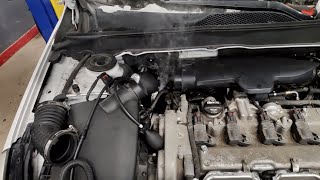
How to confirm: Visually inspect and physically check if the intake manifold bolts are loose; they are often found to be several turns from tight. A smoke test of the intake system will definitively show a leak around the intake gasket area. 🎬 Watch: How to perform a smoke test and tighten intake bolts. This issue is almost certainly the cause if P0324 is accompanied by other codes like P0171, P0106, and P0068.
Typical fix: Remove one bolt at a time, apply medium-strength threadlocker, and re-torque all intake manifold bolts in the correct sequence to the manufacturer's specification of 89 lb-in (10 Nm). Do not replace the gasket unless a leak persists after torquing. GM allocates 0.4 hours for this repair under warranty.
Est. part cost: $5-$15 for threadlocker - Faulty Knock Sensor 🟡 Medium Probability
How to confirm: If intake bolts are confirmed to be tight and no vacuum leaks are present, test the knock sensor's resistance and voltage output against specifications using a multimeter or oscilloscope. The sensor is located on the engine block. For GM Ecotec engines, a typical resistance is between 93k and 110k Ohms. A 'tap test' should show a small AC voltage spike on a multimeter when the block is tapped near the sensor.
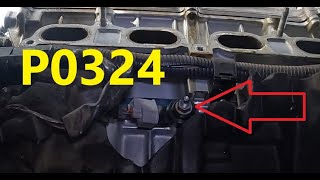
Typical fix: Replace the knock sensor. Overtightening the new sensor can damage it, so use a torque wrench. The torque specification for the 2.0L LTG engine is 18 lb-ft 🎬 Watch: Locating the knock sensor on the 2.0L engine block. (25 Nm).
Est. part cost: $40-$100 - Damaged Knock Sensor Wiring or Connector ⚪ Low Probability
How to confirm: Visually inspect the wiring harness leading to the knock sensor for any signs of chafing, melting, corrosion, or loose pins at the connector. Perform a continuity test on the wiring from the sensor connector to the ECM, which should show a resistance of approximately 0.1 Ω.
Typical fix: Repair the damaged section of the wiring harness or replace the connector pigtail.
Est. part cost: $15-$50
Rare But Worth Checking
- Failing Water Pump: A failing water pump can create a grinding or squeaking noise that the sensitive knock sensor system misinterprets as engine knock, triggering a P0324. This is documented in GM TSB #21-NA-030 for related GM V6 engines (LGX/LGZ), but the principle applies. A diagnostic step is to listen to the pump with a stethoscope and see if knock retard changes on a scan tool when the serpentine belt is removed.
- Faulty Engine Control Module (ECM): In very rare cases, an internal fault in the ECM can prevent it from properly processing the knock sensor signal. This should only be considered after all other possibilities (vacuum leaks, sensor, wiring) have been exhaustively ruled out.
Diagnosis Steps
- Scan the ECM for all stored trouble codes. Note any other codes that appear with P0324, especially P0171, P0106, or P0068, as this strongly points to a vacuum leak.
- CRITICAL STEP: Inspect the intake manifold bolts. Using a socket and ratchet (typically 10mm), check if they are loose. They are often found to be only finger-tight.
- If bolts are loose, obtain medium-strength threadlocker. Working one bolt at a time, remove it, apply threadlocker, and reinstall it. Torque all bolts in the proper sequence to 89 lb-in (10 Nm).
- Clear the codes and perform a test drive to see if P0324 returns. If it does not, the repair is complete.
- If the bolts were tight or the code returns, perform a smoke test on the intake system to check for other vacuum leaks (e.g., cracked hoses, bad PCV valve, intake gasket).
- If no vacuum leaks are found, inspect the knock sensor wiring harness for damage, corrosion, or loose connections. Pay close attention to where the harness may rub against the engine block or other components.
- If wiring is intact, test the knock sensor itself. Using a multimeter, check its internal resistance (expecting 93k-110k Ohms) and compare it to the manufacturer's specifications. An oscilloscope can be used to view the live voltage signal.
- Listen for any unusual noises from the engine bay, specifically a grinding or squeaking from the water pump area, which could indicate a failing pump being misinterpreted as knock.
- If all other tests fail, the issue may be a rare internal fault with the ECM.
Parts You'll Likely Need
- Medium-Strength Threadlocker — This is required to fix the most common cause of P0324 on this vehicle: loose intake manifold bolts. It prevents them from backing out again, as specified in TSB #PIP5529B.
Trusted brands: Loctite, Permatex
OEM price range: $10-$20
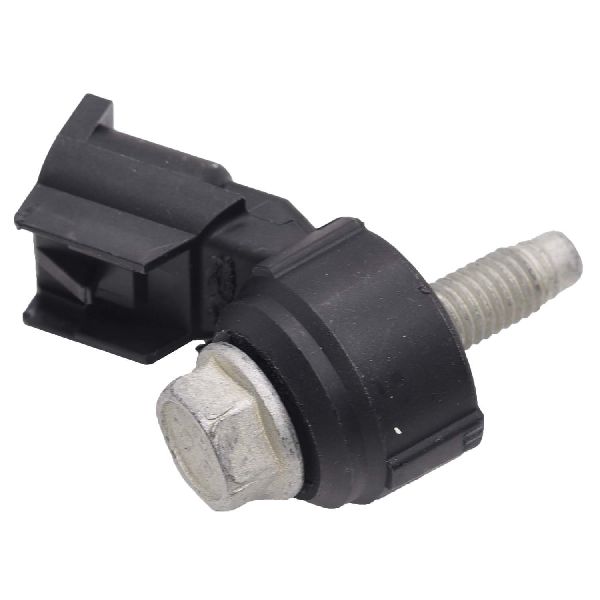
Aftermarket price range: $5-$15 - Knock Sensor (2.5L LCV)
(OEM #ACDelco 12672643)— If the intake bolts are tight and no vacuum leaks are found, the sensor itself is the next most likely component to have failed. This is the specific sensor for the 2.5L engine.
Trusted brands: ACDelco (GM OE), Bosch, Delphi
OEM price range: $60-$100
Aftermarket price range: $35-$70 - Knock Sensor (2.0L LTG)
(OEM #ACDelco 12647874)— If the intake bolts are tight and no vacuum leaks are found, the sensor itself is the next most likely component to have failed. This is the specific sensor for the 2.0L Turbo engine.
Trusted brands: ACDelco (GM OE), Bosch, NTK
OEM price range: $70-$120
Aftermarket price range: $40-$80
Related Codes That Often Appear With This One
- P0171 — System Too Lean. This code is commonly seen with P0324 because the root cause is often a vacuum leak from loose intake manifold bolts, which allows unmetered air into the engine. It is explicitly listed in TSB #PIP5529B.
- P0106 — Manifold Absolute Pressure (MAP) Sensor Performance. The vacuum leak also causes the MAP sensor readings to be inconsistent with what the ECM expects, triggering this code. It is explicitly listed in TSB #PIP5529B.
- P0068 — MAP/MAF - Throttle Position Correlation. This code indicates a discrepancy between the throttle position and the air being measured by the MAP/MAF sensors, which is a direct result of the unmetered air from the vacuum leak. It is explicitly listed in TSB #PIP5529B.
- P0506 — Idle Air Control RPM Lower Than Expected. The vacuum leak can cause an unstable or low idle, triggering this code. It is explicitly listed in TSB #PIP5529B.
- P0326 / P0331 — Knock Sensor 1/2 Circuit Range/Performance. These codes are more specific to sensor performance and can appear alongside the general system error code P0324 when caused by the same underlying vacuum leak or wiring issue. They are also listed in TSB #PIP5529B.
Technical Service Bulletins (TSBs) & Recalls
- PIP5529B: Communicates that a combination of DTCs, including P0324, can be caused by loose intake manifold bolts on LCV and LTG engines. The fix is to apply threadlocker and re-torque the bolts.
- 21-NA-030: Documents how noise from a failing water pump can trigger knock sensor codes on some GM engines, a principle applicable here.
Platform-Specific Known Issues
- TSB #PIP5529B: Loose Intake Manifold Bolts: This bulletin is the primary vehicle-specific issue. It documents that loose intake manifold bolts can cause P0324 along with a host of other codes (P0068, P0101, P0106, P0171, P0131, P0137, P0326, P0331, P0506). The official fix is to remove one bolt at a time, apply medium-strength threadlocker, and re-torque the bolts to 89 lb-in (10 Nm).
Mechanic-Grade Diagnostic Values
- Knock Sensor Internal Resistance — expected: 93k to 110k Ohms. Failure: An open circuit (OL) or a reading significantly outside this range.
- Knock Sensor Bolt Torque (2.0L LTG) — expected: 18 lb-ft (25 Nm). Failure: Incorrect torque can cause false signals or no signal. Over-tightening can damage the sensor.
- Knock Sensor Circuit Bias Voltage (Key On, Engine Off) — expected: Approximately 2.5V to 5V DC. Failure: No voltage suggests an ECM or wiring issue. No voltage drop when plugging in the sensor suggests a bad sensor or open circuit.
- Knock Sensor AC Voltage (Tap Test) — expected: A small AC voltage spike on an oscilloscope or multimeter when the engine block is tapped near the sensor.. Failure: No voltage spike indicates the sensor's internal piezoelectric crystal is dead.
- Scan Tool 'Total Knock Retard' Parameter — expected: Should not be continuously above 6.0 degrees for more than 5 seconds under load (1800-2000 RPM).. Failure: Sustained high knock retard values when no audible knock is present can indicate a system fault.
Scan Tool Commands That Help
- GDS2 (GM Dealer Tool): Knock Sensor Signal Live Data — While monitoring live data, a technician can tap near the sensor to see if the signal responds on the scan tool. A lack of response, even if voltage is present at the sensor, can point to a wiring or ECM issue.
- GDS2 (GM Dealer Tool): Knock Retard PID — This data parameter shows how many degrees of timing the ECM is pulling. If P0324 is active, this value may be erratic or fixed. After a repair, observing that knock retard operates normally under load is a good confirmation of the fix.
Wiring & Ground Locations
- Knock Sensor Location — On the engine block, under the intake manifold for both the 2.5L LCV and 2.0L LTG engines.. This location makes the sensor and its wiring susceptible to heat and vibration, but also makes access difficult, reinforcing the need to check easier items (like intake bolts) first.
- ECM Knock Sensor Pins (Example) — On a generic GM 73-way ECM connector (J2), the knock sensor signal may be on Pin J2-8 ('KNOCK SENSOR-FLAT RESPONSE') and the return on Pin J2-9 ('KNOCK SENSOR RETURN').. Knowing the specific pins at the ECM allows for end-to-end continuity testing of the knock sensor circuit, definitively ruling out a wiring break.
- G100, G101, G102, G103 — A group of primary engine grounds located on the lower left side of the engine block.. A poor engine ground can introduce electrical noise and cause various sensor errors, including a P0324. Ensuring these grounds are clean and tight is a critical step in diagnosing electrical faults.
- G105 — A ground splice pack located at the left front of the engine compartment, often behind the cooling fan relays.. This ground point serves multiple components in the engine bay. A fault here could cause widespread issues, including problems with the knock control system.
OEM Part Supersession History
ACDelco 12623095→ACDelco 12647874— Part has been updated by the manufacturer.
Heads up: The original part number 12623095 was used on earlier 2.0L LTG engines, while 12647874 is specified for the 2016-2017 Envision. Using the older part may cause issues.
Model Year Variations Within This Range
- 2016 vs 2017: The 2016 Buick Envision was offered exclusively with the 2.0L LTG Turbo I4 engine. For the 2017 model year, the 2.5L LCV I4 was introduced as the standard engine, with the 2.0L LTG remaining as an option. The primary TSB-documented cause (loose intake bolts) applies to both engines.
Helpful Videos
We Have This Part in Stock


The information in this article is provided for general reference and educational purposes only. Vehicle specifications, procedures, and part compatibility can vary by production date, trim level, and region. Always consult your vehicle's factory service manual and verify part numbers before purchasing or performing repairs. Safety-critical components such as airbags, seat belts, and braking systems should be installed by a qualified professional.
- Buick ENVISION:
- 🎬 Helpful Videos
- 🛍️ Shop This Part
- What's Unique About the 2016-2017 Buick ENVISION
- Diagnostic Flowchart
- Symptoms You May Notice
- Most Likely Causes
- Rare But Worth Checking
- Diagnosis Steps
- Parts You'll Likely Need
- Related Codes That Often Appear With This One
- Technical Service Bulletins (TSBs) & Recalls
- Platform-Specific Known Issues
- Mechanic-Grade Diagnostic Values
- Scan Tool Commands That Help
- Wiring & Ground Locations
- OEM Part Supersession History
- Model Year Variations Within This Range
- 🎟️ Get 5% Off