

P0308 on 2001-2008 GMC Sierra 3500: Cylinder 8 Misfire Causes & Fixes
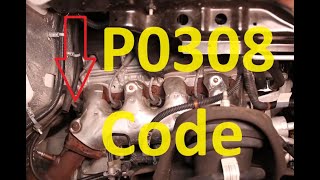
P0308 indicates a misfire on cylinder 8 in your GMC Sierra 3500. The most common causes are a bad spark plug, ignition coil, or spark plug wire. However, be aware that GM has issued Technical Service Bulletins (TSBs) for these trucks, indicating a worn camshaft or lifter can also cause this code, which is a much more serious and expensive repair.
- P0308 is a specific misfire on cylinder 8, which is the rearmost cylinder on the passenger side of the engine.
- Always start diagnosis with the simplest and most common parts: the spark plug, ignition coil, and spark plug wire for cylinder 8.
- A simple and effective diagnostic step is to swap the ignition coil from cylinder 8 with another cylinder and see if the misfire code follows the coil.
- Be aware that these GMC V8 engines have a documented history of camshaft and lifter failure causing this exact code. If basic fixes don't work, this more serious mechanical issue is a strong possibility.
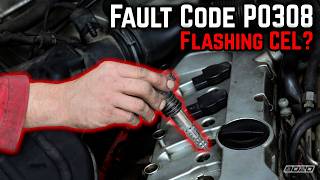
- Do not drive for extended periods with a flashing Check Engine Light, as this can quickly lead to expensive catalytic converter damage.
What's Unique About the 2001-2008 Gmc SIERRA 3500
For the V8 engines in the 2001-2008 Sierra 3500 (primarily the 6.0L LQ4 and 8.1L L18), a P0308 code requires careful diagnosis. While standard ignition parts are common culprits, these engines have a documented history of valvetrain issues. Specifically, GM TSBs (PIP4138R, now superseded by 19-NA-219) point directly to worn camshaft lobes and lifters as a cause for P0300-P0308 codes. This means a persistent P0308 that isn't solved by ignition or fuel system parts could indicate a significant mechanical engine problem requiring professional repair. Additionally, the location of cylinder 8 at the rear passenger side makes it susceptible to coolant leaks from nearby heater hoses, which can damage ignition components.
Diagnostic Flowchart
Tap your situation to follow the diagnostic path that matches what you're seeing on this vehicle.
Generation note: The 2001-2008 model years span two generations: the GMT800 (2001-2007 "Classic") and the GMT900 (2007.5-2008). Both generations offered V8 gas engines, like the 6.0L and 8.1L, which can experience this code. The TSBs regarding potential camshaft and lifter issues apply across this entire date range.
Symptoms You May Notice
- Rough or vibrating idle
- Engine shaking or stumbling on acceleration
- Noticeable loss of power
- Flashing or steady Check Engine Light
- Smell of unburnt fuel from the exhaust
- Ticking or squeaking noise from the engine, which may point to a lifter or camshaft issue
- Replacing only spark plugs when the ignition coil or wire is the actual cause.
- Replacing all ignition and fuel components when the underlying issue is a mechanical failure of the camshaft or lifters, as described in TSBs.
- Replacing O2 sensors. A misfire will cause abnormal oxygen sensor readings, but the sensor is simply reporting the problem, not causing it.
Most Likely Causes
- Worn or Fouled Spark Plug 🔴 High Probability Spark plugs are a regular maintenance item that can fail over time from heat and deposits. Cylinder 8 is located at the rear of the engine bay on the passenger side, where heat can be more concentrated and access is difficult, sometimes leading to it being skipped during tune-ups.
How to confirm: Remove the spark plug from cylinder 8 and inspect it for a worn electrode, heavy carbon buildup, or oil/coolant fouling. Compare it to a plug from a known good cylinder. A plug fouled with coolant may indicate a more serious issue like a cracked cylinder head or intake gasket leak.
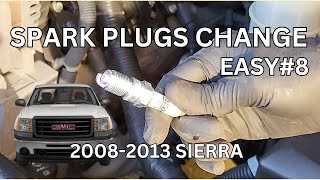
Typical fix: Replace the spark plug. It is best practice to replace all 8 plugs at the same time 🎬 Watch: How to reach and replace the difficult cylinder 8 spark plug. to ensure even performance. The OEM recommended plug is often an ACDelco Iridium or Platinum, such as the 41-962.
Est. part cost: $8-$25 per plug - Faulty Ignition Coil or Spark Plug Wire 🔴 High Probability The coil-on-plug design places the coil directly in a high-heat environment, leading to eventual failure. Wires can also degrade over time. GM has also issued TSBs for loose spark plug wire connections causing misfires. Coolant leaks from heater hoses near the firewall are known to drip onto the cylinder 8 coil and wire, causing failure.
How to confirm: Swap the ignition coil from cylinder 8 with another cylinder (e.g., cylinder 6). Clear the codes and drive the vehicle. If the misfire code changes to P0306, the ignition coil is faulty. Inspect the wire for damage, looseness, or signs of coolant contamination.
Typical fix: Replace the faulty ignition coil and/or spark plug wire. The common OEM ignition coil for these engines is the ACDelco D585.
Est. part cost: $40-$90 for a coil, $50-$100 for a set of wires - Worn Camshaft Lobe and/or Failed Lifter 🟡 Medium Probability As documented in GM TSB #PIP4138R and its successor #19-NA-219, V8 engines in this range are known to develop valvetrain issues, including worn cam lobes and lifter failures, which directly cause misfires. This is a known weak point on these engines, often preceded by a persistent ticking or chirping sound.
How to confirm: This is a difficult diagnosis. It's typically suspected after ignition and fuel system causes are ruled out. A professional may use an oscilloscope to analyze valve events or perform a physical inspection of the valvetrain by removing the valve covers and rocker arms to check for excessive play, which involves significant engine disassembly.
Typical fix: This is a major repair requiring replacement of the camshaft, all lifters, and associated gaskets and bolts. Often done by a professional.
Est. part cost: $500-$1500+ for parts alone. Professional repair can range from $2,500 to over $5,000. - Clogged or Faulty Fuel Injector 🟡 Medium Probability Fuel injectors can become clogged with deposits over time, preventing the correct amount of fuel from being delivered to cylinder 8. Ethanol in fuel can also contribute to injector degradation over many years. On return-style fuel systems (common on early models), cylinder 8 is the last on the rail and can be more susceptible to collecting debris.
How to confirm: Listen to the injector with a mechanic's stethoscope; it should have a consistent clicking sound. You can also test the injector's resistance with a multimeter or swap it with another cylinder to see if the misfire moves (this is more labor-intensive). A noid light can confirm if the injector is receiving an electrical pulse.
Typical fix: Replace the faulty fuel injector. Sometimes, running a concentrated fuel system cleaner through the gas tank can resolve minor clogging.
Est. part cost: $50-$150
Rare But Worth Checking
- Intake Manifold Gasket Leak: A vacuum leak near the intake runner for cylinder 8 can lean out the air/fuel mixture and cause a misfire. This is often accompanied by a hissing sound and other lean codes. On 1999-2004 models, the original intake gaskets were a known failure point.
- Low Cylinder Compression: Internal engine damage such as worn piston rings, a burnt valve, or a blown head gasket can cause a loss of compression, leading to a misfire. A compression test is required to diagnose this.
- Damaged Wiring Harness: The wiring harness or connector for the ignition coil or fuel injector on cylinder 8 can become damaged from heat, chafing, or contamination from leaking fluids, causing an intermittent connection.
Diagnosis Steps
- Check for any other stored DTCs with an OBD-II scanner. Note freeze frame data to see the conditions when the misfire occurred.
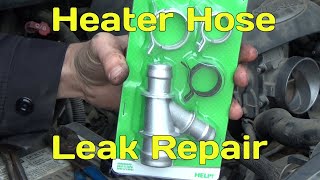
- Visually inspect the ignition coil, spark plug wire, and general area around cylinder 8 (rear-most on the passenger side) for any obvious damage, loose connections, or fluid leaks, paying close attention to the heater hoses above it. 🎬 See how to fix the common heater hose leaks causing this misfire.
- Swap the ignition coil from cylinder 8 with a coil from another cylinder (e.g., cylinder 6). Clear the codes and run the engine. If the code changes to P0306, the coil is the problem.
- If the misfire does not move, perform the same swap test with the spark plug and then the spark plug wire.
- If the misfire still remains on cylinder 8, inspect the spark plug wire for resistance (should be under 1,000 ohms per foot) and any signs of arcing or damage.
- Test the fuel injector. Listen for a steady clicking sound. For a more definitive test, use a 'noid light' to check for an electrical pulse from the PCM.
- If ignition and fuel delivery seem okay, perform a cylinder compression test to check for mechanical engine problems like bad rings or valves.
- If compression is good, check for a vacuum leak near cylinder 8's intake runner by spraying carb cleaner or starter fluid and listening for a change in engine idle.
- If all of the above checks out, and especially if you hear a persistent engine tick, the issue may be related to the valvetrain (camshaft/lifters) as described in TSB PIP4138R. This level of diagnosis is best left to a professional.
Parts You'll Likely Need
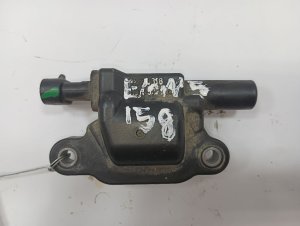
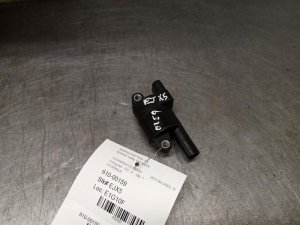
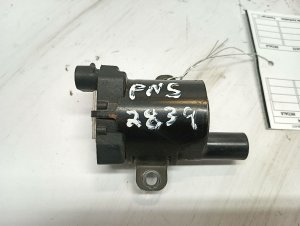
- Ignition Coil
(OEM #ACDelco D585 (10457730))— Subjected to high heat and vibration, ignition coils are a common failure item that directly causes a single-cylinder misfire. The D585 is the round-body style coil used on many of these engines.
Trusted brands: ACDelco, Delphi, NGK
OEM price range: $50-$90
Aftermarket price range: $30-$70 - Spark Plug
(OEM #ACDelco 41-962 (Platinum))— Spark plugs are a standard wear item. A fouled or worn-out plug cannot create a strong enough spark for proper combustion. The 41-962 is a widely cited OEM plug for these V8s.
Trusted brands: ACDelco, NGK
OEM price range: $10-$20
Aftermarket price range: $5-$15 - Camshaft and Lifter Kit — In cases where TSB PIP4138R applies, a worn camshaft and failed lifters are the root cause. This is a known mechanical weak point on some GM V8s of this era that requires significant engine work to resolve.
Related Codes That Often Appear With This One
- P0300 — If the misfire is intermittent or beginning to affect other cylinders, a P0300 (Random/Multiple Cylinder Misfire) code may appear alongside P0308.
- P0171 or P0174 — If the misfire is caused by a vacuum leak or a clogged fuel injector, the engine may run lean, triggering a System Too Lean code for Bank 1 (P0171) or Bank 2 (P0174).
Technical Service Bulletins (TSBs) & Recalls
- PIP4138R: Notes that DTCs P0300-P0308 can be caused by a worn camshaft lobe and/or lifter if standard diagnostics do not isolate the cause.
- 19-NA-219: Successor to PIP4138R, this TSB provides updated diagnostic advice for engine misfires on various GM vehicles, continuing to point towards potential camshaft and lifter issues after basic checks are exhausted.
- PIP5628G: Mentions that vehicles with misfire codes P0300-P0308 may require specific diagnostic information to be communicated to the Technical Assistance Center (TAC) for proper diagnosis, indicating the complexity of some misfire scenarios.
Platform-Specific Known Issues
- A known issue documented in TSB PIP4138R and its successor, 19-NA-219, is that a worn camshaft lobe and/or lifter can cause a P0308 code. This is a more severe mechanical failure beyond typical ignition or fuel problems.
- Coolant leaks from the heater core quick-connect hoses at the firewall can drip directly onto the cylinder 8 ignition coil and spark plug wire, causing them to short out and fail.
- A user on a Reddit forum, r/ChevyTrucks, described a P0308 on their 2016 Silverado that was ultimately caused by coolant from the heater core quick connects dripping on the #8 plug wire. After fixing the leak and cleaning the wire, the code was resolved.
Mechanic-Grade Diagnostic Values
- Fuel Pressure (Gasoline Engines, Key On, Engine Off) — expected: 55-65 PSI. Failure: Pressure below 55 PSI indicates a weak fuel pump, clogged filter, or faulty regulator.
- Fuel Injector Resistance (Vortec V8) — expected: 11 - 14 ohms. Failure: A reading significantly outside this range, or a variance of more than 1-2 ohms from other injectors, points to a faulty injector coil.
- Ignition Coil Primary Resistance (ACDelco D585) — expected: 1.5 - 1.6 ohms. Failure: A reading far outside this range suggests a bad primary winding. Test between pins A and D on the coil connector.
- Ignition Coil Secondary Resistance (ACDelco D585) — expected: 5,100 - 5,140 ohms. Failure: An open circuit (infinite resistance) or a reading far outside this range indicates a failed secondary winding. Test from Pin A to the spark plug wire output terminal.
- Spark Plug Wire Resistance — expected: Under 1,000 ohms per foot of length. Failure: Excessively high resistance means the wire is worn out and will deliver a weak spark.
Hidden / Shadow Codes Worth Checking
- Misfire Counter Data (Per Cylinder): This is not a DTC, but live data accessible with a professional scan tool like a GM Tech2. It shows a running count of misfire events for each specific cylinder in real-time. A high or rapidly increasing count on cylinder 8 confirms the misfire, even if it's not severe enough to keep the CEL flashing. (see via GM Tech2, GDS2, or other high-end bidirectional scan tool with access to GM-specific live data PIDs.)
Scan Tool Commands That Help
- GM Tech2 / GDS2 / Professional Bidirectional Scanner: Crankshaft Position (CKP) System Variation Learn — This procedure is required if the crankshaft position sensor, ECM, engine, or harmonic balancer has been replaced. The PCM learns the minor imperfections in the crankshaft reluctor wheel to accurately detect misfires. If this data is corrupt or not learned, the PCM can falsely report misfire codes like P0308 or set a P1336/P0315. The procedure involves revving the engine to a specific RPM (fuel cut-off, around 4000-5000 RPM) to allow the PCM to calibrate.
Wiring & Ground Locations
- G102 — At the left rear of the engine block.. This is the primary ground point for all 8 ignition coils. A loose or corroded connection here can cause a weak or intermittent spark on one or more cylinders, leading to misfire codes.
- G104 — At the left rear of the engine block, near G102.. This is another critical engine-to-chassis ground. Poor grounding here can affect the entire engine management system, including the PCM's ability to properly fire the coils and injectors.
- Cylinder 8 Coil/Injector Harness — Runs along the passenger side fuel rail and valve cover, to the rearmost cylinder.. This section of the harness is exposed to high heat from the exhaust manifold and is located under the heater core hoses. It is prone to heat-induced brittleness, chafing against the engine, and damage from leaking coolant, which can cause a short or open circuit for the cylinder 8 coil or injector.
Real Owner Repair Stories
- Reddit user in r/ChevyTrucks (2011 Suburban (GMT900 platform with similar engine architecture)) — Persistent P0308 misfire code.
❌ Tried (didn't work) Standard ignition part diagnosis.
✅ What actually fixed it The heater core quick-connect fittings at the firewall were leaking coolant directly onto the #8 spark plug wire and boot. Replacing the leaking plastic fittings and cleaning the ignition components resolved the misfire. - Chevrolet Forum user 'racincade' (GMC Sierra with 6.0L V8, 100,000 miles) — Check engine light flashed under load while passing.
❌ Tried (didn't work) Initial speculation about injectors or coils.
✅ What actually fixed it The truck still had its original spark plugs at 100,000 miles. The plugs were found to be completely worn out ('shot'). Replacing all 8 spark plugs resolved the misfire under load.
"I Checked Everything" — The Actual Cause
- A common scenario for a persistent P0308 on this platform is a small coolant leak from the plastic heater hose quick-connect fittings located on the firewall directly above cylinder 8. A smoke test for vacuum leaks will not detect this. The coolant drips onto the spark plug wire and coil, causing the spark to short to ground, especially under high load. The fix is not related to the ignition components themselves, but rather repairing the coolant leak.
When the Usual Fixes Don't Work
- While a faulty ignition coil or spark plug is the most frequent cause of P0308, a significant number of owner-confirmed repairs for the 2001-2008 Sierra 3500 point to external factors or less common causes. A recurring theme in forums is a coolant leak from the heater core hoses dripping directly onto the cylinder 8 ignition components, causing a short that is not resolved by simply replacing the coil or plug. Furthermore, after exhausting ignition and fuel system checks, mechanics should be highly suspicious of the valvetrain issues outlined in GM's own service bulletins (PIP4138R), as a worn camshaft or lifter is a documented, albeit more severe, root cause for this specific code on these engines.
OEM Part Supersession History
ACDelco D585 / GM 10457730→The part number remains widely known as D585, but branding has changed. Delphi was the original GM supplier, but is now a separate aftermarket company.— Corporate restructuring (Delphi spun off from GM).
Heads up: While many aftermarket coils are available, enthusiasts and professional mechanics often seek out genuine GM-branded coils or used original coils stamped with '19005218' on the metal bracket, believing them to have higher quality control than some aftermarket replacements.GM 12591131→ACDelco 41-962 (Double Platinum)— Standard part lifecycle and material updates.
Heads up: The ACDelco 41-962 is a direct replacement. It cross-references to aftermarket plugs like NGK 3784 (PTR5D-10) and Champion 9405.
Model Year Variations Within This Range
- 2001-2007 (GMT800) vs. 2007.5-2008 (GMT900): The 2007 model year was a split between the old 'Classic' GMT800 body style and the new GMT900 body style. While they share core V8 engine architecture, the GMT900 platform introduced a more complex electrical system and was the platform where Active Fuel Management (AFM) became more common on lighter-duty V8s, a system known for causing lifter-related misfires.
- 2001-2004 (approx.): Earlier models, particularly with the 8.1L V8, more commonly used a return-style fuel system where a regulator on the fuel rail sends excess fuel back to the tank. Later models transitioned to returnless systems. On a return-style system, the #8 injector is the last in line and can be more prone to clogging from debris that settles at the end of the rail.
Helpful Videos
We Have This Part in Stock


The information in this article is provided for general reference and educational purposes only. Vehicle specifications, procedures, and part compatibility can vary by production date, trim level, and region. Always consult your vehicle's factory service manual and verify part numbers before purchasing or performing repairs. Safety-critical components such as airbags, seat belts, and braking systems should be installed by a qualified professional.
- Gmc SIERRA 3500:
- 🎬 Helpful Videos
- 🛍️ Shop This Part
- What's Unique About the 2001-2008 Gmc SIERRA 3500
- Diagnostic Flowchart
- Symptoms You May Notice
- Most Likely Causes
- Rare But Worth Checking
- Diagnosis Steps
- Parts You'll Likely Need
- Related Codes That Often Appear With This One
- Technical Service Bulletins (TSBs) & Recalls
- Platform-Specific Known Issues
- Mechanic-Grade Diagnostic Values
- Hidden / Shadow Codes Worth Checking
- Scan Tool Commands That Help
- Wiring & Ground Locations
- Real Owner Repair Stories
- "I Checked Everything" — The Actual Cause
- When the Usual Fixes Don't Work
- OEM Part Supersession History
- Model Year Variations Within This Range
- 🎟️ Get 5% Off