

P0306 on 2018-2025 Chrysler Pacifica: Cylinder 6 Misfire Causes and Fixes
P0306 means cylinder 6 is misfiring. On the Pacifica's 3.6L Pentastar engine, this is often a bad ignition coil or spark plug. However, it can also be a symptom of more serious, known platform issues like a failed rocker arm or a bad cylinder head/head gasket.
- P0306 is a misfire on cylinder 6, which is on the rear cylinder bank and requires removing the upper intake manifold to access.
- Always start diagnosis by swapping the ignition coil with an easily accessible one from the front bank to see if the problem moves.
- If you remove the intake manifold to change the spark plug or coil, you MUST replace the intake gaskets to prevent vacuum leaks.
- Be aware of the 'Pentastar Tick.' An audible ticking from the engine is a strong indicator of a more serious rocker arm failure, a known issue with this engine.
- If basic ignition parts don't solve the problem, a mechanical issue like a failed rocker arm or a blown head gasket is a real possibility on this vehicle and requires professional diagnosis.
What's Unique About the 2018-2025 Chrysler PACIFICA

The 2018-2025 Pacifica uses the upgraded 3.6L Pentastar V6, an engine used across millions of Chrysler, Dodge, and Jeep vehicles. While generally durable, this engine has well-documented issues that can cause a P0306 misfire. 🎬 Watch: A quick breakdown of the P0306 misfire code. Beyond typical tune-up parts, owners must be aware of potential rocker arm failure, which creates a distinct ticking noise ('Pentastar Tick') and can lead to metal shavings in the engine and camshaft damage, as mentioned in owner complaints to the NHTSA and detailed in numerous forum discussions. [ODI #11632747, 29] Additionally, head gasket and cylinder head failures are also reported causes for this specific misfire code on this platform, sometimes at relatively low mileage. [ODI #11583424]
Diagnostic Flowchart

Tap your situation to follow the diagnostic path that matches what you're seeing on this vehicle.
Symptoms You May Notice

- Check Engine Light is on (may be flashing)
- Rough or vibrating idle. [Bulletin #09-011-25]
- Rough running engine. [Bulletin #09-013-20 REV. A]
- Sluggish acceleration and loss of power.
- Hesitation or stumbling when accelerating.
- Audible ticking or valvetrain noise from the engine, sometimes compared to a sewing machine. [Bulletin #09-011-25, 29]
- Reduced fuel economy.
- Engine stalling in severe cases.
- Replacing only the spark plug when the ignition coil is the actual cause (or vice-versa).
- Repeatedly replacing ignition components when the underlying cause is a mechanical failure like a rocker arm or head gasket, as seen in NHTSA complaints and forum threads. [ODI #11632747]
- Mistaking the 'Pentastar Tick' of a failing rocker arm for normal fuel injector noise.
Most Likely Causes

- Faulty Ignition Coil 🔴 High Probability Coil-on-plug systems are common failure points due to constant heat and vibration. Cylinder 6 is on the rear bank (Bank 2), tucked under the intake manifold against the firewall, which can trap more heat and makes access difficult.
How to confirm: Swap the ignition coil from cylinder 6 with another cylinder (e.g., cylinder 5 on the front bank). Clear the codes and drive. If the code changes to P0305, the coil is bad.
Typical fix: Replace the faulty ignition coil. Since cylinder 6 is difficult to access, many owners and shops recommend replacing all three rear coils and spark plugs at the same time to save on future labor.
Est. part cost: $25-$75 per coil - Worn or Defective Spark Plug 🔴 High Probability The recommended service interval is 100,000 miles, but plugs can fail earlier due to wear or manufacturing defects. A TSB was issued for earlier Pentastar engines regarding internal spark plug cracks causing misfires.
How to confirm: Remove the spark plug from cylinder 6 and inspect it for wear, fouling (oil, fuel, or coolant), or damage to the electrode or ceramic insulator. Compare it to a new plug.
Typical fix: Replace the spark plug. It is highly recommended to replace all six spark plugs at once, especially if near the service interval. The upper intake manifold gaskets must also be replaced.
Est. part cost: $8-$20 per plug - Failed Rocker Arm / Lifter 🟡 Medium Probability This is a widely known design/material flaw in the 3.6L Pentastar engine's valvetrain. The rocker arm's roller bearing can fail, seize, and score the camshaft lobe, generating metal shavings. An NHTSA complaint (ODI #11632747) specifically links a P0306 code to this issue after initial misdiagnosis. [ODI #11632747] This failure can occur at a wide range of mileages.
How to confirm: Listen for a distinct ticking sound ('Pentastar Tick') from the top of the engine, which gets louder with RPM. A mechanic will need to remove the valve cover for the rear bank (Bank 2) to visually inspect the rocker arms and camshaft lobes for wear, scoring, and loose arms.
Typical fix: Requires replacing all 12 rocker arms and all 12 lifters on the affected cylinder head (Bank 2). If the camshaft is scored, it must also be replaced. This is a labor-intensive job estimated at 5-6 flat-rate hours.
Est. part cost: $200-$500 for a full set of arms, lifters, and gaskets for one bank.
Rare But Worth Checking
- Blown Head Gasket / Cracked Cylinder Head: While less common than ignition parts, this is a serious potential cause. An NHTSA complaint (ODI #11583424) reported a P0306 code with a blown cylinder 6 head gasket on a 2019 Pacifica. [ODI #11583424] Early (2011-2013) 3.6L engines had a known issue with the left cylinder head that was covered under an extended warranty, and though improved, failures can still occur.
- Clogged or Faulty Fuel Injector: A fuel injector can become clogged or fail electronically, preventing the correct amount of fuel from entering cylinder 6. This is less common than an ignition fault but should be considered if spark components are good. Swapping the injector with another cylinder (similar to the coil test) can confirm the failure.
- Intake Manifold Gasket Leak: Since the upper intake manifold must be removed to access cylinder 6, a damaged or improperly seated gasket can cause a vacuum leak affecting that cylinder. Always use new gaskets during reassembly. A user on Reddit reported a recurring P0306 even after replacing plugs and coils, highlighting the importance of proper gasket installation.
- Leaking Oil Filter Housing/Cooler Assembly: A very common issue on the 3.6L Pentastar is the oil filter housing adapter, which sits in the engine valley, developing cracks and leaking oil. While this doesn't directly cause a misfire, severe leaks can lead to low oil pressure, and oil can pool around the rear bank, potentially contaminating wiring or creating other issues.
Diagnosis Steps
- Confirm the P0306 code is present using an OBD-II scanner. Check for any other codes.
- Listen for an engine ticking noise, which could indicate the common rocker arm failure.
- Swap the cylinder 6 ignition coil with the cylinder 5 coil (front bank, middle cylinder). Clear codes and test drive. If the code changes to P0305, the ignition coil is faulty and needs replacement.
- If the code remains P0306, the next step is to inspect the spark plug. This requires removing the upper intake manifold to access the rear bank of cylinders (2, 4, 6).
- While the intake manifold is off, inspect the spark plug for wear, damage, or fouling. It is best practice to replace all six spark plugs and the intake manifold gaskets at this time. 🎬 See this step-by-step walkthrough for replacing plugs and coils.
- If plugs and coils are good, the issue is likely more complex. Check the wiring and connector for the cylinder 6 coil and fuel injector for damage or oil contamination.
- If no issues are found, perform a compression test and a cylinder leak-down test on cylinder 6. Poor results can confirm a mechanical issue like a bad head gasket, piston rings, or valve problem.
- If compression is good, the fuel injector may be at fault. Consider having it professionally tested or swapping it with another cylinder, which also requires intake manifold removal.
- For suspected rocker arm failure, a visual inspection under the Bank 2 valve cover is required to check for loose arms or scored camshaft lobes. This is the definitive diagnostic step for this common failure. 🎬 Watch: How to replace failing rocker arms and lifters.
Parts You'll Likely Need
- Ignition Coil
(OEM #5149168AH)— A very common failure point for misfires. Cylinder 6 is on the hot, hard-to-reach rear bank.
Trusted brands: Mopar, NGK, Bosch, Delphi
OEM price range: $50-$90
Aftermarket price range: $25-$75 - Spark Plug
(OEM #SP149125AE (replaces RER8ZWYPB4))— A standard maintenance item that can fail and cause a misfire. Must be replaced to rule out simple causes.
Trusted brands: Champion (OEM Manufacturer), NGK, Denso
OEM price range: $15-$25
Aftermarket price range: $8-$20 - Upper Intake Manifold Gasket Set
(OEM #5184562AC)— These are single-use gaskets that MUST be replaced anytime the upper intake manifold is removed to access cylinder 6 for a coil or plug replacement. Reusing old gaskets will cause vacuum leaks. Note that six individual gaskets are required.
Trusted brands: Mopar, Fel-Pro, Mahle
OEM price range: $30-$50
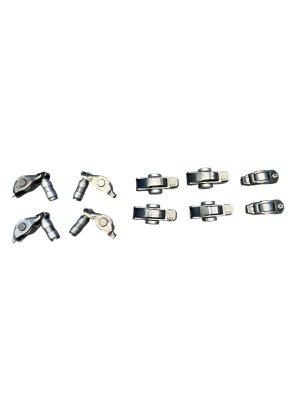
Aftermarket price range: $15-$30 - Rocker Arm and Lifter Kit
(OEM #5184296AH (Rocker Arm), 5184332AA (Lifter))— Addresses the known 'Pentastar Tick' issue, a common cause of misfires on this engine due to a valvetrain design flaw. It is recommended to replace all 12 on the affected bank.
Related Codes That Often Appear With This One
- P0300 — If the misfire is intermittent or starting to affect other cylinders, a P0300 (Random/Multiple Cylinder Misfire) may be stored alongside P0306.
- P0302, P0304 — Cylinders 2, 4, and 6 are all on the same cylinder head (Bank 2, the rear bank against the firewall). Seeing these codes together strongly points to a systemic issue on that bank, such as a failed cylinder head, blown head gasket, or camshaft/timing problem.
Technical Service Bulletins (TSBs) & Recalls
- Bulletin #09-011-25: Mentions misfire codes (P0301-P0306) along with rough idle and valvetrain noise as potential customer complaints, pointing towards the rocker arm issue.
- Bulletin #09-013-20 REV. A: Also lists misfire codes P0301-P0306 as a potential issue causing a rough running engine.
- Bulletin #09-002-17 REV. A: While not specific to the Pacifica, this TSB for other 3.6L vehicles identified a manufacturing issue causing internal cracks in spark plugs, leading to misfires.
Platform-Specific Known Issues
- Rocker Arm Failure: The 3.6L Pentastar engine is known for premature failure of the valvetrain rocker arms, causing a ticking noise and eventually leading to misfires and potential camshaft damage from metal debris. This was cited in NHTSA complaint #11632747 as the root cause of a P0306 code. [ODI #11632747, 1, 7]
- Head Gasket/Cylinder Head Failure: Multiple owner complaints and forum discussions mention head gasket failures on the Pacifica, sometimes causing coolant to leak into a cylinder and trigger a misfire code like P0306. NHTSA complaint #11583424 directly links P0306 to a blown cylinder 6 head gasket. [ODI #11583424, 26]
Mechanic-Grade Diagnostic Values
- Ignition Coil Secondary Resistance — expected: ~15.70 kΩ. Failure: A reading significantly higher or lower than the specification, or an open circuit (OL).
- Fuel Injector Resistance — expected: 10-14 Ω. Failure: A reading outside of this range, or a significant difference between injectors, indicates a faulty injector.
- Long-Term Fuel Trim (LTFT) at Idle — expected: -10% to +10%. Failure: Consistently high positive trims (>+10%) suggest a vacuum leak affecting Bank 2. Consistently high negative trims (<-10%) could indicate a leaking injector on Bank 2.
- Spark Plug Torque Specification — expected: 13 ft-lbs (17.6 Nm). Failure: Improper torque can lead to sealing issues or damage to the cylinder head.
Hidden / Shadow Codes Worth Checking
- Mode $06 Misfire Counts: Before a P0306 code is officially set, the PCM tracks misfire events for each cylinder. A technician can use a capable scan tool to view Mode $06 data and see the raw misfire count for cylinder 6, even if the Check Engine Light is not yet on. This can confirm which cylinder is the problem. (see via Access Mode $06 data through a professional-grade OBD-II scanner or a tool like the YOUCANIC Pro Scanner.)
Scan Tool Commands That Help
- wiTECH (Dealer Tool) or high-end bidirectional scanner: Cylinder Misfire / Power Balance Test — This function allows the technician to disable individual cylinders one by one and observe the change in engine RPM. If disabling cylinder 6 causes little to no change in RPM drop compared to other cylinders, it confirms that cylinder 6 was not contributing power, isolating the misfire.
Wiring & Ground Locations
- Engine Ground Strap — There are multiple ground points. A key ground strap runs from the engine block/transmission to the chassis. On older Pacifica models, a main ground point is located near the fuse box and is known to fray or break from engine movement.. A poor engine ground can cause erratic behavior in sensors and actuators, including the ignition coils and fuel injectors, potentially leading to misfire codes. Ensuring a clean, tight connection is a crucial electrical diagnostic step.
- G300 — At the base of the left 'B' pillar.. Wiring diagrams for older Pacifica models show this as a major ground distribution point for various modules. While the exact location for the 2018+ models may differ slightly, checking major chassis grounds is important if electrical issues are suspected.
- Fuse F07 (2017 Model Year) — In the Power Distribution Center (underhood fuse box).. In the 2017 model, a 25 Amp fuse in position F07 is designated for 'Ignition Coil/Fuel Injector'. While this fuse covers multiple components, checking it is a basic step if there's a suspected electrical fault in the ignition or fuel system.
Real Owner Repair Stories
- Reddit user in r/AskMechanics (Chrysler with 3.6L Pentastar V6, 146k miles) — Intermittent P0300 (random misfire) that would come and go, mostly at low idle. Flashing check engine light. No history codes stored.
❌ Tried (didn't work) One mechanic diagnosed a timing chain issue., Oil change (no metal found)., Cleaned throttle body, changed air filter.
✅ What actually fixed it A second mechanic found codes P105C and P105D and replaced 3 of the 4 Variable Valve Lift (VVL) solenoids, which were found to be 'gunky'. While the misfire wasn't completely solved at the time of posting, replacing the VVL solenoids significantly improved gas mileage and addressed other lean-related codes, pointing to the VVL system as a strong contributor to the misfire issue.
OEM Part Supersession History
5184296AD, 5184296AE, 5184296AF, 5184296AG→5184296AH— This part is the valve rocker arm, a key component in the well-known 'Pentastar Tick' failure. The multiple revisions suggest ongoing attempts by the manufacturer to improve the design or material of the roller bearing that is prone to failure.
Model Year Variations Within This Range
- 2021-2025: The Chrysler Pacifica received a significant refresh for the 2021 model year, including revised exterior styling and a new standard 10.1-inch touchscreen with the Uconnect 5 system. However, the core powertrain, the 3.6L Pentastar V6 and 9-speed automatic transmission, remained the same as the 2018-2020 models. Therefore, the root causes and diagnostic procedures for a P0306 code are consistent across the entire 2018-2025 range.
Helpful Videos
We Have This Part in Stock



The information in this article is provided for general reference and educational purposes only. Vehicle specifications, procedures, and part compatibility can vary by production date, trim level, and region. Always consult your vehicle's factory service manual and verify part numbers before purchasing or performing repairs. Safety-critical components such as airbags, seat belts, and braking systems should be installed by a qualified professional.
- Chrysler PACIFICA:
- 🎬 Helpful Videos
- 🛍️ Shop This Part
- What's Unique About the 2018-2025 Chrysler PACIFICA
- Diagnostic Flowchart
- Symptoms You May Notice
- Most Likely Causes
- Rare But Worth Checking
- Diagnosis Steps
- Parts You'll Likely Need
- Related Codes That Often Appear With This One
- Technical Service Bulletins (TSBs) & Recalls
- Platform-Specific Known Issues
- Mechanic-Grade Diagnostic Values
- Hidden / Shadow Codes Worth Checking
- Scan Tool Commands That Help
- Wiring & Ground Locations
- Real Owner Repair Stories
- OEM Part Supersession History
- Model Year Variations Within This Range
- 🎟️ Get 5% Off