

P0305 on 2019-2021 Audi A6: Cylinder 5 Misfire Causes and Fixes
P0305 on a 2019-2021 Audi A6 indicates a misfire in cylinder 5. The most common causes are a failed ignition coil or a worn spark plug. Swapping the coil from cylinder 5 with another cylinder is a quick way to diagnose the issue. If ignition parts are good, fuel injectors and software updates are the next items to investigate.
- P0305 specifically identifies a misfire in cylinder 5.
- The most likely culprits are a bad ignition coil or a worn spark plug.
- A simple and effective diagnostic step is to swap the ignition coil from cylinder 5 to a neighboring cylinder and see if the fault code follows.
- Do not ignore a flashing check engine light, as it signals a severe misfire that can quickly damage your catalytic converter.
- Adhering to Audi's 40,000-mile spark plug service interval is crucial for preventing misfires.
What's Unique About the 2019-2021 Audi A6

The 2019-2021 Audi A6 (C8 generation) with the 3.0L V6 Turbo engine (DLZA) is a sophisticated direct-injection powertrain. While misfires can happen on any engine, these models and their platform mates (Q7, Q8) are subject to several Technical Service Bulletins (TSBs) related to misfire detection software. In some cases, a simple software update at the dealership is required to fix false or intermittent misfire codes. Additionally, like many direct-injection engines, they can be susceptible to carbon buildup on intake valves over time, which can impede airflow and cause misfires.
Diagnostic Flowchart

Tap your situation to follow the diagnostic path that matches what you're seeing on this vehicle.
Symptoms You May Notice
- Rough or shaky idle.
- Hesitation or stumbling during acceleration.
- Noticeable loss of engine power.
- Flashing or solid Check Engine Light.
- Increased fuel consumption.
- A smell of raw fuel from the exhaust.
- Replacing only the spark plug when the ignition coil was the actual cause (or vice-versa).
- Replacing fuel system components like the low-pressure fuel pump, which would typically affect all cylinders, not just one.
- Assuming a catalytic converter is bad because of misfire-related codes, when the misfire itself is the root cause.
Most Likely Causes

- Faulty Ignition Coil 🔴 High Probability Ignition coils are a common failure item on many modern Audi engines. Heat and vibration can cause the internal windings to break down over time, leading to a weak or absent spark.
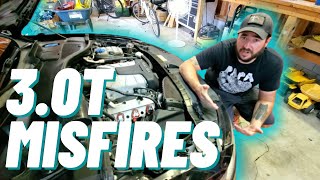
How to confirm: Swap the ignition coil from cylinder 5 with another cylinder (e.g., cylinder 4). Clear the codes and drive the car. If the code changes to P0304, the ignition coil is faulty. 🎬 Watch: Step-by-step guide to diagnosing misfires on the 3.0T engine.
Typical fix: Replace the faulty ignition coil. It is often recommended to replace all six coils at the same time as a preventative measure, especially if they are original and the vehicle has higher mileage.
Est. part cost: $40-$75 per coil - Worn or Fouled Spark Plug 🔴 High Probability Audi specifies a replacement interval of every 40,000 miles or 6 years for the 3.0T engine. Worn electrodes or carbon/oil fouling can prevent a strong spark, causing a misfire.
How to confirm: Remove the spark plug from cylinder 5 and inspect it. Look for a worn-down center electrode, heavy black carbon deposits, or oil fouling. Compare its condition to a new plug.
Typical fix: Replace the spark plug in cylinder 5. It is best practice to replace all six spark plugs at the same time to ensure even performance and avoid future misfires.
Est. part cost: $25-$45 per plug - Faulty Fuel Injector 🟡 Medium Probability Direct fuel injectors operate under high pressure and can become clogged with carbon deposits or fail electronically. Some Audi engines have been known to have injectors that leak fuel into the cylinder after shutdown, which can cause a rough, misfiring idle on a cold start.
How to confirm: This is more difficult for a DIYer. A professional can perform a fuel injector balance test. Swapping injectors is possible but is much more labor-intensive than swapping coils. An injector could also be stuck open, which may result in a fuel-washed spark plug.
Typical fix: Replace the faulty fuel injector. This requires removing the fuel rail and is often done as a set.
Est. part cost: $150-$300 per injector - Engine Control Module (ECM) Software Issue ⚪ Low Probability Audi has issued multiple TSBs for misfire detection on this platform, indicating the original software can be overly sensitive or has logic flaws. Forum discussions confirm owners of platform-mates (like the Q8) being told by dealers that a fix from Audi was pending for certain misfire issues.
How to confirm: A dealership or qualified shop with access to Audi's ODIS diagnostic system can check the current software version against the latest available version mentioned in TSBs like A0124212069038_5.
Typical fix: Update the ECM software to the latest version. This must be done by a dealer or a specialist shop.
Est. part cost: $0-$250 (may be covered under emissions warranty)
Rare But Worth Checking
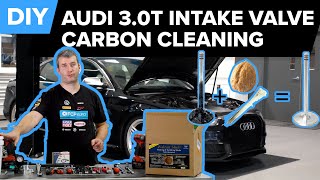
- Carbon Buildup on Intake Valves: Direct injection engines spray fuel directly into the cylinder, so gasoline detergents don't clean the intake valves. Over time, oil vapor from the PCV system bakes onto the valves, forming carbon deposits that restrict airflow and can cause misfires, especially on higher-mileage vehicles. 🎬 See how to perform a carbon cleaning on intake valves.
- Low Cylinder Compression: Internal engine issues like a worn piston ring, a leaking valve, or a head gasket failure can cause a loss of compression in cylinder 5. A compression test is needed to diagnose this. In a documented case on a 2018 Q7 with the 3.0T, a misfire code was followed by a compression test that showed only 3 BAR of pressure (spec is 10+ BAR), indicating a major internal engine failure.
- Vacuum Leak: A leak in a vacuum hose, PCV system, or intake manifold gasket near cylinder 5 can introduce unmetered air, disrupting the air-fuel ratio and causing a lean misfire. Checking fuel trims for Bank 2 can help identify this; high positive trims suggest the ECM is adding extra fuel to compensate for a leak.
Diagnosis Steps
- Read the trouble codes with an OBD-II scanner to confirm P0305 and check for any other codes.
- Check for a flashing check engine light. If it's flashing, avoid driving the vehicle to prevent catalytic converter damage.
- Swap the ignition coil from cylinder 5 with an adjacent cylinder on the same bank (e.g., cylinder 4 or 6). The 3.0T V6 cylinders are numbered 1-2-3 on the passenger side (Bank 1, right) and 4-5-6 on the driver's side (Bank 2, left), from front to back. 🎬 Watch this video to help identify and diagnose cylinder issues.
- Clear the codes and drive the vehicle until the check engine light returns.
- Re-scan for codes. If the code is now P0304 or P0306, the ignition coil is the culprit and should be replaced.
- If the code remains P0305, the next step is to inspect and likely replace the spark plug in cylinder 5. Given the 40,000-mile service interval, it's wise to replace all six.
- If the misfire persists, check the fuel trims (Short Term and Long Term) for Bank 2. High positive values (>10%) could indicate a vacuum leak near that bank.
- If ignition and vacuum leaks are ruled out, the issue is likely more complex, such as a faulty fuel injector, carbon buildup, or a mechanical engine problem. At this point, professional diagnosis with tools like a borescope, fuel pressure gauge, or compression tester is recommended.
Parts You'll Likely Need

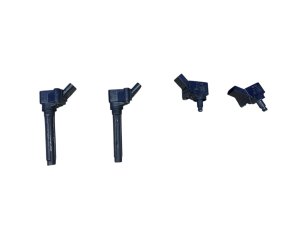
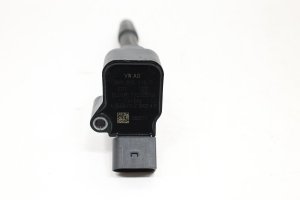
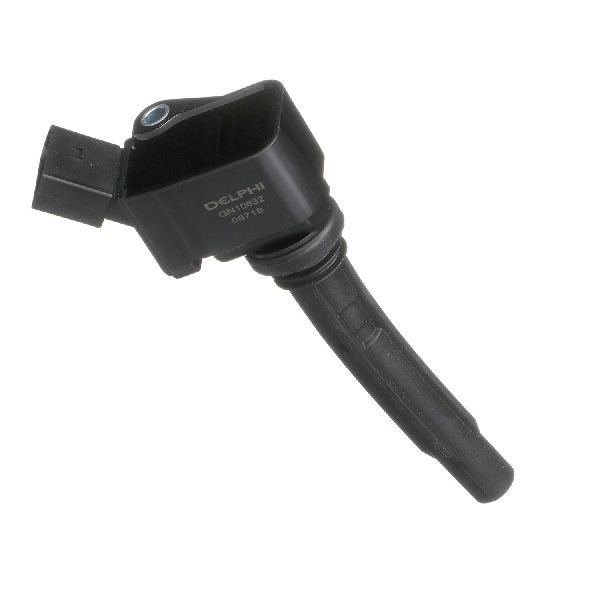
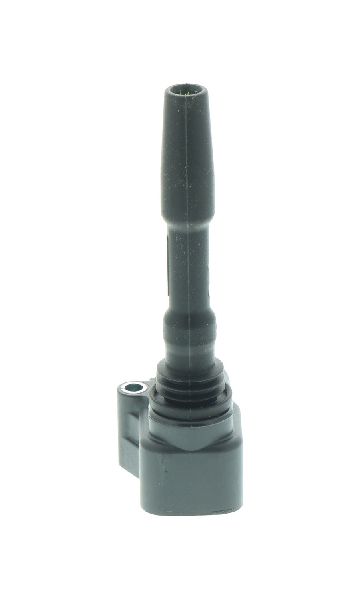
- Ignition Coil
(OEM #06E-905-115-G)— This is the most frequent cause of a single-cylinder misfire on this engine. This part number supersedes several previous versions (F, E, D, etc.).
Trusted brands: Audi (Genuine), Bosch, Eldor, NGK
OEM price range: $60-$80
Aftermarket price range: $40-$65 - Spark Plug
(OEM #06M-905-606-F)— Spark plugs are a routine maintenance item and must be replaced at regular intervals (40,000 miles) to prevent misfires.
Trusted brands: Audi (Genuine), NGK, Bosch
OEM price range: $30-$45
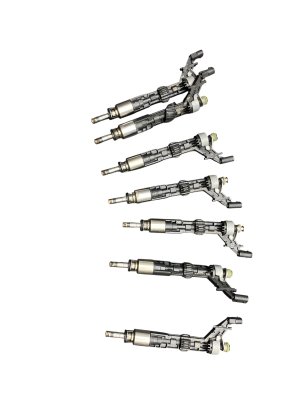
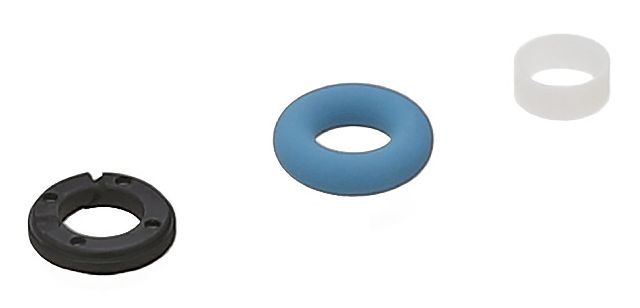
Aftermarket price range: $25-$35 - Fuel Injector — If ignition components are confirmed to be good, a clogged or failed fuel injector is the next most likely cause. Often sold in kits for full-bank replacement.
Trusted brands: Audi (Genuine), Bosch
OEM price range: $250-$350
Aftermarket price range: $150-$250
Related Codes That Often Appear With This One
- P0300 — If the misfire is intermittent or affects other cylinders, a P0300 (Random/Multiple Cylinder Misfire) may be stored alongside P0305.
- P0304, P0306 — If other misfire codes for Bank 2 (cylinders 4, 5, 6) are present, it could point to an issue affecting that entire cylinder bank, such as a Bank 2-specific vacuum leak, a failing catalytic converter on that side, or a timing issue.
- P0430 — Catalyst System Efficiency Below Threshold (Bank 2). A chronic misfire on cylinder 5 will send unburnt fuel into the Bank 2 catalytic converter, which can overheat and destroy it, leading to this code.
Technical Service Bulletins (TSBs) & Recalls
- A0124212069038_5 (2024-05-15): Provides information for when the MIL is illuminated due to cylinder misfires (P0300-P0306).
- A0123802069038_4 (2023-10-02): Mentions an optimized software update to correct misfires and prevent the MIL from illuminating.
- A0123912069038_5 (2023-11-01): Information for when the MIL is illuminated with DTCs P0300-P0306.
- A0123612069038_3 (2023-07-17): Information for when the MIL is on and DTCs P0300-P0306 may be stored.
- A0123352069038_2 (2023-01-06): Instructions for when the MIL is illuminated and P0300-P0306 DTCs may be stored.
- A0122312069038_1 (2022-12-22): Mentions a software update is available for instances where the MIL is illuminated with DTCs P0300-P0306.
Platform-Specific Known Issues
- Multiple Technical Service Bulletins (TSBs) exist for misfire detection (P0300-P0306), often resolved with an ECM software update. These include A0124212069038_5, A0123912069038_5, and others, indicating an ongoing effort by Audi to refine misfire diagnostics.
- Owners of platform-mates like the Audi Q8 have reported dealers acknowledging misfire patterns on Bank 2 as a known issue that Audi was developing a software fix for, separate from any mechanical fault.
- Like other direct-injection engines, the 3.0T can suffer from carbon buildup on the intake valves, which can restrict airflow and cause misfires, particularly on higher-mileage vehicles.
Mechanic-Grade Diagnostic Values
- Cylinder Compression — expected: 10 BAR (145 PSI) or higher. New specification is often 160-200 PSI.. Failure: Readings below the wear limit of 145 PSI, or significant variation between cylinders, indicates internal engine wear or damage. A reading of 3 BAR or lower suggests a severe mechanical failure.
Hidden / Shadow Codes Worth Checking
- Live Misfire Counters: This is not a stored code, but live data showing the number of misfire events per cylinder in real-time. It allows a technician to see which cylinder is misfiring, and under what conditions (idle, load), even before a P030x code is stored. (see via Using a VAG-specific scan tool like VCDS or OBDeleven. In VCDS, this is found in 'Advanced Measuring Values' by searching for 'misfire'. On older controllers, it was in Measuring Blocks 015 and 016.)
- P130A: An Audi-specific DTC for 'Hide Cylinder'. Its presence alongside a standard misfire code can point the technician toward specific diagnostic paths within Audi's Guided Fault Finding, sometimes indicating a software-related issue rather than a hard part failure. (see via This code would be read by a comprehensive OBD-II scanner or dealer-level tools like ODIS.)
Scan Tool Commands That Help
- ODIS (Official Dealer Software): Guided Fault Finding (GFF) — This is the standard dealer procedure for any fault code. The system automatically creates a step-by-step diagnostic test plan based on the specific code (P0305), vehicle data, and known issues (TSBs), guiding the technician through checks and tests.
- VCDS (VAG-COM): Advanced Measuring Values — Used to monitor live data streams from the ECM. For a P0305, a technician would select and log 'Misfire counter cylinder 5', 'Engine Speed', and 'Engine Load' to see exactly when the misfires occur (e.g., only at cold idle, only under high boost), which helps narrow down the cause.
Real Owner Repair Stories
- AudiWorld Forums user (2018 Audi Q7 3.0T (DLZA engine family)) — Misfire code.
❌ Tried (didn't work) Initial diagnosis pointed towards common causes.
✅ What actually fixed it The vehicle required a full engine replacement. A compression test revealed the misfiring cylinder had only 3 BAR of pressure, far below the 10+ BAR specification, indicating a catastrophic internal engine failure that could not be repaired simply. - YouTube creator 'S4tify' (Audi C7 S4 3.0T (Supercharged predecessor, but diagnostic principle is identical)) — Persistent misfire on a single cylinder (Cylinder 3 in the video).
❌ Tried (didn't work) Swapping ignition coils between cylinders., Swapping spark plugs between cylinders.
✅ What actually fixed it The root cause was a leaking intercooler core located inside the supercharger. Coolant was leaking internally into the combustion chamber, fouling combustion in that cylinder. The diagnosis was confirmed by observing a coolant level drop in the dedicated supercharger coolant reservoir. The fix was to replace the intercooler cores. - Reddit user (Audi C6 A6 (Older generation, but demonstrates an electrical edge case)) — Sudden rough running and misfires, specifically code P0301.
❌ Tried (didn't work) Initial diagnosis focused on the ignition system for cylinder 1.
✅ What actually fixed it The actual cause was a failed active engine mount, which stored its own code (P1573). The electrical failure of the solenoid within the engine mount sent a fault signal that the ECU misinterpreted, causing it to log a misfire code. Replacing the failed engine mount resolved both the P1573 and the P0301 codes. - AudiForums.com user (Audi A6 (generation not specified, but relevant cause)) — Misfire codes P0300, P0305, P0306.
❌ Tried (didn't work) Replacing spark plugs., Replacing ignition coils was suspected but ruled out.
✅ What actually fixed it The problem was a severely clogged PCV valve. After cleaning it, approximately one ounce of carbon buildup was removed, and the misfire codes were resolved.
"I Checked Everything" — The Actual Cause
- In cases where a persistent single-cylinder misfire isn't solved by ignition parts, the cause can be an internal coolant leak from the supercharger's intercooler core. This allows coolant directly into the cylinder, fouling combustion. A smoke test for vacuum leaks would come back clean as it's not an air leak. This is diagnosed by ruling everything else out and potentially seeing a drop in the supercharger's specific coolant circuit.
- An electrical failure in a component like an active engine mount can cause the ECU to log a misfire code as a secondary effect. Standard misfire diagnostics (smoke test, coil swap) will show no faults, leading to confusion. The true cause is only found by diagnosing the other, seemingly unrelated, fault code from the failed component.
Model Year Variations Within This Range

- 2019-2020: Early production years of a new generation, like the C8, are more likely to experience initial 'teething problems'. While no specific part change is noted for the P0305 cause, several recalls and TSBs were issued for these early models to address various issues, including the crucial misfire detection software updates.
Helpful Videos
Used OEM Parts in Stock
New Aftermarket Parts Available


The information in this article is provided for general reference and educational purposes only. Vehicle specifications, procedures, and part compatibility can vary by production date, trim level, and region. Always consult your vehicle's factory service manual and verify part numbers before purchasing or performing repairs. Safety-critical components such as airbags, seat belts, and braking systems should be installed by a qualified professional.
- Audi A6:
- 🎬 Helpful Videos
- 🛍️ Shop This Part
- What's Unique About the 2019-2021 Audi A6
- Diagnostic Flowchart
- Symptoms You May Notice
- Most Likely Causes
- Rare But Worth Checking
- Diagnosis Steps
- Parts You'll Likely Need
- Related Codes That Often Appear With This One
- Technical Service Bulletins (TSBs) & Recalls
- Platform-Specific Known Issues
- Mechanic-Grade Diagnostic Values
- Hidden / Shadow Codes Worth Checking
- Scan Tool Commands That Help
- Real Owner Repair Stories
- "I Checked Everything" — The Actual Cause
- Model Year Variations Within This Range
- 🎟️ Get 5% Off