

P0304 on 2014-2017 Mazda MAZDA6: Cylinder 4 Misfire Causes and Fixes
On a 2014-2017 Mazda 6, a P0304 code is most often caused by a failed ignition coil or a worn spark plug in cylinder 4. A faulty ignition coil from a specific supplier (YUMEBISHI) is a known issue on these models, addressed by Mazda in TSB 01-014/16. Replacing a single coil costs about $40-$150 for the part and is a very easy DIY fix that many owners perform.
- P0304 on a 2014-2017 Mazda 6 means cylinder #4 (closest to the driver) is misfiring.
- The most likely cause is a bad ignition coil, a known issue covered by a TSB for 2014-2016 models.
- The second most likely cause is a worn spark plug, especially if the car has over 75,000 miles.
- Diagnosing the problem is straightforward: swap the coil from cylinder 4 to cylinder 3. If the code changes to P0303, you've found the bad coil.
- Do not ignore a flashing check engine light, as it signals a severe misfire that can quickly damage your catalytic converter.
What's Unique About the 2014-2017 Mazda MAZDA6

The 2014-2017 Mazda 6, equipped with the Skyactiv-G engine, has several documented issues that can lead to a P0304 code. Mazda issued a Technical Service Bulletin (TSB 01-014/16, later superseded by 01-014-16-3208A) for 2014-2016 models due to prematurely failing ignition coils from supplier YUMEBISHI. The bulletin advises replacing these with the more reliable MITSUBISHI-produced coils. Additionally, other TSBs point to unique causes like frozen water in the muffler restricting exhaust flow in cold climates (TSB 01-007-19-3541) and fuel injector circuit faults that often appear with misfire codes (TSB 01-004-17-3317a).
Diagnostic Flowchart

Tap your situation to follow the diagnostic path that matches what you're seeing on this vehicle.
Symptoms You May Notice
- Check engine light is on or flashing
- Rough or shaky idle
- Engine hesitation or stumbling during acceleration
- Noticeable loss of power
- Reduced fuel economy
- Smell of unburned fuel from the exhaust
- Replacing only the spark plug when the ignition coil is the actual culprit. Due to the known TSB for coils, it's a primary suspect and should be tested first.
- Replacing ignition parts when the actual cause is carbon buildup on the intake valves, a known issue for Skyactiv-G direct injection engines.
Most Likely Causes

- Failed Ignition Coil 🔴 High Probability Mazda issued TSB 01-014-16-3208A for 2014-2016 models with faulty ignition coils from supplier YUMEBISHI, which were prone to internal failure due to temperature fluctuations. The TSB recommends replacing any YUMEBISHI coils (identified by a 4-digit lot number) with the MITSUBISHI version (5-digit lot number).
How to confirm: Swap the ignition coil from cylinder 4 with another cylinder (e.g., cylinder 3). Clear the codes and drive the car. If the code changes to P0303, the ignition coil is bad. This is the standard diagnostic procedure recommended by Mazda and confirmed by many owners.
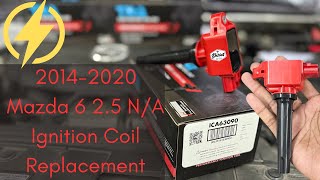
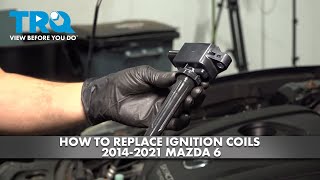
Typical fix: Replace the faulty ignition coil. The TSB advises checking all other coils and replacing any others from the faulty YUMEBISHI supplier made before March 28, 2016. Many owners on forums choose to replace just the single failed coil, while others replace all four as preventative maintenance.
Est. part cost: $40-$150 - Worn or Fouled Spark Plug 🔴 High Probability Spark plugs are a routine maintenance item. The recommended replacement interval for the OEM NGK Iridium plugs (ILKAR7L11) is 75,000 miles. Exceeding this interval significantly increases the chance of a misfire. A repeatedly fouling plug on the same cylinder can indicate other issues, like a leaking fuel injector or oil consumption.
How to confirm: Remove the spark plug from cylinder 4 and inspect it. Look for a worn electrode, heavy carbon buildup, oil, or fuel fouling. Compare it to a plug from a working cylinder. A brand new plug can sometimes be faulty out of the box.
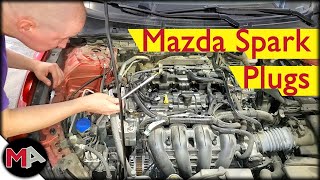
Typical fix: Replace the spark plug in cylinder 4. It is best practice to replace all four spark plugs at the same time to ensure even performance and wear.
Est. part cost: $40-$80 for a set of four - Clogged or Leaking Fuel Injector 🟡 Medium Probability The Skyactiv-G is a direct-injection engine. While generally reliable, these injectors can become clogged or fail. TSBs 01-004-17-3317a and 01-017-16-3242 specifically note that fuel injector circuit faults (like P0204) can be stored at the same time as a P0304 misfire code.
How to confirm: A professional may need to perform a fuel injector balance test. A DIY method is to listen for a consistent clicking sound from the injector with a mechanic's stethoscope. A wet, fuel-fouled spark plug on cylinder 4 (when the coil and plug are known to be good) strongly suggests a leaking injector.
Typical fix: Replace the fuel injector for cylinder 4. This is more involved on a direct-injection engine and may require special tools. Using top-tier fuel with detergents may help prevent clogging.
Est. part cost: $100-$250 - Intake Valve Carbon Buildup 🟡 Medium Probability Like most gasoline direct injection (GDI) engines, the Skyactiv-G is prone to carbon buildup on the intake valves because fuel is injected directly into the cylinder and does not wash over the valves. This can disrupt airflow, leading to misfires, especially on cold starts or under load. One forum user noted cylinder 4 valves were more caked than others, speculating it's due to the PCV hose routing.
How to confirm: This is difficult to confirm without a borescope inspection of the intake ports. Symptoms often include cold start misfires that may smooth out as the engine warms up, and hesitation under acceleration.
Typical fix: A professional service involving walnut shell blasting is the most effective way to clean the valves. Some owners use chemical intake cleaning sprays (like CRC GDI Valve Cleaner) every 10,000-30,000 miles as a preventative measure.
Est. part cost: $0 (for a chemical spray) to $500-$800 (for professional walnut blasting) - Restricted Exhaust Flow ⚪ Low Probability Mazda issued several TSBs (01-007-19-3541, 01-006-18-3429, 01-002-17-3299a) specifically for this issue, where frozen water can accumulate in the muffler (main silencer) in cold climates, creating backpressure that leads to misfires, often on multiple cylinders.
How to confirm: This is difficult to confirm without inspecting the exhaust system. The issue typically only appears in freezing temperatures and may be accompanied by a noticeable lack of engine power, especially on a cold start.
Typical fix: An early TSB procedure involved replacing the main silencer. A later TSB (01-007-19) involves drilling a small drain hole in the main silencer to allow water to escape. This should be performed by a qualified technician.
Est. part cost: $0 (if drilling a hole) or cost of muffler replacement if damaged
Rare But Worth Checking
- Low Engine Compression: While not common, internal engine issues like a bad valve, leaking head gasket, or worn piston rings can cause a persistent misfire that isn't resolved by replacing ignition or fuel parts. A compression and/or leak-down test is needed to diagnose this.
- Vacuum Leak: A leak in the intake manifold gasket near cylinder 4 could lean out the air/fuel mixture enough to cause a misfire. This is less common for a single-cylinder misfire code but is still a possibility.
Diagnosis Steps
- Read the code with an OBD-II scanner to confirm P0304 is present. Check for any other codes.
- Identify Cylinder 4: On the 2.5L inline-four engine, the cylinders are numbered 1-2-3-4 from the front (belt side) to the back (transmission/driver's side). Cylinder 4 is the one closest to the driver.
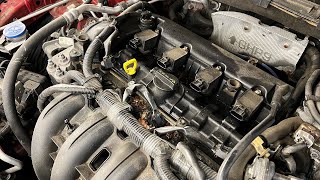
- Swap the Ignition Coil: Disconnect the electrical connector and remove the 8mm bolt holding the coil in place. Swap the coil from cylinder 4 with the one from cylinder 3. Clear the codes and run the engine. If the code changes to P0303, the coil is faulty and needs replacement. This is the most common fix.
- Inspect and Swap the Spark Plug: If the misfire remains on cylinder 4, remove the spark plug. Inspect it for wear, damage, or fouling. If it looks questionable, replace it. You can also swap the plug with another cylinder to see if the misfire follows.
- Check the Fuel Injector: If the coil and plug are good, the issue may be the fuel injector. Listen for a steady clicking sound from the injector. A fuel-soaked spark plug is a strong indicator of a leaking injector.
- Inspect for Vacuum Leaks: Visually inspect vacuum hoses around the intake manifold for cracks or loose connections. Spraying brake cleaner near gasket areas while monitoring engine RPM can help identify leaks.
- Consider TSBs: If you live in a cold climate, consider the possibility of a restricted exhaust due to frozen water in the muffler, as noted in TSB 01-007-19-3541.
- Inspect for Carbon Buildup: If the car has over 60,000 miles and experiences cold start misfires, consider carbon buildup on the intake valves as a likely cause.
- Perform a Compression Test: If all else fails, a compression test can identify mechanical engine problems. A healthy Skyactiv-G 2.5L engine should have compression readings around 160-170 PSI per cylinder, with minimal variation between them.
Parts You'll Likely Need
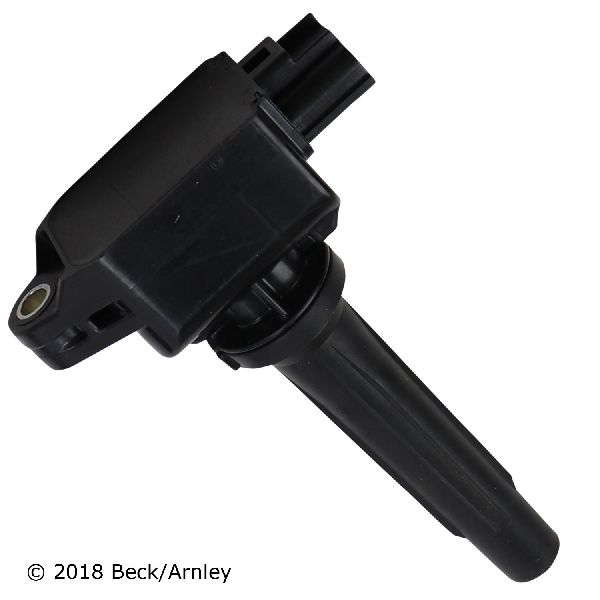
- Ignition Coil
(OEM #PE20-18-100A)— This is the most common cause of P0304 on this vehicle, with a known TSB (01-014-16-3208A) addressing premature failure of the YUMEBISHI-supplied coils.
Trusted brands: NGK, Delphi, Bosch, Mazda (Mitsubishi)
OEM price range: $120-$180
Aftermarket price range: $40-$90 - Spark Plugs
(OEM #ILKAR7L11 (NGK #94124))— Spark plugs are a standard wear item and a frequent cause of misfires if not replaced at the recommended 75,000-mile interval.
Trusted brands: NGK, Denso
OEM price range: $15-$25 per plug
Aftermarket price range: $10-$18 per plug - Fuel Injector
(OEM #PY01-13-250)— A clogged or leaking injector can cause a misfire and is a known issue for direct injection engines. TSBs also link injector circuit faults to this code.
Trusted brands: Mazda (OEM), Standard Motor Products
OEM price range: $150-$250
Aftermarket price range: $80-$150
Related Codes That Often Appear With This One
- P0300 — If the misfire is intermittent or affects multiple cylinders (e.g., due to carbon buildup or a vacuum leak), a P0300 (Random Misfire Detected) code may appear alongside P0304.
- P0301, P0302, P0303 — If the cause (like a failing fuel pump or major vacuum leak) affects the whole engine, you may see misfire codes for other cylinders as well.
- P0204 — This code for 'Fuel Injector Circuit/Open Cylinder No.4' is specifically mentioned in Mazda TSBs as being stored at the same time as P0304, indicating a related fuel injector or wiring issue.
- P0172 — A 'System Too Rich' code can appear with P0304 if a fuel injector is stuck open or leaking, causing excess fuel in the cylinder.
- P0171 — A 'System Too Lean' code can appear if the misfire is caused by a clogged fuel injector or a vacuum leak near cylinder 4. One owner on a Mazdas247 forum fixed their P0304 and P0171 by replacing a faulty front Air-Fuel Ratio Sensor.
Technical Service Bulletins (TSBs) & Recalls

- 01-014/16: Check Engine Light On With DTC P0300-P0304 due to internal failure of ignition coil(s).
- 01-007-19-3541: Misfire codes (P0300-P0304) may be caused by frozen water accumulated in the main silencer.
- 01-004-17-3317a: Notes that engine misfire DTCs (P0301-P0304) are usually stored at the same time as fuel injector circuit DTCs (P0201-P0204).
- 01-006-18-3429: Misfire codes may be caused by frozen water in the main silencer, restricting exhaust flow.
- 01-017-16-3242: Misfire DTCs are usually stored at the same time as fuel injector circuit DTCs.
- 01-002-17-3299a: Misfire codes may be caused by frozen water accumulated in the main silencer.
Platform-Specific Known Issues

- YUMEBISHI vs. MITSUBISHI Ignition Coils: A critical detail for this platform is the specific supplier of the ignition coils. TSB 01-014-16-3208A explicitly calls out coils made by YUMEBISHI (identifiable by a 4-digit lot number) as prone to failure. The replacement parts are made by MITSUBISHI (5-digit lot number). When diagnosing a P0304, it's worth physically inspecting the coils to see if they are the problematic YUMEBISHI type.
- Frozen Muffler in Cold Climates: A unique issue covered by multiple TSBs is the accumulation and freezing of water in the main muffler (silencer). This creates excessive exhaust backpressure, leading to rough running and misfire codes (P0300, P0304, etc.) specifically on cold starts in below-freezing weather. The fix is to either replace the muffler or drill a small drain hole per the TSB instructions.
Mechanic-Grade Diagnostic Values
- High-Pressure Fuel System — expected: Up to 200 bar (2900 psi). Failure: Significantly lower pressure under load can indicate a failing high-pressure fuel pump, leading to lean misfires.
- Ignition Coil Voltage — expected: 12V. Failure: While the coil's job is to step up voltage, it requires a steady 12V supply to function. Low input voltage could indicate a wiring or ground issue.
- Engine Compression — expected: 160-170 PSI per cylinder. Failure: A reading significantly lower in cylinder 4 compared to the others indicates a mechanical issue like bad piston rings, a burnt valve, or a head gasket leak.
Hidden / Shadow Codes Worth Checking
- Mode $06, TID $A5: Mode $06 provides access to raw data from the PCM's self-tests. Test ID (TID) $A5 specifically tracks the misfire count for Cylinder 4. The value represents the number of misfires detected in the last drive cycle or monitoring period. (see via Use an advanced OBD-II scan tool or software like FORScan that can access Mode $06 data. This allows a technician to see if cylinder 4 is misfiring, even if the count is not yet high enough to trigger a P0304 code and illuminate the check engine light.)
Scan Tool Commands That Help
- Mazda IDS / FORScan: Power Balance Test — This function allows a technician to disable individual cylinders one by one and observe the corresponding drop in engine RPM. If disabling cylinder 4 results in little or no change in RPM compared to other cylinders, it confirms that cylinder 4 is not contributing power, pinpointing the misfire.
Wiring & Ground Locations
- Engine/Transmission Ground Strap — There is a primary ground strap connecting from the negative battery terminal to a bracket on top of the transmission (for manual models) or directly to the engine/trans case. Another ground is located on the passenger-side engine mount.. A corroded or loose main engine ground can cause a variety of electrical issues, including weak spark from the ignition coils, leading to intermittent or persistent misfires. While not specific to one cylinder, it's a foundational check for any electrical diagnosis.
Real Owner Repair Stories
- Mazdas247 Forum User (Mazda CX-5 (platform-mate with same engine)) — P0304 misfire code, hesitation/bucking under load, especially at higher RPMs.
❌ Tried (didn't work) Replaced all 4 spark plugs, Replaced all 4 ignition coils, Cleaned carbon from intake valves, Performed compression and leak-down tests (which passed with good results)
✅ What actually fixed it The final fix was replacing the front Air-Fuel Ratio (O2) sensor. The faulty sensor was providing incorrect data, causing the PCM to create a lean fuel mixture (P0171) that resulted in the misfire on cylinder 4 under load. - YouTube video by 'Repairs and Stuff' (Mazda with 2.5L Skyactiv-G engine) — P0304 and P0172 (System Too Rich) codes, rough running, smoke from exhaust.
❌ Tried (didn't work) Initial diagnosis might point to ignition, but the accompanying P0172 code is a key clue.
✅ What actually fixed it The spark plug in cylinder 4 was found to be wet with fuel. This indicated a leaking fuel injector. Replacing the fuel injector for cylinder 4 resolved both the misfire (P0304) and the rich condition (P0172).
OEM Part Supersession History
PE20-18-100 (YUMEBISHI)→PE20-18-100A (MITSUBISHI)— The original YUMEBISHI coils were prone to internal failure as noted in TSB 01-014/16. Mazda switched to a more reliable MITSUBISHI-made coil.
Heads up: While physically similar, the older YUMEBISHI part is known to be less reliable. The recommended replacement part is PE20-18-100A or a later revision. Other superseded part numbers include PE01-18-100 and P51B-18-100.
Model Year Variations Within This Range
- 2014: The 2014 model year was the first for the third-generation (GJ) Mazda 6 in North America, representing a complete departure from the previous Ford-related platform. It introduced the new Skyactiv-G 2.5L engine and new chassis architecture.
- 2017: For the 2017 model year, Mazda made refinements to improve sound insulation and ride quality, but the core 2.5L Skyactiv-G powertrain related to the P0304 code remained unchanged from the 2014-2016 models.
Helpful Videos

Used OEM Parts in Stock

New Aftermarket Parts Available


The information in this article is provided for general reference and educational purposes only. Vehicle specifications, procedures, and part compatibility can vary by production date, trim level, and region. Always consult your vehicle's factory service manual and verify part numbers before purchasing or performing repairs. Safety-critical components such as airbags, seat belts, and braking systems should be installed by a qualified professional.
- Mazda MAZDA6:
- 🎬 Helpful Videos
- 🛍️ Shop This Part
- What's Unique About the 2014-2017 Mazda MAZDA6
- Diagnostic Flowchart
- Symptoms You May Notice
- Most Likely Causes
- Rare But Worth Checking
- Diagnosis Steps
- Parts You'll Likely Need
- Related Codes That Often Appear With This One
- Technical Service Bulletins (TSBs) & Recalls
- Platform-Specific Known Issues
- Mechanic-Grade Diagnostic Values
- Hidden / Shadow Codes Worth Checking
- Scan Tool Commands That Help
- Wiring & Ground Locations
- Real Owner Repair Stories
- OEM Part Supersession History
- Model Year Variations Within This Range
- 🎟️ Get 5% Off