

P0304 on 2023-2025 Ford Escape: Cylinder 4 Misfire Causes and Fixes
P0304 on a 2023-2025 Ford Escape is a cylinder 4 misfire, most often caused by a faulty ignition coil or spark plug. However, it is critical to check your engine coolant level, as this code can be an early symptom of a more serious engine issue known to affect some Ford EcoBoost engines. For 1.5L models, a cracked fuel injector is also a possibility under a major safety recall.
- P0304 is a misfire in cylinder 4, the cylinder closest to the driver's side on EcoBoost models.
- The most likely fix is replacing the ignition coil and/or spark plug for cylinder 4.
- Before starting repairs, you MUST check the engine coolant level. A low level without external leaks is a major red flag for a serious engine problem.
- Do not ignore a flashing check engine light, as this can lead to expensive catalytic converter damage.
- A specific TSB (24-2384) exists for this exact problem on your vehicle, confirming that spark plugs are a primary checkpoint.
What's Unique About the 2023-2025 Ford ESCAPE

For the 2023-2025 Escape with 1.5L and 2.0L EcoBoost engines, Ford has issued Technical Service Bulletin (TSB) 24-2384 specifically for misfire codes including P0304. While this bulletin points to common causes like spark plugs, it also advises using a borescope to inspect for internal engine damage if a plug is found to be damaged. This extra diagnostic step is important because previous generations of these engines had a well-documented design flaw that could lead to coolant leaking into the cylinders, causing misfires and eventual engine failure. 🎬 See this deep dive into EcoBoost coolant intrusion issues. While the engine block was redesigned for 2020+ models, some owners of newer Escapes still report symptoms consistent with coolant intrusion, making it a necessary check. Additionally, the 1.5L engine has a critical safety recall for cracked fuel injectors which can cause misfires and create a fire hazard.
Diagnostic Flowchart
Tap your situation to follow the diagnostic path that matches what you're seeing on this vehicle.
Symptoms You May Notice
- Check Engine Light is on or flashing 🎬 Watch: A breakdown of common causes for the P0304 code.
- Rough or shaky engine idle
- Noticeable loss of power and poor acceleration
- Engine hesitates or stumbles
- Reduced fuel economy
- Smell of unburnt fuel from the exhaust
- For coolant-related issues: white smoke from the exhaust (especially on startup) and a consistently low coolant level.
- For a leaking fuel injector: strong smell of raw gasoline in or around the engine bay.
- Repeatedly replacing spark plugs and coils without checking the coolant level. If coolant is fouling the plug, new ignition parts will not solve the problem and the code will return.
- Assuming a rough idle is a transmission problem when it is actually a consistent engine misfire.
Most Likely Causes

- Faulty Ignition Coil 🔴 High Probability Ignition coils are a common failure point on modern direct-injection engines and are a primary diagnostic check in Ford's TSBs for misfires.
How to confirm: Swap the ignition coil from cylinder 4 with another cylinder (e.g., cylinder 3). Clear the codes and drive. If the code changes to P0303, the coil is faulty.
Typical fix: Replace the faulty ignition coil. It is often recommended to replace the corresponding spark plug at the same time.
Est. part cost: $40-$90 - Worn or Fouled Spark Plug 🔴 High Probability Spark plugs are a routine maintenance item. TSB 24-2384 for this specific vehicle begins its diagnostic procedure with inspecting the spark plugs. A plug can also be fouled by coolant or fuel from other issues.
How to confirm: After ruling out the coil, remove the spark plug from cylinder 4. Inspect it for wear (worn electrode), damage (cracked porcelain), or fouling (black and sooty for fuel, white/greenish for coolant).
Typical fix: Replace the spark plug. If the plugs are old, it is best practice to replace all of them as a set to ensure consistent performance.
Est. part cost: $10-$25 per plug - Faulty or Cracked Fuel Injector 🟡 Medium Probability Direct injection (GDI) fuel injectors operate under very high pressure and can become clogged or fail electronically. Critically, 2020-2023 Escapes with the 1.5L engine are under a safety recall (NHTSA ID 22V-859) for fuel injectors that can crack, leak fuel, cause misfires, and potentially lead to an engine fire.
How to confirm: If ignition is good, the injector is a likely cause. A strong fuel smell near the engine is a major red flag. A mechanic can perform a power balance test to disable the injector and see if it affects engine idle. Swapping injectors is more labor-intensive than coils but follows the same logic.
Typical fix: Replace the faulty fuel injector. For GDI engines, it is often recommended to replace them as a set. If the vehicle is under the 1.5L recall, the dealer will perform the fix for free. 🎬 Watch: How to replace a fuel injector on the 1.5L engine.
Est. part cost: $80-$200 per injector, with labor being higher than port injection systems. - Engine Coolant Intrusion ⚪ Low Probability The pre-2020 1.5L and 2.0L EcoBoost engines had a known block design flaw allowing coolant into cylinders. While the 2020+ engines were redesigned to correct this, some owners of newer models still report symptoms of coolant loss and misfires, suggesting the possibility, though reduced, may still exist.
How to confirm: Check the coolant reservoir for a consistently low level with no visible external leaks. A fouled spark plug with a white, ashy, or unusually clean (steam-cleaned) appearance is a strong indicator. A mechanic can perform a cooling system pressure test or use a borescope to look for coolant inside the cylinder.
Typical fix: This is a major repair. On previous models, the fix required a new engine short block or long block.
Est. part cost: $4000-$8000+
Rare But Worth Checking
- Carbon Buildup on Intake Valves: A common issue on all GDI engines, including the EcoBoost. Since fuel is injected directly into the cylinder, it no longer cleans the back of the intake valves. Over time, carbon deposits can build up, restrict airflow to a cylinder, and cause misfires. This typically requires professional cleaning (e.g., walnut blasting).
- PCM Misfire Monitor Relearn Needed: If major engine work (like a short block replacement) was recently performed, the PCM may need a 'misfire monitor neutral profile correction' performed by a dealer with specialized tools to prevent false misfire codes.
- Vacuum Leak: A leak in a vacuum hose, PCV system, or intake manifold gasket can introduce unmetered air and cause a lean condition, leading to misfires. An owner on a forum reported a cut vacuum hose was the cause of their P0304.
- Low Compression: Internal engine damage, such as a bad valve, worn piston rings, or cylinder wall damage can cause a loss of compression, preventing proper combustion. A compression test would confirm this after all other causes are ruled out.
- Damaged Wiring Harness: An exposed or shorted wire in the circuit for the ignition coil or fuel injector can cause an intermittent misfire that is difficult to diagnose. This can mimic a failed component.
Diagnosis Steps

- Read the code with an OBD-II scanner to confirm P0304 and check for any other codes.
- CRITICAL STEP (1.5L/2.0L): Check the engine coolant level in the expansion tank. If it is low and there are no visible leaks on the ground, be highly suspicious of coolant intrusion.
- CRITICAL STEP (1.5L): Check your VIN on the NHTSA website for open recalls, specifically recall 22V-859 for a cracked fuel injector. A strong smell of fuel is a key symptom.
- Locate cylinder 4. On the 2.0L I4, cylinders are numbered 1-2-3-4 from passenger to driver side. On the 1.5L I3, they are 1-2-3.
- Swap the ignition coil from cylinder 4 to an adjacent cylinder (e.g., cylinder 3). Clear the codes and run the engine to see if the misfire moves to P0303. If it does, the ignition coil is bad.
- If the misfire stays on cylinder 4, move the spark plug from cylinder 4 to the cylinder with the known-good coil. If the misfire now follows the spark plug, the plug is bad.
- If the plug and coil are good, inspect the wiring and connector for the cylinder 4 ignition coil and fuel injector for any damage, corrosion, or looseness.
- If ignition components are ruled out, the issue may be the fuel injector. This is more difficult to test and may require professional diagnosis or careful swapping if you are an experienced DIYer.
- If a damaged spark plug was found or coolant intrusion is suspected, follow the guidance in TSB 24-2384 and use a borescope to inspect the cylinder walls and piston for damage or signs of coolant.
Parts You'll Likely Need
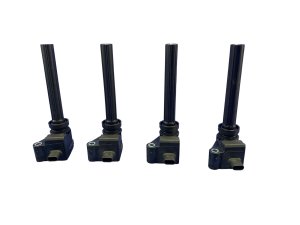
- Ignition Coil
(OEM #JX6Z-12029-B (2.0L); HX7Z-12029-A (1.5L))— This is one of the most frequent failure points for a single-cylinder misfire and is a primary diagnostic step in TSBs.
Trusted brands: Motorcraft, NGK, Delphi
OEM price range: $70-$100
Aftermarket price range: $40-$70 - Spark Plug
(OEM #SP-594 (Motorcraft for 2.0L))— Spark plugs are a normal wear item and are the first component to inspect per Ford's own technical service bulletins for misfires. They can also become fouled by fuel or coolant, providing diagnostic clues.
Trusted brands: Motorcraft, NGK, Bosch
OEM price range: $15-$25
Aftermarket price range: $10-$20
Related Codes That Often Appear With This One
- P0300 — If the condition causing the misfire is not isolated to one cylinder (e.g., a vacuum leak or low fuel pressure), a P0300 'Random/Multiple Cylinder Misfire' code may appear alongside P0304.
- P0301, P0302, P0303 — If other cylinders are also misfiring, their respective codes will be stored. Seeing multiple codes can point towards a systemic issue rather than a single failed component.
- P0316 — This code means 'Misfire Detected on Startup (First 1000 Revolutions)' and often appears with specific cylinder misfire codes, especially when related to issues like coolant intrusion that are more pronounced on a cold engine.
- P0204 — This code for 'Injector Circuit/Open - Cylinder 4' points directly to a problem with the fuel injector or its wiring, and will often accompany a P0304 if the injector is the root cause.
Technical Service Bulletins (TSBs) & Recalls
- 24-2384: Misfire With DTCs P0301, P0302, P0303, And/Or P0304 Stored In The PCM
- SSM 53971: Engine Misfire With DTCs P0301-P0304 (for 2.3L EcoBoost)
- SSM 52630: Engine Misfire With DTCs P0301-P0304 (for 3.0L EcoBoost)
- 20-2100: 1.5L EcoBoost - Low Coolant, White Exhaust Smoke And/Or Illuminated MIL (historical context)
Platform-Specific Known Issues

- TSB 24-2384: Specifically for 2023-2025 Escapes with 1.5L and 2.0L engines, this bulletin addresses P0301-P0304 misfire codes. It outlines a diagnostic procedure starting with spark plug inspection, checking PCM grounds, and escalating to a borescope inspection of the cylinders if a plug is damaged.
- Historical Coolant Intrusion: While TSBs like 20-2100 apply to earlier models (2017-2019), they document a known issue with 1.5L EcoBoost engines where coolant enters cylinders, causing misfires. The engine was redesigned for the 2020+ models, but some owner reports suggest vigilance is still required. A low coolant level should be treated as a serious symptom.
- CRITICAL RECALL - 1.5L Engine Fuel Injector: NHTSA Recall 22V-859 (Ford program numbers 24S16, 25V165) was issued for some 2020-2023 Escapes with the 1.5L 3-cylinder engine. A fuel injector may crack and leak fuel into the cylinder head, which can cause misfires, a fuel odor, and increases the risk of an engine fire. This must be checked via VIN on the NHTSA website.
Mechanic-Grade Diagnostic Values
- Ignition Coil Primary Resistance — expected: Approximately 0.4 to 2.0 ohms.. Failure: A reading of OL (over-limit/infinite) indicates an open coil, while a reading significantly outside the expected range indicates a faulty coil.
- Ignition Coil Secondary Resistance — expected: Approximately 6,000 to 15,000 ohms (6k-15k Ω).. Failure: A reading of OL or one substantially outside this range points to a failed secondary winding in the coil.
- Low-Pressure Fuel System Pressure (at idle) — expected: 4.0 to 7.0 bar (approx. 58 to 101 PSI).. Failure: Pressure dropping below 4.0 bar at idle can indicate a weak in-tank fuel pump, which can starve the high-pressure pump and cause misfires under load.
- High-Pressure Fuel System Pressure (at idle) — expected: 40 to 120 bar (approx. 580 to 1740 PSI), varies with engine load.. Failure: If the actual fuel rail pressure shown on a scan tool does not match the desired pressure, it indicates a problem with the high-pressure pump or its sensor. A large discrepancy can cause misfires.
Hidden / Shadow Codes Worth Checking
- Mode $06, TID $A2-$AB: Mode $06 data provides access to raw, non-continuous monitor test results. Test IDs (TID) from $A2 through $AB often correspond to misfire event counters for each cylinder (e.g., $A2 for cylinder 1, $A3 for cylinder 2, and so on). For P0304, a technician would monitor the counter for cylinder 4. (see via An advanced OBD-II scan tool with Mode $06 capability. This allows a mechanic to see small numbers of misfires that haven't yet reached the threshold to set a P0304 code, which is useful for diagnosing intermittent issues.)
Scan Tool Commands That Help
- Ford IDS, FORScan, or high-level Snap-on/Autel scanners: Misfire Monitor Neutral Profile Correction (also known as Crankshaft Position Sensor Profile Correction) — This procedure is required after major engine or transmission repairs, such as replacing the PCM, crankshaft, crankshaft sensor, or flywheel. It forces the PCM to relearn the precise rotational profile of the crankshaft. If this is not performed, the PCM may interpret normal crankshaft speed variations as misfires and set false codes like P0304.
- Ford IDS, FORScan, or similar bidirectional scanner: Power Balance Test — This test allows a technician to disable individual cylinders one by one and observe the drop in engine RPM. If disabling cylinder 4 causes little or no change in RPM compared to other cylinders, it confirms that cylinder 4 is not contributing power, helping to isolate the issue without swapping parts.
Wiring & Ground Locations
- G103 / G102 — Typically located on the engine block or inner fender/cowl area near the rear of the engine compartment.. These are primary engine and PCM ground points. A loose or corroded ground at this location can cause erratic behavior in the ignition system, fuel injectors, and sensors, leading to phantom misfire codes that are difficult to trace. Ensuring a clean, tight connection is a crucial step in diagnosing electrical-related misfires.
- C175B — This is a major multi-pin connector at the Powertrain Control Module (PCM).. The control signals for the ignition coils and fuel injectors pass through this connector. Any corrosion, moisture intrusion, or pushed-out pins within this connector can interrupt the signal to cylinder 4's coil or injector, directly causing a P0304 code. It is a key inspection point if a wiring issue is suspected.
Real Owner Repair Stories
- Forum discussions on EcoBoost platforms (Ford Escape with 1.5L/2.0L EcoBoost) — Intermittent P0304, rough idle especially when warm, slight hesitation under light acceleration.
❌ Tried (didn't work) Replaced spark plug on cylinder 4, Replaced ignition coil on cylinder 4, Swapped coil to another cylinder with no change
✅ What actually fixed it The integrated PCV valve diaphragm in the valve cover had a small tear. This created a vacuum leak that was not always present and was difficult to detect with a smoke test when the engine was off. The fix was to replace the entire valve cover assembly, as the PCV valve is not serviced separately.
OEM Part Supersession History
JX6Z-12029-A→JX6Z-12029-B— Ford often updates part numbers to reflect design revisions, supplier changes, or improvements in material to increase durability and performance. This is a common practice for ignition components.
Model Year Variations Within This Range
- 2023 vs 2024: There are no significant mechanical or powertrain differences between the 2023 and 2024 Ford Escape models; the engines and performance specifications are identical. The primary changes were the discontinuation of the 'Base' trim level for retail customers and minor updates to the infotainment navigation system for 2024. These changes do not affect the diagnosis or causes of a P0304 code.
Helpful Videos

We Have This Part in Stock

The information in this article is provided for general reference and educational purposes only. Vehicle specifications, procedures, and part compatibility can vary by production date, trim level, and region. Always consult your vehicle's factory service manual and verify part numbers before purchasing or performing repairs. Safety-critical components such as airbags, seat belts, and braking systems should be installed by a qualified professional.
- Ford ESCAPE:
- 🎬 Helpful Videos
- 🛍️ Shop This Part
- What's Unique About the 2023-2025 Ford ESCAPE
- Diagnostic Flowchart
- Symptoms You May Notice
- Most Likely Causes
- Rare But Worth Checking
- Diagnosis Steps
- Parts You'll Likely Need
- Related Codes That Often Appear With This One
- Technical Service Bulletins (TSBs) & Recalls
- Platform-Specific Known Issues
- Mechanic-Grade Diagnostic Values
- Hidden / Shadow Codes Worth Checking
- Scan Tool Commands That Help
- Wiring & Ground Locations
- Real Owner Repair Stories
- OEM Part Supersession History
- Model Year Variations Within This Range
- 🎟️ Get 5% Off