

P0303 on 2017-2019 Jaguar XF: Cylinder 3 Misfire Causes and Fixes
P0303 indicates a misfire on cylinder 3. The most common cause is a faulty ignition coil or a worn spark plug. Swapping the ignition coil from cylinder 3 to another cylinder is a quick and effective diagnostic step. If the code follows the coil, you've found the culprit. On these specific models, however, be aware of TSBs that point to VVT solenoids or software issues.
- P0303 on a 2017-2019 Jaguar XF is a cylinder 3 misfire, most often caused by a bad ignition coil or spark plug.
- Always check for other codes. If you see timing-related codes like P054A or P0014, suspect a faulty VVT solenoid as per TSB #SSM74160.
- A simple and effective first diagnostic step is to swap the ignition coil from cylinder 3 to another cylinder and see if the misfire code follows.
- Do not ignore a flashing check engine light, as it signals a severe misfire that can quickly destroy the catalytic converter, leading to a much more expensive repair.
What's Unique About the 2017-2019 Jaguar XF
On the 2017-2019 Jaguar XF, a P0303 code isn't always a simple case of a bad spark plug. A notable Technical Service Bulletin (TSB #SSM74160) indicates this misfire code can appear alongside a cluster of seemingly unrelated electrical and timing codes (like P054A, P0014, P0341) *without* any noticeable driveability problems. This points to a potential underlying issue with a component like a Variable Valve Timing (VVT) solenoid, which can mislead the diagnostic process if you only focus on traditional misfire causes. Additionally, another TSB (JTB00533NAS1) notes that cold-start misfires can be due to fuel injection software calibration, requiring a PCM update rather than a hardware replacement.
Diagnostic Flowchart
Tap your situation to follow the diagnostic path that matches what you're seeing on this vehicle.
Symptoms You May Notice
- Rough or unsteady idle
- Hesitation or stumbling during acceleration
- Reduced engine power and performance, possibly with a "Restricted Performance" message
- Solid or flashing Check Engine Light
- Decreased fuel economy
- Smell of unburnt gasoline from the exhaust
- In some cases, no noticeable driveability issues, per TSB #SSM74160.
- Replacing only the spark plug when the ignition coil is the actual cause.
- Focusing only on cylinder 3 ignition components when multiple timing-related codes are present, which could indicate a VVT solenoid issue as per TSB #SSM74160.
- Replacing catalytic converters due to a glowing manifold, when the glowing is a symptom of unburnt fuel from the misfire, not the cause.
Most Likely Causes
- Faulty Ignition Coil 🔴 High Probability Ignition coils on modern engines are common failure items due to constant exposure to high heat and voltage cycles. They are the most cited cause for single-cylinder misfires on Jaguar forums.
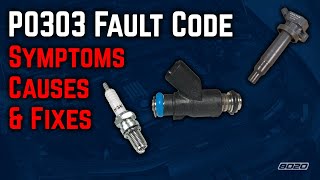
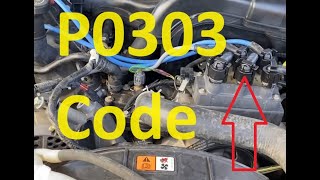
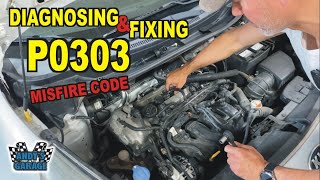
How to confirm: Swap the ignition coil from cylinder 3 with one from another cylinder (e.g., cylinder 1). Clear the codes and run the engine. If the code changes to P0301, the coil is faulty. This is the standard, universally recommended first diagnostic step. 🎬 Watch: A mechanic's guide to diagnosing a P0303 misfire code.
Typical fix: Replace the faulty ignition coil. It is often recommended to replace them as a set if they are original and the vehicle has high mileage to prevent future failures.
Est. part cost: $50-$150 - Worn or Fouled Spark Plug 🔴 High Probability
How to confirm: After confirming the coil is good, remove the spark plug from cylinder 3. Inspect it for a worn electrode, heavy black carbon deposits, oil, or fuel fouling, which would appear as a wet, glossy black coating.
Typical fix: Replace the spark plug. It is best practice to replace all spark plugs as a set to ensure even performance. For the V6 engine, this may require a special 14mm, 12-point thin-walled socket. 🎬 Watch: Step-by-step guide to replacing Jaguar V6 coils and plugs.
Est. part cost: $15-$40 per plug - Faulty Variable Valve Timing (VVT) Solenoid 🟡 Medium Probability TSB #SSM74160 specifically identifies a faulty VVT solenoid as a cause for P0303 appearing with other codes, even without driveability symptoms, on 2017-2019 models. This issue was linked to a bad batch of parts.
How to confirm: This is best confirmed when P0303 is present with other timing-related codes like P054A, P0014, P000B, or P0341. Diagnosis requires an advanced scan tool to monitor VVT operation. The solenoid is located near the top of the engine, close to the valve cover. A resistance test can also be performed; a good solenoid should read around 7-12 ohms.
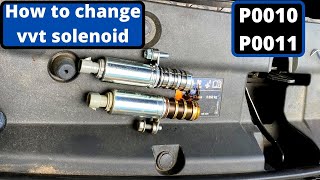
Typical fix: Replace the faulty VVT solenoid. The TSB suggests using a part manufactured after August 23, 2018. The OEM part number AJ813329 has been superseded by T4N32636. 🎬 See this video for a walkthrough on replacing VVT solenoids.
Est. part cost: $100-$200 - Clogged or Faulty Fuel Injector 🟡 Medium Probability Direct injection engines can be sensitive to fuel quality, and injectors can become clogged or fail electronically. Water ingress from hood vents has also been reported to cause corrosion around injectors on similar Jaguar models.
How to confirm: Listen for a steady clicking sound from the injector with a mechanic's stethoscope. A professional can perform a flow test or use a scan tool to check injector balance rates. Swapping injectors between cylinders is also a valid, though more labor-intensive, diagnostic step.
Typical fix: Replace the faulty fuel injector. This can be a more involved job on direct injection engines.
Est. part cost: $150-$300
Rare But Worth Checking
- Intake Valve Carbon Buildup: Because the 2.0L and 3.0L engines use direct injection, fuel doesn't wash over the intake valves. Oil vapors from the PCV system can bake onto the valves, disrupting airflow and causing misfires, especially at idle. This is a known issue on JLR direct injection engines. The fix is typically a professional 'walnut blasting' cleaning service.
- Low Engine Compression: This is a more serious mechanical issue, such as a worn piston ring, a burnt valve, or a leaking head gasket. A compression test is needed to diagnose this after all other causes have been ruled out.
- Powertrain Control Module (PCM) Software Issue: Other Jaguar TSBs for similar models (like JTB00533NAS1) mention that cold-start misfires (often with P0316) can be caused by a fuel injection calibration issue, which requires a software update at a dealership.
- Loose Engine Ground Strap: TSB SSM75509 and SSM75510, for the related Ingenium I6 engine, note that random misfire codes can be caused by a loose engine ground strap fastener, leading to high resistance in the ignition coil circuit. This is worth checking as a simple mechanical fix.
Diagnosis Steps
- Use an OBD-II scanner to check for any other codes stored alongside P0303. Pay close attention to the codes mentioned in TSB #SSM74160.
- Determine your engine (V6 or I4) and locate cylinder 3. For the 3.0L V6 (AJ126), Bank 1 is the passenger side (US) and Bank 2 is the driver's side. Cylinders are numbered front-to-back on each bank, but in an alternating pattern for the V6. Cylinder 1 is front-passenger, Cylinder 2 is front-driver, Cylinder 3 is middle-passenger. For the 2.0L I4, cylinder 3 is the third cylinder back from the front of the engine.
- Swap the ignition coil from cylinder 3 with another cylinder (e.g., cylinder 1). Clear the codes, start the engine, and see if the misfire code moves to the new cylinder (e.g., P0301). If it does, the coil is bad.
- If the code remains P0303, inspect the spark plug from cylinder 3. Look for wear, fouling, or damage. Replace if necessary, preferably as a full set.
- If the coil and plug are good, inspect the wiring and connector for the cylinder 3 ignition coil and fuel injector for any signs of damage, corrosion, or loose connections.
- If no issues are found, the problem may be the fuel injector. Listen for its characteristic clicking sound. A professional diagnosis may be needed to confirm.
- If multiple timing-related codes are present, investigate the VVT system as suggested by TSB #SSM74160. This step may require a professional with a Jaguar-specific diagnostic tool.
- Check engine ground strap connections to ensure they are clean and tight, as noted in similar engine TSBs.
- As a final step, a mechanical compression test can be performed to rule out internal engine problems like worn rings or valve issues.
Parts You'll Likely Need
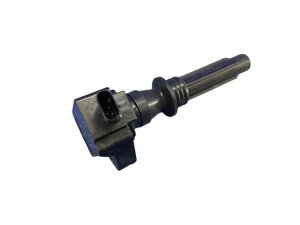
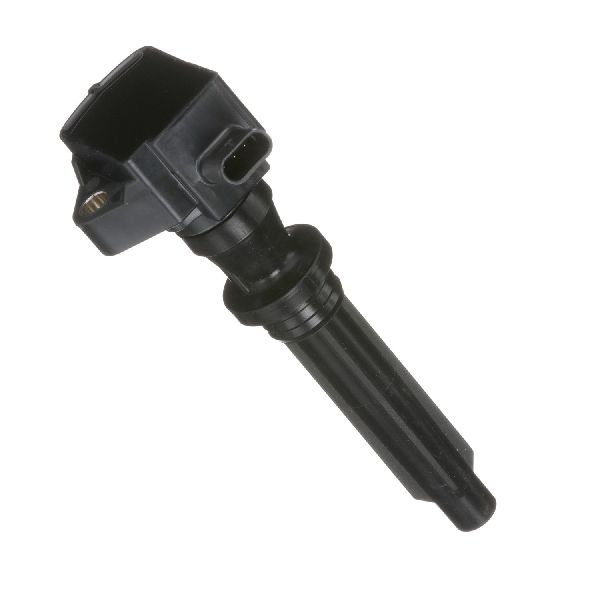
- Ignition Coil
(OEM #AJ811378)— This is one of the most frequent causes of a single-cylinder misfire on Jaguar engines.
Trusted brands: Bosch, Delphi, NGK
OEM price range: $60-$100
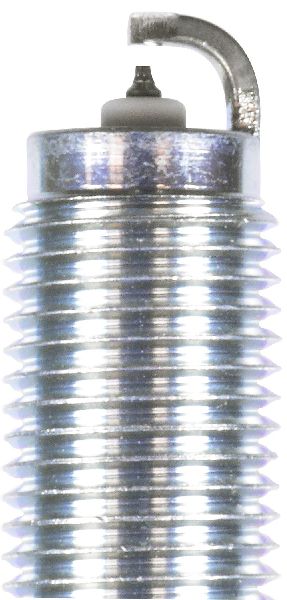
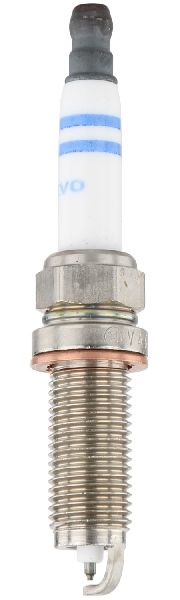
Aftermarket price range: $40-$75 - Spark Plug
(OEM #NGK ILKAR7C10 (Verify for specific engine))— Spark plugs are a routine maintenance item and a common cause of misfires as they wear out or become fouled.
Trusted brands: NGK, Denso
OEM price range: $20-$35
Aftermarket price range: $15-$25 - VVT Solenoid
(OEM #AJ813329 (Superseded by T4N32636))— Specifically cited in a TSB for causing P0303 along with other codes on this vehicle, often without driveability symptoms.
Trusted brands: Jaguar (OEM), Standard Motor Products
OEM price range: $100-$200
Aftermarket price range: $70-$150
Related Codes That Often Appear With This One
- P0300 — Indicates a random or multiple cylinder misfire, suggesting the problem is not isolated to cylinder 3 and may be a systemic issue like a vacuum leak or fuel pressure problem.
- P0302 — Indicates a misfire on cylinder 2. TSB #SSM74160 specifically mentions P0302 and P0303 appearing together.
- P054A, P0014, P000B, P0341 — These are various camshaft and timing-related codes. According to TSB #SSM74160, their presence with P0303 strongly points to a VVT system fault rather than a simple ignition problem.
- P1315 / P1316 — These are Jaguar-specific codes indicating a misfire severe enough to damage the catalytic converter.
- P0316 — Indicates a misfire was detected within the first 1000 engine revolutions on startup. Its presence with P0303, especially on cold starts, may point to the software calibration issue mentioned in TSB JTB00533NAS1.
Technical Service Bulletins (TSBs) & Recalls
- SSM74160: Notes that P0303 can be stored with a group of other electrical/timing DTCs without any noticeable performance issue, pointing to a faulty VVT solenoid.
Platform-Specific Known Issues
- TSB #SSM74160: A key issue for the 2017-2019 XF where the Malfunction Indicator Lamp (MIL) illuminates with DTCs P0303, P0302, and various timing codes (P054A, P0014, P000B, P0341) stored in the PCM, but with no actual driveability concern. The bulletin points to a faulty VVT solenoid from a specific manufacturing batch.
- TSB #JTB00533NAS1: Notes that on a cold start, misfire codes including P0303 can be set due to a fuel injection software calibration issue. The fix is a software update performed by a dealer, not a parts replacement.
Mechanic-Grade Diagnostic Values
- VVT Solenoid Resistance — expected: Approximately 7-12 Ohms. Failure: A reading significantly higher (e.g., 26 Ohms) or an open circuit (infinite resistance) indicates a faulty solenoid.
- Fuel Injector Resistance (High Impedance) — expected: Approximately 10-16 Ohms. Failure: A reading significantly outside this range, or one that is substantially different from the other injectors, points to a fault.
- Low-Pressure Fuel Pump Priming Pressure — expected: Approximately 106 PSI on startup/prime. Failure: Significantly lower pressure indicates a weak low-pressure fuel pump.
- High-Pressure Fuel Rail Pressure (at idle) — expected: Around 500 PSI. Failure: Pressure that is significantly lower or fails to build may indicate a high-pressure fuel pump issue.
- High-Pressure Fuel Rail Pressure (under load) — expected: 1,500 - 2,800 PSI. Failure: Pressure that does not increase with engine load points to a failing High-Pressure Fuel Pump (HPFP).
Hidden / Shadow Codes Worth Checking
- P0353: Ignition Coil 'C' (Cylinder 3) Primary/Secondary Circuit Malfunction. Its presence with P0303 strongly suggests an electrical problem with the coil, its wiring, or the connector, rather than a fuel or mechanical issue. (see via Standard OBD-II scanner)
Scan Tool Commands That Help
- Jaguar SDD (Symptom Driven Diagnostics): High-Pressure Fuel Pump Individual Control — For V6/V8 engines, this bidirectional control allows a technician to switch off each of the two high-pressure fuel pumps individually. This is used to isolate a faulty pump that may be causing misfires under load without setting a specific fuel pump code.
- Jaguar SDD (Symptom Driven Diagnostics): PCM Software Update — Required to fix cold-start misfires (P0303 with P0316) caused by a fuel injection calibration issue, as per TSB JTB00533NAS1.
Real Owner Repair Stories
- JaguarForums.com thread cited in Go-Parts.com article (2013 Jaguar XF 3.0L V6) — P0303 and P0305 misfire codes.
❌ Tried (didn't work) Replacing ignition coils, Replacing spark plugs
✅ What actually fixed it The problem was ultimately traced to bad fuel injectors, which were replaced. - JaguarForums.com user (2005 S-Type 3.0L V6) — Persistent P0303 code with no noticeable performance degradation.
❌ Tried (didn't work) Swapping ignition coil from cylinder 3 to cylinder 2., Swapping spark plug from cylinder 3 to cylinder 1.
✅ What actually fixed it The code remained P0303 after swapping components, successfully ruling out the coil and spark plug as the cause. The diagnosis then correctly pointed toward a faulty fuel injector or a wiring issue for cylinder 3.
"I Checked Everything" — The Actual Cause
- In cases related to official Jaguar TSBs, a standard smoke test for vacuum leaks will come back clean. The actual cause for P0303 could be a faulty VVT solenoid as described in TSB SSM74160, or a software calibration issue requiring a PCM reflash as per TSB JTB00533NAS1. These electronic and software-based faults produce a misfire code without a physical leak in the intake system.
When the Usual Fixes Don't Work
- In a documented case involving a Jaguar with a persistent P0303, the owner followed the standard diagnostic procedure of swapping the ignition coil and spark plug to other cylinders. However, the misfire code did not move with the components and remained on cylinder 3. This ruled out the two most common causes and shifted the diagnosis toward a less common culprit, the fuel injector or its wiring, which was the correct path.
OEM Part Supersession History
AJ811378→AJ813989, C2Z18784, AJ811462— Standard part revision and consolidation.
Model Year Variations Within This Range
- 2019: For the 2019 model year, a 'Smartphone Pack' adding Apple CarPlay and Android Auto became standard across the XF range. A 'Chequered Flag' special edition was also introduced, featuring unique cosmetic details like a sport bumper, specific badging, and R-Sport leather interior. These changes do not directly affect P0303 diagnosis but help identify later models.
Helpful Videos

Used OEM Parts in Stock


New Aftermarket Parts Available


The information in this article is provided for general reference and educational purposes only. Vehicle specifications, procedures, and part compatibility can vary by production date, trim level, and region. Always consult your vehicle's factory service manual and verify part numbers before purchasing or performing repairs. Safety-critical components such as airbags, seat belts, and braking systems should be installed by a qualified professional.
- Jaguar XF:
- 🎬 Helpful Videos
- 🛍️ Shop This Part
- What's Unique About the 2017-2019 Jaguar XF
- Diagnostic Flowchart
- Symptoms You May Notice
- Most Likely Causes
- Rare But Worth Checking
- Diagnosis Steps
- Parts You'll Likely Need
- Related Codes That Often Appear With This One
- Technical Service Bulletins (TSBs) & Recalls
- Platform-Specific Known Issues
- Mechanic-Grade Diagnostic Values
- Hidden / Shadow Codes Worth Checking
- Scan Tool Commands That Help
- Real Owner Repair Stories
- "I Checked Everything" — The Actual Cause
- When the Usual Fixes Don't Work
- OEM Part Supersession History
- Model Year Variations Within This Range
- 🎟️ Get 5% Off