

P0303 on 2016-2018 Honda Civic: Cylinder 3 Misfire Causes and Fixes
P0303 on a 2016-2018 Honda Civic means cylinder 3 is misfiring. For both the 1.5L and 2.0L engines, the most common fixes are replacing the spark plug or ignition coil for cylinder 3. However, on the 1.5L Turbo engine, this code is frequently linked to a known fuel dilution issue, especially in colder climates or with short-trip driving patterns. This often requires a software update from a Honda dealer as outlined in TSB A19-033, and may also involve replacing the fuel injectors.
- P0303 means cylinder #3 is misfiring.
- The easiest and most common DIY fixes are replacing the spark plug or ignition coil for cylinder 3.
- If you have the 1.5L Turbo engine, this code is very likely related to a known fuel dilution issue that Honda addresses with a software update under TSB A19-033.
- Do not ignore a flashing check engine light, as it signals a severe misfire that can damage your catalytic converter.
- Always check with a Honda dealer about warranty extensions or applicable TSBs for your VIN before paying for repairs related to this code on a 1.5L model.
What's Unique About the 2016-2018 Honda CIVIC

The 2016-2018 Civic is the 10th generation. While standard ignition part failures can cause a P0303 on any engine, the 1.5L Turbo (L15B7) direct-injection engine in this generation is known for a specific issue with fuel dilution. Due to a combination of software logic, high-pressure direct injection, and certain driving patterns (frequent short trips in cold weather), unburned gasoline can get past the piston rings and mix with the engine oil. This thins the oil, reducing its effectiveness and leading to various drivability problems, including misfires. Honda has acknowledged this with Technical Service Bulletins (like A19-033) that involve software updates for the engine and A/C control unit, an oil change, and sometimes replacing spark plugs or even fuel injectors to fully resolve the issue.
Diagnostic Flowchart

Tap your situation to follow the diagnostic path that matches what you're seeing on this vehicle.
Symptoms You May Notice
- Rough or shaky idle
- Hesitation or stumbling during acceleration
- Noticeable loss of engine power
- Flashing or solid Check Engine Light
- Reduced fuel economy
- Smell of gasoline from the exhaust or in the cabin
- Engine running in "limp mode" with multiple warning lights on the dashboard
- Replacing only the spark plug or coil on a 1.5L Turbo model without addressing the underlying fuel dilution/software/injector issue. The new parts will likely fail or foul again quickly.
- Replacing an oxygen sensor, which is highly unlikely to cause a single-cylinder misfire. An O2 sensor issue would typically trigger other codes and affect all cylinders.
- Assuming the spark plugs are good until 100k miles. On the 1.5T engine, due to fuel and carbon fouling, they can fail much earlier.
Most Likely Causes

- Worn or Fouled Spark Plug 🔴 High Probability Spark plugs are a regular maintenance item, but their life can be shortened on the 1.5L Turbo due to fouling from the fuel dilution issue. Even on the 2.0L, they are a primary wear item. A Honda technician on a forum noted the service interval can be as early as 40k miles.
How to confirm: Remove the spark plug from cylinder 3 (the third from the timing belt side) and inspect it. Look for a gasoline smell, black sooty deposits (carbon fouling), or oil residue. Compare its condition to a plug from another cylinder.
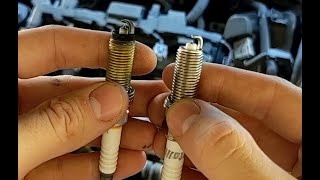
Typical fix: Replace all four spark plugs as a set. Using OEM-spec NGK or Denso plugs is highly recommended. 🎬 Watch: Save money by replacing your 1.5T spark plugs yourself.
Est. part cost: $60-$120 - Faulty Ignition Coil 🔴 High Probability Coil-on-plug systems are a common failure point across all modern engines due to constant heat and vibration. It's a very frequent cause of a single-cylinder misfire.
How to confirm: Swap the ignition coil from cylinder 3 with another cylinder (e.g., cylinder 2). Clear the codes with a scanner and drive the car. If the code changes to P0302 (Cylinder 2 Misfire), the coil is confirmed to be bad.
Typical fix: Replace the faulty ignition coil. While you can replace just one, some owners prefer to replace them as a set if they are high mileage.
Est. part cost: $50-$150 - Clogged or Faulty Fuel Injector (1.5L Turbo) 🟡 Medium Probability The L15B7's direct injection system is a known weak point. The fuel dilution issue is often traced back to faulty injectors. Honda has issued internal communications to dealers to collect injectors from vehicles exhibiting misfire codes for analysis. This suggests it's a known issue being investigated by the manufacturer.
How to confirm: This is more complex. A professional may need to perform a fuel injector balance test. A DIY method involves checking resistance across the injector terminals or listening for a consistent 'clicking' sound with a mechanic's stethoscope. Swapping injectors is possible but much more labor-intensive than coils or plugs.
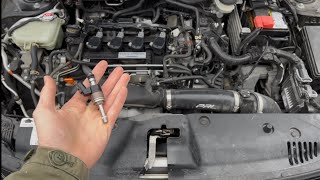
Typical fix: Replace the faulty fuel injector. It is often recommended to replace all four direct injectors as a set. Honda sells a kit (part number 16010-59B-315) for this purpose. 🎬 See this step-by-step guide for replacing 1.5L turbo fuel injectors.
Est. part cost: $250-$500 (for a set) - Engine Control Software (1.5L Turbo Only) 🟡 Medium Probability As per Honda TSB A19-033, the original software logic for fuel mapping and A/C operation contributes to fuel dilution and misfires, especially in cold weather with short trips.
How to confirm: A Honda dealer must check the vehicle's VIN against their service records to see if TSB A19-033 (or related bulletins) applies and has not been completed. This is a critical step for any 1.5T owner experiencing misfires.
Typical fix: The dealer will perform a software update for the PGM-FI (engine computer) and the A/C control unit. They will also perform an oil change and may replace the spark plugs as part of the TSB procedure.
Est. part cost: $0 (if covered by warranty extension)
Rare But Worth Checking
- Leaking Head Gasket: While rare, some owners of the 1.5T engine in both Civics and Accords have reported head gasket failures leading to P0303. This allows coolant to enter the cylinder, fouling the spark and causing a misfire. This is a major repair. One owner reported a dealer quote of over $5,000.
- Internal Engine Mechanical Failure: Severe oil dilution can lead to premature wear on internal engine components. Honda's warranty extension for the 1.5L engine specifically covers camshafts and rocker arm assemblies, which can be damaged by poor lubrication and subsequently cause misfires.
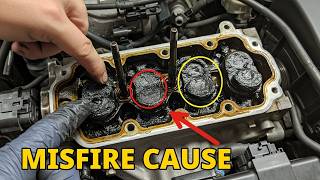
- Carbon Buildup on Intake Valves: Direct injection (DI) engines like the 1.5T are prone to carbon buildup on the back of the intake valves over time. This can disrupt airflow into the cylinder and cause misfires. This typically occurs at higher mileage (over 80,000 miles) and requires professional cleaning (e.g., walnut blasting). 🎬 Learn how carbon buildup causes misfires in direct injection engines.
Diagnosis Steps
- Read the code with an OBD-II scanner. Note P0303 and any other codes, especially P0172 or other misfire codes.
- If you have a 1.5L Turbo engine, check the oil dipstick. A strong smell of gasoline on the dipstick is a tell-tale sign of the fuel dilution issue.
- Contact a Honda dealer with your VIN to check for open recalls or warranty extensions related to TSB A19-033. This should be a primary step for 1.5T owners.
- Perform a simple diagnostic swap. Switch the ignition coil from cylinder 3 with the coil from cylinder 2. Cylinder 3 is the third from the passenger side (belt side) of the engine.
- Clear the codes and drive the vehicle until the check engine light returns.
- If the code is now P0302, you have a bad ignition coil. Replace it.
- If the code remains P0303, the coil is likely good. Proceed to the next step.
- Remove and inspect the spark plug from cylinder 3. Look for signs of wear, black sooty carbon buildup, or a wet, gasoline-fouled appearance.
- If the spark plug is worn or fouled, replace all four spark plugs as a set. Ensure they are gapped correctly before installation.
- If the plugs and coils are confirmed good, the issue on a 1.5T is very likely a clogged fuel injector. On a 2.0L, it could be the injector or a less common mechanical issue. At this point, professional diagnosis is recommended.
Parts You'll Likely Need

- Ignition Coil
(OEM #30520-59B-023 (1.5T), 30520-5R0-013 (2.0L))— A failed ignition coil is a very common cause for a single-cylinder misfire. Part number 30520-59B-023 supersedes 30520-59B-013 for the 1.5T engine. Part number 30520-5R0-013 is for the 2.0L.
Trusted brands: Honda (Genuine), NGK, Hitachi, Denso
OEM price range: $70-$110
Aftermarket price range: $40-$80 - Spark Plugs (Set of 4)
(OEM #12290-59B-003 (NGK ILZKAR8H8S) for 1.5T)— Spark plugs are a maintenance item and can become fouled or worn, causing a weak spark. On the 1.5T, they are often fouled by fuel dilution. This part number is the specified NGK Laser Iridium plug.
Trusted brands: NGK, Denso
OEM price range: $80-$130
Aftermarket price range: $50-$90 - Fuel Injector Set (1.5L Turbo)
(OEM #16010-59B-315)— For the 1.5L Turbo engine, faulty fuel injectors are a common cause of misfires, often related to the broader fuel dilution issue. This kit includes a set of 4 injectors and is the updated part from Honda.
Trusted brands: Honda (Genuine)
OEM price range: $400-$500
Aftermarket price range: $150-$300
Related Codes That Often Appear With This One
- P0172 — This code for "Fuel System Too Rich" is explicitly mentioned in Honda's TSBs alongside the misfire codes (P0300-P0304). It's a strong indicator of the fuel dilution problem on the 1.5L Turbo engine.
- P0300, P0301, P0302, P0304 — These are codes for random misfires or misfires in other cylinders. Their presence alongside P0303 suggests a problem affecting the whole engine (like severe fuel dilution, a vacuum leak, or clogged fuel injectors) rather than just a single cylinder's coil or plug.
Technical Service Bulletins (TSBs) & Recalls
- A19-033: Warranty Extension: 2016-18 Civic 1.5L: Software Update with A/C Control Unit Replacement; DTC P0300, P0301, P0302, P0303, P0304, or P0172; Whirling Noise from Engine.
- A19-012: Predecessor bulletin, now superseded by A19-033.
- A18-137: Precursor TSB also addressing drivability issues and misfire/rich condition DTCs.
Platform-Specific Known Issues
- TSB A19-033 (1.5L Turbo Engine): Honda issued a technical service bulletin and extended the warranty for 2016-2018 Civics with the 1.5L engine. The issue involves potential drivability problems, including misfire codes (P0300-P0304) and a rich condition code (P0172), caused by fuel dilution of the engine oil. The fix requires a software update for the engine and A/C control units, an oil change, and potentially new spark plugs.
- Owner Complaint ODI #11458677: A 2018 Civic owner reported engine misfire codes P0302 and P0303 accompanied by a strong smell of gasoline in the cabin, which aligns with the symptoms described in the TSB.
- Forum Experience from CivicX.com: Multiple threads on the 'CivicX' forum detail owner experiences with P0303 on the 1.5T engine. A common repair path involves first replacing spark plugs and ignition coils. When that fails, the next step is often replacing all four fuel injectors, which frequently solves the problem for good, especially when combined with the dealer software update.
Mechanic-Grade Diagnostic Values
- Ignition Coil Resistance (2.0L K20C2 Engine) — expected: Primary: ~0.41 Ohms; Secondary: ~9.81K Ohms. Failure: A reading significantly outside these values, especially an open circuit (infinite resistance) or a short (zero resistance).
- Fuel Injector Resistance — expected: ~10 to 13 Ohms. Failure: A low reading indicates a shorted injector, which can damage the PCM driver circuit. An open circuit indicates a failed injector.
Hidden / Shadow Codes Worth Checking
- Mode $06 Misfire Data: This is not a specific code, but a function within the OBD-II system that monitors misfire events on a per-cylinder basis during the current and last 10 driving cycles. The PCM counts misfires even if they aren't frequent enough to trigger a P0303 code and illuminate the check engine light. (see via Requires an advanced scan tool that can access OBD-II Mode $06 data. The tool will display a list of Test IDs (TIDs) and Component IDs (CIDs). The misfire counters for each cylinder will be listed, allowing a technician to see which cylinder is misfiring, even intermittently.)
Scan Tool Commands That Help
- Honda HDS (or equivalent advanced scanner): CKP Pattern Clear / CKP Pattern Learn — This function should be used after any major engine work or if 'ghost misfires' are suspected. It clears the stored crankshaft position sensor (CKP) signal pattern and forces the PCM to relearn it. An incorrect pattern can cause the PCM to misinterpret normal crankshaft speed fluctuations as misfires.
- Honda HDS (or equivalent advanced scanner): Misfire Data Stream — This live data function shows real-time misfire counts for each cylinder. It is the primary tool for confirming which cylinder is actively misfiring while the engine is running, which is essential for diagnosis.
- Noid Light / Oscilloscope: Injector Pulse Test — After confirming a P0303 is not caused by spark, a noid light is connected to the cylinder 3 injector harness. While cranking or running the engine, the light should flash, indicating the PCM is sending a signal. If the light does not flash, it points to a problem with the wiring or the PCM's injector driver, not the injector itself.
Real Owner Repair Stories
- GoTech diagnostic YouTube video (2013 Honda Fit (1.5L engine, but diagnostic process is highly relevant)) — Dead misfire on cylinder 3, check engine light with codes P0303 and P0203 (Injector Circuit Malfunction).
❌ Tried (didn't work) The vehicle arrived with a box of parts that had already been replaced by others, including all four fuel injectors, a PCM, and a wiring harness.
✅ What actually fixed it The technician diagnosed that the PCM was not sending a pulse to the #3 injector using a noid light. A resistance test on the 'new' injector for cylinder 3 showed it was shorted (low resistance). The conclusion was that the shorted replacement injector had damaged the replacement PCM's driver circuit. The final fix was to replace BOTH the faulty fuel injector and the PCM again. - YouTube channel 'this old car' (Honda Civic (generation not specified, but mechanically relevant)) — Persistent misfire codes on multiple cylinders, rough idle, but good power otherwise.
❌ Tried (didn't work) Initial valve adjustment was done before the engine had been run, leading to an incorrect setting.
✅ What actually fixed it A second valve adjustment was performed. The exhaust valves, particularly on cylinder 3, were found to be 'way too tight,' likely holding the valve slightly open and causing a loss of compression. After correctly adjusting the valve lash to specification, the idle smoothed out and the misfire codes were resolved.
"I Checked Everything" — The Actual Cause
- In some advanced cases on Hondas, misfire codes can be set with no actual misfire felt, and all standard tests (spark, fuel, compression, smoke test for vacuum leaks) will pass. This can be a 'ghost misfire' caused by electromagnetic interference (EMI) from another failing component, such as an electrically-controlled water pump. The electrical noise disrupts the crankshaft position sensor signal, tricking the PCM into logging false misfires. This type of issue can only be diagnosed by using an oscilloscope to analyze the crank sensor waveform for noise that correlates with the misfire counter increments on a scan tool.
OEM Part Supersession History
16010-59B-305→16010-59B-315— This is the fuel injector kit for the 1.5L Turbo engine. Part updates often address reliability or performance issues identified after production.
Model Year Variations Within This Range
- 2016-2018: The 2016-2018 models with the 1.5L Turbo engine were the primary subjects of Honda's TSBs (like A19-033) and warranty extension for the fuel dilution issue. While the hardware is largely the same across these years, later model years (2019+) received updated software from the factory to mitigate the problem. There were no major mechanical changes affecting this code between the 2017 and 2018 model years.
Helpful Videos

Used OEM Parts in Stock


New Aftermarket Parts Available


The information in this article is provided for general reference and educational purposes only. Vehicle specifications, procedures, and part compatibility can vary by production date, trim level, and region. Always consult your vehicle's factory service manual and verify part numbers before purchasing or performing repairs. Safety-critical components such as airbags, seat belts, and braking systems should be installed by a qualified professional.
- Honda CIVIC:
- 🎬 Helpful Videos
- 🛍️ Shop This Part
- What's Unique About the 2016-2018 Honda CIVIC
- Diagnostic Flowchart
- Symptoms You May Notice
- Most Likely Causes
- Rare But Worth Checking
- Diagnosis Steps
- Parts You'll Likely Need
- Related Codes That Often Appear With This One
- Technical Service Bulletins (TSBs) & Recalls
- Platform-Specific Known Issues
- Mechanic-Grade Diagnostic Values
- Hidden / Shadow Codes Worth Checking
- Scan Tool Commands That Help
- Real Owner Repair Stories
- "I Checked Everything" — The Actual Cause
- OEM Part Supersession History
- Model Year Variations Within This Range
- 🎟️ Get 5% Off