

P0302 on 2011-2013 Dodge Grand Caravan: Cylinder 2 Misfire Causes and Fixes
P0302 on a 2011-2013 Grand Caravan is a cylinder 2 misfire. While it can be a simple spark plug or ignition coil, this specific vehicle is known for a serious left cylinder head issue that causes this exact code. The underlying cause is often excessive wear on valve guides and seats. Start with simple ignition checks, but be prepared for a potential engine repair costing thousands if a leak-down test fails.
- P0302 on a 2011-2013 Grand Caravan is not a typical misfire code; it has a high likelihood of being caused by a known defect in the left cylinder head.
- Always perform basic diagnostics first: check the spark plug and swap the ignition coil to rule out simple fixes.
- If simple fixes don't work, do not continue replacing parts. The next step is a professional diagnosis involving a leak-down test to check for internal engine issues.
- Reference TSB #0900214a, which confirms Chrysler's acknowledgment of the problem and the proper repair (cylinder head replacement).
- Cylinder 2 is on the front-facing cylinder bank (left bank) of the engine, which is the one affected by the TSB.
What's Unique About the 2011-2013 Dodge GRAND CARAVAN
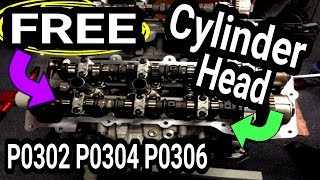
The 2011-2013 Dodge Grand Caravan is equipped with the early 3.6L Pentastar V6, which is known for a specific, well-documented issue with the left-side cylinder head. This defect, caused by overheating and premature wear of the valve guides and seats, leads to a loss of compression and misfires specifically in cylinders 2, 4, and 6. Because of this known issue, a P0302 code on this van carries a higher-than-normal probability of being a serious internal engine problem, not just a simple ignition component failure. Chrysler acknowledged this by issuing TSB 09-002-14 REV. B and a warranty extension (X56) for the left cylinder head 🎬 Watch: How to get a free cylinder head under warranty. on these model years.
Diagnostic Flowchart
Tap your situation to follow the diagnostic path that matches what you're seeing on this vehicle.
Symptoms You May Notice
- Check Engine Light is on or flashing
- Rough or shaky idle
- Engine hesitation or stumbling during acceleration
- Noticeable loss of engine power
- Reduced fuel economy
- Engine bucking and skipping.
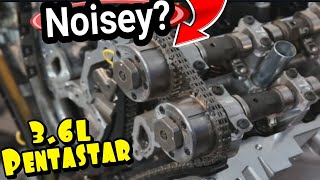
- Ticking or tapping noise from the engine bay, which could indicate a rocker arm/lifter issue instead of, or in addition to, the cylinder head problem.
- Replacing only spark plugs and coils without further diagnosis. Many owners replace these parts only for the P0302 code to return, because the underlying cause was the cylinder head.
- Confusing the ticking noise of a failed rocker arm with general engine noise, leading to a misdiagnosis of the cylinder head when the valvetrain components are the actual cause of the misfire.
Most Likely Causes
- Defective Left Cylinder Head 🔴 High Probability Early 3.6L Pentastar V6 engines had a manufacturing defect in the left cylinder head, causing premature valve seat/guide wear due to overheating of the valve seats. This was acknowledged by Chrysler via TSB #09-002-14 REV. B and a warranty extension (X56). The issue specifically causes compression loss and misfires on the left bank cylinders: 2, 4, and 6.
How to confirm: After ruling out ignition and fuel issues, a professional mechanic must perform a cylinder leak-down test. The TSB specifies that if cylinder 2, 4, or 6 exhibits leakage of 25% or greater, the head must be replaced. This is the definitive diagnostic step.
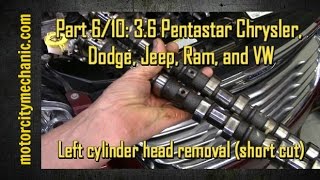
Typical fix: Replacement of the left cylinder head with an updated part (part number ending in AC or later). The repair involves removing the upper intake manifold, valve cover, timing components, and camshafts. 🎬 See this shortcut for removing the left cylinder head.
Est. part cost: $800-$1500 - Failed Ignition Coil 🟡 Medium Probability
How to confirm: Swap the ignition coil from cylinder 2 with another cylinder (e.g., cylinder 4, which is also on the front/left bank and relatively easy to access). Clear the codes and drive the vehicle. If the code changes to P0304, the ignition coil is faulty.
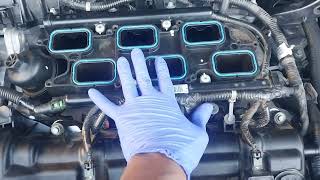
Typical fix: Replace the faulty ignition coil. Accessing the rear bank requires removing the upper intake manifold, so many owners replace all three coils on one bank at the same time.
Est. part cost: $30-$70 - Worn or Fouled Spark Plug 🟡 Medium Probability
How to confirm: Remove the spark plug from cylinder 2 and inspect it. Look for heavy carbon buildup, oil fouling, or a worn/damaged electrode. Compare it to a plug from another cylinder. Ensure the gap is correct.
Typical fix: Replace the spark plug. It is recommended to replace all six at the same time, which requires removing the upper intake manifold.
Est. part cost: $8-$20 per plug - Collapsed Lifter / Worn Rocker Arm 🟡 Medium Probability This is another widely documented failure on the 3.6L Pentastar, separate from the cylinder head issue. The needle bearings in the rocker arm's roller can fail, causing the arm to seize or develop excessive play. This prevents the valve from opening correctly, leading to a misfire and often a distinct ticking or tapping sound.
How to confirm: If a ticking noise is present, a mechanic should remove the valve cover to visually inspect the rocker arms and camshaft lobes for wear or damage. Swapping the rocker arms from cylinder 2 to another cylinder (e.g., cylinder 4) can confirm the fault if the misfire code moves. A technician found that small flat spots on the rocker arm's roller bearing were enough to cause an intermittent misfire by preventing the valve from opening completely.
Typical fix: Replacement of all rocker arms and lifters on the affected bank is recommended. The camshaft should also be inspected for damage. 🎬 Watch: A walkthrough of rocker arm and lifter repairs.
Est. part cost: $200-$400 for a full set of rockers and lifters - Faulty Fuel Injector ⚪ Low Probability
How to confirm: This is more complex. A professional can test the injector's resistance and perform a flow test. A DIY method is to listen for a consistent clicking sound from the injector using a mechanic's stethoscope. One can also swap the injector with another cylinder, but this requires removing the fuel rail.
Typical fix: Replace the faulty fuel injector.
Est. part cost: $50-$120
Rare But Worth Checking
- Low Engine Compression (Piston/Ring issue): While less common than the cylinder head issue, a problem with the piston rings in cylinder 2 could cause a loss of compression and a misfire. A compression test would diagnose this.
- Faulty Powertrain Control Module (PCM): In some rare cases, after all mechanical, ignition, and fuel components have been verified as good, a faulty PCM can be the cause. One owner of a similar platform (Chrysler Town & Country) reported that replacing the PCM resolved a persistent P0302 code that was heat-related, after plugs, coils, and injectors failed to fix it. A mechanic on a similar vehicle with a 3.6L Pentastar determined the ignition coil was not grounding properly through the PCM and fixed it by replacing the module.
Diagnosis Steps
- Read the code: Use an OBD-II scanner to confirm P0302 and check for any other codes, especially P0300, P0304, or P0306.
- Listen for Noises: Pay close attention to any ticking or tapping sounds from the top of the engine, which could point towards a rocker arm/lifter failure.
- Swap Ignition Coil: Swap the ignition coil from cylinder 2 with the coil from cylinder 4. Clear the codes. If the misfire code moves to P0304, the coil is bad. If the code remains P0302, the coil is likely good.
- Inspect Spark Plug: Remove and inspect the spark plug from cylinder 2. Is it worn, fouled with oil, or damaged? Replace if necessary. Since the intake must be removed for other cylinders, it's wise to proceed to the next steps before replacing all plugs.
- Check Fuel Injector: Listen to the fuel injector on cylinder 2 with a stethoscope. It should have a regular, audible clicking sound. Compare its sound to an adjacent injector.
- Perform Compression and Leak-Down Tests: If the above steps do not resolve the issue, a mechanical problem is almost certain. A professional should perform a cylinder leak-down test on cylinders 2, 4, and 6. Per TSB 09-002-14 REV. B, if any of these cylinders show leakage of 25% or more, the left cylinder head needs to be replaced. This is the most critical diagnostic step for this specific vehicle.
- Inspect Valvetrain: If the leak-down test is inconclusive but a ticking noise is present, the valve cover should be removed to inspect the rocker arms and camshafts for wear or damage.
Parts You'll Likely Need
- Left Cylinder Head Assembly
(OEM #68141353AC)— This is the updated Mopar part number for the left cylinder head, designed to fix the valve seat wear issue. It supersedes previous part numbers like 68141353AB and RL141353AC (remanufactured).
Related Codes That Often Appear With This One
- P0300 — If the misfire is severe or intermittent, it may be logged as a 'Random Misfire' before being isolated to cylinder 2. It is also listed as a primary code in the TSB for the cylinder head issue.
- P0304 — This indicates a misfire on cylinder 4. Seeing P0302, P0304, and/or P0306 together strongly suggests the known left cylinder head issue, as all three are on the same bank and listed in the TSB.
- P0306 — This indicates a misfire on cylinder 6. Seeing it with P0302 points to the common cylinder head problem affecting the entire left bank.
Technical Service Bulletins (TSBs) & Recalls
- Bulletin #09-002-14 REV. B (Supersedes 09-002-14 REV. A): "MIL Illumination: P0300, P0302, P0304 or P0306 (X56 Warranty Extension) This bulletin involves checking for excessive cylinder leakage and replacing the cylinder head if necessary…"
- Warranty Bulletin D-14-12: Announces the X56 warranty extension (10 years / 150,000 miles) and directs dealers to use TSB 09-002-14 for diagnosis and repair.
Platform-Specific Known Issues
- A widely known defect in the left cylinder head of 2011-2013 3.6L Pentastar engines causes misfire codes P0302, P0304, and P0306. Chrysler issued Technical Service Bulletin #09-002-14 REV. B and extended the warranty on the left cylinder head to 10 years or 150,000 miles under warranty extension code X56. Though this warranty is now expired for most vehicles, it confirms the prevalence of the issue. The diagnostic procedure in the TSB calls for a cylinder leak-down test; if leakage is 25% or greater, the head must be replaced.
Mechanic-Grade Diagnostic Values
- Fuel Pressure (Key On, Engine Off) — expected: 400 kPa +/- 14 kPa (58 psi +/- 2 psi). Failure: Significantly lower pressure suggests a weak fuel pump; higher pressure suggests a faulty regulator.
- Fuel Injector Resistance — expected: 11 to 14 ohms. Failure: A reading outside this range indicates an electrically failed injector.
- Ignition Coil Primary Resistance — expected: 0.8 to 1.1 ohms. Failure: A reading of OL (open loop/infinite) or one significantly outside the range indicates a bad coil.
- Ignition Coil Secondary Resistance — expected: 5,000 to 15,000 ohms. Failure: A reading outside this range suggests a failure in the coil's secondary winding.
Hidden / Shadow Codes Worth Checking
- Mode $06, TID $83 (example): This function on advanced scan tools does not show a 'code' but provides raw data from the PCM's onboard testing monitors. For misfires, it shows the actual count of misfire events per cylinder for the current and last 10 driving cycles. This allows a technician to see if a cylinder is misfiring even if the count isn't high enough to trigger a formal P0302 code. (see via An advanced OBD-II scan tool with Mode $06 capability, such as those from Autel, Snap-on, or a tool like BlueDriver.)
Scan Tool Commands That Help
- wiTECH (dealer tool) or equivalent professional scan tool: Cylinder Contribution / Power Balance Test — This active test allows the technician to disable fuel to each cylinder one by one and measures the corresponding drop in engine RPM. If disabling cylinder 2 causes little or no RPM drop compared to other cylinders, it confirms that cylinder 2 is not contributing power, definitively isolating the misfire.
- wiTECH (dealer tool): PCM Reprogramming/Flash — In some cases, PCM software can be overly sensitive or have glitches that falsely trigger misfire codes. Checking for and applying any available PCM software updates using the wiTECH tool can resolve software-related issues before proceeding to mechanical repairs.
Wiring & Ground Locations
- Cylinder 2 Ignition Coil Connector — On the left (front) cylinder bank, the second coil from the front of the engine.. The connector itself or its wiring can become corroded or damaged, leading to a poor connection and a misfire on cylinder 2. The connector pigtail is a replaceable part.
- Cylinder 2 Fuel Injector Connector — On the left fuel rail, corresponding to the second cylinder from the front of the engine.. Similar to the coil connector, damage to the fuel injector wiring or connector can prevent the injector from firing correctly, causing a P0302 code. The power feed wire (often pink/white) is shared among injectors, so a problem there might cause multiple codes.
- Engine Mount Ground Strap — Connects from the engine block to the chassis, often near the upper engine mount on the passenger side.. A broken or corroded main engine ground strap can cause a host of bizarre electrical issues, including weak spark and misfires, as the ignition system struggles to find a proper ground path. A visual inspection for a missing or frayed strap is a worthwhile check for intermittent electrical problems.
Real Owner Repair Stories
- Reddit user 'redgus78' in r/MechanicAdvice (2014 Chrysler Town & Country with 3.6L Pentastar) — P0306 code (misfire on cylinder 6, same bank) and a rough idle.
❌ Tried (didn't work) Swapping ignition coils, Swapping fuel injectors, Replacing spark plugs, Performing a compression check (was good), Performing a leak-down test (was good)
✅ What actually fixed it A visual inspection after removing the valve cover revealed a worn exhaust rocker arm and a scored cam lobe on the affected cylinder. Replacing the damaged rocker arm and camshaft resolved the misfire code. - DodgeForum.com user (2015 Grand Caravan, 61,000 miles) — Intermittent P0302 code, occasional rough idle, and a single instance of a ticking noise from the engine.
❌ Tried (didn't work) Replaced all spark plugs, Swapped ignition coils between cylinders, Used a fuel system cleaner (Seafoam)
✅ What actually fixed it The user did not post a final resolution, but another forum member diagnosed the symptoms (ticking noise, misfire on left bank) as classic signs of a bad rocker arm, which can lead to camshaft wear if not addressed. This points away from the initial attempts and toward a mechanical valvetrain issue. - YouTube diagnosis by a professional technician (2013 Chrysler Town & Country with 3.6L V6) — P0302 misfire code that set quickly at idle, but the misfire was not physically felt.
❌ Tried (didn't work) Swapped coils, plugs, and injectors to another cylinder (misfire stayed on cylinder 2), Cylinder leak-down test was good (8-10% leakage, below the 25% failure threshold)
✅ What actually fixed it A relative compression test using an oscilloscope showed an intermittent drop on cylinder 2. The final diagnosis was a failing lifter. This highlights that even if a leak-down test passes, a valvetrain component like a lifter can still be the root cause.
OEM Part Supersession History
5184296AD, 5184296AE, 5184296AF, 5184296AG→5184296AH— Progressive updates to the engine valve rocker arm to improve the durability of the roller bearing, which was a common failure point causing ticking and misfires.
Heads up: While older versions will fit, using the latest 'AH' revision is strongly recommended when replacing any rocker arms to prevent repeat failures.05184445AI (and others)→68141353AC (new) or RL141353AC (remanufactured)— Redesign to correct the valve guide and seat wear issue on the left cylinder head for 2011-2013 models.
Heads up: When replacing the head with the updated part, a separate bolt/plug kit (Mopar #68154699AA) MUST be used, as the new heads are shipped without the necessary oil gallery plugs.05184085AC→05184085AD— Standard part revision for the fuel injector.
Heads up: Part number 0280158233 is also a compatible OEM equivalent.
Model Year Variations Within This Range
- 2011-mid 2012: These models were equipped with the original left cylinder head design that was prone to premature valve seat wear, causing P0302, P0304, and P0306. The problem was largely corrected on engines built on or after July 25, 2012.
Helpful Videos
Used OEM Parts in Stock
New Aftermarket Parts Available



The information in this article is provided for general reference and educational purposes only. Vehicle specifications, procedures, and part compatibility can vary by production date, trim level, and region. Always consult your vehicle's factory service manual and verify part numbers before purchasing or performing repairs. Safety-critical components such as airbags, seat belts, and braking systems should be installed by a qualified professional.
- Dodge GRAND CARAVAN:
- 🎬 Helpful Videos
- 🛍️ Shop This Part
- What's Unique About the 2011-2013 Dodge GRAND CARAVAN
- Diagnostic Flowchart
- Symptoms You May Notice
- Most Likely Causes
- Rare But Worth Checking
- Diagnosis Steps
- Parts You'll Likely Need
- Related Codes That Often Appear With This One
- Technical Service Bulletins (TSBs) & Recalls
- Platform-Specific Known Issues
- Mechanic-Grade Diagnostic Values
- Hidden / Shadow Codes Worth Checking
- Scan Tool Commands That Help
- Wiring & Ground Locations
- Real Owner Repair Stories
- OEM Part Supersession History
- Model Year Variations Within This Range
- 🎟️ Get 5% Off