

P0302 on 2019-2021 Audi Q8: Cylinder 2 Misfire Causes and Fixes
P0302 indicates a misfire in cylinder 2 on your Audi Q8's 3.0L V6 engine. The most common culprits are a faulty ignition coil or a worn spark plug. Swapping the coil from cylinder 2 with another cylinder is a quick way to diagnose the issue. Less common but notable on the EA839 engine family is the potential for faulty rocker arms or fuel injectors.
- P0302 means your Audi Q8 has a misfire specifically in cylinder 2.
- The most likely cause is a bad ignition coil, followed by a worn spark plug.
- A simple DIY diagnostic is to swap the ignition coil from cylinder 2 with another cylinder and see if the trouble code follows the coil.
- Do not drive if the Check Engine Light is flashing, as this can cause expensive damage to the catalytic converter.
- It is recommended to replace all six ignition coils or all six spark plugs at the same time for best results.
What's Unique About the 2019-2021 Audi Q8
The 3.0L V6 Turbo engine (EA839) in the 2019-2021 Audi Q8 is a direct-injection engine, which can be susceptible to carbon buildup on intake valves over time, potentially leading to misfires. However, for a relatively new vehicle, the more common causes are related to the ignition system. Ignition coil failure is a known issue on modern Audi engines, and while it's a simple fix, it's a frequent reason for misfire codes like P0302. Furthermore, some EA839 engines have experienced issues with rocker arms, which can lead to misfires, though this is a more serious and less common cause. A TSB (2054182/7) also notes that certain software calibrations combined with winter-blend fuels can cause misfire codes at idle on this engine family.
Diagnostic Flowchart
Tap your situation to follow the diagnostic path that matches what you're seeing on this vehicle.
Symptoms You May Notice
- Rough or vibrating idle
- Hesitation or jerking during acceleration
- Reduced engine power and performance
- Flashing or solid Check Engine Light
- Increased fuel consumption
- Smell of unburnt fuel from the exhaust
- Difficulty starting the engine
- Replacing the oxygen sensor. A misfire will often cause an O2 sensor to report unusual readings, but the sensor itself is usually not the root cause.
- Assuming it's 'bad gas'. While poor quality fuel can cause issues, it typically results in random misfires (P0300) across multiple cylinders, not a consistent misfire on a single cylinder like P0302.
Most Likely Causes
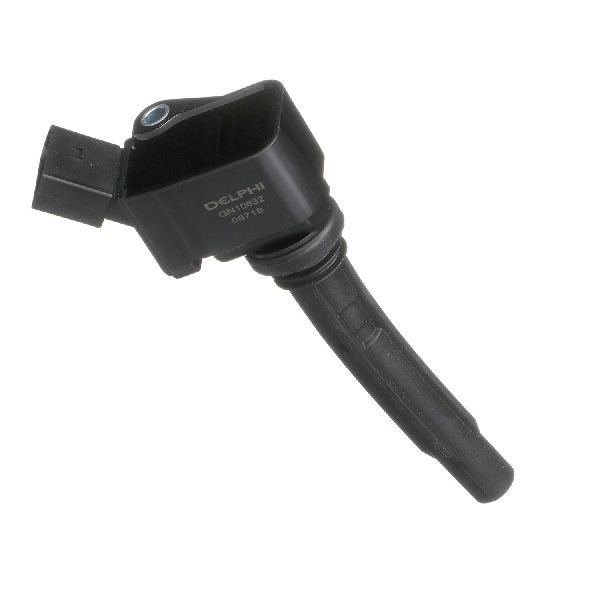
- Faulty Ignition Coil 🔴 High Probability Ignition coils are a common failure point on many modern VAG (Volkswagen Audi Group) engines due to heat cycles and high electrical loads. They are considered a wearable item.
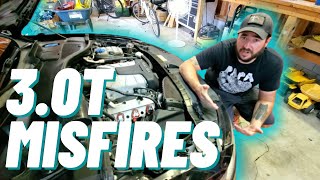
How to confirm: Swap the ignition coil from cylinder 2 with another cylinder (e.g., cylinder 1). Cylinder 2 is the middle cylinder on the passenger side. Clear the codes and drive the vehicle. If the code changes to P0301, the ignition coil is faulty. This is the most definitive DIY diagnostic step. 🎬 Watch: How to diagnose a misfire on the Audi 3.0T engine
Typical fix: Replace the faulty ignition coil. It is often recommended to replace all six coils at the same time as a preventative measure, since they tend to fail around the same time.
Est. part cost: $40-$105 - Worn Spark Plug 🔴 High Probability
How to confirm: Remove the spark plug from cylinder 2 and inspect it for wear (worn electrode), fouling (black, oily, or white deposits), or damage. Compare it to a new plug. The service interval for spark plugs can be as low as 30,000 miles. If the coil swap test doesn't isolate the coil, try swapping the spark plugs next.
Typical fix: Replace the spark plug in cylinder 2. It is best practice to replace all six spark plugs at the same time to ensure even performance and because they have a set service life. A YouTube video on a 2019 Q8 shows this is a difficult job due to a large wiring harness blocking access. 🎬 See this DIY walkthrough for replacing coil packs and spark plugs
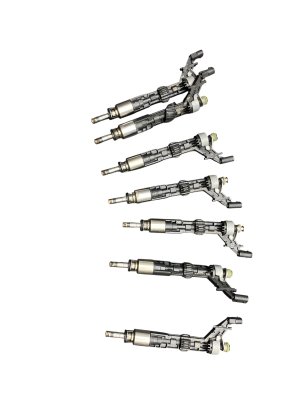
Est. part cost: $15-$30 per plug - Clogged or Faulty Fuel Injector 🟡 Medium Probability Direct injection fuel injectors operate under high pressure and can become clogged or fail electronically over time. Poor fuel quality can contribute to this.
How to confirm: This is more difficult to diagnose. A professional can perform a fuel injector balance test. Swapping injectors between cylinders is possible but labor-intensive. An owner on an AudiWorld forum exhausted ignition and compression checks before replacing injectors, which smoothed the engine, though their code issue persisted due to another problem.
Typical fix: Replace the faulty fuel injector. This is a more complex job that may require removal of the intake manifold. It's recommended to use genuine or OEM Bosch parts.
Est. part cost: $150-$325 per injector
Rare But Worth Checking
- Carbon Buildup on Intake Valves: While less common on newer vehicles, direct injection engines can suffer from carbon buildup which restricts airflow and can cause misfires, especially during cold starts or under heavy load.
- Low Engine Compression: This is a more serious mechanical issue, such as a problem with piston rings, head gasket, or valves, and is unlikely on a newer vehicle without other significant symptoms. A compression test can confirm this.
- Vacuum Leak: A vacuum leak near cylinder 2 could lean out the air/fuel mixture and cause a misfire. An AudiWorld forum member reported a loose vacuum line as the cause of their misfire.
- Faulty Rocker Arm/Lifter: A known issue on the EA839 engine family is rocker arm failure. This can cause a ticking noise and will eventually lead to a persistent misfire code. This is a significant mechanical repair.
- ECU Software Calibration: Audi TSB 2054182/7 describes a condition where misfires can be detected at idle on Bank 2 (cylinders 4, 5, 6) on 2021 Q7/Q8 models due to a software sensitivity to winter-blend fuels. While this TSB is for Bank 2, it highlights that software can be a cause for misfire detection.
Diagnosis Steps
- Read the code with an OBD-II scanner to confirm P0302 and check for any other accompanying codes. 🎬 Watch: A pro mechanic's guide to diagnosing Audi V6 misfire codes
- Note the freeze frame data to see the engine conditions (speed, load, temperature) when the misfire occurred.
- To diagnose the ignition coil, swap the coil from cylinder 2 with the coil from cylinder 1. Cylinder 2 is the middle cylinder on the passenger side.
- Clear the codes and drive the car, attempting to replicate the conditions from the freeze frame data, until the check engine light returns.
- Re-scan the codes. If the code is now P0301, the ignition coil is the problem and needs to be replaced.
- If the code remains P0302, the coil is likely good. The next step is to inspect the spark plug.
- Remove the spark plug from cylinder 2. Check for signs of wear, damage, or fouling. A DIY video for the 2019 Q8 notes this is challenging due to a large wiring harness obstructing access to the coils and plugs.
- If the spark plug looks worn or damaged, replace it. It's best to replace all six at once.
- If the coil and spark plug are good, the issue may be a faulty fuel injector, vacuum leak, or a more serious mechanical problem like low compression or a faulty rocker arm. Further diagnosis by a professional may be required.
Parts You'll Likely Need
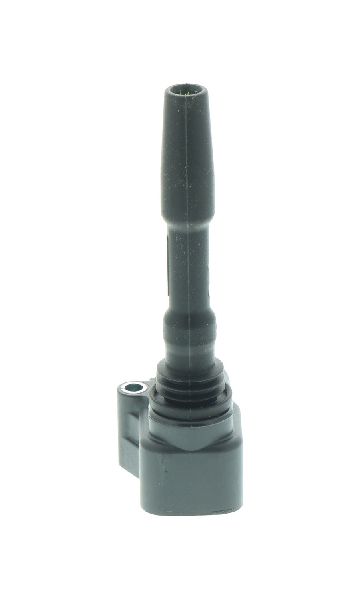
- Ignition Coil
(OEM #06L905110K)— This is the most frequent cause of a single-cylinder misfire on this engine.
Trusted brands: Bosch, NGK, Eldor, Genuine Audi
OEM price range: $80-$105
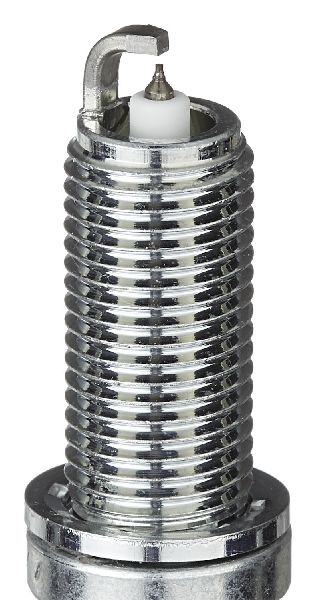
Aftermarket price range: $40-$75 - Spark Plug
(OEM #06M905606F)— Spark plugs are a routine maintenance item and a common cause of misfires as they wear out.
Trusted brands: NGK, Bosch, Genuine Audi
OEM price range: $20-$30
Aftermarket price range: $15-$25 - Fuel Injector
(OEM #06M906036AE)— If the ignition system components are confirmed to be good, a faulty fuel injector is the next most likely cause.
Trusted brands: Bosch, Genuine Audi
OEM price range: $250-$325
Aftermarket price range: $150-$220
Related Codes That Often Appear With This One
- P0300 — If the misfire is intermittent or starting to affect other cylinders, a P0300 (Random/Multiple Cylinder Misfire) code may appear alongside P0302.
- P0301, P0303, P0304, P0305, P0306 — If other ignition coils or injectors are failing, you may see misfire codes for other specific cylinders. Seeing multiple codes on one bank (e.g., P0301, P0302, P0303) could point to a shared issue like a vacuum leak or timing problem on that bank.
Technical Service Bulletins (TSBs) & Recalls
- A0124212069038_5: This bulletin provides information when the MIL is illuminated, cylinder misfires; P0300, P0301, P0302, P0303, P0304, P0305, P0306
- A0123912069038_5: This bulletin provides information for when the MIL is illuminated, DTCs P0300, P0301, P0302, P0303, P0304, P0305, P0306.
- A0123802069038_4: This bulltin provides information for when the MIL, cylinder misfires, DTCs P0300, P0301, P0302, P0303, P0304, P0305, P0306.
- 2054182/7: PSS TSB for 2021 Q7/Q8 3.0L TFSI engines regarding Bank 2 misfires at idle, caused by software sensitivity to winter fuel.
Platform-Specific Known Issues
- Audi has issued several Technical Service Bulletins (TSBs) related to cylinder misfires (P0300-P0306) for this vehicle platform, including A0124212069038_5, A0123912069038_5, and A0123802069038_4, indicating that this is a known issue for the manufacturer.
- TSB 2054182/7 specifically addresses misfires at idle on 2021 Q7/Q8 models with the 3.0L TFSI engine, attributing the cause to a software calibration's sensitivity to winter-blend fuels and noting a software update was planned.
Mechanic-Grade Diagnostic Values
- Low-Pressure Fuel System — expected: 4 to 6 bar. Failure: Pressure below this range indicates a failing in-tank low-pressure fuel pump (LPFP).
- High-Pressure Fuel System — expected: Up to 200 bar (approx. 2900 PSI). Failure: Pressure significantly below the requested value under load can indicate a failing High-Pressure Fuel Pump (HPFP).
- Ignition Coil Primary Winding Resistance — expected: 0.49 - 0.57 ohms. Failure: Readings outside this range indicate a faulty coil.
- Ignition Coil Secondary Winding Resistance — expected: 9.5 - 11.1 kilohms. Failure: Readings outside this range indicate a faulty coil.
Hidden / Shadow Codes Worth Checking
- P2310: Control Circuit for Ignition Coil 4 - Short to Plus. While this example is for cylinder 4, a similar code (e.g., P2304 for cylinder 2) indicates a specific electrical fault in the coil circuit, not just a combustion misfire. This is more specific than a P0302 code. (see via Advanced scanners like VCDS or OBDeleven may show these more specific electrical faults that a basic OBD-II reader might miss.)
Scan Tool Commands That Help
- VCDS or OBDeleven: Live Data Misfire Counter — Use live data in the Engine control module (Address 01) to view misfire counts for each cylinder in real-time ('Misfire sum counter' and 'Cylinder X misfire counter'). This is crucial for confirming which cylinder is actively misfiring during idle or a test drive, especially if the CEL is not flashing.
- VCDS: Output Tests (Sequential or Selective) — Can be used with the engine off to test the electrical circuits for components like fuel injectors. The ECU will attempt to activate the component, and a 'short to ground' message is a normal part of the test sequence. This can help identify wiring or component electrical issues without the engine running.
Wiring & Ground Locations
- Battery Ground Cable (Earth Cable) — Connects the battery negative terminal to the chassis. On the Q8 e-tron, a similar platform, the main ground is on the front panel of the plenum chamber. The specific part for the 2019-2020 Q8 is identifiable.. A loose or corroded main engine or battery ground can cause intermittent and hard-to-diagnose electrical issues, including weak spark leading to misfires. While not specific to cylinder 2, it's a fundamental check for any electrical-related fault code. The OEM part number is 4M0971238B.
- Ignition Coil Harness — Runs across the top of the valve covers, connecting to each ignition coil.. On the EA839 V6, the factory engine harness sits directly on top of the ignition coils, which can restrict airflow and contribute to heat-related failures. Some aftermarket coil kits include spacers to raise the harness for better cooling.
Real Owner Repair Stories
- AudiWorld Forums (2019 Audi Q8, 64,235 miles) — Rattling/ticking noise from engine.
❌ Tried (didn't work) Not specified, but the issue was significant enough to warrant major investigation.
✅ What actually fixed it The user's issue was identified as being related to the known rocker arm failure common on early EA839 engines. Another user in the thread confirms their 2019 model had the same issue, implying this is a likely cause for ticking noises leading to misfires on 2019 models.
OEM Part Supersession History
06L905110C, D, E, F, H→06L905110K— Standard revision and improvement process for a common failure part.
Heads up: The newest revision (K) is the recommended replacement for all previous versions. Using older stock is not advised.
Model Year Variations Within This Range
- 2019 (early production): Early production 2019 models of the EA839 engine family were fitted with rocker arms prone to premature failure of the needle bearings. This issue was reportedly corrected with an updated part number sometime in 2019. Vehicles with a build date of July 2019 or later are less likely to be affected.
- 2019-2021: The 3.0L V6 engine (335 hp) remained consistent through this period. However, reviewers noted hesitation and accelerator lag in the 2019 models, which may have been addressed with software updates in later years.
Helpful Videos

Used OEM Parts in Stock

New Aftermarket Parts Available


The information in this article is provided for general reference and educational purposes only. Vehicle specifications, procedures, and part compatibility can vary by production date, trim level, and region. Always consult your vehicle's factory service manual and verify part numbers before purchasing or performing repairs. Safety-critical components such as airbags, seat belts, and braking systems should be installed by a qualified professional.
- Audi Q8:
- 🎬 Helpful Videos
- 🛍️ Shop This Part
- What's Unique About the 2019-2021 Audi Q8
- Diagnostic Flowchart
- Symptoms You May Notice
- Most Likely Causes
- Rare But Worth Checking
- Diagnosis Steps
- Parts You'll Likely Need
- Related Codes That Often Appear With This One
- Technical Service Bulletins (TSBs) & Recalls
- Platform-Specific Known Issues
- Mechanic-Grade Diagnostic Values
- Hidden / Shadow Codes Worth Checking
- Scan Tool Commands That Help
- Wiring & Ground Locations
- Real Owner Repair Stories
- OEM Part Supersession History
- Model Year Variations Within This Range
- 🎟️ Get 5% Off