

P0301 on 2021 Volkswagen ID.4: What an EV 'Misfire' Code Really Means
This is not a standard misfire. On the all-electric 2021 VW ID.4, code P0301 indicates a fault in the high-voltage electric drive system, not a cylinder misfire. This requires immediate professional diagnosis by a qualified EV technician and is not a DIY repair.
- P0301 on a VW ID.4 is NOT a cylinder misfire; it is a serious electric drive system fault.
- Do not follow any DIY advice intended for gasoline engines, as it is completely irrelevant and dangerous.
- The vehicle should not be driven. Have it towed to a qualified VW or EV technician for diagnosis.
- The fix could be as simple as a software update or as complex as replacing the power inverter or the entire drive motor.
- This is not a DIY-friendly repair due to the extreme danger of high-voltage systems and a complete lack of public repair documentation.
What's Unique About the 2021-2021 Volkswagen ID.4
The primary difference is that the ID.4 is a fully electric vehicle. It lacks an internal combustion engine, spark plugs, fuel injectors, and ignition coils. Therefore, all standard diagnostic advice for a P0301 code is completely irrelevant and misleading for this vehicle. The appearance of this code points to a manufacturer-specific interpretation related to the complex high-voltage powertrain, which can only be accurately diagnosed with specialized tools like VW's ODIS system.
Diagnostic Flowchart
Tap your situation to follow the diagnostic path that matches what you're seeing on this vehicle.
Symptoms You May Notice
- Check Engine Light (MIL) is illuminated
- Reduced power or vehicle entering a limited 'limp' mode
- Error messages on the instrument cluster related to the 'Electrical System' or 'Drive System'
- Potential for unusual noises (whining, grinding, or clunking) from the electric drive unit
- Replacing spark plugs
- Replacing ignition coils
- Replacing fuel injectors
- Checking for engine vacuum leaks
Most Likely Causes
- Internal fault in the Power and Control Electronics for Electric Drive (inverter) 🔴 High Probability The power electronics module (inverter) manages the flow of high-voltage DC from the battery to three-phase AC for the motor. As a complex, high-power component, it is a potential point of failure in any EV.
How to confirm: Requires a VW-specific diagnostic scan tool (like ODIS) to read manufacturer-level fault codes and data blocks from the drive system control modules.
Typical fix: Replacement of the power electronics module.
Est. part cost: $2000-$4000 - Electric drive motor fault 🟡 Medium Probability The code could correspond to a fault in one of the motor's three-phase windings, an internal short, or a failure of the drive motor rotor position sender. Later ID.4 models use a drive unit designated APP550, but the 2021 model uses an earlier version.
How to confirm: Advanced diagnostics using a VW-specific scan tool to test motor parameters and potentially insulation testing (megohmmeter test) of the motor windings.
Typical fix: Replacement of the entire electric drive unit.
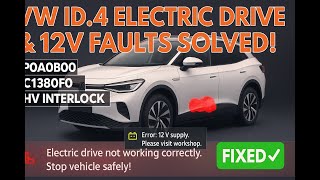
Est. part cost: $4000-$7000 - Software or control module glitch 🟡 Medium Probability EVs rely heavily on software to manage the powertrain. A software update may be required to resolve erroneous fault codes or control logic issues 🎬 Watch: How a technician resolves electric drive and 12V faults, a common occurrence in early-production complex vehicles.
How to confirm: A technician would check for any available software updates or Technical Service Bulletins (TSBs) for the powertrain control modules using the ODIS system.
Typical fix: Performing a software update at a Volkswagen dealership.
Est. part cost: $0 (if under warranty or campaign) - High-voltage wiring or connection issue ⚪ Low Probability A loose or corroded high-voltage connection between the battery, inverter, and motor could cause intermittent power delivery issues, potentially triggering a fault.
How to confirm: Visual inspection of all high-voltage cable connections (by a qualified technician only) and potentially resistance/continuity checks.
Typical fix: Repairing or replacing the affected high-voltage cable or connector.
Est. part cost: $200-$1000
Diagnosis Steps
- STOP: Do not attempt DIY diagnosis beyond reading the initial code.
- Schedule an appointment with a Volkswagen dealership or a certified EV repair facility immediately.
- A technician will connect a VW-specific diagnostic tool (ODIS) to the vehicle.
- The technician will retrieve the full fault code data, including freeze-frame data and manufacturer-specific codes.
- Based on the specific VW trouble code information, the technician will follow a guided fault-finding procedure to test the power electronics, drive motor, and related software.
- Diagnosis will likely involve checking software versions and performing high-voltage component tests, which is not a DIY task.
Parts You'll Likely Need
- Power and Control Electronics Module (Inverter) — This module, formally called 'Power and Control Electronics for Electric Drive' in VW literature, controls the electric motor. A fault within its complex circuitry is a likely cause for a drive system error code like P0301.
Trusted brands: Volkswagen OE
OEM price range: $2000-$4000
Aftermarket price range: N/A - Electric Drive Motor Unit — If the fault is traced to the motor itself (e.g., a winding failure), the entire drive unit is typically replaced. The rear axle shaft for a 2021-22 RWD model is associated with part number 1EA501202B.
Trusted brands: Volkswagen OE
OEM price range: $4000-$7000
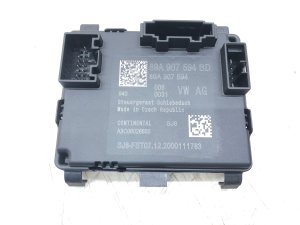
Aftermarket price range: N/A - CAN-Bus Gateway Control Module
(OEM #1EA937012N)— While not a direct cause, a faulty gateway module can cause communication errors between various high-voltage components, potentially leading to erroneous fault codes. This part is an example of the vehicle's complex electronic architecture.
Trusted brands: Volkswagen OE
OEM price range: $175-$250
Aftermarket price range: N/A
Related Codes That Often Appear With This One
- P0300 — Indicates a random or multiple 'misfire' condition, suggesting a widespread fault in the electric drive system rather than a single component. It is listed in the same dealer communication as P0301. [Bulletin #VIN4APIN20220118]
- P0302, P0303, P0304 — These codes correspond to other 'cylinders' and, on the ID.4, likely point to faults in other phases or components of the electric drive system. Their presence alongside P0301 would indicate a more severe system failure. [Bulletin #VIN4APIN20220118]
- P1D74, P1D75 — These are manufacturer-specific codes that were listed in the same TSB as P0301, indicating they are related to the same underlying electrical system issues on the ID.4. [Bulletin #VIN4APIN20220118]
Technical Service Bulletins (TSBs) & Recalls
- VIN4APIN20220118: This appears to be an internal dealer communication summary, not a public-facing TSB. It notes customer complaints of MIL-on with P0301 and other related codes under the 'ELECTRICAL SYSTEM' category for the 2021 ID.4, confirming the code's existence on this platform.
Platform-Specific Known Issues
- The 2021 ID.4 has been subject to several recalls and service campaigns, primarily related to software updates and high-voltage battery concerns. While not directly linked to P0301 in available documentation, it highlights the importance of ensuring the vehicle's software is up to date, as this can resolve various electrical issues.
- A notable finding is the complete lack of public owner reports detailing a P0301 fault on forums like 'VWIDTalk.com' or Reddit. This strongly suggests the fault is either extremely rare or is resolved exclusively by dealerships under warranty, preventing public discussion and documentation of repair experiences. 🎬 Watch: One owner's experience with ID.4 reliability and drive system issues
Mechanic-Grade Diagnostic Values
- Insulation resistance of electric drive motor (any phase to chassis ground) — expected: Above 550 MΩ (Megaohms) when tested at 500V-1000V.. Failure: A very low resistance reading, such as 0.036 MΩ, indicates an internal short to ground in the motor or inverter.
- Resistance of a High-Voltage Interlock Loop (HVIL) switch or connector pin — expected: Less than 1.0 Ω (Ohm) when the circuit is closed/connected.. Failure: A higher than expected resistance reading indicates a poor connection, corrosion, or a faulty switch in the safety loop, which can prevent the high-voltage system from activating.
Hidden / Shadow Codes Worth Checking
- P0A0B00: High Voltage System Interlock Circuit Performance. This indicates a break or fault in the safety loop that runs through all high-voltage components. (see via Advanced scan tools like VCDS, ODIS, or high-end Autel/Launch scanners that can read manufacturer-specific codes from modules like the Battery Management System.)
- P1CA700 / P1CA800: Manufacturer-specific codes related to the Battery Energy Control Module, indicating faults with the HV system fuse igniter or general electrical faults. (see via Advanced scan tools capable of deep interrogation of the Battery Energy Control Module (address 8C).)
Scan Tool Commands That Help
- ODIS (Volkswagen Official Diagnostic System): Component Protection Removal — Required after replacing certain control modules, such as the CAN Gateway (1EA937012N), to allow the new module to communicate with the rest of the vehicle. Failure to perform this will result in the new part not functioning.
- ODIS or equivalent professional tool (e.g., VNCI): Recommission High-Voltage System — After replacing a major HV component like the on-board charger or after the system has been disabled due to a fault, this procedure is necessary to safely re-energize the HV contactors and bring the system back online.
- Autel MaxiSYS EV / similar EV-specific tools: Battery Pack Offline Analysis — When a fault is suspected within the high-voltage battery itself, this function allows a technician to test the battery pack's state of health (SOH) and individual modules outside of the vehicle's main operating system.
Wiring & Ground Locations
- Ground Point 638 — On the right-hand A-pillar, inside the cabin.. A poor ground at this major chassis point could cause communication errors or erratic behavior in nearby control modules, potentially leading to false diagnostic codes.
- Ground Point 928 — On the housing of the electric drive motor 2 (for AWD models, but similar points exist for RWD).. This is the primary ground for the drive unit itself. Corrosion or a loose connection here could directly impact sensor readings and the operation of the power electronics (inverter).
- Firewall Ground Lug — On the firewall behind the 12V battery under the hood.. This is the main grounding point for the 12V system. A fault here can cause widespread electronic issues, as all control modules rely on a stable 12V supply for operation, even in an EV.
- JX1 — The component identifier for the 'Power and control electronics for electric drive' (the inverter), located on the rear drive unit.. Knowing this designator helps locate the correct component when referencing official wiring diagrams and repair procedures.
Real Owner Repair Stories
- YouTube user 'Car Hackers English' (Volkswagen ID.4 (year not specified, but early model)) — Vehicle would not start, displaying 'Electric drive not working correctly' and '12V supply error' messages. Fault codes P0A0B00 (HV Interlock) and C1380F0 were present.
❌ Tried (didn't work) Replacing the 12V battery.
✅ What actually fixed it The On-Board Charger (OBC) was faulty and had to be replaced. After replacement, the new module had to be programmed online using a VNCI diagnostic tool with ODIS software, followed by a procedure to 'recommission' the high-voltage system. - SEATCUPRA.NET forum user (Cupra Formentor (VW Group PHEV with similar system logic)) — Generic 'Drive system error - please visit workshop' message appeared, engine would not run.
❌ Tried (didn't work) Immediate restart of the vehicle.
✅ What actually fixed it This was a temporary software glitch. The error cleared itself after the vehicle was turned off and the key was moved more than 20 meters away for over 20-30 minutes, allowing the vehicle's systems to fully shut down and reset. Another user reported the error cleared after leaving the car overnight.
OEM Part Supersession History
1EA937012N→Interchangeable with 5WA937615 and 83A905217B— Cross-platform compatibility (used in Audi Q4 e-tron).
Heads up: This part is not plug-and-play. It requires online programming with ODIS to remove 'Component Protection' after installation.
Model Year Variations Within This Range
- 2021 (built May 2020 - Jan 2022): Early production 2021 models were built with software that could cause the battery management control module to reboot or the pulse inverter to deactivate, leading to a loss of power. Later production vehicles and vehicles that have had recall 23V-040 performed have updated software to correct this logic flaw.
Helpful Videos
We Have This Part in Stock



The information in this article is provided for general reference and educational purposes only. Vehicle specifications, procedures, and part compatibility can vary by production date, trim level, and region. Always consult your vehicle's factory service manual and verify part numbers before purchasing or performing repairs. Safety-critical components such as airbags, seat belts, and braking systems should be installed by a qualified professional.
- Volkswagen ID.4:
- 🎬 Helpful Videos
- 🛍️ Shop This Part
- What's Unique About the 2021-2021 Volkswagen ID.4
- Diagnostic Flowchart
- Symptoms You May Notice
- Most Likely Causes
- Diagnosis Steps
- Parts You'll Likely Need
- Related Codes That Often Appear With This One
- Technical Service Bulletins (TSBs) & Recalls
- Platform-Specific Known Issues
- Mechanic-Grade Diagnostic Values
- Hidden / Shadow Codes Worth Checking
- Scan Tool Commands That Help
- Wiring & Ground Locations
- Real Owner Repair Stories
- OEM Part Supersession History
- Model Year Variations Within This Range
- 🎟️ Get 5% Off