

P0300 on 2006-2007 Saturn ION: Random Misfire Causes and Fixes
P0300 on a 2006-2007 Saturn ION indicates a random misfire, most commonly caused by a faulty Ignition Control Module (ICM) located under the coil pack assembly. The ICM is highly prone to failure from engine heat. To ensure a lasting repair, mechanics and experienced owners strongly recommend replacing the ICM and the ignition coil pack assembly as a single unit, as a failing coil can destroy the new module.
- P0300 on a 2006-2007 Saturn ION is most frequently caused by a bad Ignition Control Module (ICM), often due to heat failure.
- For a lasting repair, it is highly recommended to replace the ignition coil pack assembly at the same time as the ICM.
- Do not drive if the Check Engine Light is flashing, as this signals a severe misfire that can quickly destroy the catalytic converter, a much more expensive repair.
- While less common, vacuum leaks from a cracked intake manifold gasket are another potential cause to investigate if ignition parts don't solve the problem.
What's Unique About the 2006-2007 Saturn ION

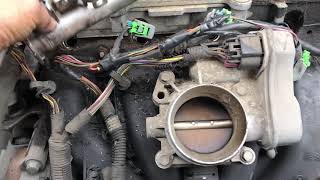
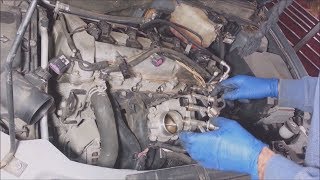
The Saturn ION shares its GM Delta platform and Ecotec engines with the Chevrolet Cobalt and HHR. A very common and well-documented issue on these engines is the failure of the Ignition Control Module (ICM), which is mounted directly under the ignition coil assembly. This module is prone to failure from engine heat over time, causing intermittent random misfires that often worsen as the engine warms up. One owner confirmed this by using a heat gun on the ICM, which recreated the misfire. 🎬 Watch: A common misfire repair walkthrough for the 2.2L Ecotec. Because a failing coil can damage a new module, mechanics often recommend replacing the ICM and the coil pack assembly as a single unit. On some Ecotec engines, the ICM also plays a role in generating the camshaft position signal, so its failure can sometimes trigger false cam sensor codes.
Diagnostic Flowchart

Tap your situation to follow the diagnostic path that matches what you're seeing on this vehicle.
Symptoms You May Notice
- Rough or shaking idle
- Engine hesitation or stumbling during acceleration, especially at mid-throttle
- Flashing or solid Check Engine Light
- Significant loss of power, feeling like the engine is running on only two cylinders
- Difficulty starting the engine
- Smell of unburnt fuel from the exhaust
- Engine is louder than normal during misfire events
- Replacing only the spark plugs when the ignition control module is the actual root cause.
- Replacing only the ignition control module, only to have it fail again shortly after because the old coil pack was faulty and overloaded it. This is a very common mistake according to multiple mechanic testimonials.
- Replacing fuel injectors when the problem is a simpler vacuum leak or an ignition system fault.
- Replacing the Camshaft Position Sensor when a P0341 code appears alongside P0300. The cam sensor code is often a 'false code' triggered by the erratic engine rotation from the severe misfire itself, or because the ICM is failing to generate the correct cam signal.
Most Likely Causes

- Faulty Ignition Control Module (ICM) 🔴 High Probability The ICM is mounted under the coil pack on top of the Ecotec engine, where it is exposed to significant heat, leading to a high failure rate. This is a widely documented issue on the ION and its platform mates like the Cobalt and HHR.
How to confirm: Diagnosis can be tricky as failure is often intermittent and heat-related. A common symptom is the misfire appearing or worsening as the engine warms up. Testing the module itself can be difficult without specialized tools, so it is often diagnosed by eliminating other causes (plugs, coils, fuel pressure) first.
Typical fix: Replace the Ignition Control Module. It is highly recommended to also replace the ignition coil pack assembly at the same time. Multiple owner accounts and mechanic videos confirm that an old, failing coil pack can quickly overload and destroy a brand-new ICM, leading to a repeat failure. 🎬 See how to test and replace the ICM and coils.
Est. part cost: $50-$150 - Worn or Fouled Spark Plugs 🟡 Medium Probability
How to confirm: Remove the spark plugs and inspect them for wear (eroded electrode), carbon fouling (black, sooty), or oil fouling. A worn plug will have a large gap. Fouled plugs were noted in one diagnostic case before a faulty ICM was found to be the root cause.
Typical fix: Replace all four spark plugs. Use OEM-spec plugs (ACDelco Iridium is a common choice) for best performance and longevity. Ensure they are gapped correctly (typically 0.040 inches for the 1.9L).
Est. part cost: $20-$50 - Defective Ignition Coil Pack Assembly 🟡 Medium Probability The coil pack assembly is a single cassette-style unit that provides spark to all cylinders. Like the ICM it sits on, it is subject to constant heat and vibration and can develop internal faults or cracks.
How to confirm: Test for spark at each boot using a spark tester. Since the coil pack is a single unit, if one coil is weak or has failed, the entire assembly must be replaced. Resistance tests can be performed but may not reveal an intermittent, heat-related failure.
Typical fix: Replace the entire ignition coil pack assembly. This is almost always done along with the ICM as a set to prevent comeback failures.
Est. part cost: $80-$200 - Clogged or Failing Fuel Injectors (Especially 2.4L LE5) 🟡 Medium Probability GM issued a Technical Service Bulletin (TSB #08-06-04-001) for the 2006-2007 ION with the 2.4L LE5 engine. It states that P0300, often with P0171 (System Too Lean), can be caused by plugged orifices in the fuel injectors.
How to confirm: The TSB recommends performing an injector balance test with a specialized tool (AFIT CH-47976). If an injector is found to be lean, the bulletin advises replacing all four. Resistance for Ecotec injectors should be between 11-14 ohms when the engine is between 50-90°F.
Typical fix: Replace all four fuel injectors with the revised part (dark blue overmold color). The TSB explicitly states that this condition cannot be corrected by cleaning. After replacement, the ECM must be reprogrammed with an updated calibration. 🎬 Watch: Fixing misfire and injector codes on the 2.4L engine. A forum user confirmed their independent shop could not do this, requiring a dealer visit.
Est. part cost: $50-$150 per injector - Vacuum Leak ⚪ Low Probability The Ecotec engine's plastic intake manifold or its gasket can develop leaks over time. Hoses, like those for the charcoal canister, can also become deteriorated and spongy, creating leaks.
How to confirm: Perform a smoke test by introducing smoke into the intake system and watching for leaks; this is the most effective method. Alternatively, carefully spray carburetor cleaner or soapy water around the intake manifold gasket and vacuum hoses with the engine running and listen for a change in idle speed or look for bubbles.
Typical fix: Replace the leaking vacuum hose or the intake manifold gasket.
Est. part cost: $15-$70
Rare But Worth Checking
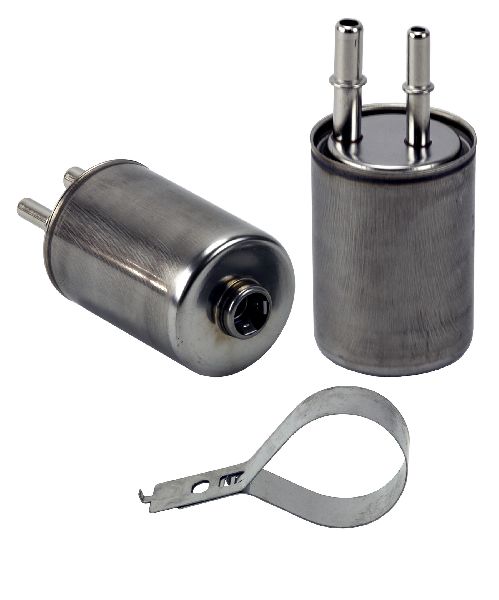
- Low Fuel Pressure: A weak fuel pump or clogged fuel filter can starve the engine for fuel, causing a random misfire across all cylinders. Check this if ignition components are confirmed to be good. Fuel pressure should be around 55 psi with the key on, engine running. One user reported seeing 55-65 psi at idle.
- Clogged Catalytic Converter: If the exhaust is restricted, it can create backpressure that leads to misfires. This is usually accompanied by a significant loss of power, a glowing red converter, and potentially a P0420 code.
- Wiring Harness Short: A forum post for Ecotec engines mentions that the ignition control module or fuel injector wiring harnesses can chafe and short to ground on A/C lines or brackets, causing intermittent misfires.
- Fuel Contamination: TSB PIP3333C notes that on vehicles with returnless fuel systems like the ION, contaminants can get trapped in the fuel rail. This can cause intermittent misfires on specific cylinders during turns (e.g., cylinder 1 on a left turn, cylinder 4 on a right turn) as the fuel sloshes, but can also contribute to a general P0300.
Diagnosis Steps
- Scan for any other trouble codes. Codes like P0171 (Lean) or specific cylinder misfires (P0301-P0304) provide valuable clues.
- Check live misfire data with a scan tool to see if the misfires are truly random or concentrated on specific cylinders, even if only a P0300 is set.
- Inspect the spark plugs for wear, fouling, and correct gap. If they are old or in poor condition, replace them as a first step.
- Given the extremely high failure rate, strongly consider replacing the Ignition Control Module (ICM) and coil pack assembly together as a unit, especially if the misfire worsens when the engine is hot. Many owners and mechanics consider this the primary fix.
- Check for vacuum leaks. Use a smoke machine for best results. Pay attention to the intake manifold gasket and all connected hoses.
- Check fuel pressure with a gauge connected to the fuel rail's Schrader valve. Pressure should be steady and within the manufacturer's specification (around 55 PSI KOER - Key On, Engine Running).
- If you have the 2.4L LE5 engine and a P0171 code is also present, suspect clogged fuel injectors per TSB #08-06-04-001. This requires advanced testing (injector balance test) or diagnosis by a professional.
- If all else fails, check for a clogged catalytic converter by measuring backpressure or using an infrared thermometer to check for a significant temperature difference between the inlet and outlet.
Parts You'll Likely Need

- Ignition Control Module
(OEM #12599232 (ACDelco D1978A))— This is the most common point of failure for a P0300 code on the 2006-2007 Saturn ION due to its location and susceptibility to heat damage.
Trusted brands: ACDelco, Delphi, Standard Motor Products
OEM price range: $80-$120
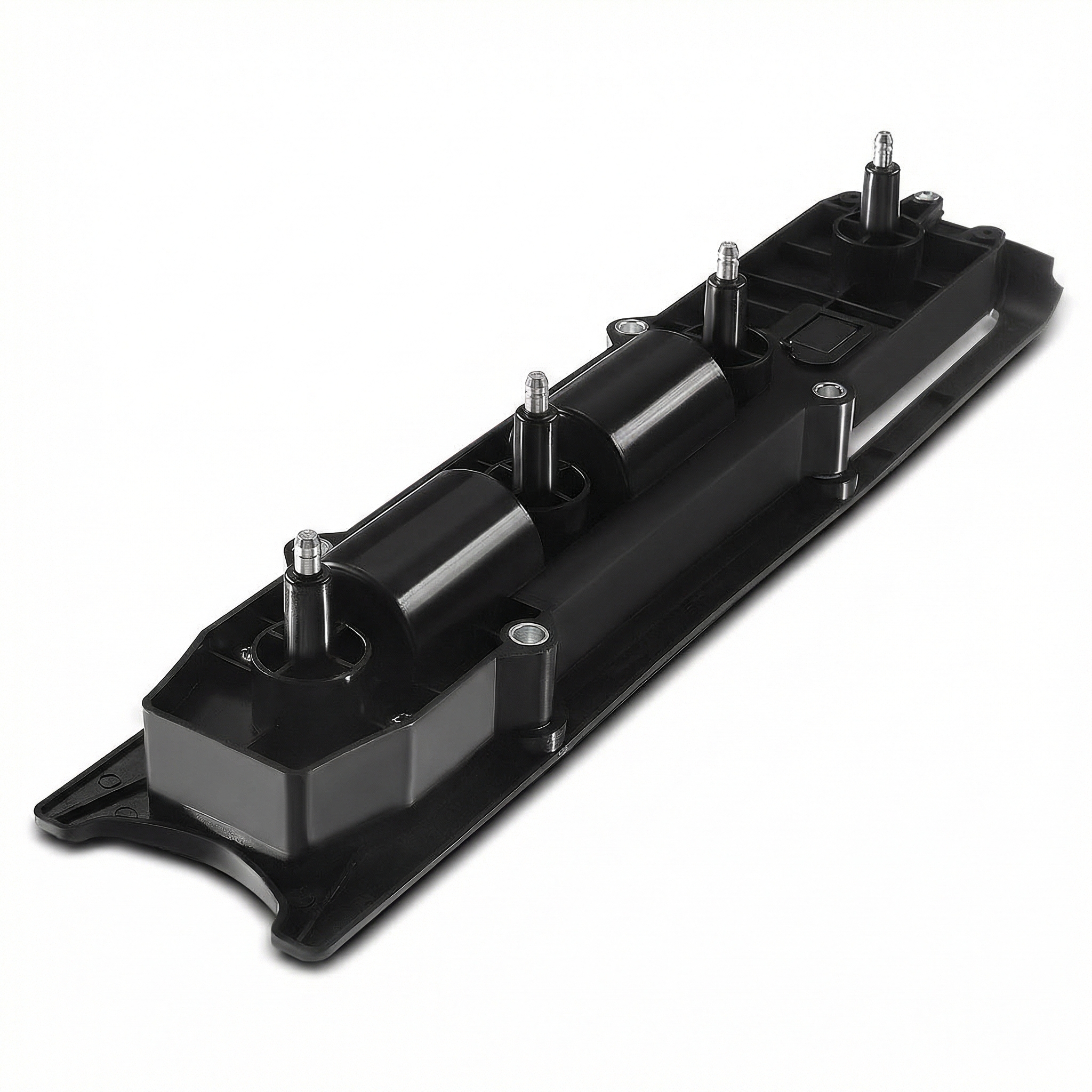
Aftermarket price range: $50-$90 - Ignition Coil Pack Assembly
(OEM #12599233 (ACDelco D597A))— This assembly houses the coils that provide spark. It is often replaced with the ICM as a preventative measure, since a bad coil can damage the new module.
Trusted brands: ACDelco, Delphi, NGK
OEM price range: $120-$180
Aftermarket price range: $80-$130 - Spark Plugs
(OEM #ACDelco 41-103 (Iridium))— Worn spark plugs are a common cause of misfires and should be inspected and replaced as part of routine maintenance or when diagnosing a P0300.
Trusted brands: ACDelco, NGK
OEM price range: $25-$50 (set of 4)
Aftermarket price range: $20-$40 (set of 4) - Fuel Injector (2.4L LE5)
(OEM #12602480)— For the 2.4L engine, clogged injectors are a known issue per a TSB. The bulletin recommends replacing all four with this updated part number if a lean condition is found.
Trusted brands: ACDelco
OEM price range: $60-$100 per injector
Aftermarket price range: $40-$80 per injector
Related Codes That Often Appear With This One
- P0301, P0302, P0303, P0304 — If the computer can eventually isolate the misfire to a specific cylinder, it will set one of these codes in addition to or instead of P0300. One owner reported P0300 on the scanner, but live data showed cylinders 2 and 3 were the ones actively misfiring.
- P0171 — This code for 'System Too Lean' often appears with P0300. On the 2.4L LE5 engine, this combination specifically points towards the clogged fuel injector issue described in TSB #08-06-04-001. It can also be caused by a significant vacuum leak.
- P0341 — A Camshaft Position Sensor code can sometimes be a 'false code' triggered by the erratic engine rotation from a severe misfire, not a faulty sensor itself. On some Ecotec engines, the ICM is responsible for generating the cam signal, making it the true cause.
Technical Service Bulletins (TSBs) & Recalls
- 08-06-04-001: Check Engine Light On, DTCs P0171, P0300, P1174 Set (Perform Injector Test, Replace Injectors and Reprogram ECM, if Necessary) - Specific to 2.4L LE5 engine.
- PIP5628G: Preliminary information communicating the need to gather diagnostic data for P0300-P0308 codes, indicating ongoing manufacturer tracking.
- PIP3333C: Addresses intermittent misfires (P0300, P0301, P0304) and points to potential fuel contamination in the fuel rail as a rare cause.
Platform-Specific Known Issues
- Ignition Module and Coil Pack Assembly Failure: The most prevalent issue. The ICM and coil pack are a combined unit mounted on top of the engine, subject to intense heat. Failure is extremely common and causes a P0300 that often worsens as the engine warms up. The consensus repair is to replace both components simultaneously.
- Clogged Fuel Injectors (2.4L LE5 Engine): A GM Technical Service Bulletin specifically addresses P0300 and P0171 on the 2.4L engine, caused by clogged fuel injectors that cannot be cleaned. The fix requires replacing all four injectors and reprogramming the ECM.
Mechanic-Grade Diagnostic Values
- Fuel Pressure (KOER - Key On, Engine Running) — expected: 55 - 65 PSI. Failure: Pressure that is low, drops off, or is wildly inconsistent can indicate a weak fuel pump or clogged filter.
- Fuel Injector Resistance — expected: 11 - 14 ohms. Failure: A reading significantly outside this range, or an injector that reads very differently from the others, indicates a faulty injector coil.
- Engine Compression — expected: ~200 PSI per cylinder. Failure: Low compression in one or more cylinders would indicate a mechanical engine problem, not an ignition or fuel issue.
- Live Data Misfire Counters — expected: Near zero on all cylinders at idle and under load.. Failure: Even with only a P0300 code set, live data may show specific cylinders with rapidly accumulating misfire counts, pinpointing the source.
Scan Tool Commands That Help
- GM Tech 2 or equivalent professional scan tool: Crankshaft Position Variation Learn Procedure (CKP Relearn) — This procedure must be performed after replacing the crankshaft position sensor, and sometimes after replacing the PCM or performing major engine work. It synchronizes the sensor with the actual position of the crankshaft. Failure to perform this can set a P0315 and contribute to misfire detection issues. In one case, attempting this procedure and having it fail to resolve the issue helped point to a faulty ICM.
- GM Tech 2 or equivalent professional scan tool: Injector Balance Test — This is the specific test recommended by GM in TSB #08-06-04-001 to diagnose clogged injectors on the 2.4L LE5 engine. It measures the pressure drop for each injector to identify a lean or restricted one.
- GM Tech 2 or equivalent professional scan tool: ECM/PCM Reprogramming — Required after replacing the fuel injectors for the issue described in TSB #08-06-04-001 on the 2.4L LE5. An updated software calibration must be loaded into the engine computer.
Wiring & Ground Locations
- G103 — At the lower left front side of the engine compartment.. This is a critical ground point that serves the Engine Control Module (ECM) and the Ignition Control Module (ICM). A poor connection here can cause erratic behavior and random misfires.
- G105 — On the lower left rear of the engine, above the starter.. This is another primary engine ground. Ensuring it is clean and tight is a fundamental step in diagnosing any electrical issue, including misfires.
- G107 — At the rear of the engine.. An essential engine ground point. A loose or corroded connection can lead to a wide range of difficult-to-diagnose electrical problems.
- ICM Connector — The main electrical plug on the Ignition Control Module, located under the coil pack assembly.. This 6-pin connector provides power, ground, and control signals from the PCM to the ICM. Checking for corrosion or backed-out pins is crucial, especially when replacing the ICM.
Real Owner Repair Stories
- YouTube channel 'Car Nut' (2006 Saturn Ion 2.2L) — Flashing check engine light, multiple codes including P0300, P0341 (cam sensor), P0128, and P0326. Live data showed heavy misfires on cylinders 2 and 3.
❌ Tried (didn't work) The mechanic noted that in the past, he had tried replacing only the Ignition Control Module, which resulted in the new module burning out within a couple of days because the old, faulty coil pack destroyed it.
✅ What actually fixed it The mechanic replaced both the Ignition Control Module (ICM) and the entire ignition coil pack assembly as a single job. He explained this is the only way to ensure the repair lasts, as a bad coil will take out a new module. After replacement and clearing the codes, the car ran smoothly with no misfires. - Reddit user in r/MechanicAdvice (2005 Saturn Ion 2.2L) — Constant misfire at idle and just off-idle, running rich with black smoke, potent smell of unburnt fuel. Only code was P0300.
❌ Tried (didn't work) Verified mechanical timing chain points, Replaced with new OEM coil pack and new spark plugs, Replaced with new OEM fuel injectors, Cleaned MAF sensor, Verified ECT sensor reading, Compression test (passed with 190psi across all cylinders), Leak-down test (passed with <5% leakdown), Checked for vacuum leaks (held 20 inches of vacuum), Disconnected exhaust from header to check for clogged catalytic converter (no change)
✅ What actually fixed it The user did not post a final resolution, but after exhausting all common mechanical, ignition, and fuel system checks, the final suspicion was a faulty Engine Control Unit (ECU/PCM). This story is valuable for illustrating an exhaustive diagnostic process that ruled out all common causes.
"I Checked Everything" — The Actual Cause
- In one detailed case, an owner with a persistent P0300 had strong vacuum (20 inches) and a carb cleaner spray test revealed no leaks. Additionally, they performed compression tests, leak-down tests, and even disconnected the exhaust to rule out a clogged catalytic converter, all of which passed. Despite these 'clean' results for common causes, the misfire persisted, leading them to suspect a faulty ECU as the root cause after all other possibilities were exhausted.
OEM Part Supersession History
12580215→19300922— Standard part revision and replacement by the manufacturer (GM).
Heads up: The new part number is the current recommended replacement for the original Ignition Control Module.
Model Year Variations Within This Range
- 2007: The 2.2L L61 engine in the 2007 Ion received a power increase (140 to 145 hp) and was fitted with the same ECU used by the 2.4L LE5 engine. This is a notable difference from the 2006 model and could impact software-related diagnostics or the need for year-specific programming.
Helpful Videos
Used OEM Parts in Stock


New Aftermarket Parts Available



The information in this article is provided for general reference and educational purposes only. Vehicle specifications, procedures, and part compatibility can vary by production date, trim level, and region. Always consult your vehicle's factory service manual and verify part numbers before purchasing or performing repairs. Safety-critical components such as airbags, seat belts, and braking systems should be installed by a qualified professional.
- Saturn ION:
- 🎬 Helpful Videos
- 🛍️ Shop This Part
- What's Unique About the 2006-2007 Saturn ION
- Diagnostic Flowchart
- Symptoms You May Notice
- Most Likely Causes
- Rare But Worth Checking
- Diagnosis Steps
- Parts You'll Likely Need
- Related Codes That Often Appear With This One
- Technical Service Bulletins (TSBs) & Recalls
- Platform-Specific Known Issues
- Mechanic-Grade Diagnostic Values
- Scan Tool Commands That Help
- Wiring & Ground Locations
- Real Owner Repair Stories
- "I Checked Everything" — The Actual Cause
- OEM Part Supersession History
- Model Year Variations Within This Range
- 🎟️ Get 5% Off