

P0300 on 2006-2010 Pontiac Solstice: Random Misfire Causes and Fixes
P0300 on a Pontiac Solstice indicates random engine misfires. The most common causes are worn spark plugs or failing ignition coils. For the 2.0L Turbo GXP model, also suspect issues with the high-pressure fuel pump (HPFP) or carbon buildup on intake valves. A basic tune-up with new plugs is often the first and most effective step.
- P0300 means your Solstice's engine is misfiring on random cylinders.
- Start your diagnosis with the cheapest and most common fixes: inspect and likely replace the spark plugs.
- If you have a GXP (2.0L Turbo), be aware of platform-specific issues like the high-pressure fuel pump (HPFP) and carbon buildup on intake valves.
- Do not ignore a flashing check engine light; continuing to drive can cause expensive damage to your catalytic converter.
- Using a scan tool to check for other codes and view live misfire data is crucial for an accurate diagnosis.
What's Unique About the 2006-2010 Pontiac SOLSTICE

The Pontiac Solstice was available with two distinct Ecotec engines: the base 2.4L LE5 (port-injected) and the GXP's 2.0L LNF (turbocharged, direct-injected). While both can suffer from common misfire causes like bad spark plugs, the GXP's direct injection system introduces unique potential causes for a P0300 code. These include failure of the high-pressure fuel pump (HPFP) and carbon buildup on the intake valves, a known issue with early direct-injected engines that prevents fuel from cleaning the valves. A Technical Service Bulletin for the GXP also notes that short-trip driving without reaching full operating temperature can foul spark plugs, leading to misfires. Additionally, the camshaft position actuator solenoids (VVT solenoids) are a known failure point on both engines that can cause rough running and misfires.
Diagnostic Flowchart
Tap your situation to follow the diagnostic path that matches what you're seeing on this vehicle.
Symptoms You May Notice
- Flashing or solid Check Engine Light
- Rough or shaking idle.
- Engine hesitation or stumbling during acceleration.
- Noticeable loss of power
- Reduced fuel economy.
- Difficulty starting the engine.
- Engine stalling, especially at low speeds or at a stop.
- Popping or backfiring sounds from the exhaust.
- Replacing oxygen (O2) sensors. While a faulty O2 sensor can contribute to fuel mixture problems, it's rarely the direct cause of a P0300 code and should only be replaced if a specific O2 sensor code is also present.
- Replacing the mass airflow (MAF) sensor without proper diagnosis. Cleaning the MAF sensor with a dedicated cleaner is a better first step if it's suspected.
- Assuming a bad catalytic converter. A misfire can damage a converter, but a clogged converter is usually a result of the misfire, not the cause. It typically presents with other codes like P0420.
Most Likely Causes

- Worn or Fouled Spark Plugs 🔴 High Probability Spark plugs are a standard wear item. On the 2.0L GXP, short trips without proper warm-up can cause fuel fouling on the plugs, leading to misfires. They are the most common starting point for any P0300 diagnosis.
How to confirm: Visually inspect the spark plugs for wear, corrosion, or black, sooty deposits. Check that the gap is to factory specification using a gap tool.
Typical fix: Replace all four spark plugs as a set. Use the correct OEM-spec plug (e.g., ACDelco Iridium) for your engine to ensure proper performance.
Est. part cost: $20-$60 - Failing Ignition Coil(s) 🟡 Medium Probability Coil-on-plug systems are reliable but individual coils can fail with age and heat cycles, causing a weak or non-existent spark.
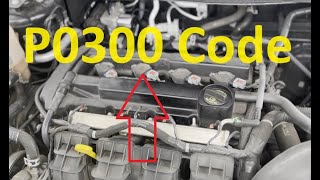
How to confirm: Use a scan tool to check for cylinder-specific misfire codes (P0301-P0304). Swap the suspected bad coil with a coil from a known good cylinder. If the misfire code follows the coil, the coil is faulty. Also inspect the wiring connector to the coil, as some owners report the wire separating from the connector.
Typical fix: Replace the faulty ignition coil. It is often recommended to replace all coils and spark plugs at the same time for long-term reliability.
Est. part cost: $30-$70 per coil - Vacuum Leak 🟡 Medium Probability Hoses and gaskets become brittle over time. A common source is a leaking intake manifold gasket or a cracked vacuum hose, which allows unmetered air into the engine, disrupting the air-fuel ratio.
How to confirm: Listen for a hissing sound around the engine bay at idle. A professional can perform a smoke test to precisely locate the source of the leak. A DIY method involves carefully spraying carburetor cleaner around suspected leak points; a change in engine idle indicates a leak.
Typical fix: Replace the cracked hose or leaking gasket.
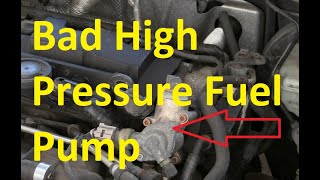
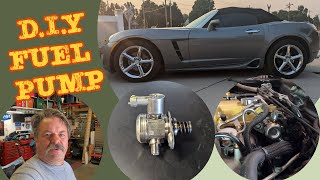
Est. part cost: $10-$150 - Failing High-Pressure Fuel Pump (HPFP) - 2.0L GXP Only 🟡 Medium Probability The LNF engine's direct injection system relies on this mechanical pump, which is a known failure point. Wear and tear can lead to insufficient fuel pressure under load, causing lean misfires.
How to confirm: Requires a scan tool capable of reading high-side fuel pressure (desired vs. actual). The pressure should rise significantly under load. Low or erratic pressure, especially when it deviates from the desired pressure, indicates a problem. This is often accompanied by code P0087.
Typical fix: Replace the high-pressure fuel pump. The OEM part is ACDelco.
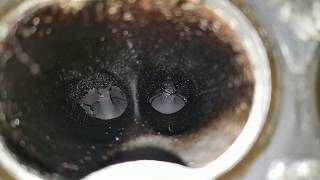
Est. part cost: $250-$500 - Carbon Buildup on Intake Valves - 2.0L GXP Only ⚪ Low Probability Direct injection sprays fuel directly into the cylinder, so it doesn't wash over and clean the intake valves. Over time, oil vapor from the PCV system can bake onto the valves, restricting airflow and causing misfires, especially at idle and on cold starts.
How to confirm: This requires a borescope inspection of the intake ports and valves. It is often diagnosed after eliminating all other possible causes. Misfires that are present at idle but seem to clear up under acceleration can be a strong indicator.
Typical fix: Manual cleaning of the valves (walnut blasting) is the most effective method, as confirmed by owners on forums. Chemical cleaning procedures can also be performed as a less-intensive first step.
Est. part cost: $50 (for chemicals) - $600+ (for professional walnut blasting)
Rare But Worth Checking
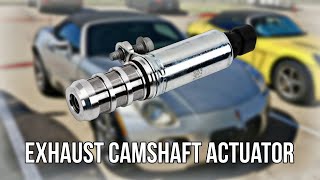
- Faulty Camshaft Position Actuator Solenoids (VVT Solenoids): Both the intake and exhaust VVT solenoids on the 2.4L and 2.0L engines are a very common failure item. They can get clogged with dirty oil, causing them to stick. This disrupts valve timing and can lead to a rough idle, stalling, and random misfires. This issue will often, but not always, be accompanied by codes like P0010, P0011, P0013, or P0014.
- Clogged or Dirty Fuel Injectors: While less common than pump failure on the GXP, injectors can become restricted, causing a lean misfire. This is a potential issue on both 2.4L and 2.0L engines.
- Low Compression / Mechanical Engine Issue: A leaking head gasket or worn piston rings can cause a loss of compression, leading to misfires. This is a serious issue and should be confirmed with a compression test after checking ignition and fuel systems.
- Faulty Camshaft or Crankshaft Position Sensor: These sensors provide critical timing information. If their signals are erratic, it can disrupt ignition and fuel timing, causing random misfires. It's important to distinguish these sensors from the more commonly failing VVT solenoids.
Diagnosis Steps
- Read all stored fault codes with an OBD-II scanner. Note any codes accompanying P0300, as they provide critical clues (e.g., P0087 for HPFP, P0014 for VVT).
- Use the scanner's live data function to monitor misfire counts per cylinder to see if the misfire is truly random or favors specific cylinders.
- Inspect the condition of all four spark plugs. Replace if they are worn, fouled, or damaged. Ensure they are the correct ACDelco/NGK Iridium plugs specified for the engine.
- If misfires are concentrated on one or two cylinders, swap the ignition coil(s) from the misfiring cylinder(s) to known good ones. Clear codes and see if the misfire follows the coil. Inspect the coil wiring harness for damage or loose connections.
- Inspect all vacuum lines and the air intake tube for cracks or loose connections. A smoke test is the most effective way to find a leak.
- For GXP models, use a capable scan tool to monitor high-side fuel pressure (Actual vs. Desired) during idle and under load to check for a failing HPFP.
- Inspect and test the Camshaft Position Actuator Solenoids (VVT). They can be removed, cleaned, and tested. Given their high failure rate and relatively low cost, replacement is often a practical diagnostic step if codes P0010-P0014 are present.
- If all else fails, perform an engine compression test to rule out mechanical issues like a bad head gasket or piston rings.
- For GXP models with high mileage where other causes have been eliminated, consider a borescope inspection for carbon buildup on the intake valves.
Parts You'll Likely Need

- Spark Plugs
(OEM #ACDelco 41-108 (for 2.4L LE5), ACDelco 41-104 (for 2.0L LNF))— This is the most common and simplest fix for a random misfire. They are a routine maintenance item.
Trusted brands: ACDelco, NGK
OEM price range: $30-$60
Aftermarket price range: $20-$40 - Ignition Coil
(OEM #ACDelco D522C (or 12638824))— A common failure item that directly causes misfires. When one fails, others may be near the end of their life.
Trusted brands: ACDelco, Delphi
OEM price range: $50-$80
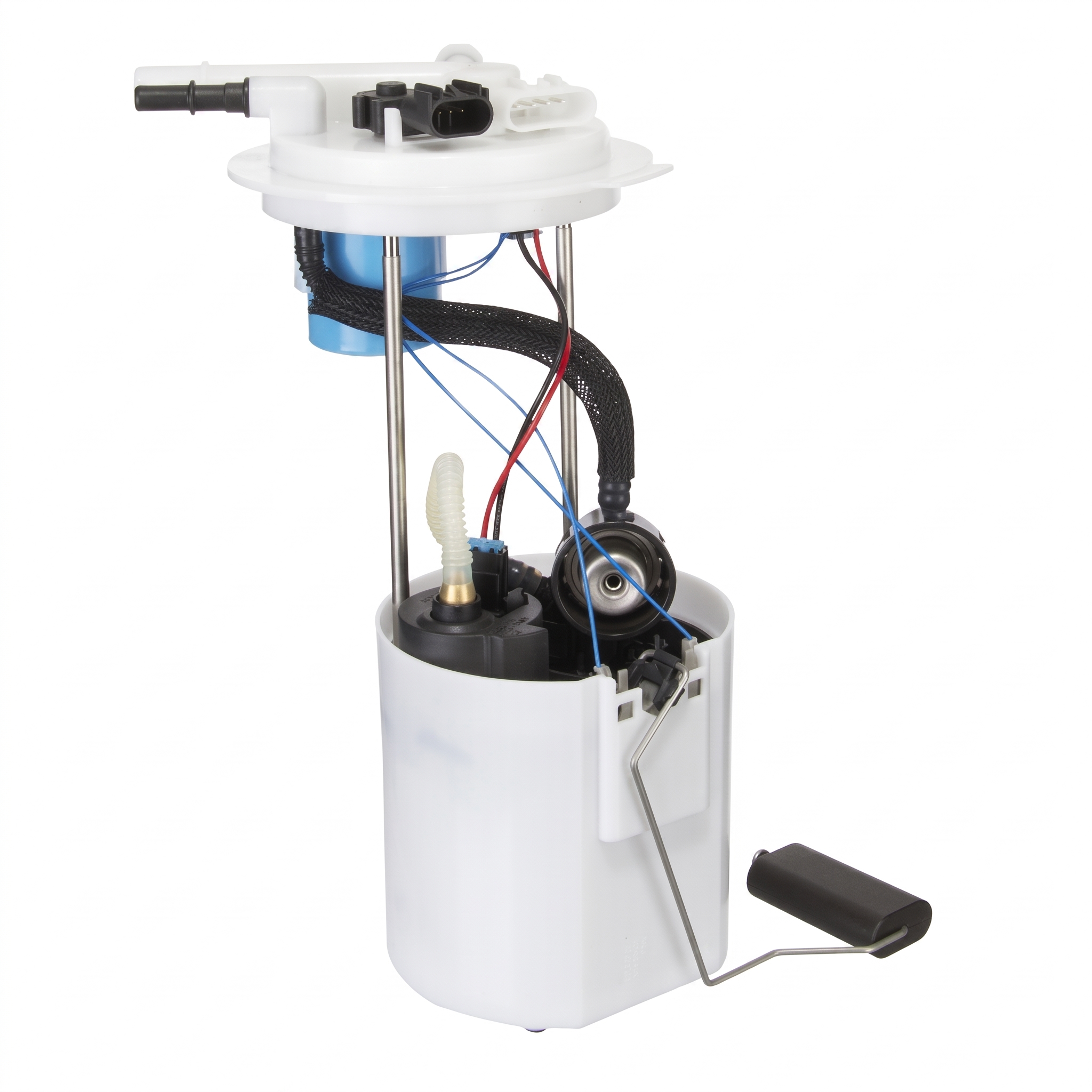
Aftermarket price range: $30-$60 - High-Pressure Fuel Pump (HPFP)
(OEM #ACDelco 12677329 (superseded by 12691016))— A specific and known failure point on the 2.0L LNF GXP engine that leads to fuel starvation misfires under load.
Trusted brands: ACDelco (GM Genuine)
OEM price range: $250-$450
Aftermarket price range: $150-$300 - Camshaft Position Actuator Solenoid
(OEM #Intake: 12655420, Exhaust: 12655421)— A very common failure item on both Ecotec engines that causes rough idle and misfires due to incorrect valve timing. Often clogged by dirty oil.
Trusted brands: ACDelco, Dorman
OEM price range: $40-$60 each
Aftermarket price range: $25-$45 each
Related Codes That Often Appear With This One
- P0301, P0302, P0303, P0304 — These codes indicate a misfire on a specific cylinder. They often accompany P0300 if the misfire is frequent on certain cylinders but also occurs randomly on others.
- P0171 — This code means "System Too Lean (Bank 1)" and often points to a vacuum leak, which allows unmetered air into the engine and is a common cause of random misfires.
- P0087 — This code means "Fuel Rail/System Pressure - Too Low" and on a GXP model, strongly points to a failing high-pressure fuel pump (HPFP).
- P0010, P0011, P0013, P0014 — These codes point directly to faults in the Camshaft Position Actuator Solenoid (VVT) system. A failing solenoid can cause erratic timing and lead to a P0300 misfire code.
- P050D — Mentioned in TSB #PIP5628G, this code for "Cold Start Rough Idle" can appear alongside misfire codes, indicating a potential diagnostic challenge. [TSB #PIP5628G]
Technical Service Bulletins (TSBs) & Recalls
- TSB #PIP5628G: Mentions diagnostic aid for misfire codes P0300-P0308 and P050D (Cold Start Rough Idle).
- TSB #PIP4944A: While not directly for P0300, this TSB addresses rough idle and stalling on LNF engines, sometimes related to the HPFP or fuel system components that could cause a P0300.
Platform-Specific Known Issues

- On 2.0L GXP models, short-trip driving can foul spark plugs, requiring replacement with an updated part number per TSB #07-06-04-010B.
- The 2.0L GXP direct-injected engine is susceptible to carbon buildup on the intake valves, which can cause misfires, especially when cold, as documented in GM service information.
- Aftermarket lightweight crank pulleys on the 2.0L LNF engine have been known to cause false misfire detection at idle.
Mechanic-Grade Diagnostic Values
- VVT Solenoid Resistance — expected: 5 to 15 Ohms. New solenoids typically measure around 12-12.8 Ohms.. Failure: A reading of infinite resistance (open circuit) or significantly outside the 5-15 Ohm range indicates a failed solenoid.
- Ignition Coil Primary Resistance — expected: 0.4 to 2.0 Ohms.. Failure: A reading outside this range suggests a faulty primary winding in the coil.
- Ignition Coil Secondary Resistance — expected: 6,000 to 10,000 Ohms (6k-10k Ω).. Failure: A reading outside this range suggests a faulty secondary winding.
- Low-Side Fuel Pressure (2.4L LE5 Engine) — expected: 40.5 to 47 PSI at idle.. Failure: Pressure significantly below this range indicates a weak fuel pump or clogged filter, leading to a lean condition and misfires.
- High-Side Fuel Pressure (2.0L LNF Engine) — expected: Pressure varies with demand, up to ~2,250 PSI. The critical value is the comparison between 'Desired Fuel Rail Pressure' and 'Actual Fuel Rail Pressure' on a scan tool.. Failure: If the 'Actual' pressure cannot meet the 'Desired' pressure, especially under load, it strongly indicates a failing High-Pressure Fuel Pump (HPFP).
Hidden / Shadow Codes Worth Checking
- Mode $06, Test ID ~$53: While not a 'code', Mode $06 data on a professional scan tool contains misfire counters for each individual cylinder. Even if only a P0300 is stored, a technician can view these counters to see if the 'random' misfire is actually favoring one or two cylinders, which drastically speeds up diagnosis. (see via Requires a scan tool with Mode $06 functionality. The specific Test ID for cylinder misfires can vary, but it is a standard diagnostic feature.)
Scan Tool Commands That Help
- Tech2 / GDS2 or equivalent professional scanner: Crankshaft Position Variation Relearn (CASE Relearn) — This procedure should be performed after replacing a crankshaft position sensor, ECM, or making major engine repairs. Failure to perform the relearn can cause the ECM to inaccurately detect misfires and set a P0300 code even when no mechanical misfire is occurring.
- Tech2 / GDS2 or equivalent: Fuel Injector Balance Test — This bidirectional test commands each injector to fire for a set duration while the scan tool measures the corresponding drop in fuel pressure. It can be used to identify a clogged or weak injector that may be causing misfires on a specific cylinder.
Wiring & Ground Locations
- G102 — At the right front corner of the engine compartment, mounted on the frame rail.. This ground point is specifically cited as the ground for the ignition coils. A poor connection here can cause a weak spark across all cylinders, leading to random misfires.
- G103 — At the left rear of the engine compartment on the cowl, above the brake booster.. This is a critical ground for the Engine Control Module (ECM), Body Control Module (BCM), and the Data Link Connector (DLC). Corrosion or a loose connection here can cause a wide range of erratic electronic issues, including false misfire detection.
- ECM Connector C2 (Pin 1, 2, 20, 21) — The middle of the three large connectors on the Engine Control Module (ECM).. These specific pins on the ECM connector are the control circuits for the four ignition coils. Testing for a signal at these pins can confirm if the ECM is commanding the coils to fire. For example, Pin 1 (PU/WH wire) is for Ignition Coil 1 Control.
Real Owner Repair Stories
- CorvetteForum user (GM Platform) (Chevrolet Corvette (GM V8)) — Persistent P0300 code after other attempted fixes.
❌ Tried (didn't work) Not specified, but implied other common fixes failed.
✅ What actually fixed it Performing a Crankshaft Position (CASE) Relearn procedure using EFI Live scan tool software. - CorvetteForum user (GM Platform) (Chevrolet Corvette (GM V8) with aftermarket plug wires.) — P0300 code appeared after 3 years of using aftermarket plug wires.
❌ Tried (didn't work) Initial diagnosis pointed away from wires as they were relatively new.
✅ What actually fixed it Replacing the aftermarket Taylor plug wires with the factory OEM set resolved the code immediately. The aftermarket wires had developed incorrect resistance over time.
OEM Part Supersession History
12655420→12679099, among others— Standard part revision and improvement by the manufacturer.
Heads up: This is the Intake Camshaft Position Actuator Solenoid (typically has a grey connector). The superseded part is a direct replacement.12655421→12679100, among others— Standard part revision and improvement by the manufacturer.
Heads up: This is the Exhaust Camshaft Position Actuator Solenoid (typically has a black connector). The superseded part is a direct replacement.
Model Year Variations Within This Range
- 2007-2010: The GXP model with the 2.0L LNF Turbo direct-injection engine was introduced in 2007. This engine has unique P0300 causes like HPFP failure and intake valve carbon buildup not present on the 2.4L base model.
- 2009-2010: A coupe body style was introduced for 2009. Also, ABS and a limited-slip differential became standard on the base model, which were previously optional. These changes do not directly affect P0300 causes but are notable platform variations.
- 2006 vs 2007-2009: The 2.4L LE5 engine was rated at 177 hp in early models, while some later documentation rates it at 173 hp. This may reflect a minor tuning change or a change in rating standards over the production run.
Helpful Videos



We Have This Part in Stock


The information in this article is provided for general reference and educational purposes only. Vehicle specifications, procedures, and part compatibility can vary by production date, trim level, and region. Always consult your vehicle's factory service manual and verify part numbers before purchasing or performing repairs. Safety-critical components such as airbags, seat belts, and braking systems should be installed by a qualified professional.
- Pontiac SOLSTICE:
- 🎬 Helpful Videos
- 🛍️ Shop This Part
- What's Unique About the 2006-2010 Pontiac SOLSTICE
- Diagnostic Flowchart
- Symptoms You May Notice
- Most Likely Causes
- Rare But Worth Checking
- Diagnosis Steps
- Parts You'll Likely Need
- Related Codes That Often Appear With This One
- Technical Service Bulletins (TSBs) & Recalls
- Platform-Specific Known Issues
- Mechanic-Grade Diagnostic Values
- Hidden / Shadow Codes Worth Checking
- Scan Tool Commands That Help
- Wiring & Ground Locations
- Real Owner Repair Stories
- OEM Part Supersession History
- Model Year Variations Within This Range
- 🎟️ Get 5% Off