

P0300 on 2017-2019 Honda Ridgeline: Random Misfire Causes and Fixes
On a 2017-2019 Ridgeline, P0300 is most often caused by faulty fuel injectors, a known issue covered by Honda's Technical Service Bulletin (TSB) 21-010. This TSB also led to a warranty extension for this specific repair to 10 years or 150,000 miles. Before suspecting other parts, it is critical to have a Honda dealer check your VIN for warranty coverage, as this is the most probable cause.
- P0300 on a 2017-2019 Ridgeline is very likely caused by faulty fuel injectors.
- Honda has a warranty extension (10 years / 150,000 miles) for this specific issue. Always check with a dealer first.
- Do not replace catalytic converters or O2 sensors for codes P0420/P0430 until the fuel injector issue has been ruled out.
- If the check engine light is flashing, stop driving immediately to prevent expensive catalytic converter damage.
- The correct repair is to replace all six fuel injectors as a set, along with associated seals and gaskets.
What's Unique About the 2017-2019 Honda RIDGELINE

The 3.5L V6 direct-injection engine in this generation of Ridgeline is known for a specific fuel injector issue. Debris from the manufacturing process of the high-pressure fuel pump or the injectors themselves can cause them to clog or fail internally. This problem is so prevalent that Honda issued TSB 21-010 (which superseded A18-025) and extended the warranty coverage for the fuel injectors to 10 years or 150,000 miles for affected vehicles. Therefore, P0300 on this truck, especially when accompanied by codes like P219A/B or P0420/P0430, is very frequently linked to this specific, documented injector problem.
Diagnostic Flowchart
Tap your situation to follow the diagnostic path that matches what you're seeing on this vehicle.
Symptoms You May Notice
- Rough or vibrating idle.
- Hesitation or stumbling during acceleration, sometimes described as a "fish bite" sensation.
- Solid or flashing Check Engine Light.
- Reduced engine power and poor performance.
- Poor fuel economy.
- Engine may be hard to start.
- Smell of raw fuel from the exhaust.
- Replacing oxygen sensors or catalytic converters when the root cause is the fuel injectors. The TSBs specifically note that injector issues can trigger codes P0420/P0430, falsely implicating the catalytic converters. Always address the injector TSB first.
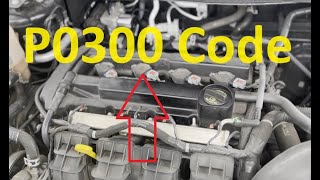
- Replacing only one or two ignition coils when the issue is fuel-related. This will not solve a random misfire 🎬 Watch this overview of common P0300 causes and fixes. caused by the injectors.
Most Likely Causes

- Faulty Fuel Injectors 🔴 High Probability Debris from the high-pressure pump or injector manufacturing can cause clogging or internal wear. This is a well-documented issue acknowledged by Honda in TSB 21-010.
How to confirm: The primary confirmation is through a Honda dealer. Provide your VIN to check for eligibility under the fuel injector warranty extension (TSB 21-010). A scan tool showing accompanying codes like P219A/P219B or P0420/P0430 is a strong indicator. The dealer may also perform a "Cylinder AF Test" with the Honda Diagnostic System (HDS) to confirm.
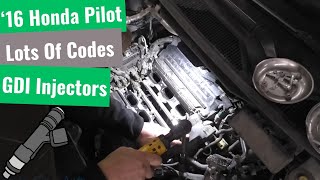
Typical fix: Replace all six fuel injectors as a set using the updated part kit. 🎬 Watch this step-by-step guide on replacing GDI fuel injectors. This is often covered under the 10-year/150,000-mile warranty extension.
Est. part cost: $235-$422 (OEM Kit) - Worn or Fouled Spark Plugs 🟡 Medium Probability Spark plugs are a standard maintenance item. While not a specific platform weakness, worn plugs are a common cause of misfires on any vehicle as they approach their service life (typically around 100,000 miles).
How to confirm: Remove and visually inspect the spark plugs for wear on the electrode, carbon buildup, oil fouling, or cracks in the porcelain. Check if the installed plugs are the correct OEM-spec NGK Laser Iridium plugs.
Typical fix: Replace all six spark plugs. It is highly recommended to use the OEM-spec NGK plugs to avoid compatibility issues.
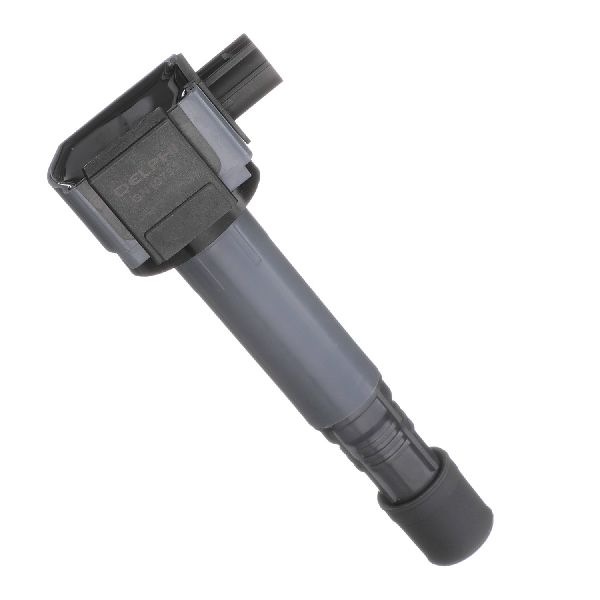
Est. part cost: $15-$25 per plug - Faulty Ignition Coil ⚪ Low Probability Ignition coil failure is not a widespread issue on this platform but can occur on an individual basis like on any modern vehicle. It is rare for multiple coils to fail simultaneously.
How to confirm: Use a scan tool with live data (Mode $06) to identify which cylinders have the highest misfire counts. Swap the ignition coil from a misfiring cylinder with one from a known good cylinder. Clear the codes and drive the vehicle. If the misfire code changes to the new cylinder (e.g., P0303 becomes P0301 after swapping coils from cylinder 3 to 1), the coil is bad.
Typical fix: Replace the single faulty ignition coil. It's often wise to use OEM (Honda) or the original equipment manufacturer (Hitachi).
Est. part cost: $60-$90
Rare But Worth Checking
- Vacuum Leak: A leak in a vacuum hose, PCV system, or intake manifold gasket can introduce unmetered air, leading to a lean air-fuel mixture and random misfires. A smoke test is the most effective way to find a leak.
- Low Fuel Pressure: While less common than the injector issue on this platform, a failing in-tank fuel pump or a problem with the high-pressure fuel pump can cause insufficient fuel supply, leading to misfires under load.
- Clogged Catalytic Converter: If a long-term misfire has been ignored, the catalytic converter can become clogged with unburnt fuel, creating excessive backpressure and causing more misfires. This will usually be accompanied by a P0420 or P0430 code. In some cases, owners have reported needing converter replacement after the injector fix due to damage from the initial problem.
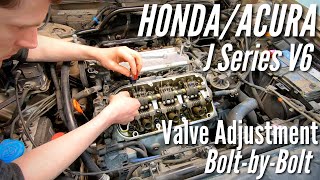
- Valve Adjustment Needed: Honda J-series engines can develop misfires if the valve clearances become too tight over time. While more common on older port-injected versions, it's still a possibility, especially on higher mileage engines. This often presents as a rough idle when warm. 🎬 See how to perform a valve adjustment on the J-series engine.
Diagnosis Steps
- Contact a Honda dealer with your VIN. This is the most critical first step. Ask them to check for eligibility under the warranty extension for fuel injectors (TSB 21-010). Due to the high probability of this being the cause, this can save significant diagnostic time and money.
- If the dealer confirms eligibility, have them perform the warranty repair. This typically involves replacing all six fuel injectors.
- If not covered by warranty, proceed with standard diagnosis. Use a scan tool to check for other codes (P219A/B, P0420/P0430 strongly suggest injectors) and view live misfire data (Mode $06) to see which cylinders are most affected.
- Inspect the spark plugs. Remove them and check for wear, fouling, or incorrect gap. Replace with OEM-spec plugs if they are worn or past their service life.
- If misfires are concentrated on one or two cylinders, swap the ignition coil(s) with known good cylinders to see if the misfire moves with the coil.
- If plugs and coils are good, the fuel injectors remain the most likely cause. The repair involves replacing all six injectors with the updated kit.
- If the problem persists, perform a smoke test to check for vacuum leaks and test fuel pressure to rule out a weak fuel pump.
- For higher mileage engines, consider a valve adjustment if all other causes have been ruled out.
Parts You'll Likely Need

- Fuel Injector Set
(OEM #16010-RLV-315)— This is the most common cause of P0300 on this vehicle, as documented by Honda's own service bulletins. The part is a kit that includes all 6 injectors and required seals.
Trusted brands: Genuine Honda
OEM price range: $235-$422 (for a set of 6)
Aftermarket price range: $150-$250 (for a set of 6) - Spark Plug
(OEM #NGK DILKAR7K11S (Honda P/N: 12290-R9P-A01))— Standard maintenance item that can cause misfires when worn.
Trusted brands: NGK
OEM price range: $20-$30
Aftermarket price range: $15-$25 - Ignition Coil
(OEM #30520-5G0-A01)— A less common but possible cause of misfires. Failure is typically isolated to a single coil.
Trusted brands: Genuine Honda, Hitachi
OEM price range: $60-$90
Aftermarket price range: $40-$70
Related Codes That Often Appear With This One
- P0301-P0306 — As the random misfire becomes more consistent on specific cylinders, the ECM will log a cylinder-specific code. The TSB applies to these codes as well.
- P219A / P219B — These codes indicate an air-fuel ratio imbalance between cylinders and are explicitly mentioned in the fuel injector TSBs as being directly related to the injector problem.
- P0420 / P0430 — These catalyst efficiency codes can be triggered either by a PCM software misinterpretation or by actual damage to the catalytic converters from prolonged misfiring. The TSB addresses both possibilities, but the primary fix is replacing the injectors.
Technical Service Bulletins (TSBs) & Recalls
- 21-010: Warranty Extension: MIL Comes On with DTC P0420/P0430, P030x, and/or P219A/B (Without Software Update).
- A18-025: MIL Comes On with DTC P0300-P0306 or P219A/B (Superseded by 21-010).
Platform-Specific Known Issues
- Honda has issued Technical Service Bulletin 21-010, which supersedes A18-025, for this exact issue. It acknowledges that debris from the high-pressure pump or injector machining can cause fuel injectors to fail, leading to misfires and related codes.
- American Honda extended the warranty for this specific repair to 10 years from the original purchase date or 150,000 miles, whichever comes first, for eligible vehicles.
- Owner experiences on forums like Reddit show that even if a VIN is not initially listed as eligible, some owners have had success asking the dealer service advisor to file a 'Goodwill' claim with Honda of America, which has resulted in Honda covering 80-100% of the repair cost.
- Failure to address the misfire can lead to consequential damage to the catalytic converters, which is a much more expensive repair and may not be covered by the goodwill extension.
Mechanic-Grade Diagnostic Values
- Valve Clearance (Cold Engine) — expected: Intake: 0.20-0.24 mm (0.008-0.009 in), Exhaust: 0.28-0.32 mm (0.011-0.013 in). A common practice is to set them to 8 thousandths for intake and 12 thousandths for exhaust.. Failure: Valves that are too tight (no clearance) can cause misfires, especially on a cold start. Valves that are too loose will create audible valve train noise.
- Ignition Coil Primary Winding Resistance — expected: Approximately 0.49—0.57 ohms.. Failure: A reading outside of this range indicates a faulty coil. However, a coil can still be bad even if it tests within spec.
- Ignition Coil Secondary Winding Resistance — expected: Approximately 9.5—11.1 kilohms.. Failure: An open circuit (OL) or a reading significantly outside this range indicates a faulty coil.
Scan Tool Commands That Help

- Honda Diagnostic System (HDS) / i-HDS: Cylinder AF Test (Air-Fuel Test) — This is a dealer-level function used to pinpoint which specific cylinder has an air-fuel ratio deviation, which is extremely useful for confirming a faulty injector when codes P219A/B are present with P0300.
- Honda Diagnostic System (HDS) / i-HDS: CKP (Crankshaft Position) Pattern Relearn — This procedure should be performed after any work involving the crankshaft position sensor or timing components to ensure the ECM has an accurate reference for detecting misfires.
- Honda Diagnostic System (HDS) / i-HDS: Snapshot Function — Allows a technician to capture real-time ECU parameter data at the moment a misfire or other trigger event occurs, helping to diagnose intermittent issues.
Wiring & Ground Locations
- Engine Bay Grounding Point (Community-Identified) — There is a pre-threaded but unused M6 bolt hole on the chassis frame, located to the right of the airbox near the passenger-side fender.. The factory ground connection point is difficult to access for jump-starting or testing, as it is under an air intake cover. Owners add a 40mm M6-1.0 bolt to this empty hole to create a clean, accessible ground point, which can help rule out poor grounding as an intermittent cause of electrical issues, including misfires.
- Main Battery Ground Cable — Connects the negative battery terminal to the vehicle chassis. The OEM part number is 32600-TG7-A50.. A corroded or loose main ground cable can cause a host of random electrical problems, including weak spark and erratic sensor readings that can lead to a P0300 code. Ensuring this connection is clean and tight is a fundamental diagnostic step.
Real Owner Repair Stories
- YouTube - Pine Hollow Auto Diagnostics (Honda Accord V6 (similar J-series engine)) — Rough running at idle, setting a P0300 code.
❌ Tried (didn't work) Initial diagnosis pointed towards common causes, but the technician suspected a mechanical issue.
✅ What actually fixed it A valve clearance adjustment fixed the issue. Several exhaust valves were found to have zero clearance (too tight), causing a misfire at idle. After adjusting the valves to the correct specification (8 thousandths for intake, 12 thousandths for exhaust), the rough idle and P0300 code were resolved without replacing any parts. - Reddit user on r/hondaridgeline (2017 Honda Ridgeline) — Check engine light, misfire codes.
❌ Tried (didn't work) Dealer initially played dumb about warranty coverage for the known fuel injector issue.
✅ What actually fixed it The owner presented the dealer with the NHTSA document for the warranty extension (TSB 21-010). The dealer then agreed to replace all six fuel injectors under the extended warranty, which resolved the misfire codes.
When the Usual Fixes Don't Work
- While the fuel injector TSB is the most common cause, it is not the only one. In higher mileage (100k+) J35Y6 engines, or in cases where the P0300 code returns after the injector replacement, a valve adjustment becomes a very strong possibility. Tight exhaust valves are a known cause of misfires on Honda J-series engines and can present with identical symptoms. One owner of a similar V6 had a P0300 code completely resolved by a valve adjustment after finding multiple valves with no clearance.
OEM Part Supersession History
16010-RLV-305 (Injectors)→16010-RLV-315 (Injectors)— Updated part to address the internal debris and failure issues outlined in the TSBs.
Heads up: The official repair kit specified in the TSB is part number 06160-RLV-305. This kit contains the set of updated injectors and all necessary seals and gaskets for the replacement job.
Helpful Videos
Used OEM Parts in Stock


New Aftermarket Parts Available


The information in this article is provided for general reference and educational purposes only. Vehicle specifications, procedures, and part compatibility can vary by production date, trim level, and region. Always consult your vehicle's factory service manual and verify part numbers before purchasing or performing repairs. Safety-critical components such as airbags, seat belts, and braking systems should be installed by a qualified professional.
- Honda RIDGELINE:
- 🎬 Helpful Videos
- 🛍️ Shop This Part
- What's Unique About the 2017-2019 Honda RIDGELINE
- Diagnostic Flowchart
- Symptoms You May Notice
- Most Likely Causes
- Rare But Worth Checking
- Diagnosis Steps
- Parts You'll Likely Need
- Related Codes That Often Appear With This One
- Technical Service Bulletins (TSBs) & Recalls
- Platform-Specific Known Issues
- Mechanic-Grade Diagnostic Values
- Scan Tool Commands That Help
- Wiring & Ground Locations
- Real Owner Repair Stories
- When the Usual Fixes Don't Work
- OEM Part Supersession History
- 🎟️ Get 5% Off