

P0300 on 2017-2018 Honda CR-V 1.5T: Random Misfire Causes and Fixes
P0300 on a 2017-2018 CR-V is most often caused by a known oil dilution issue that requires a software update from a Honda dealer. This fix is covered under a warranty extension. The underlying cause is unburned fuel contaminating the engine oil, especially during short trips in cold weather. If the software update has been performed, fouled spark plugs or faulty/leaking fuel injectors are the next most likely causes.
- The most likely cause of P0300 on a 2017-2018 CR-V is a known oil dilution issue that Honda has issued a fix for.
- Your first step should be to contact a Honda dealer to see if your vehicle needs the free software update covered by a warranty extension.
- Do not ignore a flashing check engine light, as it signals a severe misfire that can cause expensive catalytic converter damage.
- If the software update has been performed, the next most common causes are fouled spark plugs or faulty fuel injectors.
What's Unique About the 2017-2018 Honda CR-V

The 2017-2018 CR-V with the 1.5L Turbo engine is known for a specific issue where gasoline can dilute the engine oil. This happens because the direct fuel injection system can spray fuel onto cold cylinder walls during short trips or in cold climates, which then seeps past the piston rings into the oil pan. 🎬 Watch: A deep dive into why oil dilution happens. This 'oil dilution' problem degrades the oil's viscosity and lubricating properties, leading to drivability problems and triggering random misfires (P0300). Honda has acknowledged this by issuing multiple Technical Service Bulletins (TSBs) and a warranty extension to correct the software and related components.
Diagnostic Flowchart

Tap your situation to follow the diagnostic path that matches what you're seeing on this vehicle.
Symptoms You May Notice

- Rough or unstable idle
- Hesitation or stumbling during acceleration
- Noticeable loss of engine power
- Flashing or solid Check Engine Light
- Fuel smell from the exhaust or inside the cabin
- Engine stalling in some cases
- Oil level on the dipstick is unusually high and smells strongly of gasoline.
- Multiple, unrelated warning lights appearing simultaneously (Emissions System, Brake System, Power Steering, etc.).
- Replacing only ignition coils or spark plugs without first checking with a Honda dealer for the required software update. The primary cause for this specific vehicle is often the software logic, and replacing parts alone may not provide a permanent fix if the oil dilution continues.
Most Likely Causes

- Engine Control Module (ECM) Software 🔴 High Probability Early software versions for the 1.5T engine did not manage engine warm-up effectively in cold conditions, allowing excess fuel to wash past piston rings and dilute the oil. This was the primary subject of multiple TSBs and product updates from Honda.
How to confirm: A Honda dealer must check your vehicle's VIN against their database for open product updates or warranty extensions, specifically referencing TSBs like A18-114 and A19-037. This should be the first step in any diagnosis.
Typical fix: The dealer performs a software update for the PGM-FI (Programmed Fuel Injection) and Transmission Control Unit (TCU). This update changes the engine warm-up strategy. An oil change is also performed. In some cases, the A/C control unit itself is replaced as part of the campaign.
Est. part cost: $0 (if covered by warranty extension or product update) - Fouled or Worn Spark Plugs 🟡 Medium Probability Oil dilution and the resulting rich fuel mixture can quickly cause spark plugs to become fouled with fuel or carbon deposits, preventing a proper spark. TSB A19-037 explicitly includes spark plugs as a component covered by the warranty extension if they fail due to this issue.
How to confirm: Remove the spark plugs and inspect them for black, sooty deposits, a wet appearance from fuel, or oil contamination. Also check for a worn electrode or an incorrect gap.
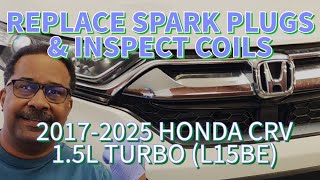
Typical fix: Replace all four spark plugs. 🎬 See this walkthrough for replacing your spark plugs and coils. It is critical to use the correct OEM-spec Iridium plugs from NGK or Denso.
Est. part cost: $80-$120 - Faulty or Leaking Fuel Injectors 🟡 Medium Probability The direct injection system operates under very high pressure. Injectors can become clogged, leak, or get stuck open, which directly contributes to both the oil dilution problem and random misfires. Some owners report needing injector replacement even after the software fix.
How to confirm: This is difficult to diagnose at home. A professional can perform a fuel injector balance test or use a scan tool to monitor fuel trims for signs of a rich condition. A strong smell of fuel in the oil is a major clue.
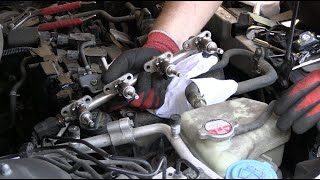
Typical fix: Replace the faulty fuel injector(s). Honda sells them as a complete kit (part #06160-5PA-305) that includes all four injectors and the fuel feed pipe, as they are often replaced as a set. 🎬 Watch: Step-by-step guide to replacing your fuel injectors.
Est. part cost: $550-$850 for the OEM kit - Failing Ignition Coils ⚪ Low Probability While not a specific weakness tied to the oil dilution issue, ignition coils are a common cause of misfires on any modern engine. Heat and vibration eventually cause them to fail.
How to confirm: If you have a specific cylinder misfire code (e.g., P0302) along with P0300, swap the ignition coil from the misfiring cylinder with one from a good cylinder. If the code follows the coil (e.g., changes to P0303), the coil is bad.
Typical fix: Replace the faulty ignition coil.
Est. part cost: $50-$90 per coil
Rare But Worth Checking
- Internal Engine Damage (Camshafts, Rocker Arms): In severe or prolonged cases of oil dilution, the thinned oil fails to provide adequate lubrication, which can cause premature wear or damage to internal engine components. Honda's warranty extension (TSB A19-037) specifically covers camshafts and rocker arm assemblies for this reason, indicating it's a known, albeit rare, consequence. This is a worst-case scenario and is often accompanied by a distinct whirling or ticking noise from the engine.
- Carbon Buildup on Intake Valves: As a direct-injection engine, the 1.5T is susceptible to carbon buildup on the intake valves over time because fuel is not sprayed over them to keep them clean. This buildup disrupts airflow and can cause misfires, especially on cold starts. This typically becomes a problem at higher mileage (e.g., 50,000-80,000 miles) and requires professional cleaning like walnut blasting.
Diagnosis Steps
- Check with a Honda dealer to see if your vehicle's VIN is eligible for the warranty extension and has had the software update (related to TSBs A18-114, A19-037, etc.). This should always be the first step and is a free check.
- Scan for any other accompanying trouble codes, such as P0172 or specific cylinder misfire codes (P0301-P0304).
- Inspect the engine oil level and smell. Pull the dipstick. An unusually high oil level or a strong smell of raw gasoline is a key indicator of the oil dilution issue.
- Remove and inspect all four spark plugs. Look for signs of heavy carbon fouling, fuel saturation (wetness), or oil contamination. Replace if they are worn or fouled, as they are often a casualty of the main problem.
- If a specific cylinder misfire code is present (e.g., P0301), swap the ignition coil with a known good cylinder (e.g., cylinder 2) to see if the misfire code follows the coil (e.g., changes to P0302).
- If the software is up to date and spark/ignition components are good, the fuel injectors are the next likely suspect. Professional diagnosis via a balance test or fuel trim analysis is recommended.
- At higher mileage (>60,000 miles), if misfires persist especially on cold starts, consider carbon buildup on intake valves. This requires a borescope inspection or intake manifold removal to confirm.
Parts You'll Likely Need
- Spark Plugs
(OEM #12290-5PA-A01)— Often become fouled due to the rich conditions and oil dilution, leading to a weak or inconsistent spark. They are a frequent casualty of the root problem and are covered by the warranty extension if damaged by this condition.
Trusted brands: NGK (OEM), Denso (OEM)
OEM price range: $25-$35 per plug
Aftermarket price range: $20-$28 per plug - Ignition Coil
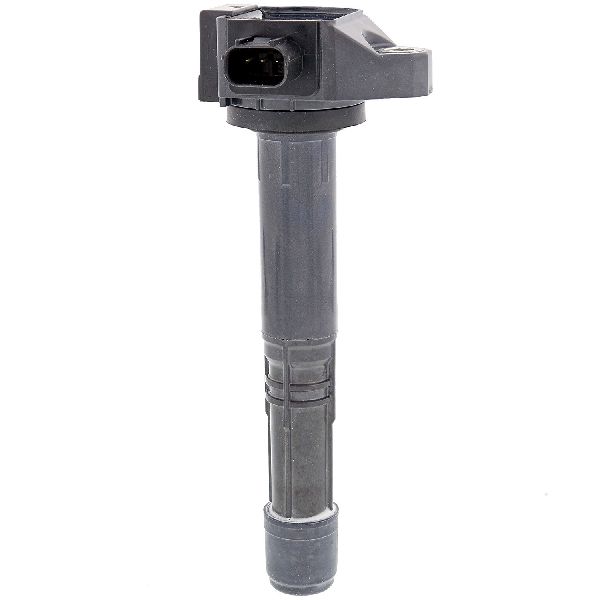
(OEM #30520-59B-013)— A common failure point for misfires on any vehicle. While not the primary platform-specific cause, it's a possibility that's easy to diagnose via swapping.
Trusted brands: NGK, Bosch, Hitachi
OEM price range: $70-$90
Aftermarket price range: $45-$75 - Fuel Injector Kit
(OEM #06160-5PA-305)— Faulty or leaking injectors can be a root cause of the fuel mixture issues that lead to oil dilution and misfires. Often required if the software update and new plugs do not solve the problem.
Trusted brands: Honda (OEM)
OEM price range: $550-$850 for the kit
Aftermarket price range: Not commonly available
Related Codes That Often Appear With This One
- P0172 — Stands for 'System Too Rich (Bank 1)'. This code is frequently seen with P0300 because the underlying causes, such as leaking fuel injectors or incorrect software parameters, introduce too much fuel into the combustion chamber, leading to both oil dilution and misfires.
- P0301, P0302, P0303, P0304 — These codes indicate a misfire on a specific cylinder (1, 2, 3, or 4). They often accompany P0300 when the random misfire begins to occur more frequently on certain cylinders, helping to pinpoint if a single component like a coil or injector is starting to fail completely.
Technical Service Bulletins (TSBs) & Recalls
- A19-037: Warranty Extension for 2017-18 CR-V for DTCs P0300, P0301-P0304, or P0172, and/or a whirling engine noise. Extends warranty on components like camshafts and rocker arms to 6 years/unlimited miles.
- A18-114: Product Update for 2017-18 CR-V. Involves software updates for the PGM-FI (engine) and TCU (transmission), an oil change, and sometimes replacement of the A/C control unit to fix drivability issues.
- A18-147: Superseded by TSB 19-032. This was an earlier version of the software update and A/C control unit replacement procedure.
Platform-Specific Known Issues
- Engine Oil Dilution: The most significant issue for this vehicle. Caused by unburned fuel getting past the piston rings and mixing with the engine oil, primarily during short drives in cold climates. This degrades the oil's lubricating properties and triggers misfires. Honda addressed this with a software update (TSB 18-114) and warranty extension (TSB 19-037).
- Warranty Extension (TSB A19-037): Honda extended the powertrain warranty to 6 years/unlimited miles for affected components like camshafts, rocker arm assemblies, and spark plugs if they are damaged as a result of the oil dilution issue. Owners should always have a dealer check their VIN for eligibility before paying for related repairs.
Mechanic-Grade Diagnostic Values
- High-Pressure Fuel System — expected: Up to 200 bar (2900 psi). Failure: Significantly lower pressure under load may indicate a failing high-pressure fuel pump.
- Turbocharger Boost Pressure — expected: 18.5 psi (1.28 bar). Failure: Lower than specified boost under wide-open throttle can indicate a leak or a problem with the electronic wastegate.
- Long-Term Fuel Trim (LTFT) at idle and cruise — expected: Within +/- 10%. Failure: Consistently high positive values (e.g., > +20%) suggest the ECU is adding fuel to compensate for a vacuum leak or a weak fuel system, common precursors to a P0300 code.
- Injector Pulse Width — expected: Typically 1-10 milliseconds (ms), varying with load and RPM.. Failure: An unusually long pulse width at idle could indicate the ECU is trying to compensate for a lean condition, while a very short pulse width could indicate a leaking injector causing a rich condition.
Hidden / Shadow Codes Worth Checking
- Mode $06 Misfire Counters (e.g., CYL1 MISFIRE): This is not a DTC, but live data accessible via advanced scan tools. It provides a running count of misfire events per cylinder, even before they are frequent enough to set a P0301-P0304 code. It is invaluable for seeing which cylinder(s) are contributing most to a P0300. (see via A professional scan tool or Honda HDS is required to view Mode $06 data or the specific misfire counters.)
Scan Tool Commands That Help
- Honda HDS (or equivalent professional scanner): CKP Pattern Clear / CKP Pattern Learn — This procedure must be performed after replacing the crankshaft position (CKP) sensor or making major mechanical changes. It synchronizes the sensor with the crankshaft's unique magnetic signature. Failing to do this can cause the ECU to falsely detect misfires and set a P0300 code.
- Honda HDS: PGM-FI and TCU Software Update — This is the primary fix for the oil dilution issue. It updates the fuel and transmission control logic to help the engine warm up faster, reducing the window for fuel to seep into the oil. This is detailed in TSB A18-114.
- Honda HDS: Reset Throttle Position Learned Values / PCM Idle Learn Procedure — These resets are required after the PGM-FI software update to ensure the throttle body and idle control systems are calibrated to the new software parameters.
Wiring & Ground Locations
- G101 — Main ECU ground, typically located on the thermostat housing on the engine block.. A corroded or loose G101 ground can cause erratic ECU behavior, leading to incorrect sensor readings and phantom misfire codes. It is a critical power and logic ground for the entire engine management system.
- Battery Ground Cable Assembly (PN: 32600-TLA-A00) — Connects the battery negative terminal to the chassis and transmission case.. The ground connection point on the transmission case is known to corrode. A poor ground path for the engine block can affect the signals from critical sensors like the crank and cam sensors, leading to misfire detection issues.
Real Owner Repair Stories
- Reddit user in r/accord (2018 Honda CR-V) — Vehicle required fuel injector replacement.
❌ Tried (didn't work) Not specified, but the issue was diagnosed as needing new injectors.
✅ What actually fixed it The dealer identified faulty fuel injectors. However, the owner was informed that the original part number (16010-5PA-305) was discontinued and the superseding part (06160-5PA-305) was on critical backorder, indicating a widespread issue and parts shortage.
OEM Part Supersession History
16010-5PA-305→06160-5PA-305— Unknown, but part number changes often indicate a revision to address a known issue or a change in manufacturer.
Heads up: The original part number is no longer available. The new kit, 06160-5PA-305, includes all four injectors and the fuel feed pipe and is the correct replacement.
Model Year Variations Within This Range
- 2017-2018: While the core engine is the same, the 1.5T in the CR-V has a specific tune, with a boost pressure of 18.5 psi and a 10.3:1 compression ratio. This differs from the same L15B7 engine in the Civic Si (20.3 psi boost) or standard Civic (16.5 psi boost, 10.6:1 CR). These differences are why the CR-V has its own specific PGM-FI software and is uniquely susceptible to the oil dilution issue under certain driving conditions.
Helpful Videos

Used OEM Parts in Stock


New Aftermarket Parts Available


The information in this article is provided for general reference and educational purposes only. Vehicle specifications, procedures, and part compatibility can vary by production date, trim level, and region. Always consult your vehicle's factory service manual and verify part numbers before purchasing or performing repairs. Safety-critical components such as airbags, seat belts, and braking systems should be installed by a qualified professional.
- Honda CR-V:
- 🎬 Helpful Videos
- 🛍️ Shop This Part
- What's Unique About the 2017-2018 Honda CR-V
- Diagnostic Flowchart
- Symptoms You May Notice
- Most Likely Causes
- Rare But Worth Checking
- Diagnosis Steps
- Parts You'll Likely Need
- Related Codes That Often Appear With This One
- Technical Service Bulletins (TSBs) & Recalls
- Platform-Specific Known Issues
- Mechanic-Grade Diagnostic Values
- Hidden / Shadow Codes Worth Checking
- Scan Tool Commands That Help
- Wiring & Ground Locations
- Real Owner Repair Stories
- OEM Part Supersession History
- Model Year Variations Within This Range
- 🎟️ Get 5% Off