

P0300 on 2012-2016 GMC Sierra Denali: Random Misfire Causes and Fixes
P0300 on a 2012-2016 GMC Sierra Denali indicates a random or multiple cylinder misfire. While common causes like spark plugs or coils are possible, this code on these trucks frequently points to a more serious issue with the Active Fuel Management (AFM) system, such as a collapsed lifter. The repair can be costly, often requiring replacement of lifters, the Valve Lifter Oil Manifold (VLOM), and sometimes the camshaft.
- P0300 on a 2012-2016 Sierra Denali is a serious code that should be addressed immediately.
- The most likely cause is a failure within the Active Fuel Management (AFM) system, specifically a collapsed or stuck lifter.
- Listen for a distinct ticking or tapping sound from the engine, as this is a key symptom of lifter failure.
- Repair is complex and expensive, often requiring replacement of lifters, the camshaft, and other related components.
- While you should check basic ignition and fuel components first, be prepared for the possibility of a major mechanical repair.
What's Unique About the 2012-2016 Gmc SIERRA DENALI

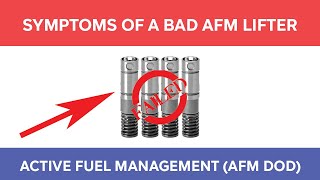
The 2012-2016 GMC Sierra Denali, particularly models with the 5.3L and 6.2L V8 engines, uses an Active Fuel Management (AFM) or Displacement on Demand (DoD) system. This system is designed to improve fuel economy by deactivating half of the engine's cylinders (specifically cylinders 1, 7, 4, and 6) under light loads. Unfortunately, the AFM lifters are a notorious failure point, often collapsing or getting stuck due to issues with oil pressure, contamination, or internal pin failure. 🎬 See common symptoms and causes of AFM lifter failure This directly leads to misfires and the P0300 code. A critical component, the Valve Lifter Oil Manifold (VLOM), controls oil flow to these lifters and is also a common failure point. As a result, a P0300 code on this truck is more likely to be a significant mechanical issue than on many other vehicles.
Diagnostic Flowchart

Tap your situation to follow the diagnostic path that matches what you're seeing on this vehicle.
Generation note: This range covers the end of the second generation (2012-2013) and the beginning of the third generation (2014-2016 K2XX platform). Both generations feature V8 engines with Active Fuel Management (AFM), and the associated lifter issues are common across these model years. The 2014+ models feature the newer EcoTec3 engine family (5.3L L83, 6.2L L86), but still suffer from similar AFM-related problems, as documented in TSBs like 15-06-01-002.
Symptoms You May Notice

- Rough or shaking idle.
- Engine stumbling or hesitating during acceleration.
- Flashing Check Engine Light, especially under load.
- Noticeable loss of engine power.
- A distinct ticking or tapping noise from the upper engine, which may sound like a loud clock.
- Increased oil consumption, sometimes a precursor or related symptom due to PCV issues or ring wear.
- Hard starting.
- A 'StabiliTrak' service message appearing on the dash simultaneously with the check engine light.
- Replacing only spark plugs when the underlying cause is a failing AFM lifter. The new plugs will soon foul, and the misfire will return.
- Replacing an oxygen sensor. While a faulty O2 sensor can affect fuel trim, it's less likely to be the primary cause of a significant random misfire on this platform compared to mechanical issues.
- Replacing only the collapsed lifter. TSBs and best practices recommend replacing the entire bank of lifters, the VLOM, and inspecting the camshaft to prevent a repeat failure, which is very common if only one part is addressed.
Most Likely Causes

- Failed Active Fuel Management (AFM) Lifters 🔴 High Probability The complex design of the AFM lifters makes them prone to collapsing or getting stuck, either from oiling issues, contamination of the VLOM filter screen, or inherent design flaws in the lifter's locking pins. This is a widely documented problem on these GM V8 engines, confirmed by numerous TSBs.
How to confirm: Diagnosis often starts with listening for a characteristic ticking noise. A mechanic will use a scan tool to view misfire data on specific cylinders, often finding them concentrated on AFM cylinders (1, 4, 6, 7). Confirmation requires removing the valve covers and cylinder heads to inspect the lifters and camshaft. A bent pushrod is also a common finding that points directly to a collapsed lifter.
Typical fix: Replace all AFM lifters on the affected bank, or more commonly, all 16 lifters (8 AFM, 8 standard). The camshaft is often damaged by the failed lifter and requires inspection and likely replacement. The Valve Lifter Oil Manifold (VLOM) is also frequently replaced as a precaution or known failure point. Many owners opt for an 'AFM delete kit' which replaces the problematic components with standard, more reliable lifters and requires an ECU tune to disable the system.
Est. part cost: $400-$1500 - Worn Spark Plugs and/or Faulty Ignition Coils 🟡 Medium Probability While a common issue on any vehicle, oil consumption related to the AFM system or a faulty PCV system can foul spark plugs prematurely, leading to misfires. Carbon tracking on the plug's ceramic can cause a persistent misfire even if the plug looks otherwise okay.
How to confirm: Inspect the spark plugs for wear, incorrect gap, or fouling from oil or carbon. A plug from a misfiring cylinder may be black and oily. Ignition coils can be tested by swapping a coil from a misfiring cylinder to a known good cylinder to see if the misfire follows the coil.
Typical fix: Replace all spark plugs and/or the faulty ignition coil(s). It is recommended to use high-quality OEM-spec parts like ACDelco Iridium plugs (e.g., 41-162 for many applications). Do not attempt to gap Iridium plugs as they are preset.
Est. part cost: $80-$300 - Clogged or Faulty Fuel Injectors 🟡 Medium Probability On the 2014+ direct injection engines, injectors can become clogged over time. More seriously, they can leak fuel into the cylinder after shutdown, which can lead to a hydrolock condition on startup, potentially bending a pushrod or damaging a lifter.
How to confirm: A professional can perform a fuel injector balance test or a leak-down test. A cold start misfire that clears up (related to code P050D) can be a strong indicator of a leaking injector.
Typical fix: Clean or replace the faulty fuel injectors. On direct injection models, this is a more involved job. If one injector is confirmed to be leaking, some TSBs recommend replacing the entire bank of injectors.
Est. part cost: $70-$200 per injector - Vacuum Leaks ⚪ Low Probability The PCV hose connecting the valve cover to the intake manifold is a known weak point that can crack or become brittle, causing an unmetered air leak. Intake manifold gaskets can also fail over time.
How to confirm: A mechanic will perform a smoke test to identify the source of the leak. Visually inspecting the PCV tube for cracks or breaks is a good first step. A rough idle is a primary symptom.
Typical fix: Replace the leaking gasket or hose. The PCV valve itself is also a maintenance item that can get stuck and should be checked.
Est. part cost: $20-$200
Rare But Worth Checking
- Worn Camshaft Lobe: This is almost always a direct result of a failed roller lifter. The roller on the lifter can seize or break apart, grinding down the camshaft lobe. TSB #PIP4138R and #15-06-01-002 explicitly state to inspect the camshaft for damage when replacing lifters.
- Clogged VLOM Filter Screen: Underneath the oil pressure sensor, there is a small, round filter screen for the Valve Lifter Oil Manifold (VLOM). This screen can become clogged with sludge or debris, starving the AFM lifters of the necessary oil pressure to function correctly, leading to their failure.
- Poor Engine Ground Connection: A faulty or corroded ground strap for the engine block or cylinder head can cause intermittent electrical issues for the ignition coils and injectors, leading to a random misfire that is difficult to diagnose.
- Cracked Cylinder Head: As noted in TSB #GCUS-3-314, a leak into the combustion chamber can cause a P0300 code. This may present with symptoms like coolant loss or milky engine oil. This was a known issue on some early castings.
Diagnosis Steps
- Check for other DTCs. Codes for specific cylinders (P0301-P0308) can help narrow the search.
- Use a scan tool with live data to view misfire counts for each cylinder. This is crucial for identifying if the misfire is truly random or concentrated on the AFM cylinders (1, 4, 6, 7).
- Listen for an engine ticking/tapping noise, which is a strong indicator of lifter failure.
- Inspect the basics: check spark plugs for wear and fouling (especially oil fouling), and inspect ignition coil wires and connections.
- Test ignition coils by swapping them between cylinders to see if the misfire code follows.
- Perform a smoke test to check for vacuum leaks, paying close attention to the PCV hose from the valve cover to the intake manifold.
- If ignition and vacuum systems are good, proceed to mechanical checks. This includes a compression test to check for internal engine issues. Zero or low compression on an AFM cylinder is a major red flag for a collapsed lifter.
- If a specific cylinder shows low compression or high misfire counts, the next step is to remove the valve cover to inspect the valve train. Watch the rocker arms while the engine is cranked; a non-moving rocker arm indicates a collapsed lifter.
Parts You'll Likely Need
- AFM Valve Lifter Kit
(OEM #12645725 (Superseded by other numbers, kit contents vary))— This is the most probable cause of a P0300 on these engines. A failed lifter causes a persistent misfire. A kit usually includes lifters and guides.
Trusted brands: ACDelco, Delphi
OEM price range: $300-$500
Aftermarket price range: $200-$400 - Camshaft
(OEM #Varies by specific engine (L83/L86))— A failed lifter often damages the camshaft lobe, requiring both to be replaced to ensure a lasting repair.
Trusted brands: ACDelco, Melling
OEM price range: $300-$600
Aftermarket price range: $200-$400 - Valve Lifter Oil Manifold (VLOM)
(OEM #12571609 (example, part varies))— The VLOM controls oil flow to the AFM lifters and is a common failure point. TSBs recommend replacing it whenever lifters are replaced to prevent a repeat failure.
Trusted brands: ACDelco
OEM price range: $150-$250
Aftermarket price range: $100-$200 - Spark Plugs
(OEM #ACDelco 41-162 (for 2014+ 5.3L/6.2L))— Often fouled by oil due to AFM or PCV issues. They are a critical maintenance item and should be replaced during a major repair.
Trusted brands: ACDelco, NGK
OEM price range: $8-$15 per plug
Aftermarket price range: $6-$12 per plug - Head Gasket and Bolt Set — Required for reassembly after removing the cylinder heads to access the lifters.
Trusted brands: ACDelco, Fel-Pro
OEM price range: $200-$400
Aftermarket price range: $100-$250
Related Codes That Often Appear With This One
- P0301-P0308 — These codes indicate a misfire on a specific cylinder (e.g., P0304 for Cylinder 4). They often accompany P0300, especially when an AFM lifter fails, as the misfire will be concentrated on that cylinder but may still be detected randomly at times.
- P050D — This code for 'Cold Start Rough Idle' is mentioned alongside P0300 in TSB #PIP5628E and can point towards leaking fuel injectors on direct-injection models or other cold-start related misfire conditions.
Technical Service Bulletins (TSBs) & Recalls
- TSB #15-06-01-002B/G/H: Addresses engine misfire/tick noise and DTC P0300, identifying the cause as a mechanically collapsed/stuck AFM lifter, possibly with a bent pushrod. Recommends replacing the VLOM and affected bank of lifters, and inspecting the camshaft.
- TSB #PIP4138R: Specifically calls out checking for a worn camshaft lobe when P0300-P0308 codes are present and other diagnostics don't isolate the cause.
- TSB #PIP5628E: Links P0300-P0308 codes with P050D (Cold Start Rough Idle), indicating a potential connection with cold-start misfires, often related to fuel injectors on DI engines.
- TSB #GCUS-3-314: Mentions P0300 as a possible symptom of a cracked cylinder head leading to a leak into the combustion chamber.
Platform-Specific Known Issues
- Active Fuel Management (AFM) system lifter failure is the most significant issue tied to P0300 on this platform. GM has released multiple technical service bulletins related to this problem.
- TSB #15-06-01-002B (and later revisions) directly addresses P0300 caused by a collapsed or stuck AFM lifter, sometimes resulting in a bent pushrod.
- TSB #PIP4138R points technicians to check for a worn camshaft lobe if standard diagnostics do not resolve a P0300-P0308 misfire.
- TSB #GCUS-3-314 warns of potential cylinder head leaks leading to a P0300 misfire, which can also cause coolant contamination in the oil.
Mechanic-Grade Diagnostic Values
- Ignition Coil Primary Winding Resistance — expected: 0.4 to 2 ohms. Failure: A reading of 0 ohms (short) or an open circuit (infinite resistance).
- Ignition Coil Secondary Winding Resistance — expected: 6,000 to 10,000 ohms (6k-10k Ω). Failure: A reading significantly outside this range indicates a faulty coil.
- Long-Term and Short-Term Fuel Trims (LTFT/STFT) — expected: Between -10% and +10%. Failure: Consistently exceeding +10% indicates the engine is adding fuel to compensate for a lean condition (e.g., vacuum leak). Consistently exceeding -10% indicates the engine is removing fuel to compensate for a rich condition (e.g., leaking injector).
- Low-Side Fuel Pressure (In-tank pump) — expected: Approximately 40 GPH (gallons per hour) flow rating for typical replacement pumps.. Failure: Low fuel pressure can cause lean conditions and misfires under load. A direct pressure test is needed for PSI/kPa readings.
Scan Tool Commands That Help
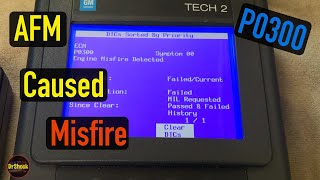
- GDS2/Tech2: Misfire Graph / Misfire Data — This is the most critical first step after reading the P0300 code. It displays misfire counts per cylinder in real-time, allowing a technician to see if the 'random' misfire is actually concentrated on one or more specific cylinders, especially the AFM cylinders (1, 4, 6, 7).
- GDS2/Tech2: Cylinder Deactivation — This bidirectional control allows a technician to manually command the AFM system on and off to test the response of the solenoids in the VLOM and the lifters themselves. This can help isolate a fault within the AFM system.
- GDS2/Tech2: Injector Balance Test — This function systematically fires each injector while measuring the corresponding drop in fuel pressure to identify a weak or clogged injector that may be causing a misfire on a specific cylinder.
Wiring & Ground Locations
- Bank 1 (Driver's Side) Ignition Coil Ground — On the front of the driver's side cylinder head. A black wire with a ring terminal is bolted directly to the head.. This single ground point is for the entire bank of four ignition coils. If it becomes loose or corroded, all four cylinders on that bank can misfire intermittently or completely, causing a P0300. This is a known failure point where the wire breaks inside the ring terminal lug due to corrosion and vibration.
- Bank 2 (Passenger's Side) Ignition Coil Ground — On the rear of the passenger's side cylinder head.. Similar to the Bank 1 ground, this location grounds the passenger side ignition coils. A fault here will affect cylinders 2, 4, 6, and 8.
- Hood to Firewall Ground Strap — A small, braided or solid wire strap running from the underside of the hood to the firewall.. While primarily for radio frequency interference (RFI), a broken or missing hood ground can, in rare cases, contribute to unexplained electrical noise that may affect sensitive engine electronics. It is a common point of failure due to repeated flexing.
Real Owner Repair Stories
- The G Automotive And More, YouTube (GMC Sierra 5.3L (year not specified, but GMT900 platform)) — Check engine light flashing, running very badly, P0300 code. Scan tool showed misfires on cylinders 1 and 3, but testing revealed the entire driver's side bank had no spark.
❌ Tried (didn't work) Swapping ignition coils did not resolve the issue, as the no-spark condition remained on the same bank.
✅ What actually fixed it The main ground wire for the Bank 1 (driver's side) ignition coils was broken inside the ring terminal where it bolts to the front of the cylinder head. The wire was corroded (green) and had failed from vibration. Repair involved cutting off the old terminal, cleaning the wire, and crimping on a new ring terminal to re-secure the ground. - Reddit user r/AskMechanics (2014 GMC Sierra 5.3L V8) — Intermittent, severe shuttering at idle with tachometer dropping 500 RPM. P0300 code. Later, flashing check engine light. Cylinder 1 spark plug was fouled with oil.
❌ Tried (didn't work) Adding HEET water remover and injector cleaner to the fuel., Replacing the fouled spark plug in cylinder 1 (misfire remained).
✅ What actually fixed it The user suspected a failing AFM lifter based on the oil-fouled plug on an AFM cylinder and the intermittent nature of the problem. The final diagnosis confirmed by a mechanic was a failed lifter, a very common issue for this engine.
OEM Part Supersession History
12571595, 12639516→12645725, 12680871— GM has updated the AFM lifter design multiple times to improve reliability and address the common failure of the locking pin mechanism.
Heads up: While physically interchangeable, it is highly recommended to use the latest available part number when replacing failed lifters. It is also recommended to replace the Valve Lifter Oil Manifold (VLOM), with an updated part like #12571609, as the original may have contributed to the lifter failure.
Model Year Variations Within This Range
- 2014-2016: The 2014 model year marked the introduction of the K2XX platform and the new EcoTec3 engine family (5.3L L83 and 6.2L L86). These engines feature direct injection, which introduced new potential causes for P0300, such as high-pressure fuel system faults and carbon buildup on intake valves, which were not a concern on the 2012-2013 models with port injection.
Helpful Videos

We Have This Part in Stock


The information in this article is provided for general reference and educational purposes only. Vehicle specifications, procedures, and part compatibility can vary by production date, trim level, and region. Always consult your vehicle's factory service manual and verify part numbers before purchasing or performing repairs. Safety-critical components such as airbags, seat belts, and braking systems should be installed by a qualified professional.
- Gmc SIERRA DENALI:
- 🎬 Helpful Videos
- 🛍️ Shop This Part
- What's Unique About the 2012-2016 Gmc SIERRA DENALI
- Diagnostic Flowchart
- Symptoms You May Notice
- Most Likely Causes
- Rare But Worth Checking
- Diagnosis Steps
- Parts You'll Likely Need
- Related Codes That Often Appear With This One
- Technical Service Bulletins (TSBs) & Recalls
- Platform-Specific Known Issues
- Mechanic-Grade Diagnostic Values
- Scan Tool Commands That Help
- Wiring & Ground Locations
- Real Owner Repair Stories
- OEM Part Supersession History
- Model Year Variations Within This Range
- 🎟️ Get 5% Off