

P0300 on 2023-2025 Ford Escape: Random Misfire Causes and Fixes
P0300 on a 2023-2025 Ford Escape often points to a software issue requiring a dealer update, especially on 1.5L and 2.0L EcoBoost engines as noted in Ford's Technical Service Bulletins. If not software, the next most common causes are worn spark plugs or faulty ignition coils. For some vehicles, a leaking fuel injector may be the cause, subject to recall 24S54.
- For a 2023-2025 Ford Escape with a P0300, the first step should be checking for a software update, as this is a known issue covered by Ford TSBs for both 1.5L and 2.0L engines.
- The code is almost always accompanied by P0316 (Misfire on Startup), strongly suggesting the TSBs related to cold starts are relevant.
- If a software update doesn't apply or fix the issue, standard misfire diagnosis applies: start with the cheapest and most common parts, which are spark plugs, followed by ignition coils.
- Be aware of more serious, engine-specific issues: check for the fuel injector recall (24S54) and, on 2.0L models, watch for signs of coolant loss that could point to a cracked cylinder head.
What's Unique About the 2023-2025 Ford ESCAPE

For the 2023-2025 Ford Escape, the P0300 code is frequently linked to software glitches in both the 1.5L and 2.0L EcoBoost engines. Ford has issued multiple Technical Service Bulletins (TSBs), including TSB 24-2014 and 25-2133, acknowledging that a simple PCM software update can resolve random misfires that occur on startup or after a cold soak. 🎬 Watch: Diagnosing common cold start misfires on EcoBoost engines. Beyond software, these direct-injection engines can also be susceptible to issues like leaking fuel injectors, which prompted recall 24S54. While less common on this generation, a history of cracked cylinder heads on earlier 2.0L EcoBoost engines due to an 'open-deck' block design makes any sign of coolant loss a serious concern.
Diagnostic Flowchart
Tap your situation to follow the diagnostic path that matches what you're seeing on this vehicle.
Symptoms You May Notice
- Rough or shaky idle, especially on a cold start
- Hesitation or stumbling during acceleration
- Reduced engine power
- Flashing or solid Check Engine Light
- Difficulty starting the engine
- Noticeable engine vibration
- Fuel odor inside or outside the vehicle (related to injector recall)
- Replacing only oxygen sensors without checking for the root cause of the misfire. An O2 sensor will report a lean condition caused by the misfire, but is not usually the cause itself.
- Replacing the catalytic converter when it was actually damaged as a result of the misfire, not the cause of it.
Most Likely Causes

- Powertrain Control Module (PCM) Software Issue 🔴 High Probability Ford has issued multiple TSBs (e.g., TSB 25-2133 for the 1.5L and TSB 24-2014 for the 2.0L) specifically for this year range, stating that misfire codes P0300 and P0316 can be caused by software logic, especially after a cold start. This is the most common first step in diagnosis at the dealership.
How to confirm: A Ford dealer or a qualified shop with access to Ford's diagnostic software (FDRS) can check if your vehicle's PCM software is outdated and if it falls under a relevant TSB. Many owners report the dealer is aware of the issue.
Typical fix: Reprogramming the PCM with the latest software update. This is typically performed by a dealership and is covered under the vehicle's emissions warranty.
Est. part cost: $0 - Worn or Defective Spark Plugs 🟡 Medium Probability Spark plugs are a standard wear item. While modern plugs last a long time, a faulty batch or factors like fuel quality can cause premature failure, leading to weak or inconsistent spark.
How to confirm: Visually inspect the spark plugs for wear, damage, or carbon fouling on the electrodes. Check the spark plug gap against manufacturer specifications. A white, steam-cleaned appearance can indicate a coolant leak.
Typical fix: Replace all spark plugs as a set. 🎬 See this walkthrough for replacing spark plugs and coils. It is recommended to use OEM Motorcraft plugs for best performance.
Est. part cost: $40-$100 - Faulty Ignition Coil(s) 🟡 Medium Probability An ignition coil provides the high voltage needed to create a spark. While P0300 indicates a random misfire, it can be caused by one or more coils beginning to fail intermittently before failing completely on a single cylinder.
How to confirm: Use an OBD-II scanner with Mode 6 data to see misfire counts per cylinder. 🎬 Watch: How to use Mode 6 to track misfire rates. If misfires are randomly distributed, it's less likely to be a single coil. If one cylinder shows more misfires, you can swap its coil with another cylinder's coil to see if the misfire follows the coil.
Typical fix: Replace the failing ignition coil(s). Many technicians recommend replacing all coils if they are original and the vehicle has higher mileage.
Est. part cost: $50-$120 per coil - Leaking or Clogged Fuel Injectors ⚪ Low Probability Ford has issued a recall (24S54) for some 2023-2024 Escapes for port fuel injectors that may leak due to a missing O-ring support disc, posing a fire risk and causing performance issues like difficulty starting and fuel odors. Direct injection systems are also prone to carbon buildup which can affect injector performance.
How to confirm: A fuel pressure test can identify delivery issues; a rapid drop in pressure after shutdown can indicate a leak. A strong smell of gasoline in the engine bay is a major warning sign. A professional can perform a fuel injector balance test to check flow rates.
Typical fix: For the recall, a dealer will install new O-ring support discs. Otherwise, cleaning or replacing the faulty injector(s) is required.
Est. part cost: $100-$300 per injector
Rare But Worth Checking
- Cracked Cylinder Head (2.0L EcoBoost only): Some 2.0L EcoBoost engines from the previous generation had a known issue with the cylinder head cracking due to an 'open-deck' block design, causing coolant to leak into the cylinders. This is a major repair but should be considered if you also have symptoms of unexplained coolant loss or white smoke from the exhaust. Ford addressed this with TSB 23-2092 for earlier models.
- Vacuum Leak: A leak in a vacuum hose or intake manifold gasket can introduce unmetered air, throwing off the air-fuel ratio and causing random misfires. This can often be detected by a hissing sound at idle or found professionally with a smoke test.
- Faulty Purge Valve: A canister purge valve that is stuck open can create a vacuum leak, disrupting the air-fuel mixture and causing a random misfire, sometimes more noticeable after refueling. This has been suggested by owners in forums as a possible cause.
Diagnosis Steps

- Read the DTCs with an OBD-II scanner and check for any other pending or stored codes, especially P0316 or cylinder-specific misfire codes.
- Check for applicable TSBs using your vehicle's VIN. For the 2023-2025 Escape, TSBs 25-2133 (1.5L) and 24-2014 (2.0L) are highly relevant.
- If a software-related TSB applies, have the PCM reprogrammed by a dealer. This is the most likely fix for many vehicles in this year range and should be the first step.
- If no TSB applies or the software update doesn't fix it, perform a visual inspection of the engine bay. Look for obvious issues like disconnected vacuum hoses, damaged wiring, or signs of fluid leaks.
- Check for symptoms of the fuel injector recall (24S54), such as a strong fuel smell in the engine bay.
- Inspect the spark plugs. Remove them and check for wear, damage, oil fouling, or coolant contamination (white crust). Replace if they are worn or damaged.
- Test the ignition coils. The easiest way is to swap a coil from a known good cylinder with one from a cylinder that shows high misfire counts (if your scanner supports Mode 6).
- If you are also losing coolant without any visible leaks, suspect a more serious internal engine issue like a cracked cylinder head and seek professional diagnosis immediately.
Parts You'll Likely Need
- Spark Plug
(OEM #JYSP-12Y-PTX (also known as SP-597-X))— Spark plugs are a common wear item and a primary cause of misfires. Replacing them is a fundamental step in resolving a P0300 code if a software update isn't the solution.
Trusted brands: Motorcraft, NGK, Bosch
OEM price range: $15-$25 per plug
Aftermarket price range: $8-$18 per plug - Ignition Coil (Coil-on-Plug)
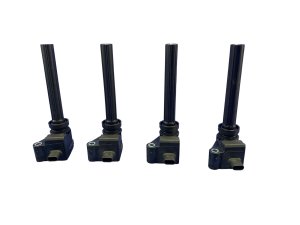
(OEM #P2GZ-12029-A (Fits both 1.5L & 2.0L))— Ignition coils can fail intermittently, causing random misfires before they fail completely. They are a common failure point in many modern engines.
Trusted brands: Motorcraft, NGK, Delphi
OEM price range: $70-$120 per coil
Aftermarket price range: $40-$80 per coil
Related Codes That Often Appear With This One
- P0316 — Stands for 'Misfire Detected on Startup (First 1000 Revolutions)'. This code is explicitly mentioned alongside P0300 in multiple Ford TSBs for the Escape, indicating the misfire is most prominent right after starting the engine cold.
- P0301, P0302, P0303, etc. — These are cylinder-specific misfire codes. A P0300 may initially appear before the PCM isolates the problem to a specific cylinder, or it may be accompanied by one of these codes if the misfire is happening on multiple, but not all, cylinders.
- P0402 — Stands for 'Exhaust Gas Recirculation (EGR) Flow Excessive Detected'. This code is mentioned alongside P0300 and P0316 in TSB 24-2014 for the 2.0L engine, indicating the software issue can also affect EGR system readings.
Technical Service Bulletins (TSBs) & Recalls

- SSM 53417: Notes that 2024 1.5L EcoBoost engines may show P0300 and P0316.
- TSB 25-2133: Addresses P0300 and P0316 on 2023 models after a cold soak, recommending a PCM reprogram.
- SSM 53293: Mentions P0300 and P0316 on 2024 1.5L EcoBoost engines.
- TSB 23-2275: States that 2023 2.0L EcoBoost models may show P0300/P0316 due to PCM software and require a reprogram.
- TSB 24-2014: Supersedes TSB 23-2275, updating the service procedure for the 2.0L software-related misfire.
Platform-Specific Known Issues
- 1.5L & 2.0L EcoBoost Software Misfire: Ford has identified that the PCM software can incorrectly detect misfires (P0300 & P0316) on startup, especially after a cold soak. TSB 25-2133 (1.5L) and TSB 24-2014 (2.0L) instruct dealers to reprogram the PCM. Many owners on forums confirm this exact scenario, where the check engine light appears after the car sits, but may go away on its own after a few drive cycles, only to return later.
- Fuel Injector Recall 24S54: A specific batch of 2023-2024 Escapes were built with a
Mechanic-Grade Diagnostic Values
- Ignition Coil Primary Winding Resistance — expected: 0.4 to 2.0 Ohms. Failure: A reading outside this range (e.g., OL for open circuit or 0 for a short) indicates a faulty coil.
- Ignition Coil Secondary Winding Resistance — expected: 6,000 to 10,000 Ohms (6k-10k Ω). Failure: A reading significantly outside this range suggests the internal windings are compromised.
- Low-Side Fuel Pressure (Key on, engine off) — expected: ~3.0 bar (~43.5 psi). Failure: Significantly lower pressure indicates a weak in-tank fuel pump or a clogged filter, starving the high-pressure pump.
Hidden / Shadow Codes Worth Checking
- Mode 6, Test ID $A2-$AF, Comp ID $01-$0C: Provides misfire counts for each individual cylinder during the current and last 10 driving cycles. Even with a generic P0300, this data can reveal if one or two cylinders are misfiring more frequently than others, helping to pinpoint a failing coil or plug before a cylinder-specific code (P0301, etc.) is triggered. (see via Requires a scan tool capable of reading Mode 6 data, such as FORScan, Snap-on, or the dealer's IDS/FDRS. The data is presented as a count or percentage against a maximum allowable threshold.)
Scan Tool Commands That Help
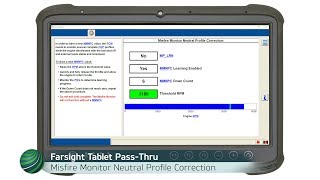
- Ford IDS/FDRS, compatible professional scanners (e.g., Snap-on): Misfire Monitor Neutral Profile Correction — This procedure is critical after any major engine or transmission repair, PCM replacement, or crankshaft sensor replacement. It relearns the crankshaft's rotational profile. Failure to perform this can cause the PCM to falsely detect misfires and set a P0300 code, even on a perfectly healthy engine.
- Ford IDS/FDRS: Relative Compression Test — As a quick, non-invasive way to check for base engine mechanical problems. The tool analyzes crankshaft speed during cranking to identify cylinders with lower-than-normal compression, which would cause a misfire. This can rule out or confirm a mechanical fault without using a manual compression gauge.
Real Owner Repair Stories
- YouTube user video (FordTechMakuloco channel referenced) (Newer Ford F-250 (procedure applies to all modern Fords including Escape)) — Check engine light flashing under wide-open throttle with codes P0300, P0304, and P0307.
❌ Tried (didn't work) Initial diagnosis pointed towards standard ignition or fuel issues.
✅ What actually fixed it The engine had been replaced by a shop that did not perform the 'Misfire Monitor Neutral Profile Correction' procedure. Taking the vehicle to a Ford dealer to run this 5-minute scan tool function completely resolved the misfire codes. - Reddit user comment in r/fordescape (General Ford Escape) — P0300 Random Misfire code.
❌ Tried (didn't work) Chasing spark plugs or ignition coils when the misfire is truly random and not isolated to one cylinder.
✅ What actually fixed it The user advised that a common cause for a true P0300 (with no specific cylinder codes) is a sticking canister purge valve, which creates a vacuum leak and disrupts the air/fuel mixture. This issue can be more pronounced after refueling.
"I Checked Everything" — The Actual Cause
- A common scenario is a P0300 with high positive fuel trims, suggesting a vacuum leak, but a smoke test on the intake manifold and vacuum lines comes back clean. The actual cause can be a faulty canister purge valve stuck open. This introduces unmetered fuel vapors from the gas tank into the intake manifold, leaning out the mixture. This type of leak is often missed because it's part of the EVAP system, not the primary intake tract, and may only be problematic under certain conditions, like after refueling.
Model Year Variations Within This Range
- 2023-2025: While the 1.5L and 2.0L EcoBoost powertrains are consistent across this range, Ford has issued separate TSBs addressing the P0300/P0316 software issue. TSB 23-2275 (superseded by 24-2014) targets 2023 models with the 2.0L engine built before May 2023. Newer bulletins like SSM 53417 and SSM 53293 specifically call out 2024-2025 models with the 1.5L engine, noting a software fix is in development and to not replace parts. This indicates the software-related misfire is an ongoing issue affecting different production batches within this model year range.
Helpful Videos

We Have This Part in Stock

The information in this article is provided for general reference and educational purposes only. Vehicle specifications, procedures, and part compatibility can vary by production date, trim level, and region. Always consult your vehicle's factory service manual and verify part numbers before purchasing or performing repairs. Safety-critical components such as airbags, seat belts, and braking systems should be installed by a qualified professional.
- Ford ESCAPE:
- 🎬 Helpful Videos
- 🛍️ Shop This Part
- What's Unique About the 2023-2025 Ford ESCAPE
- Diagnostic Flowchart
- Symptoms You May Notice
- Most Likely Causes
- Rare But Worth Checking
- Diagnosis Steps
- Parts You'll Likely Need
- Related Codes That Often Appear With This One
- Technical Service Bulletins (TSBs) & Recalls
- Platform-Specific Known Issues
- Mechanic-Grade Diagnostic Values
- Hidden / Shadow Codes Worth Checking
- Scan Tool Commands That Help
- Real Owner Repair Stories
- "I Checked Everything" — The Actual Cause
- Model Year Variations Within This Range
- 🎟️ Get 5% Off