

P0300 on 2012-2016 Dodge Caravan: Random Misfire Causes and Fixes
P0300 on a 2012-2016 Dodge Caravan indicates a random misfire. While common causes include worn spark plugs and ignition coils, this van is known for more serious mechanical issues. A faulty left cylinder head is a major concern on 2012-2013 models, and premature failure of rocker arms and camshafts (often signaled by a ticking noise) is a known issue across all years. Software issues may also require a Powertrain Control Module (PCM) replacement as per manufacturer bulletins for 2015-2016 model
- For 2012-2013 models, you must rule out the known defective left cylinder head issue before replacing any other parts. A cylinder leak-down test is essential.
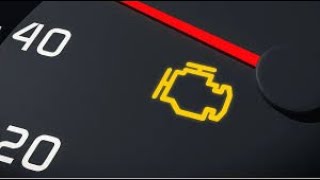
- A flashing check engine light indicates a severe misfire that can destroy your catalytic converter, leading to a much more expensive repair. Avoid driving if this occurs.
- Common ignition parts like spark plugs and coils are potential causes, but be aware that TSBs point to more complex fixes like PCM replacement for this specific vehicle.
- Accessing the rear bank of spark plugs requires removing the upper intake manifold, adding to the labor time and cost of a basic tune-up.
What's Unique About the 2012-2016 Dodge CARAVAN

For the 2012-2016 Dodge Caravan with the 3.6L Pentastar engine, a P0300 code is more complex than on many other vehicles. Early models in this range (especially 2012-2013) were subject to a significant manufacturer warranty extension (X56) for a defective left cylinder head that causes misfires. Across all years, the Pentastar engine is also known for premature failure of the valvetrain's roller rocker arms, which can seize and damage the camshaft lobes, creating a distinct ticking noise followed by misfires. Additionally, Dodge issued technical bulletins advising that a P0300 code on 2015-2016 models could be caused by a faulty Powertrain Control Module (PCM) itself, requiring replacement and reprogramming. [Bulletin #18-069-16, Bulletin #18-017-15]
Diagnostic Flowchart

Tap your situation to follow the diagnostic path that matches what you're seeing on this vehicle.
Symptoms You May Notice

- Engine shaking, stuttering, or vibrating, especially at idle.
- Rough running and poor acceleration.
- Flashing or solid Check Engine Light.
- Reduced fuel economy.
- Difficulty starting the engine.
- A distinct, rhythmic ticking or tapping noise from the top of the engine, often described as sounding like a 'sewing machine', which may get louder with RPMs. This is a strong indicator of rocker arm/camshaft failure.
- Replacing only spark plugs and ignition coils on a 2012-2013 model without first performing a cylinder leak-down test to rule out the known cylinder head defect.
- Replacing a single ignition coil when a random P0300 code is present, as the issue is often more widespread or mechanical in nature.
- Ignoring a ticking sound and focusing only on ignition components, leading to a missed diagnosis of a failing rocker arm and camshaft.
Most Likely Causes

- Defective Left Cylinder Head 🔴 High Probability A well-documented manufacturing defect with valve seats on the left cylinder head (cylinders 2, 4, 6) affected 2011-2013 models built on or before July 25, 2012. Chrysler issued a 10-year/150,000-mile warranty extension (X56) for this specific issue.
How to confirm: A professional mechanic must perform a cylinder leak-down test on the affected cylinders (2, 4, or 6). Leakage of 25% or more confirms the issue per Chrysler's service bulletin (TSB #09-002-14 REV. B). This should be the first major diagnostic step on 2012-2013 models, especially if codes like P0302, P0304, or P0306 are also present.
Typical fix: Complete replacement of the left cylinder head with an updated part.
Est. part cost: $500-$1500 - Worn Camshafts or Roller Rockers 🔴 High Probability The 3.6L Pentastar can suffer from premature wear of the roller rockers' needle bearings. When they fail, the rocker can seize, stop spinning, and the camshaft lobe grinds into it, causing damage to both components. This leads to improper valve lift and misfires. The issue is often first noticed as a ticking sound.
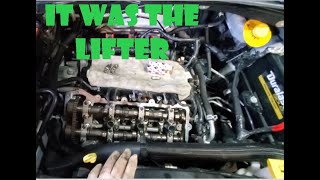
How to confirm: After ruling out ignition and fuel, a visual inspection under the valve covers 🎬 See this walkthrough on replacing rockers, lifters, and camshafts. is required. Look for scoring or galling on camshaft lobes and check for play or seizure in the roller rockers. A seized rocker will have a flat, worn spot where the cam has been dragging across it.
Typical fix: Requires replacement of all affected camshafts and all roller rockers on the affected head. It is highly recommended to replace all 12 rockers on a head even if only one has failed.
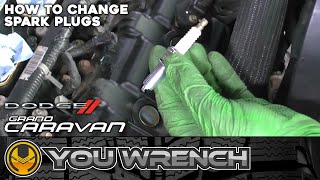
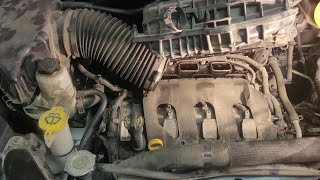
Est. part cost: $400-$1200 - Worn Spark Plugs or Faulty Ignition Coils 🟡 Medium Probability The rear spark plugs and coils (on the firewall side) are difficult to access, requiring removal of the upper intake manifold. 🎬 Watch: How to remove the intake to reach the rear plugs. This can lead to deferred maintenance. Using incorrect (non-iridium) plugs can also cause misfires.
How to confirm: Inspect spark plugs for wear, fouling, or damage. The OEM plugs are Iridium and have a 100,000-mile service life. Inspect ignition coil boots for carbon tracks or cracks, which indicate the spark is arcing to the head. If a specific cylinder code is present (e.g., P0304), swap the coil with a known good cylinder to see if the code follows.
Typical fix: Replace all six spark plugs and any faulty ignition coils. It is recommended to replace the intake plenum gaskets at the same time due to the labor involved.
Est. part cost: $50-$250 - Faulty Powertrain Control Module (PCM) ⚪ Low Probability Manufacturer TSB #18-069-16 specifically identifies the PCM as the cause for P0300 on 2015-2016 models built between July 27, 2015 and September 11, 2015, due to an improperly coated atmospheric vent. [Bulletin #18-069-16] Another TSB links P0300 on a cold start to a communication issue with the Body Control Module, suggesting complex software faults. [Bulletin #18-017-15]
How to confirm: This is a diagnosis of exclusion. All other mechanical and electrical causes (ignition, fuel, vacuum, compression) must be ruled out first. A dealer or specialized shop with wiTECH software must confirm the diagnosis by checking if the vehicle's VIN falls under the TSB's specified build dates. [Bulletin #18-069-16]
Typical fix: Replace the PCM and reprogram it with the latest software. [Bulletin #18-069-16]
Est. part cost: $300-$800
Rare But Worth Checking
- Clogged or Failing Fuel Injectors: An injector that is not delivering the correct amount of fuel can cause a misfire. If the issue affects multiple cylinders, it could be related to a fuel pressure problem or a clogged fuel rail.
- Vacuum Leak: A leak in a vacuum hose, PCV valve, or the intake manifold gasket can introduce unmetered air, throwing off the air-fuel ratio and causing random misfires. A smoke test is the most effective way to find leaks.
- Faulty O2 Sensors: TSB #18-104-15 lists P0300 alongside O2 sensor slow response codes (P0133, P0153), indicating that failing O2 sensors can contribute to or be associated with misfire conditions by providing incorrect data to the PCM.
Diagnosis Steps
- Scan for all DTCs. Pay close attention to any specific cylinder misfire codes (P030x) or other related codes (O2 sensor, PCM communication, etc.).
- Listen carefully for a rhythmic ticking noise from the engine's top end. If present, prioritize inspection of the valvetrain (rocker arms and camshafts).
- If you have a 2012-2013 model, perform a cylinder leak-down test to check for the known cylinder head issue, especially if P0302, P0304, or P0306 are present.
- Inspect all spark plugs and ignition coils. Look for worn electrodes on plugs and fine cracks or carbon tracks on coil boots. Swap coils to see if a specific misfire code follows the coil.
- Check for vacuum leaks by inspecting all hoses connected to the intake manifold and by performing a smoke test to find hidden leaks.
- Test fuel pressure to ensure the fuel pump and regulator are functioning correctly.
- If other causes are eliminated, remove the valve covers to visually inspect camshafts and roller rockers for wear, scoring, or damage.
- As a final step, especially on 2015-2016 models, consult a dealer regarding TSB #18-069-16, which may point to a necessary PCM replacement. [Bulletin #18-069-16]
Parts You'll Likely Need
- Cylinder Head, Left
(OEM #68141353AC)— This is the primary fix for the well-documented valve seat issue on 2012-2013 models causing P0300. The part number RL141353AC was a remanufactured unit, while 68141353AC is a new Mopar part that supersedes previous versions.
Trusted brands: Mopar
OEM price range: $800-$1500
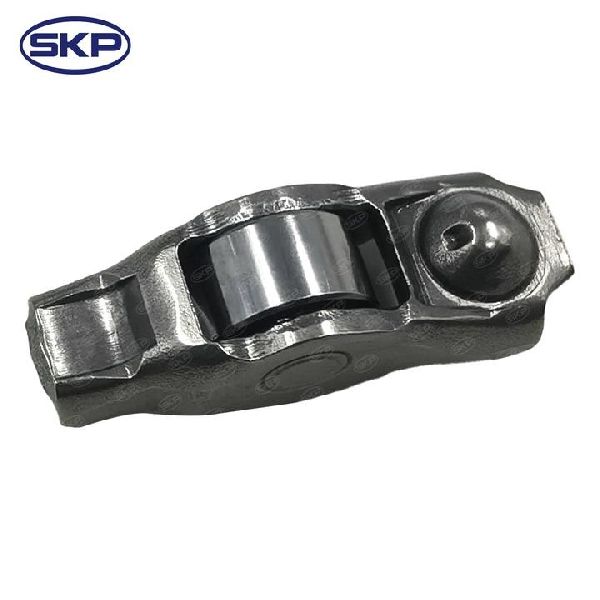
Aftermarket price range: $500-$1000 - Rocker Arm
(OEM #5184296AH)— A primary failure point in the 3.6L Pentastar valvetrain. The needle bearings fail, causing the rocker to seize and damage the camshaft. It is recommended to replace all 12 on the affected bank if one fails.
Trusted brands: Mopar, Melling
OEM price range: $15-$25 per arm
Aftermarket price range: $10-$20 per arm
Related Codes That Often Appear With This One
- P0301, P0302, P0303, P0304, P0305, P0306 — These codes specify which cylinder is misfiring. P0300 often appears with one or more of these. On this van, P0302, P0304, and P0306 are strong indicators of the left cylinder head issue.
- P23xx (e.g., P2302, P2305) — These codes for 'Ignition Coil Secondary Circuit' can accompany P0300 if a faulty PCM is the root cause, as outlined in TSB #18-069-16. [Bulletin #18-069-16]
- P0133, P0153 — These codes indicate a slow response from the upstream oxygen sensors. A TSB links them with P0300, suggesting they can be related symptoms or contributing causes. [Bulletin #18-104-15]
- U0140 — This code for 'Lost Communication With Body Control Module' was linked to P0300 in TSB #18-017-15, pointing towards a deeper electrical or module-level problem.
Technical Service Bulletins (TSBs) & Recalls
- 18-069-16: PCM Replacement, MIL Illumination / DTCs P0300, P030X or P23XX
- 18-017-15: Links P0300 at cold idle with U0140 and camshaft position codes.
- 18-104-15: Associates P0300 with specific cylinder misfires and O2 sensor slow response codes.
- 09-002-14: Details the diagnosis and repair for the extended warranty on the left cylinder head for P0300 codes.
Platform-Specific Known Issues
- TSB #09-002-14 (related to warranty extension X56) addresses the left cylinder head issue on models built on or before July 25, 2012, which causes P0300, P0302, P0304, or P0306. The fix is a cylinder leak-down test and head replacement if leakage is over 25%.
- TSB #18-069-16 states that for some 2015-2016 models, the fix for P0300 is to replace the Powertrain Control Module (PCM) and update its software.
- TSB #18-017-15 notes that P0300 can appear on a cold engine idle along with communication code U0140, pointing to a complex electrical or software fault. [Bulletin #18-017-15]
Mechanic-Grade Diagnostic Values
- Fuel Pressure — expected: ~58 PSI. Failure: Low fuel pressure can cause random misfires across all cylinders.
- Ignition Coil Primary Resistance — expected: 0.4 - 2.0 Ohms. Failure: A reading outside this range indicates a faulty primary winding in the coil.
- Ignition Coil Secondary Resistance — expected: 6,000 - 13,000 Ohms (6k - 13k Ω). Failure: A reading outside this range indicates a faulty secondary winding.
- Fuel Injector Resistance — expected: 12 - 13 Ohms. Failure: A significantly higher reading or an open circuit (infinite resistance) points to a failed injector.
- Engine Oil Pressure (Warmed Up, At Idle) — expected: 25 - 35 PSI. Failure: Chronically low oil pressure can affect the VVT system and lead to various engine performance issues, including misfires.
- Engine Oil Pressure (Warmed Up, Under Load) — expected: 60 - 75 PSI. Failure: The 3.6L Pentastar has a 2-stage oil pump; failure to switch to the high-pressure stage above ~3500 RPM could indicate a pump or solenoid issue.
Scan Tool Commands That Help
- wiTECH or advanced generic scanner: Injector Kill / Cylinder Cutout Test — This function allows a technician to disable one cylinder at a time. If disabling a cylinder causes no change in engine RPM, it confirms that cylinder was not contributing power, helping to isolate a misfire that may not have set a specific P030x code yet.
- wiTECH or advanced generic scanner: View Misfire Counters (Live Data) — While a P0300 indicates random misfires, live data can show which specific cylinders are accumulating the most misfire counts in real-time. This helps focus diagnosis on a particular cylinder or bank even without a hard P0301-P0306 code.
Wiring & Ground Locations
- Engine Mount Ground Strap — Connects from the chassis to a post on the upper front engine mount, near the power steering reservoir.. A broken or corroded main engine ground strap can cause a host of electrical issues, including weak spark, which can lead to random misfires. This strap is known to break and is often overlooked.
- G102 — Left rear of the engine compartment.. This is a primary ground point for components in the engine bay. Corrosion or a loose connection here can affect multiple systems, including ignition and fuel.
- Cylinder Numbering — The cylinder bank against the firewall (rear) is Bank 1 (cylinders 1, 3, 5, from passenger to driver side). The bank at the radiator (front) is Bank 2 (cylinders 2, 4, 6, from passenger to driver side).. Correctly identifying cylinders is crucial for diagnosis. The known cylinder head issue affects Bank 2 (cylinders 2, 4, 6), while the difficult-to-access spark plugs are on Bank 1.
Real Owner Repair Stories
- DodgeForum.com user 'IanES' (2016 Dodge Grand Caravan, 102k miles) — Infamous '3.6 tick' and a rough idle.
❌ Tried (didn't work) Initially replaced rocker arms and spark plugs using a 'shortcut' method without removing cams.
✅ What actually fixed it The owner discovered one of the new rocker arms was out of position after the initial repair. After disassembling again and correctly seating the rocker arm, the P0300 code and rough idle were resolved. - BobIsTheOilGuy forum user 'KrisZ' (2015 Grand Caravan) — Engine started shaky, then died. Hard to start, then threw P0300 with a strong smell of gas.
❌ Tried (didn't work) Installed what were claimed to be OEM '5184296AH' rocker arms purchased from an eBay seller.
✅ What actually fixed it The user realized that later-generation Pentastar engines use a different rocker arm profile. The eBay parts were incorrect for the engine, despite the part number. Replacing them with genuine Mopar parts from a reputable dealer fixed the misfire.
"I Checked Everything" — The Actual Cause
- In one documented case, a 2015 Dodge Caravan with P0300 and P0306 had a good compression test (150 PSI across most cylinders). The cause was not a vacuum leak or ignition issue, but a completely worn-down exhaust camshaft lobe on one cylinder. The good compression reading was misleading because while the intake valve was working, the exhaust valve was not opening properly to release the air, leading to an artificially high reading on that cylinder (210 PSI).
OEM Part Supersession History
5184296AD, 5184296AE, 5184296AF, 5184296AG→5184296AH— These are successive updates to the Pentastar's rocker arm, likely to improve the durability of the needle bearings that were a common failure point.
Heads up: While 5184296AH is the latest revision for many models, the 2016+ updated Pentastar engine has different valvetrain geometry. Using an older-style rocker arm, even with the 'AH' part number, on a 2016+ engine can cause immediate misfires and rough running. Extreme caution is needed to source the correct part for the specific engine generation.
Model Year Variations Within This Range
- 2012-2013: These model years are highly prone to the left cylinder head defect covered by TSB 09-002-14 and warranty extension X56. A P0300, especially with P0302, P0304, or P0306, should have the cylinder head investigated first.
- 2015-2016: A specific build range of these vans (July-Sept 2015) is subject to TSB #18-069-16, which identifies a faulty PCM as the cause for P0300. Another TSB (#18-017-15) from 2015 links P0300 on cold starts to a BCM communication fault. [Bulletin #18-069-16, Bulletin #18-017-15]
- 2016: For the 2016 model year, FCA introduced an updated 3.6L Pentastar engine. This version featured a higher compression ratio (11.3:1 vs 10.2:1), two-stage variable valve lift (VVL), cooled EGR, and new injectors and coils. This means some valvetrain parts, like rocker arms, are not interchangeable with earlier years in this range.
Helpful Videos

We Have This Part in Stock




The information in this article is provided for general reference and educational purposes only. Vehicle specifications, procedures, and part compatibility can vary by production date, trim level, and region. Always consult your vehicle's factory service manual and verify part numbers before purchasing or performing repairs. Safety-critical components such as airbags, seat belts, and braking systems should be installed by a qualified professional.
- Dodge CARAVAN:
- 🎬 Helpful Videos
- 🛍️ Shop This Part
- What's Unique About the 2012-2016 Dodge CARAVAN
- Diagnostic Flowchart
- Symptoms You May Notice
- Most Likely Causes
- Rare But Worth Checking
- Diagnosis Steps
- Parts You'll Likely Need
- Related Codes That Often Appear With This One
- Technical Service Bulletins (TSBs) & Recalls
- Platform-Specific Known Issues
- Mechanic-Grade Diagnostic Values
- Scan Tool Commands That Help
- Wiring & Ground Locations
- Real Owner Repair Stories
- "I Checked Everything" — The Actual Cause
- OEM Part Supersession History
- Model Year Variations Within This Range
- 🎟️ Get 5% Off