

P0300 on 2009-2016 Chevrolet Silverado 3500: Random Misfire Causes, AFM Lifter Failure, & Fixes
P0300 on a Silverado 3500 indicates random cylinder misfires. While it can be simple fixes like spark plugs or coils, this truck's V8 engines are highly prone to serious issues like failed Active Fuel Management (AFM) lifters (often with a ticking noise), worn camshafts, or internal coolant leaks, as documented in multiple GM TSBs. Diagnosis is critical to avoid replacing unnecessary parts.
- P0300 means multiple cylinders are misfiring, not just one.
- Do not ignore a flashing check engine light, as it signals a severe misfire that can destroy your catalytic converter.
- On this specific truck, be highly suspicious of a failed AFM lifter, especially if you hear a ticking noise from the engine.
- Diagnosis should start with the basics (plugs, coils, wires) but may quickly lead to more complex mechanical or fuel system issues.
- Consult the provided TSBs, as they point to known patterns of failure on this platform, including internal coolant leaks and camshaft wear.
What's Unique About the 2009-2016 Chevrolet SILVERADO 3500
On the V8 engines (e.g., 6.0L Vortec, 5.3L/6.2L EcoTec3) in this generation of Silverado, a P0300 code is frequently more than a simple tune-up issue. These trucks are notorious for problems with the Active Fuel Management (AFM) system, where specialized lifters can collapse or get stuck, causing misfires and a distinct ticking noise. This is a well-documented mechanical failure cited in numerous GM Technical Service Bulletins (TSBs). Furthermore, TSBs also point to other significant issues like worn camshaft lobes (TSB PIP4138R) and internal coolant leaks (TSB GCUS-3-314) as known causes for a P0300, making a thorough diagnosis essential to avoid costly missteps.
Diagnostic Flowchart
Tap your situation to follow the diagnostic path that matches what you're seeing on this vehicle.
Generation note: This range covers two generations: the GMT900 (2009-2014) and the K2XX (2015-2016). While body styles differ, many of the common V8 engine issues, particularly those related to the Active Fuel Management (AFM) system, are prevalent across both generations. The 2014+ models feature direct injection (EcoTec3), which introduces unique failure points like high-pressure fuel injector seals.
Symptoms You May Notice
- Rough or shaking idle
- Hesitation or stumbling during acceleration
- Flashing or solid Check Engine Light
- Noticeable loss of engine power
- Reduced fuel economy
- Engine ticking, chirping, or tapping noise, especially at idle
- Smell of fuel from the exhaust
- Exhaust sound seems off or has a 'puffing' noise
- Replacing only spark plugs or coils when a mechanical problem like a failed lifter is the true cause. The ticking noise is the key differentiator. 🎬 Watch this to identify the ticking sound of a collapsed lifter.
- Replacing oxygen sensors when they are correctly reporting a problem (lean/rich condition from misfires), not causing it.
- Ignoring the AFM system as the root cause. Due to the high frequency of lifter failure on these engines, it should be a primary suspect, not an afterthought.
Most Likely Causes
- Worn Spark Plugs, Wires, or Ignition Coils 🔴 High Probability These are standard wear-and-tear items and the most common starting point for any misfire diagnosis. Fouled plugs or weak coils are a frequent cause.
How to confirm: Inspect spark plugs for wear, fouling, or incorrect gap. Test ignition coils by swapping a suspected bad coil with a known good one to see if a specific misfire code (e.g., P0301) follows the coil.
Typical fix: Replace all spark plugs and any faulty wires or coils. It's best practice to replace plugs as a set. Use of dielectric grease in the coil boots is recommended.
Est. part cost: $80-$300 - Active Fuel Management (AFM) Lifter Failure 🔴 High Probability The V8 engines use AFM to deactivate cylinders (1, 4, 6, 7) to save fuel. The specialized lifters are a known major failure point, often getting stuck or collapsing due to oiling issues, which leads to a persistent misfire and a P0300 code. This is the subject of multiple TSBs (e.g., 19-NA-219).
How to confirm: Listen for a distinct ticking or tapping noise from the top of the engine that is consistent and may increase with RPM. A mechanic can confirm by removing the valve covers to inspect for rocker arms that are not moving, indicating a collapsed lifter.
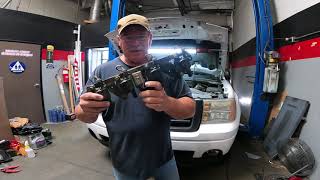
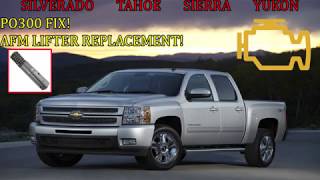
Typical fix: This is an extensive and costly repair. It requires replacing all failed lifters, lifter guides, and often the camshaft, as a failed lifter can damage the cam lobes. Many owners and shops opt to install an 'AFM delete kit' to permanently remove the problematic components. 🎬 See a complete walkthrough of the AFM lifter replacement process.
Est. part cost: $400-$1200 for parts, with labor being significantly more. - Fuel System Issues (Injectors, Pump, Regulator) 🟡 Medium Probability Dirty or failing fuel injectors can disrupt the fuel spray pattern. A weak fuel pump can lower fuel pressure, causing a lean condition and random misfires. The specified fuel pressure for these engines is typically 55-60 PSI while running.
How to confirm: Check fuel pressure with a gauge to ensure it's within the 55-60 PSI spec while running. A professional can perform a fuel injector balance test. For 2014+ models, leaking injector seals can be a cause, sometimes creating a hissing noise.
Typical fix: Clean or replace clogged fuel injectors. Replace the fuel pump or fuel pressure regulator if pressure is low. For 2014+ models, this may involve replacing injector seals or the injectors themselves.
Est. part cost: $150-$700 - Vacuum Leaks 🟡 Medium Probability Intake manifold gaskets are a common source of vacuum leaks on these V8 engines, allowing unmetered air into the engine and disrupting the air-fuel ratio. The PCV hose/system is another common leak point.
How to confirm: Listen for a hissing sound around the engine bay at idle. A key sign is very high positive short-term fuel trims at idle that return to normal when RPMs are raised. A mechanic will use a smoke machine to pinpoint the exact location of the leak.
Typical fix: Replace the faulty gasket or hose. The intake manifold gaskets are a common replacement item. 🎬 Watch how to diagnose a rough idle caused by intake leaks.
Est. part cost: $20-$250 - Worn Camshaft Lobe ⚪ Low Probability As cited in TSB #PIP4138R, a worn camshaft lobe can cause misfires. This is almost always a direct result of a failed lifter (especially a roller lifter) that has seized and ground down the cam lobe, making this a secondary failure to a bad lifter.
How to confirm: Requires removal of the valve covers and lifters to visually inspect the camshaft lobes for scoring or excessive wear. Measuring valve lift can also indicate a worn lobe.
Typical fix: Replace the camshaft and all lifters. This is a major engine repair.
Est. part cost: $500-$1500
Rare But Worth Checking
- Internal Coolant Leak (Head Gasket/Cracked Head): TSB #GCUS-3-314 and #PIP5323 specifically mention P0300 resulting from coolant leaking into the combustion chamber. Diagnosis involves adding UV dye to the coolant and checking for its presence in the cylinders with a borescope after a cold soak. Symptoms can include milky oil or unexplained coolant loss.
- Clogged Catalytic Converter: A restricted exhaust can create excessive backpressure, leading to misfires. This is often a result of long-term misfires dumping raw fuel and should be checked if other causes are ruled out. This may be accompanied by a P0420 or P0430 code.
- Faulty Crankshaft Position Sensor: An erratic signal from this sensor can cause the ECM to incorrectly report misfires. This may be accompanied by stalling or hard starting. A crank variation relearn procedure is often required after replacement.
Diagnosis Steps
- Scan for any other accompanying trouble codes. Codes like P050D or specific cylinder misfires (P030x) provide critical clues.
- Listen carefully for engine noises. A persistent ticking or chirping sound at idle strongly points to a valvetrain issue like a failed AFM lifter or worn camshaft.
- Inspect the basics: Check for worn or fouled spark plugs and damaged ignition wires/boots.
- Test the ignition coils. A common method is to swap the coil from a misfiring cylinder (if identified with a P030x code) to a good cylinder and see if the code follows the coil.
- Check fuel pressure with a gauge. It should be stable between 55-60 PSI while the engine is running.
- Check for vacuum leaks. With the engine warm, monitor short-term fuel trims at idle. If they are high (>15%) but drop to near zero around 2000 RPM, a vacuum leak from the intake manifold gasket is very likely. A smoke test can confirm the location.
- If a valvetrain noise is present, remove the valve covers to inspect for stuck/collapsed lifters (rocker arm not moving), bent pushrods, or broken valve springs.
- If coolant loss is a symptom, follow TSB #PIP5323: add UV dye to the coolant, run the engine, let it cool completely, then use a borescope to inspect cylinders for the dye.
- After repairs involving the crankshaft sensor, timing components, or significant engine work, perform a crankshaft position variation relearn procedure.
Parts You'll Likely Need
- Active Fuel Management (AFM) Lifter
(OEM #12698946)— A very common failure point on these V8 engines, a collapsed AFM lifter will cause a consistent misfire on one of the AFM cylinders (1, 4, 6, or 7). The part has been
Related Codes That Often Appear With This One
- P0301-P0308 — These codes specify which cylinder is misfiring. They often appear before or along with P0300 as the problem begins on a single cylinder (like a failing lifter) and then affects overall engine balance.
- P050D — This code indicates a rough idle on a cold start. TSB #PIP5628G and other service data link it with P0300, often pointing to leaking fuel injectors (especially on 2014+ direct injection models) or coolant intrusion.
- P219B — Indicates an air-fuel ratio imbalance on Bank 2. This can be seen with P0300 when a vacuum leak or fuel delivery issue is affecting one entire side of the engine.
Technical Service Bulletins (TSBs) & Recalls
- GCUS-3-314: Mentions P0300 caused by internal coolant leaks into the combustion chamber.
- PIP5628G: Links P0300 with P050D (cold start rough idle) and provides diagnostic aids.
- PIP5323: Details diagnosing cold start misfires (P0300) using coolant dye to check for head/gasket leaks.
- PIP4138R / 23-NA-025: Describes P0300 caused by a worn camshaft lobe, often accompanied by a chirp or tick noise.
- PIP5259D: Connects P0300 and ticking noises to failed valve operation, pointing towards AFM lifters.
- PIP5169: Warns technicians to check for crossed injector connectors on cylinders 5-7 and 6-8 after engine repairs, which can cause a P0300.
- 15-06-01-002F: Addresses engine misfires and ticking from mechanically collapsed/stuck AFM lifters due to oil aeration.
Platform-Specific Known Issues
- AFM Lifter Failure Pattern: The Active Fuel Management (AFM) system is the most significant unique cause of P0300 on these trucks. The system deactivates cylinders 1, 4, 6, and 7. When a lifter for one of these cylinders fails (collapses or gets stuck), it will often cause a single-cylinder misfire first (e.g., P0301, P0307) that progresses to a random P0300 as the condition affects overall engine stability. A distinct, persistent ticking or chirping noise from the top of the engine is a hallmark symptom.
- Direct Injection Fuel System Issues (2014+): On the K2XX generation (2014-2016) with direct injection engines (EcoTec3), P0300 is often accompanied by P050D (Cold Start Rough Idle). This combination strongly points to leaking high-pressure fuel injectors or failing injector seals. One owner reported a noise like a loose spark plug, which was caused by compression leaking past failed fuel injector seals.
- Intake Manifold Gasket Leaks: A common failure is a vacuum leak at the intake manifold gaskets. A classic symptom is a rough idle that only appears when the engine is fully warm. When cold, the engine runs a richer fuel mixture that masks the leak, but once in closed-loop, the extra unmetered air creates a lean condition and misfires. Fuel trims will be highly positive at idle but normalize at higher RPM.
Mechanic-Grade Diagnostic Values
- Ignition Coil Secondary Resistance — expected: ~6.1K ohms. Failure: A reading significantly higher or lower than the specification, or an open circuit (infinite resistance), indicates a faulty coil.
- Fuel Pressure (Key On, Engine Off) — expected: Pressurizes to 55-60 PSI. Failure: Pressure that bleeds off rapidly (e.g., completely within 15 seconds) can indicate a leaking fuel pressure regulator, check valve in the pump, or a leaking injector.
- Fuel Pressure (Engine Running at Idle) — expected: Stable around 55 PSI. Failure: Pressure below 50-55 PSI indicates a weak fuel pump or clogged filter.
- Short-Term Fuel Trim (STFT) in Freeze Frame Data — expected: Single-digit corrections (e.g., +/- 8%). Failure: Double-digit positive corrections (e.g., +25% or higher) strongly suggest a lean condition (vacuum leak, under-reporting MAF, clogged injector), while double-digit negative corrections suggest a rich condition. This helps distinguish air/fuel problems from ignition problems.
Hidden / Shadow Codes Worth Checking
- Mode $06 Misfire Data (e.g., TID $A2-$AF): This mode provides raw data from the ECM's self-tests. Technicians can view misfire counts per cylinder for the current and last 10 driving cycles, even if the misfires haven't been severe enough to set a specific P030x code. This is crucial for identifying which cylinder(s) are the primary offenders in a P0300 situation. (see via A professional scan tool with Mode $06 capability is required. The specific Test ID (TID) and Component ID (CID) for misfire counts vary by year and engine.)
Scan Tool Commands That Help
- GDS2 / Tech2 (or equivalent professional scanner): Crankshaft Position Variation Learn — This procedure is required after replacing a crankshaft position sensor, engine, or ECM. It allows the ECM to learn the minor variations in the crankshaft reluctor wheel to accurately detect misfires. Failure to perform this can cause false P0300 codes.
- GDS2 / Tech2 (or equivalent professional scanner): Injector Balance Test — This function commands the ECM to pulse each injector individually while monitoring the fuel pressure drop. It can identify a clogged or weak injector that isn't spraying enough fuel, or a leaking injector that causes too large of a pressure drop.
- GDS2 / Tech2 (or equivalent professional scanner): Misfire Graphic / Counters — Provides a real-time display of misfire events on each cylinder. This is the primary tool for observing which cylinders are misfiring, under what conditions (idle, load, etc.), and if the misfire follows a swapped component like an ignition coil.
Wiring & Ground Locations
- G102 — Located at the left rear of the engine, sometimes on the back of the cylinder head.. This is the primary ground for all 8 ignition coils. A loose or corroded G102 can cause weak or intermittent spark across multiple cylinders, directly leading to a P0300 code.
- G103 / G104 — Located on the front or rear of the cylinder heads (locations vary by year). For example, on some GMT900s, G103 is on the front of the passenger side head, and G104 is on the rear of the driver's side head.. These are critical engine grounds for the ECM and various sensors. A poor connection here can cause erratic sensor readings and incorrect ECM calculations, leading to misfire detection.
- Injector Harness Connectors (Cylinders 5-7 and 6-8) — The wiring harness for the fuel injectors on the V8 engine.. TSB #PIP5169 specifically warns that after engine repairs, it is possible to cross the injector connectors for cylinders 5 and 7, and for cylinders 6 and 8. This will cause immediate misfires on those cylinders and set a P0300 code.
- Engine Harness over Camshaft Carrier Cover — The main engine wiring harness where it routes over the top of the camshaft carrier cover.. TSB #21-NA-149 (though for a later model, the principle applies) notes that this area is prone to chafing. Damage to the wiring harness here can short out injector or coil circuits, causing random misfires.
Real Owner Repair Stories
- GM Technical Service Bulletin #PIP5169 (2013 Chevrolet Silverado) — Diagnostic Trouble Code P0300 is set immediately after engine repairs.
❌ Tried (didn't work) Not specified, but implies standard misfire diagnosis did not resolve the issue.
✅ What actually fixed it Inspecting and correcting crossed fuel injector electrical connectors. Specifically, the connectors for cylinders 5 and 7 were swapped, and/or the connectors for cylinders 6 and 8 were swapped.
"I Checked Everything" — The Actual Cause
- A cracked flexplate (the plate between the engine and torque converter) can cause a P0300 code. The crack can cause the crankshaft position sensor to get erratic readings, making the ECM believe there are misfires when there are none. This is often accompanied by a ticking or knocking noise from the bellhousing area.
OEM Part Supersession History
Various older AFM lifters (e.g., corresponding to Elgin HL-7011)→12698946 (Corresponds to newer DFM-style lifter, Elgin HL-7025)— GM redesigned the lifter for the newer Dynamic Fuel Management (DFM) engines. This new design is more robust and is backward-compatible with older AFM engines.
Heads up: The new DFM-style lifter (like 12698946 / HL-7025) WILL work in older AFM applications. However, the original, older AFM-only lifters (HL-7011) will NOT work in the newer DFM engines.
Model Year Variations Within This Range
- 2009-2014 (GMT900): These models used the Gen IV V8 engines (e.g., LY6, L96 6.0L; LC9 5.3L). AFM was a known issue, particularly on the 5.3L engines. The 6.0L V8 in the HD trucks often did not have AFM, making lifter failure less common on that specific engine, though camshaft wear could still occur.
- 2015-2016 (K2XX): These models introduced the new Gen V EcoTec3 direct-injected engines and the K2XX platform. While still susceptible to AFM lifter issues, direct injection adds new failure points like high-pressure fuel pump problems and leaking injector seals, which can also cause a P0300.
Helpful Videos
We Have This Part in Stock


The information in this article is provided for general reference and educational purposes only. Vehicle specifications, procedures, and part compatibility can vary by production date, trim level, and region. Always consult your vehicle's factory service manual and verify part numbers before purchasing or performing repairs. Safety-critical components such as airbags, seat belts, and braking systems should be installed by a qualified professional.
- Chevrolet SILVERADO 3500:
- 🎬 Helpful Videos
- 🛍️ Shop This Part
- What's Unique About the 2009-2016 Chevrolet SILVERADO 3500
- Diagnostic Flowchart
- Symptoms You May Notice
- Most Likely Causes
- Rare But Worth Checking
- Diagnosis Steps
- Parts You'll Likely Need
- Related Codes That Often Appear With This One
- Technical Service Bulletins (TSBs) & Recalls
- Platform-Specific Known Issues
- Mechanic-Grade Diagnostic Values
- Hidden / Shadow Codes Worth Checking
- Scan Tool Commands That Help
- Wiring & Ground Locations
- Real Owner Repair Stories
- "I Checked Everything" — The Actual Cause
- OEM Part Supersession History
- Model Year Variations Within This Range
- 🎟️ Get 5% Off