

P0300 on 2012-2019 Chevrolet Malibu: Causes and Fixes for Random Misfires
On 2016-2019 Malibus with the 1.5L turbo engine, P0300 is frequently caused by cracked pistons, a serious issue requiring engine repair. This was a known defect addressed by GM through service programs. For other engines and years, the cause is more likely worn spark plugs, faulty ignition coils, or vacuum leaks, which are much less expensive fixes.
- For 2016-2019 Malibus with the 1.5L Turbo engine, P0300 is a potentially critical code that often points to cracked pistons.
- The first diagnostic step for a 1.5L Turbo with P0300 should always be a compression test.
- For all other Malibu engines, the cause is likely standard ignition or fuel system faults like spark plugs, coils, or injectors.
- A flashing check engine light means stop driving immediately to prevent catalytic converter damage.
- Code P050D (Cold Start Rough Idle) is a common companion code and strengthens the case for a more serious underlying issue.
What's Unique About the 2012-2019 Chevrolet MALIBU

The 2012-2019 Malibu spans two generations, and the story of P0300 is very different for each. While older models typically suffer from standard ignition or fuel-related faults, the 9th generation (2016-2019) equipped with the 1.5L LFV turbo engine is known for a significant factory defect. These engines are prone to a condition called stochastic pre-ignition (SPI), which can cause the pistons to crack, leading to a loss of compression and a persistent P0300 code. This was so prevalent that GM issued multiple service bulletins and a customer satisfaction program (N182195660) to address the issue, turning a common trouble code into a potential indicator of catastrophic engine failure for these specific models.
Diagnostic Flowchart

Tap your situation to follow the diagnostic path that matches what you're seeing on this vehicle.
Generation note: The 2012-2019 range covers the end of the 8th generation (2012-2015, plus the 2016 'Limited' model) and the 9th generation (2016-2019). The most severe cause, cracked pistons, is a well-documented issue primarily affecting the 9th generation models with the 1.5L LFV turbo engine, specifically 2016-2017 models. 8th generation models, often with the 2.5L or 3.1L V6, are more likely to experience P0300 from traditional causes like ignition system faults, vacuum leaks, or fuel system problems.
Symptoms You May Notice

- Rough or unstable idle
- Engine shaking or vibrating excessively
- Flashing or solid Check Engine Light
- Hesitation or stumbling during acceleration
- Reduced engine power
- Poor fuel economy
- Engine stalling
- Rotten egg smell from the exhaust, indicating unburned fuel in the catalytic converter
- Replacing only oxygen sensors. While a faulty O2 sensor can contribute to fuel mixture problems, it's rarely the root cause of a persistent P0300 without other codes present.
- Replacing the catalytic converter. A misfire will destroy a catalytic converter, but the converter itself is not the cause of the misfire. A glowing red converter is a symptom of the misfire, not the cause.
Most Likely Causes

- Cracked Piston / Low Engine Compression (1.5L LFV Engine) 🔴 High Probability A known defect in 2016-2017 models with the 1.5L turbo engine can cause pre-ignition, leading to cracked pistons. This was confirmed by GM through multiple bulletins, including 19-NA-122 (which replaced PIP5421G) and Customer Satisfaction Program N182195660, detailing the failure and repair. The issue was so common that GM specified updated piston assemblies were installed from VIN HF214702 onwards for the 2017 model year.
How to confirm: Perform an engine compression test. A cylinder with significantly lower compression (e.g., 90 PSI when others are over 200 PSI) points to this issue. A subsequent cylinder leak-down test confirming leakage into the crankcase will verify a piston/ring failure. A borescope may reveal visible damage to the piston top.
Typical fix: Major engine repair. The official GM procedure is to replace all four piston and rod assemblies with updated parts, assuming the cylinder walls are not scuffed or damaged. If cylinder walls are damaged, a complete engine replacement is necessary. The repair also requires an ECM software update and a switch to a specific ACDelco dexos1 Full-Synthetic motor oil.
Est. part cost: $400-$800 for an updated piston and rod assembly kit, $3000+ for a replacement engine. - Worn or Fouled Spark Plugs 🟡 Medium Probability Spark plugs are a standard maintenance item. On direct-injection engines, they can foul more quickly. A cracked porcelain insulator on a spark plug is a common cause of a persistent misfire that can be confirmed with a simple visual inspection.
How to confirm: Visually inspect the spark plugs for wear, carbon tracking, oil fouling, or cracks. Check that the gap is to specification. Note that the 1.5L Turbo engine uses a 9/16" (14mm) spark plug socket, not the more common 5/8".
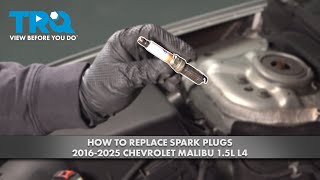
Typical fix: Replace all spark plugs as a set. 🎬 See this step-by-step walkthrough for replacing spark plugs on the 1.5L. Use high-quality plugs (e.g., ACDelco Iridium) specified for the engine.
Est. part cost: $40-$100 - Faulty Ignition Coils 🟡 Medium Probability Ignition coils are exposed to significant heat and can fail over time, producing a weak spark that is insufficient under load, leading to misfires.
How to confirm: With the engine misfiring, use a scan tool with live data to identify the misfiring cylinder(s). Swap the ignition coil from a misfiring cylinder with a known good cylinder. If the misfire follows the coil, the coil is bad.
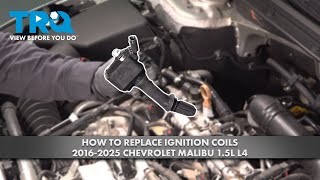
Typical fix: Replace the faulty ignition coil. 🎬 Watch: A quick guide to replacing ignition coils on your Malibu. It is often recommended to replace all coils if they are original and high-mileage.
Est. part cost: $50-$120 per coil - Clogged or Faulty Fuel Injectors ⚪ Low Probability Direct injection (DI) fuel injectors operate under very high pressure and can become clogged or fail electronically over time, disrupting the fuel spray pattern and causing a lean misfire. Carbon buildup on the back of intake valves, a common issue with DI engines, can also contribute.
How to confirm: This is difficult to diagnose without professional tools. A mechanic can perform a fuel injector balance test or use a scan tool to monitor fuel trims and injector performance. Intermittent hesitation is a key symptom.
Typical fix: Replace the faulty fuel injector(s). A professional fuel system cleaning service (e.g., walnut blasting for intake valves or an injector cleaning service) may be recommended as preventative maintenance.
Est. part cost: $70-$200 per injector
Rare But Worth Checking
- Vacuum Leak (PCV System): A leak in a vacuum hose or intake manifold gasket can introduce unmetered air, leaning out the air/fuel mixture and causing random misfires. On GM turbo engines, the PCV system is a common failure point. A clogged PCV orifice in the camshaft cover can cause excessive crankcase pressure, while a failed diaphragm can create a significant vacuum leak.
- Internal Coolant Leak: A GM service bulletin (PIP5628G) mentions that P0300 and P050D can be caused by coolant leaking into the cylinders. This can be due to a faulty head gasket or a crack in the cylinder head or block. A blacklight can be used to check for coolant dye on the piston tops.
Diagnosis Steps
- Read all stored fault codes with an OBD-II scanner. Note any codes that accompany P0300, especially P050D, P1101, or specific cylinder misfire codes (P0301-P0308).
- Identify the engine. If it is the 1.5L Turbo (RPO code LFV) in a 2016-2017 model, proceed immediately to a compression test as cracked pistons are highly probable.
- Perform an engine compression test. Compare readings across all cylinders. A significant loss of compression in one or more cylinders (e.g., below 100 PSI or more than 20% different from the others) indicates a serious mechanical problem like a cracked piston.
- If compression is good, inspect the ignition system. Remove spark plugs and ignition coils. Look for cracks, wear, oil fouling, or carbon tracking. A cracked spark plug insulator is a common, simple fix.
- Test the ignition coils by swapping them between cylinders to see if the misfire moves. This is a definitive way to isolate a bad coil.
- Check for vacuum leaks. Use a smoke machine to test the integrity of the intake manifold, vacuum hoses, and especially the PCV system integrated into the cam cover, which is a known failure point.
- Check the fuel system. Verify fuel pressure is within specification. Listen to the fuel injectors with a mechanic's stethoscope to ensure they are all clicking. A fuel injector balance test may be needed for DI engines.
- If all else fails, suspect a more complex issue like an internal coolant leak (check for coolant on plugs), a failing ECM, or a stretched timing chain, and seek professional diagnosis.
Parts You'll Likely Need
- Piston and Connecting Rod Assembly Kit
(OEM #12679522 (Superseded part number))— This is the required fix for the common cracked piston issue on 1.5
Related Codes That Often Appear With This One
- P0301-P0308 — These codes indicate a misfire on a specific cylinder (e.g., P0301 for Cylinder 1). P0300 is often triggered when a single cylinder misfire becomes severe enough to disrupt engine balance, or when multiple cylinders are failing intermittently.
- P050D — This code means 'Cold Start Rough Idle'. It is frequently seen with P0300 on these vehicles. Multiple TSBs, like PIP5628G, link this combination to a need for advanced diagnostic assistance, potentially for issues like internal coolant leaks or complex fuel/ignition problems.
- P1101 — This code indicates an Intake Air Flow System Performance issue. It can be set alongside P0300 when a vacuum leak, such as a failed PCV system in the intake manifold or cam cover, introduces unmetered air.
Technical Service Bulletins (TSBs) & Recalls
- 19-NA-122: Replaces PIP5421G. Details the diagnosis and repair for P0300 caused by a damaged piston on 2016-2017 1.5L LFV engines. Specifies replacing all four pistons with updated parts if cylinder walls are not damaged.
- N182195660: A Customer Satisfaction Program for 2016-2017 Malibus with the 1.5L engine for a pre-ignition condition that can damage pistons. The fix involves replacing the pistons.
- PIP5628G: Provides diagnostic aids for technicians dealing with P0300-P0308 and/or P050D, suggesting advanced diagnostics with scan tools and oscilloscopes to pinpoint complex misfire causes.
- 17019: A customer satisfaction program to reprogram the ECM and change the engine oil to a specific full synthetic type to prevent stochastic pre-ignition (SPI) on 2016-2017 1.5L engines.
Platform-Specific Known Issues

- A significant number of 2016-2019 Malibus with the 1.5L LFV turbo engine suffer from cracked pistons. This is a known manufacturing defect addressed by GM TSB PIP5421G. The issue causes low compression, leading to a P0300 code and requiring major engine repairs. An owner complaint to the NHTSA (ODI #11413118) for a 2017 Malibu explicitly states the cause of P0300 was a 'damaged piston' found after an inspection for low compression.
Mechanic-Grade Diagnostic Values
- High Pressure Fuel Rail Pressure (2.5L LKW Engine at Idle) — expected: 2.96–3.24 MPa (429–470 PSI). Failure: Pressure significantly higher or lower than the specified range.
- High Pressure Fuel Rail Pressure (2.0L LTG / 2.5L Engines at Idle) — expected: 1.9–5.0 MPa (276–725 PSI). Failure: Pressure outside this range indicates a potential issue with the high-pressure pump or sensor.
- Low Pressure Fuel System (8th Gen 2.5L) — expected: 50-94 PSI. Failure: Pressure dropping below 50 PSI, especially under load, indicates a weak low-pressure fuel pump.
- Cylinder Power Balance Test (GDS2) — expected: A relatively equal drop in RPM (e.g., ~100 RPM) when each cylinder's injector is disabled.. Failure: A cylinder that shows a significantly smaller RPM drop (e.g., 30 RPM vs 100 RPM for others) is not contributing its share of power.
Scan Tool Commands That Help
- GDS2/Tech2: Cylinder Power Balance Test — To isolate a weak or non-contributing cylinder when P0300 is present but a specific cylinder code (P0301-P0308) is not. The tool disables one injector at a time to measure the RPM drop; a cylinder with little to no drop is faulty.
- GDS2/Tech2: Crankshaft Position Variation Relearn — This procedure MUST be performed after replacing a crankshaft position sensor, ECM, or making major engine mechanical repairs (like piston replacement). Failure to do so can cause the ECM to incorrectly interpret normal crankshaft variations as misfires, setting a false P0300.
- GDS2: Throttle Body Idle Relearn / Air Flow Compensation Reset — After performing mechanical repairs for a misfire, especially if a vacuum leak was present or code P1101 was set. An un-metered air leak can cause the ECM to learn incorrect idle airflow values, which must be reset after the repair.
- GDS2/Tech2: Fuel Injector Balance Test — Used to identify a faulty fuel injector when a misfire is suspected to be fuel-related. This test helps diagnose injectors that are clogged, leaking, or not flowing correctly.
Wiring & Ground Locations
- Engine Harness Chafe Points (9th Gen) — Inspect the engine wiring harness for chafing against the ECM/TCM bracket, the driver's side upper control arm, and the shock tower bolt.. A production change left a harness branch unsecured, leading to rubbing and potential shorts to ground. A short in an injector or ignition coil control circuit can cause persistent, random misfires that are difficult to trace without a visual inspection of the harness in these specific locations.
Real Owner Repair Stories
- Chevy Tahoe Forum (2003 Chevrolet Tahoe (similar GM PCV system logic)) — Flashing CEL and P0300 code at highway speeds, high long-term fuel trims (+10 to +14) at idle.
❌ Tried (didn't work) Initially thought it was a standard vacuum leak and sprayed starter fluid to find it with no success.
✅ What actually fixed it The PCV valve had popped out of its hole in the valve cover, creating a large, unmetered vacuum leak. Reinserting the PCV valve fixed the vacuum leak and brought fuel trims back to normal (-2 to -4).
OEM Part Supersession History
PIP5421G (Service Bulletin)→19-NA-122 (Service Bulletin)— Updated diagnostic and repair procedures for the 1.5L LFV cracked piston issue.Pistons prior to 2017 VIN HF214702→Updated piston and rod assemblies (e.g., Part No. 12679522 mentioned in Pass 2)— The original pistons were susceptible to cracking due to stochastic pre-ignition (SPI). The updated design is more robust.
Heads up: Vehicles built after VIN HF214702 already have the updated pistons and should not be susceptible to this specific failure mode according to GM bulletin 19-NA-122.
Model Year Variations Within This Range
- 2016-2017: These model years with the 1.5L LFV engine are the primary group affected by the cracked piston defect. GM issued Customer Satisfaction Program N182195660 specifically for them, which extended coverage for piston replacement.
- 2017 (late production): Starting with VIN HF214702 for the 2017 model year, Chevrolet began installing updated piston assemblies from the factory to address the cracking issue.
- 2012-2015 (8th Generation): These models use different engines (e.g., 2.5L LKW) and are not affected by the 1.5L turbo's specific piston defect. P0300 on these vehicles is more likely due to traditional causes like faulty ignition coils, spark plugs, vacuum leaks, or issues with the high-pressure fuel system.
Helpful Videos


The information in this article is provided for general reference and educational purposes only. Vehicle specifications, procedures, and part compatibility can vary by production date, trim level, and region. Always consult your vehicle's factory service manual and verify part numbers before purchasing or performing repairs. Safety-critical components such as airbags, seat belts, and braking systems should be installed by a qualified professional.
- Chevrolet MALIBU:
- 🎬 Helpful Videos
- What's Unique About the 2012-2019 Chevrolet MALIBU
- Diagnostic Flowchart
- Symptoms You May Notice
- Most Likely Causes
- Rare But Worth Checking
- Diagnosis Steps
- Parts You'll Likely Need
- Related Codes That Often Appear With This One
- Technical Service Bulletins (TSBs) & Recalls
- Platform-Specific Known Issues
- Mechanic-Grade Diagnostic Values
- Scan Tool Commands That Help
- Wiring & Ground Locations
- Real Owner Repair Stories
- OEM Part Supersession History
- Model Year Variations Within This Range
- 🎟️ Get 5% Off