

P0300 on 2025 Cadillac XT5: Random Misfire Causes and Fixes
P0300 on a 2025 Cadillac XT5 signifies random engine misfires affecting multiple cylinders. The most common causes are worn spark plugs and faulty ignition coils. However, on the direct-injected 2.0L LSY and 3.6L LGX engines, issues like dirty fuel injectors and carbon buildup on intake valves are also frequent culprits. A Technical Service Bulletin (#18-NA-115) specifically addresses cold start misfires for this model year, which may require professional diagnosis.
- P0300 means your XT5's engine is misfiring on random cylinders, which can cause a rough idle, poor acceleration, and a flashing check engine light.
- Start your diagnosis with the most common culprits: worn spark plugs and faulty ignition coils.
- A flashing check engine light is a serious warning to stop driving to prevent catastrophic damage to the catalytic converter.
- Be aware of Technical Service Bulletins for this vehicle, especially TSB #18-NA-115, which addresses cold-start misfires on the 2025 model year and could indicate a serious engine problem.
What's Unique About the 2025-2025 Cadillac XT5
The 2025 Cadillac XT5 is available with a 2.0L Turbo (LSY) or a 3.6L V6 (LGX) engine. Both are direct-injection, making them prone to carbon buildup on intake valves, a common cause of P0300 that doesn't affect older port-injected engines. GM has issued specific Technical Service Bulletins (TSBs) relevant to these platforms. TSB #18-NA-115 directly mentions the 2025 model year for a cold start misfire and rough idle with a P0300 code. Other TSBs for mechanically similar models point to specific component failures like damaged Oil Control Valve (OCV) solenoids (TSB #21-NA-036) and internal valvetrain issues like broken rocker arms (TSB #PIP5493E), suggesting that a P0300 code on this vehicle warrants a check for known issues beyond a simple tune-up.
Diagnostic Flowchart
Tap your situation to follow the diagnostic path that matches what you're seeing on this vehicle.
Symptoms You May Notice
- Flashing or steady Check Engine Light
- Rough or shaking idle
- Hesitation or stumbling during acceleration
- Noticeable loss of engine power
- Engine sounds uneven or cuts out
- Difficulty starting the engine
- Engine shaking violently in severe cases
- Reduced fuel economy
- Replacing only one spark plug or coil when a full set is due for maintenance.
- Replacing oxygen sensors, as they are more likely to report a problem (like a lean condition from a vacuum leak) than be the root cause of a random misfire.
- Assuming the cause is major without first checking the basics of spark, fuel, and air.
- Using fuel injector cleaner to fix heavy carbon buildup on intake valves; the cleaner never touches the valves in a direct-injection engine.
Most Likely Causes
- Worn or Fouled Spark Plugs 🔴 High Probability Spark plugs are a standard maintenance item and the most common starting point for any misfire diagnosis. Real-world conditions can cause them to fail before the recommended 100,000-mile service interval.
How to confirm: Remove and inspect the spark plugs for a worn electrode, carbon tracking (a black line on the ceramic), oil fouling, or an incorrect gap. A plug wet with fuel can indicate a lack of spark.
Typical fix: Replace all spark plugs as a set. 🎬 Watch: 2017-2023 Cadillac XT5 spark plug removal and installation guide. It is highly recommended to use the OEM-specified ACDelco Iridium plugs to ensure proper performance.
Est. part cost: $60-$150 - Faulty Ignition Coil(s) 🔴 High Probability Coil-on-plug systems are a frequent failure point due to heat and vibration. A coil can become weak and cause intermittent, random misfires before it fails completely on a single cylinder, thus triggering a P0300.
How to confirm: Use a scan tool with live data to monitor misfire counts per cylinder. Swap a suspected bad coil with a coil from a known good cylinder and see if the misfire code follows the coil.
Typical fix: Replace the faulty ignition coil. It is often recommended to replace the corresponding spark plug at the same time. Using OEM ACDelco coils is advised for reliability.
Est. part cost: $50-$100 per coil - Dirty or Clogged Fuel Injectors 🟡 Medium Probability Direct injection engines, like the 3.6L LGX and 2.0L LSY, are susceptible to fuel injector issues. A real-world repair on a 2019 XT5 with a P0300 code was ultimately traced to a single faulty fuel injector after plugs and coils were replaced. The misfire was most noticeable under load between 1500-3000 RPM.
How to confirm: A professional fuel injector balance test using a scan tool like the GM GDS2 is the most definitive method. This test measures the pressure drop for each injector. Swapping an injector between cylinders to see if the misfire follows is another diagnostic step, but requires more labor and new seals upon reinstallation.
Typical fix: First, try a high-quality fuel system cleaner with Polyetheramine (PEA). If that fails, the faulty injector(s) will need to be replaced. Injector seals are single-use and must be replaced anytime an injector is removed to prevent fuel leaks.
Est. part cost: $70-$200 per injector - Vacuum Leak 🟡 Medium Probability Hoses and gaskets can degrade over time, allowing unmetered air into the intake manifold, which leans out the air-fuel mixture and can cause random misfires. A common source can be a leaking intake manifold gasket.
How to confirm: A smoke test is the most effective way to find a vacuum leak. A technician will feed pressurized smoke into the intake system and look for where it escapes. Sometimes a loose ground wire can also cause intermittent misfires that mimic a vacuum leak.
Typical fix: Replace the leaking hose or gasket.
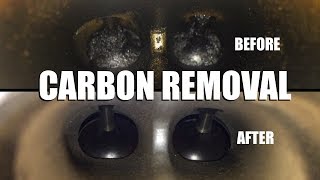
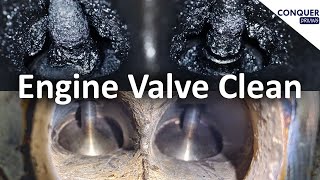
Est. part cost: $10-$100 - Carbon Buildup on Intake Valves ⚪ Low Probability On direct injection (GDI) engines like the LSY and LGX, fuel is not sprayed over the intake valves, so they don't benefit from the cleaning effect of fuel detergents. Oil vapor from the PCV system can bake onto the hot valves, restricting airflow and causing misfires, especially on cold starts or at idle. A video of an XT5 with the 3.6L engine clearly shows these deposits in the intake ports.
How to confirm: This requires visual inspection with a borescope after removing the intake manifold. A technician can also monitor Mode $06 data on an advanced scan tool to see raw misfire counts, which will often jump randomly between cylinders at idle if carbon is the cause.
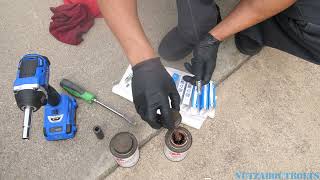
Typical fix: The valves must be physically cleaned. The most effective professional method is walnut blasting, which uses crushed walnut shells to scrub the valves clean without damaging metal components. 🎬 Watch: How walnut blasting effectively removes heavy intake valve carbon. Chemical cleaning methods can also be used.
Est. part cost: $0 (if DIY cleaning) - $600+ (for professional walnut blasting service)
Rare But Worth Checking
- Damaged Oil Control Valve (OCV) Solenoid: TSB #21-NA-036 for the 2021 XT5 specifically mentions a damaged OCV solenoid can cause an oil leak and misfires, particularly P0300, P0302, and/or P0305. The solenoid can break, leaving a piece stuck in the camshaft cover bore, which prevents proper oil pressure control for the Active Fuel Management (AFM) system, leading to cylinder deactivation issues and misfires.
- Engine Block/Cylinder Head Porosity: TSB #18-NA-115, which applies to the 2025 model year, describes a rare but severe issue where microscopic porosity in the engine casting allows coolant to seep into a cylinder. This typically causes a pronounced misfire on a cold start that may lessen as the engine warms up. The definitive fix is often engine replacement.
- Internal Engine Mechanical Issues: Other TSBs for similar GM engines (like PIP5493E) point to rare internal issues like broken rocker arms or damaged camshaft actuators as potential causes for P0300 after more common causes are ruled out. A Reddit user with a 2019 XT5 reported their dealer moving to replace rocker arms and a deactivation solenoid for a persistent cylinder 5 misfire after plugs, coils, and injectors failed to fix it.
Diagnosis Steps
- Scan the ECM for trouble codes. Note P0300 and any other codes present, such as specific cylinder misfires (P0301-P0306) or lean codes (P0171/P0174).
- Analyze freeze frame data to see the engine conditions (speed, load, temperature) when the code was set. Check live data for misfire counts per cylinder to see if any are more frequent.
- Inspect the ignition system. Remove and examine all spark plugs for wear, damage, or fouling.
- Test the ignition coils. The easiest method is to swap a coil from a cylinder with high misfire counts (if identifiable via scan tool) with a known good cylinder and see if the misfire follows.
- Check for vacuum leaks. Perform a smoke test to identify any leaks from gaskets, hoses, or the intake manifold. Also check for loose engine ground wires.
- Inspect the fuel system. Start by using a quality fuel injector cleaner with PEA. If misfires persist, check fuel pressure and consider a professional injector balance test.
Parts You'll Likely Need
- Spark Plugs
(OEM #41-123 (LGX V6), check dealer for LSY 2.0T)— This is the most common and fundamental cause of misfires and is a standard maintenance item.
Trusted brands: ACDelco, NGK
OEM price range: $15-$25 per plug
Aftermarket price range: $8-$15 per plug - Ignition Coil
(OEM #12707304 (Fits many GM applications, verify for specific engine))— A common failure point that can cause random misfires before failing completely on one cylinder.
Trusted brands: ACDelco, Delphi
OEM price range: $50-$100 per coil
Aftermarket price range: $30-$60 per coil - Fuel Injector Seal Kit
(OEM #12657373 (LGX V6))— Required anytime a direct fuel injector is removed for testing or replacement to prevent high-pressure fuel leaks.
Trusted brands: ACDelco
OEM price range: $15-$30 per injector
Aftermarket price range: $10-$20 per injector
Related Codes That Often Appear With This One
- P0301-P0306 — If the ECM can eventually isolate the misfire to a specific cylinder, a P0300 will often be accompanied by a cylinder-specific code (e.g., P0304 for cylinder 4).
- P050D — This code for 'Cold Start Rough Idle' is mentioned in TSB #PIP5628G alongside P0300, indicating a potential shared cause during cold starts that requires specific diagnostic data collection.
- P0171/P0174 — These 'System Too Lean' codes often appear with P0300 if the root cause is a significant vacuum leak affecting all cylinders.
- P0087/P0191 — These codes indicate low fuel pressure from a failing high-pressure fuel pump or sensor, which can cause widespread misfires on a direct-injection engine.
Technical Service Bulletins (TSBs) & Recalls
- 18-NA-115: Provides information on diagnosing a cold start misfire and/or rough idle with DTC P0300 set.
- PIP5628G: Communicates information that needs to be provided to GM's Technical Assistance Center (TAC) for diagnosing misfire codes P0300-P0308.
- 21-NA-036: Details a diagnostic test for a damaged OCV solenoid that may cause an oil leak and misfire, setting DTCs P0300, P0302, and/or P0305.
Platform-Specific Known Issues
- Carbon Buildup on Direct Injection Engines (LSY & LGX): Both the 2.0L Turbo and 3.6L V6 are direct-injection, which makes them highly susceptible to carbon deposits on the intake valves. This restricts airflow and is a primary cause of random misfires at idle or on cold starts that won't be fixed by a tune-up or fuel additives.
- Active Fuel Management (AFM) Component Failures: TSB #21-NA-036 highlights how a faulty Oil Control Valve (OCV) solenoid, part of the AFM system, can lead to misfires. The solenoid can break, causing oil pressure issues that incorrectly trigger cylinder deactivation. TSB PIP5493E also points to inspecting rocker arms (SRFFs) and lifters, which are part of this complex system.
- Software-Related Misfires Under Specific Conditions: An early TSB for the 2017 XT5 (PIP5493) noted a P0300/P0306 misfire that could occur specifically after a cold start followed by heavy acceleration to merge onto a highway. At the time, GM was investigating a software solution, indicating not all misfires are purely mechanical.
Mechanic-Grade Diagnostic Values
- Ignition Coil Primary Resistance — expected: 0.4 to 2.0 ohms. Failure: A reading outside this range indicates a faulty coil winding.
- Ignition Coil Secondary Resistance — expected: 6,000 to 10,000 ohms (6k-10k Ω). Failure: A reading outside this range suggests a failure in the secondary coil winding.
- Engine Compression (3.6L V6) — expected: 170-190 psi. Failure: Compression below 150 psi suggests mechanical issues like worn piston rings or valve problems.
- Low-Side Fuel Pressure — expected: Approximately 50-65 PSI (varies by specific system). Failure: Significantly lower pressure under load indicates a weak low-pressure pump or clogged filter.
Hidden / Shadow Codes Worth Checking
- Mode $06, TID $82, CID $20: Represents the ratio of Rich-Lean to Lean-Rich response times for an oxygen sensor. An out-of-spec value could indicate a slow O2 sensor, which might contribute to incorrect fuel trimming and random misfires. (see via Advanced scan tool capable of displaying Mode $06 data.)
- U0401: Invalid Data Received From ECM/PCM. While not a direct misfire code, it was found alongside a P0300 in a 2019 XT5 diagnosis, appearing in the TCM and EBCM when the vehicle entered limp mode due to severe misfires. It indicates a communication breakdown caused by the primary engine fault. (see via Full system scan tool that can read codes from modules beyond the ECM, such as the Transmission Control Module (TCM) and Electronic Brake Control Module (EBCM).)
Scan Tool Commands That Help
- GDS2: Cylinder Balance Test (Fuel Injector Kill) — Used to identify a weak or non-contributing cylinder. The technician disables one injector at a time and observes the RPM drop. If disabling an injector causes little or no change in RPM, that cylinder's injector is suspect.
- GDS2: Crankshaft Position System Variation Learning Procedure (Crank Learn) — This procedure must be performed after replacing a crankshaft sensor, ECM, or major engine components. It compensates for slight mechanical variations in the crankshaft reluctor wheel. If not performed, the ECM may misinterpret the crank signal and falsely detect misfires.
- GDS2: Misfire Graph / Misfire History — Essential for P0300 diagnosis. This live data display shows current and historical misfire counts for each individual cylinder, helping to determine if the 'random' misfire is actually more frequent on specific cylinders under certain load or RPM conditions.
Wiring & Ground Locations
- G102 — Located at the left rear of the engine.. This is a primary ground for the ignition coils. A loose or corroded G102 can cause a weak or intermittent spark across multiple cylinders, leading to a random misfire P0300 code.
- G103 — Located at the left rear of the engine compartment on the cowl, above the brake booster.. This ground serves the Engine Control Module (ECM) and Body Control Module (BCM). A poor connection here can cause a wide range of erratic electronic behavior, including phantom codes and incorrect sensor readings that could lead to a P0300.
- X50A Fuse Block - Underhood — The main underhood fuse block.. This is a central hub for power distribution. A diagnostic procedure for a related component (wiper motor) shows a test for a short to ground on a circuit at connector X2, terminal 14 of this fuse block. This illustrates the importance of checking for shorts or opens at major harness connection points when diagnosing electrical faults.
Real Owner Repair Stories
- youcanic.com (2019 Cadillac XT5 3.6L) — Check Engine Light on, misfiring under load between 1500-3000 RPM, traction control and ABS lights would also come on as vehicle entered limp mode. Codes P0300 and U0401 were present.
❌ Tried (didn't work) Swapping spark plug and ignition coil from the primary misfiring cylinder (#4) to another cylinder (#2) did not move the misfire., An upper engine cleaning to remove carbon buildup did not resolve the misfire on cylinder #4.
✅ What actually fixed it A fuel injector from cylinder #4 was swapped with the injector from cylinder #2. The misfire moved to cylinder #2, confirming a faulty fuel injector. Replacing the injector for cylinder #4 resolved the P0300 code.
When the Usual Fixes Don't Work
- In a documented repair of a 2019 XT5 with the 3.6L engine, the common initial steps of replacing spark plugs and ignition coils, and even performing a chemical carbon cleaning, failed to resolve the P0300 code. The misfire was isolated to cylinder #4 using a scan tool's live data. The ultimate cause was a single faulty fuel injector, which was only confirmed after swapping it to another cylinder and seeing the misfire follow the injector. This highlights that on direct-injection engines, a persistent misfire that doesn't respond to a tune-up should lead to fuel injector testing before assuming more severe mechanical issues.
OEM Part Supersession History
12658183→12674754, 12699383— Standard part evolution for improved durability and performance. The coil uses pure copper windings and coated laminations to resist internal shorts and corrosion.
Helpful Videos
Used OEM Parts in Stock

New Aftermarket Parts Available


The information in this article is provided for general reference and educational purposes only. Vehicle specifications, procedures, and part compatibility can vary by production date, trim level, and region. Always consult your vehicle's factory service manual and verify part numbers before purchasing or performing repairs. Safety-critical components such as airbags, seat belts, and braking systems should be installed by a qualified professional.
- Cadillac XT5:
- 🎬 Helpful Videos
- 🛍️ Shop This Part
- What's Unique About the 2025-2025 Cadillac XT5
- Diagnostic Flowchart
- Symptoms You May Notice
- Most Likely Causes
- Rare But Worth Checking
- Diagnosis Steps
- Parts You'll Likely Need
- Related Codes That Often Appear With This One
- Technical Service Bulletins (TSBs) & Recalls
- Platform-Specific Known Issues
- Mechanic-Grade Diagnostic Values
- Hidden / Shadow Codes Worth Checking
- Scan Tool Commands That Help
- Wiring & Ground Locations
- Real Owner Repair Stories
- When the Usual Fixes Don't Work
- OEM Part Supersession History
- 🎟️ Get 5% Off