

P0300 on 2000-2004 Buick Regal: Random Misfire Causes and Fixes
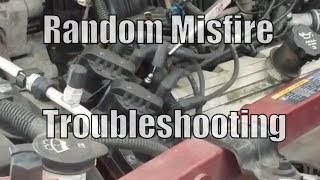
P0300 on a 2000-2004 Buick Regal with the 3.8L V6 is most often caused by a failed Ignition Control Module (ICM) located under the coil packs. Other very common causes include worn spark plugs, bad wires, a faulty ignition coil, a leaking Fuel Pressure Regulator (FPR), or vacuum leaks from the plastic Upper Intake Manifold (UIM). Replacing the ICM is a common DIY fix costing between $60 and $150 for a quality part like an ACDelco D579.
- P0300 on a 2000-2004 Regal is a random misfire code, most frequently caused by a bad Ignition Control Module (ICM).
- Do not drive if the Check Engine Light is flashing, as this can quickly damage your catalytic converter.
- Always check the simple and common items first: spark plugs, wires, coils, the fuel pressure regulator, and for vacuum leaks.
- The GM 3800 engine has well-known issues with the ICM and upper intake manifold gaskets that often lead to this specific code.
- When replacing the ICM, use a quality part and ensure the mounting surface is clean to allow for proper heat transfer.
What's Unique About the 2000-2004 Buick REGAL
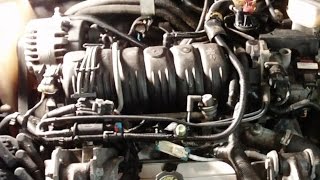
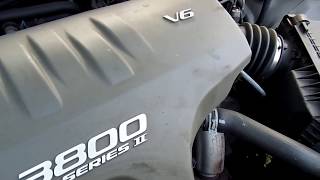
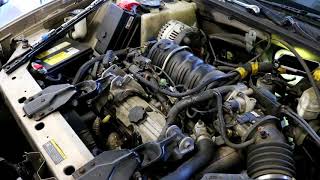
The 2000-2004 Buick Regal exclusively uses the legendary GM 3800 Series II V6 engine, in both naturally aspirated (L36) and supercharged (L67) forms. While robust, this platform has several well-known failure points that directly lead to a P0300 code. The Ignition Control Module (ICM) is notoriously prone to failure from heat cycling, as it's mounted directly to the engine. The original plastic upper intake manifold can crack or have its gasket fail, causing vacuum leaks. The fuel pressure regulator diaphragm can rupture, leaking raw fuel into the vacuum system. These three issues are responsible for a significant percentage of P0300 codes on these specific vehicles.
Diagnostic Flowchart
Tap your situation to follow the diagnostic path that matches what you're seeing on this vehicle.
Symptoms You May Notice
- Rough or shaking idle
- Hesitation or stumbling during acceleration
- Noticeable loss of engine power
- Flashing or solid Check Engine Light
- Decreased fuel economy
- Difficulty starting the engine, or extended cranking
- Possible engine stalling, especially under gentle acceleration or when warm [7, ODI #10262365]
- Black smoke from the exhaust or a strong smell of gasoline, indicating a rich condition
- Sucking or whistling noises from the engine bay, indicating a vacuum leak
- Replacing only the spark plugs without replacing old, high-resistance wires.
- Replacing fuel injectors when the issue is actually the fuel pressure regulator leaking into the vacuum line.
- Replacing ignition coils when the underlying problem is a failing Ignition Control Module.
- Replacing the PCM/ECM before thoroughly testing the ignition system, fuel system, and checking for vacuum leaks. An owner complaint reported an ECM replacement, but this is rare. [ODI #10262365]
Most Likely Causes
- Failed Ignition Control Module (ICM) 🔴 High Probability The ICM is mounted directly to the engine block under the coil packs, where it is subjected to intense heat cycles. This is a very common failure point on the GM 3800 engine, causing intermittent and random misfires as it overheats. Failure often presents when the engine is warm.
How to confirm: Remove the ICM and have it tested at an auto parts store (many offer this service for free). Testing should be done multiple times as the module can fail only when hot. A failure of the ICM can cause a lack of spark on paired cylinders (e.g., 1-4, 2-5, or 3-6). A scan tool showing misfire history concentrated on two companion cylinders is a strong indicator.
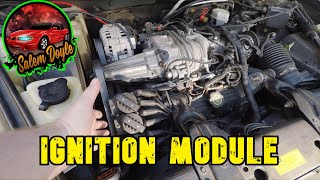
Typical fix: Replace the Ignition Control Module. 🎬 Watch this step-by-step guide on replacing the ICM. It is highly recommended to use a quality brand like ACDelco (Part #D579) and apply fresh thermal paste/dielectric grease to the heat sink plate to ensure proper heat transfer.
Est. part cost: $60-$150 - Worn Spark Plugs and/or Wires 🔴 High Probability These are standard maintenance items. Worn plugs with an excessive gap or old wires with cracked insulation can cause a weak, misdirected, or open-circuit spark, leading to misfires, especially under load.
How to confirm: Visually inspect spark plugs for wear, fouling, or damage. Inspect wires for cracks, burns, or corrosion. A simple test is to run the engine in the dark and look for arcing (blue sparks) along the wires. A more definitive test involves measuring wire resistance with a multimeter.
Typical fix: Replace all six spark plugs and the full set of spark plug wires. It's best to do these together. Using OEM-spec ACDelco iridium or platinum plugs is recommended.
Est. part cost: $50-$120 - Faulty Ignition Coil Pack(s) 🟡 Medium Probability Like the ICM, coils are exposed to heat and can fail over time. The 3800 engine uses three coil packs, each responsible for firing two cylinders in a waste-spark system (1/4, 2/5, 3/6). A failing coil will cause misfires on its two paired cylinders, which the PCM may interpret as a random P0300 code before isolating it.
How to confirm: Swap a suspected bad coil with a known good one from a different position. If the misfire moves to the new cylinders (requires a scan tool to monitor live misfire counts), the coil is bad. You can also use an inline spark tester to check for a strong, blue spark from each coil tower.
Typical fix: Replace the faulty ignition coil pack. Since the coils must be removed to access the ICM, many owners replace all three coils and the ICM at the same time as preventative maintenance.
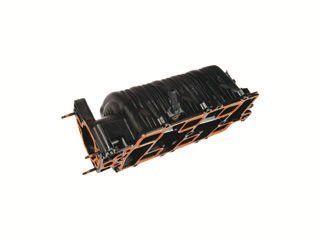
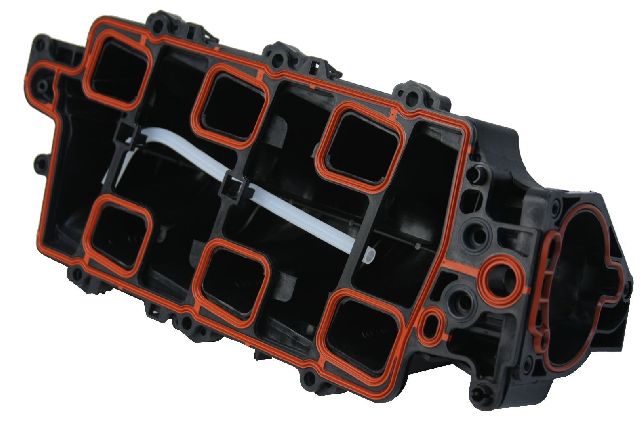
Est. part cost: $30-$70 per coil - Vacuum Leak (Upper Intake Manifold) 🟡 Medium Probability The original upper intake manifold (plenum) is made of plastic. The port for the EGR (Exhaust Gas Recirculation) valve is a known weak point that can melt or crack from heat, causing a vacuum leak and sometimes a coolant leak. The gaskets can also fail, allowing unmetered air into the engine, which creates a lean condition and causes random misfires.
How to confirm: With the engine running, spray brake cleaner, starting fluid, or an unlit propane torch around the intake manifold sealing surfaces. If the engine RPM changes, a vacuum leak is present. 🎬 See simple ways to test for intake gasket leaks. A visual inspection may reveal a melted/deformed area near the EGR valve.
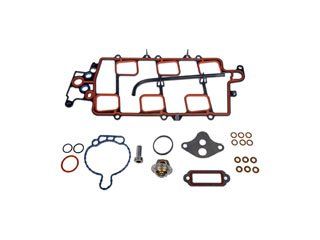
Typical fix: Replace the upper intake manifold and its gaskets. It is highly recommended to use an upgraded design from brands like Dorman (Part #615-180) or Fel-Pro (Gasket Set #MS98014T) which often include a redesigned EGR stovepipe to prevent future failure.
Est. part cost: $70-$200 for gasket set and/or plenum - Leaking Fuel Pressure Regulator (FPR) 🟡 Medium Probability The diaphragm inside the FPR can rupture, allowing raw fuel to be sucked into the vacuum line and directly into the intake manifold. This creates a severe rich running condition that can foul spark plugs and cause multiple cylinders to misfire.
How to confirm: Pull the vacuum hose off the fuel pressure regulator nipple. If gasoline is present in the hose or drips out of the regulator, the FPR has failed. There should be no fuel on the vacuum side.
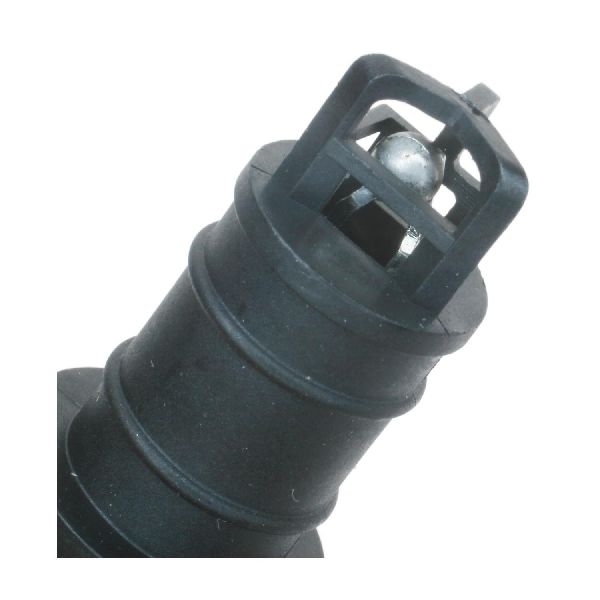
Typical fix: Replace the fuel pressure regulator. It is a simple repair, typically located on the fuel rail.
Est. part cost: $40-$90
Rare But Worth Checking
- Clogged Catalytic Converter: A clogged converter creates excessive exhaust backpressure, choking the engine and causing misfires, especially under load or at higher RPMs. This is often accompanied by a 'rotten egg' smell from the exhaust and a P0420 code.
- Dirty or Failing Mass Airflow (MAF) Sensor: A contaminated MAF sensor can provide incorrect airflow readings to the PCM, leading to an improper air/fuel mixture and misfires across all cylinders. Cleaning the sensor with a dedicated MAF sensor cleaner spray is a good first step before replacement.
- Low Fuel Pressure: A weak fuel pump or clogged fuel filter can starve the engine for fuel, causing lean misfires on multiple cylinders, often more noticeable under heavy acceleration. Fuel pressure should be tested with a gauge on the fuel rail's Schrader valve.
- Faulty Crankshaft Position Sensor (CKP): The PCM uses the CKP sensor to detect misfires. While not a common cause for P0300, an erratic sensor can send faulty data that the PCM interprets as a random misfire. In some cases, a Crankshaft Variation Relearn procedure is needed after major work.
- Internal Engine Mechanical Problems: This is the least likely cause and should be investigated last. Issues like low compression from worn piston rings, a failing head gasket, or bent/stuck valves can cause misfires. A compression test is needed for diagnosis.
Diagnosis Steps
- Scan for any other accompanying trouble codes. Codes like P0171, P0172, or specific cylinder misfires (P0301-P0306) provide valuable clues.
- Check the Check Engine Light. If it is flashing, do not drive the vehicle to avoid catalytic converter damage.
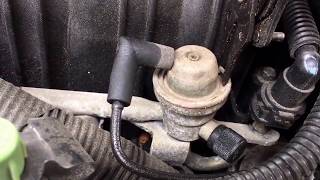
- Check the Fuel Pressure Regulator (FPR). This is a quick and common fix. Pull the vacuum line off the FPR and check for the presence or smell of raw fuel. If fuel is found, replace the regulator. 🎬 Watch how to check and swap a leaking regulator.
- Visually inspect the engine bay. Look for obvious damage to spark plug wires, carbon tracking on ignition coils, and listen
Parts You'll Likely Need
- Ignition Control Module
(OEM #10489422)— This is the most common point of failure on the GM 3800 engine leading to a P0300 code due to its location and susceptibility to heat damage.
Trusted brands: ACDelco, Delphi
OEM price range: $120-$180
Aftermarket price range: $60-$110 - Spark Plug Wires — Insulation breaks down over time, causing spark to arc to ground instead of firing the plug, a common cause of misfires.
Trusted brands: ACDelco, NGK
OEM price range: $60-$90
Aftermarket price range: $30-$50 - Spark Plugs — A fundamental part of the ignition system that wears out over time. Worn electrodes or incorrect gaps cause weak spark and misfires.
Trusted brands: ACDelco, NGK
OEM price range: $25-$40 (set of 6)
Aftermarket price range: $15-$30 (set of 6) - Upper Intake Manifold Gasket Set — The original gaskets are prone to failure, causing vacuum leaks that lead to lean misfires across multiple cylinders.
Trusted brands: Fel-Pro, ACDelco
OEM price range: $50-$80
Aftermarket price range: $25-$50 - Fuel Pressure Regulator — A ruptured diaphragm allows raw fuel into the intake, causing a rich condition and random misfires.
Trusted brands: Bosch, Delphi, ACDelco
OEM price range: $60-$100
Aftermarket price range: $40-$70
Related Codes That Often Appear With This One
- P0301-P0306 — If the PCM can eventually isolate the misfire to a specific cylinder (e.g., Cylinder 1, P0301), it will log a corresponding code alongside the P0300.
- P0171 — System Too Lean (Bank 1). This often appears with P0300 if the root cause is a major vacuum leak, such as from the intake manifold gasket.
- P0172 — System Too Rich (Bank 1). This can be triggered alongside P0300 if the fuel pressure regulator has failed and is leaking raw fuel into the intake.
- P0420 — Catalyst System Efficiency Below Threshold. A long-term misfire condition can dump unburnt fuel into the exhaust, damaging the catalytic converter and leading to this code.
Technical Service Bulletins (TSBs) & Recalls
- PIP5628G - Preliminary information for diagnosing P0300-P0308 misfire codes.
Platform-Specific Known Issues
- A safety recall (NHTSA #15V519000, superseding earlier recalls) was issued for 1997-2004 Regals for engine oil dripping from the front valve cover gasket onto the hot exhaust manifold, creating a fire risk. While not a direct cause of P0300, it highlights the high-heat environment around the front cylinder bank's ignition components.
Mechanic-Grade Diagnostic Values
- Fuel Pressure (Key On, Engine Off) — expected: 48-55 psi. Failure: Pressure below 48 psi indicates a weak fuel pump, clogged filter, or faulty regulator.
- Ignition Coil Primary Resistance — expected: 0.4 to 2 ohms. Failure: A reading outside this range suggests a faulty primary winding in the coil.
- Ignition Coil Secondary Resistance — expected: 6,000 to 10,000 ohms. Failure: A reading outside this range suggests a faulty secondary winding in the coil.
- Fuel Injector Coil Resistance — expected: 11 to 14 ohms (when engine is cool). Failure: Readings significantly outside this range, or an open/short circuit, indicate a bad injector coil. Resistance will be higher when the engine is hot.
- Injector Balance Test (Pressure Drop) — expected: All injectors should have a pressure drop within 1.5 PSI of the average for all cylinders.. Failure: An injector with a pressure drop that deviates by more than 1.5 PSI from the average is likely clogged or faulty.
Hidden / Shadow Codes Worth Checking
- P1336: Crankshaft Position (CKP) System Variation Not Learned. This code will set if the Crankshaft Variation Relearn procedure has not been completed successfully after replacing the PCM, crankshaft sensor, or making major engine repairs. (see via Standard OBD-II scanner. It indicates the need for a specific scan tool procedure.)
Scan Tool Commands That Help
- GM Tech 2 / Professional Bidirectional Scanner: Misfire Graph — Use this function to view live misfire counts for each individual cylinder. This is extremely useful for a P0300 code, as it can help determine if the 'random' misfire is actually concentrated on specific cylinders, pointing towards a failing coil pack (which fires two cylinders) or a single-cylinder issue.
- GM Tech 2 / Professional Bidirectional Scanner: Crankshaft Position (CKP) Variation Relearn — This procedure must be performed after replacing the PCM, crankshaft position sensor, or the engine assembly. The PCM learns the minor variations in the crankshaft reluctor wheel to accurately detect misfires. Failure to perform the relearn can cause the PCM to falsely detect misfires and set a P0300 or P1336 code.
- GM Tech 2 / Professional Bidirectional Scanner: Injector Balance Test — This test individually fires each fuel injector and measures the corresponding drop in fuel pressure. It is used to identify a clogged or electrically failing injector that may be causing a misfire on one or more cylinders.
Wiring & Ground Locations
- Main Engine Ground — On a transmission bell housing bolt/stud, near the starter motor on the lower left front of the engine. Often has two large ground cables attached.. This is the primary ground path for the engine block. A poor connection here can cause widespread electrical issues, including erratic sensor readings and weak ignition spark, leading to random misfires.
- ICM Ground — A ground wire attached to the ignition control module bracket itself, on the right front of the engine. Another ground for the ICM harness may be located near the supercharger tensioner bracket on L67 models.. A dedicated ground for the ignition control module is critical. A loose or corroded ICM ground can directly cause weak or no spark, leading to misfires on multiple cylinders.
- Battery to Chassis Ground — A cable running from the negative battery terminal to the chassis, often on the strut tower or frame rail near the battery.. Ensures the entire vehicle body has a solid ground reference. A bad connection here can affect the PCM and other modules that ground to the chassis, potentially causing a variety of codes, including P0300.
- ICM Connector (Pin K) — Pin 'K' on the 14-pin ICM connector is a Black with White stripe wire.. This is the primary ground input to the Ignition Control Module. Verifying continuity to ground at this pin is a key step in diagnosing a faulty ICM or wiring issue.
- ICM Connector (Pin P) — Pin 'P' on the 14-pin ICM connector is a Pink wire.. This pin supplies the 12-volt ignition power to the ICM. A voltage test at this pin confirms the module is receiving power. Lack of power would cause a no-spark condition on all cylinders.
Real Owner Repair Stories
- GM Forum user (1998 Buick Regal GS (Supercharged 3.8L)) — P0300 code that only appeared at light load on the highway (50+ mph) with the torque converter locked. Misfire counts on scanner would jump to 30-40 on cylinders 3 and 6, but the misfire was not physically felt by the driver.
❌ Tried (didn't work) Replaced spark plugs and wires., Replaced the ignition coil for cylinders 3/6., Swapped coil packs to different positions (misfire remained on 3/6).
✅ What actually fixed it The user suspected the Ignition Control Module (ICM) was the final culprit, as the misfire was isolated to a single coil's companion cylinders (3/6) and swapping the coil itself had no effect. This points directly to the driver for that coil within the ICM failing under specific load/heat conditions.
OEM Part Supersession History
Varies (Original GM UIM Gasket)→Fel-Pro MS98014T— The Fel-Pro MS98014T is an improved gasket set designed for the repair environment. It features a steel carrier with molded rubber seals and built-in torque limiters to prevent overtightening and gasket extrusion, addressing common failure points of the original design.12583236, 17113660→89060418 (and others)— Standard part evolution and consolidation for the fuel pressure regulator.
Heads up: Always verify fitment by VIN, but most regulators for the 3800 Series II are interchangeable for the 2000-2004 period.
Helpful Videos

Used OEM Parts in Stock


New Aftermarket Parts Available


The information in this article is provided for general reference and educational purposes only. Vehicle specifications, procedures, and part compatibility can vary by production date, trim level, and region. Always consult your vehicle's factory service manual and verify part numbers before purchasing or performing repairs. Safety-critical components such as airbags, seat belts, and braking systems should be installed by a qualified professional.
- Buick REGAL:
- 🎬 Helpful Videos
- 🛍️ Shop This Part
- What's Unique About the 2000-2004 Buick REGAL
- Diagnostic Flowchart
- Symptoms You May Notice
- Most Likely Causes
- Rare But Worth Checking
- Diagnosis Steps
- Parts You'll Likely Need
- Related Codes That Often Appear With This One
- Technical Service Bulletins (TSBs) & Recalls
- Platform-Specific Known Issues
- Mechanic-Grade Diagnostic Values
- Hidden / Shadow Codes Worth Checking
- Scan Tool Commands That Help
- Wiring & Ground Locations
- Real Owner Repair Stories
- OEM Part Supersession History
- 🎟️ Get 5% Off