

P0300 on 2000-2005 Buick LeSabre: Random Misfire Causes and Fixes
On a 2000-2005 Buick LeSabre with the 3.8L V6, a P0300 code is most often caused by a failed Ignition Control Module (ICM) or bad ignition coils. Other common causes include worn spark plugs, faulty wires, a vacuum leak from a cracked upper intake manifold gasket, or a faulty fuel pressure regulator.
- For a P0300 on a 2000-2005 LeSabre, the problem is almost always in the ignition system.
- The Ignition Control Module (ICM) is the most likely single point of failure. Test it by swapping ignition coils first.
- Do not ignore a flashing check engine light, as it can lead to costly catalytic converter damage.
- If the ignition system seems fine, the next most probable cause is a vacuum leak from the intake manifold gaskets, a known weak point on this engine.
What's Unique About the 2000-2005 Buick LESABRE

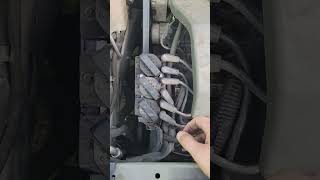
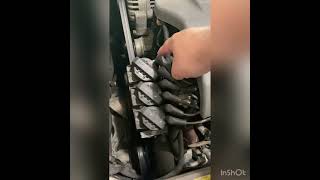
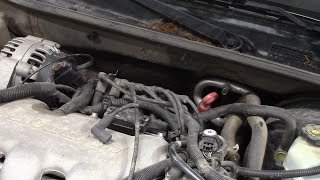
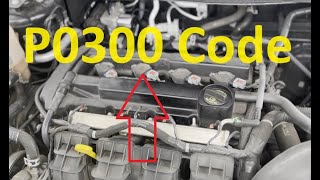
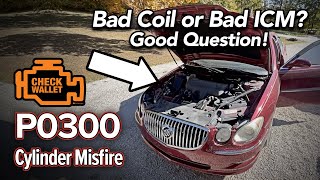
The Buick LeSabre from this era uses the legendary GM 3800 Series II V6 engine. While known for its durability, this platform has two very common and well-documented failure points that directly cause a P0300 code. The first is the Ignition Control Module (ICM), which sits under the three ignition coils 🎬 Watch: How to tell if the coil or ICM failed. and is prone to failure from heat and age. The second is the plastic upper intake manifold and its gaskets, which can crack or degrade, especially around the EGR stovepipe, 🎬 See how to check for leaking intake gaskets. causing significant vacuum or coolant leaks that disrupt the air/fuel mixture and lead to misfires.
Diagnostic Flowchart

Tap your situation to follow the diagnostic path that matches what you're seeing on this vehicle.
Symptoms You May Notice
- Rough or shaking idle
- Hesitation or stumbling during acceleration
- Flashing Check Engine Light
- Noticeable loss of engine power
- Reduced fuel economy
- Engine is hard to start
- Smell of gasoline from the exhaust
- Stalling, especially when the engine warms up
- Replacing only the spark plugs without checking the wires, coils, and ICM.
- Replacing oxygen sensors, as they will often report a lean condition due to the misfire, but are not the root cause.
- Replacing the fuel injectors without confirming a failure, as they are generally reliable on this engine and less likely to cause a random misfire than the ignition system or intake gaskets.
Most Likely Causes

- Failed Ignition Control Module (ICM) 🔴 High Probability The ICM on the 3800 engine is located under the ignition coils in a high-heat area of the engine bay, leading to a high failure rate over time. Heat cycling causes the internal electronics to fail.
How to confirm: Use a scan tool to monitor misfire data. If misfires are consistently logged on paired cylinders (e.g., 1-4, 2-5, or 3-6), swap the coil for that pair with a known good one. If the misfire stays on the same cylinders, the ICM is the prime suspect. A failing ICM may also cause the engine to stall when it gets hot but restart after cooling down.
Typical fix: Replace the Ignition Control Module. It is located beneath the three ignition coil packs. It is recommended to apply a new layer of dielectric grease or thermal paste to the back of the new module to aid heat dissipation.
Est. part cost: $70-$150 - Failed Ignition Coil(s) 🔴 High Probability The 3800 engine uses a waste-spark system with three coil packs, each firing two cylinders simultaneously (1/4, 2/5, 3/6). Age and heat can cause the internal windings to fail, resulting in a weak or no-spark condition for two cylinders at once.
How to confirm: Use a spark tester to check for spark at the wire for the misfiring cylinders. Alternatively, swap a suspected bad coil with a known good one and see if the misfire moves to the other cylinders. For example, if cylinders 3 and 6 are misfiring, swap that coil with the one for cylinders 2 and 5. If the misfire moves to 2 and 5, the coil is bad.
Typical fix: Replace the faulty ignition coil pack(s). Many owners replace all three at once as a preventative measure.
Est. part cost: $30-$60 per coil - Worn Spark Plugs or Faulty Spark Plug Wires 🟡 Medium Probability Standard wear and tear. Wires can become brittle and crack, causing spark to arc to the engine block instead of the plug, especially in damp conditions. Plugs can become fouled or the electrode can wear down, creating too large a gap for a consistent spark. It is highly recommended to use the specified OEM plugs, as these engines can be sensitive to other types.
How to confirm: Visually inspect spark plug wires for cracks, corrosion, or arcing (sometimes visible in the dark with the engine running). Remove and inspect spark plugs for wear, fouling, or incorrect gap. The correct gap for the OEM ACDelco plugs is typically 0.060 inches.
Typical fix: Replace all spark plugs and spark plug wires as a set. Use OEM-spec parts like ACDelco Iridium plugs (Part #41-101) for best results.
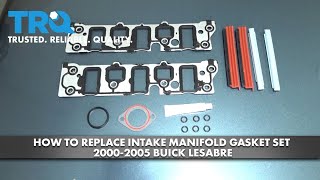
Est. part cost: $60-$120 for a full set of plugs and wires - Vacuum Leak (Intake Manifold Gaskets) 🟡 Medium Probability The original upper intake manifold on the 3800 Series II was made of a plastic composite that can crack and degrade over time, especially around the EGR stovepipe which can melt the plastic. The lower intake manifold gaskets (LIMG) are also a notorious failure point, leading to coolant and/or vacuum leaks.
How to confirm: Perform a smoke test on the intake system to see if smoke escapes from the gasket area. You may also hear a hissing sound near the intake manifold at idle. For a LIMG leak, you may notice unexplained coolant loss or a milky/sludgy substance on the oil cap.
Typical fix: Replace the upper and/or lower intake manifold gaskets. It is highly recommended to use an upgraded lower gasket set like the Fel-Pro MS98014T, which has a metal frame instead of plastic. When replacing the upper intake, ensure the EGR stovepipe sleeve is correctly installed to prevent a repeat failure.
Est. part cost: $50-$150 for an upgraded gasket kit - Faulty Fuel Pressure Regulator (FPR) 🟡 Medium Probability The diaphragm inside the fuel pressure regulator can rupture with age, allowing raw fuel to be sucked into the intake manifold through the vacuum line.
How to confirm: Locate the fuel pressure regulator on the fuel rail. Disconnect the small vacuum hose attached to it. If gasoline drips out of the hose or the port on the regulator, or if you smell strong gasoline, the regulator has failed.
Typical fix: Replace the fuel pressure regulator. This is a relatively simple and inexpensive repair.
Est. part cost: $25-$60 - Clogged Catalytic Converter ⚪ Low Probability Often a secondary failure caused by long-term misfiring. Unburned fuel from misfires enters the exhaust and superheats the converter, melting the internal substrate and causing a blockage.
How to confirm: Check for a significant lack of power, especially at higher RPMs. A backpressure test can be performed by removing the upstream oxygen sensor and measuring pressure in the exhaust manifold. A glowing red hot converter after a short drive is also a strong indicator.
Typical fix: Replace the catalytic converter. The root cause of the misfire must be fixed first to prevent damage to the new converter.
Est. part cost: $300-$800+
Rare But Worth Checking
- Faulty Mass Airflow (MAF) Sensor: A dirty or failing MAF sensor can incorrectly measure the amount of air entering the engine, leading to an improper fuel mixture and random misfires. Cleaning the sensor with a dedicated MAF cleaner can sometimes resolve the issue, but replacement is sometimes necessary.
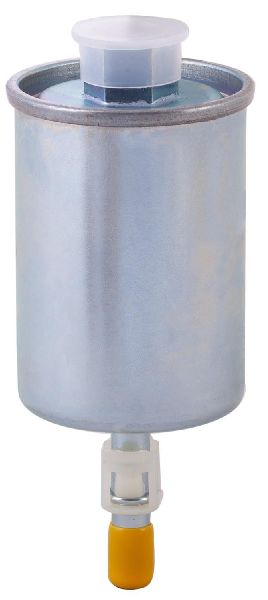
- Low Fuel Pressure: A weak fuel pump or a clogged fuel filter can starve the engine of fuel, causing lean misfires across all cylinders. A fuel pressure test is needed to confirm this. Key-on engine-off pressure should be within spec (typically 48-55 PSI for this engine).
- Faulty Crankshaft Position Sensor (CKP): The CKP sensor provides the primary engine timing signal. While a complete failure usually results in a no-start condition, an intermittent failure, sometimes when the sensor gets hot, can cause erratic timing signals and random misfires.
- Clogged Fuel Injectors: While generally reliable, fuel injectors can become clogged over time, leading to a lean misfire on one or more cylinders. GM issued a TSB (03-06-04-030F) regarding this issue, recommending a professional fuel injector cleaning procedure.
Diagnosis Steps
- Scan for any other trouble codes. Codes for specific cylinders (P0301-P0306) can help narrow the search.
- Check freeze frame data to see the engine conditions (RPM, load, temperature) when the misfire occurred.
- Check Misfire Data on a capable scan tool. This will show live misfire counts per cylinder and is the most effective way to see which cylinders are the problem.
- Inspect the ignition system. Check spark plugs and wires for wear, damage, or corrosion. Ensure plugs are the correct type (ACDelco Iridium recommended) and gapped to 0.060".
- Test the ignition coils. Swap the coil from the misfiring cylinders (e.g., 3-6) with a known good coil (e.g., 2-5). If the misfire moves to the new cylinders, the coil is bad.
- Test the Ignition Control Module (ICM). If the misfire does not move with the coil, the ICM is the most likely cause.
- Check for vacuum leaks. Perform a smoke test, paying close attention to the upper and lower intake manifold gaskets. A hissing sound is a common clue.
- Test the Fuel Pressure Regulator (FPR). Pull the vacuum line off the FPR. If fuel is present, the FPR is bad and must be replaced.
- Check fuel pressure using a fuel pressure gauge to rule out a weak fuel pump or clogged filter.
Parts You'll Likely Need
- Ignition Control Module
(OEM #ACDelco D576)— This is one of the most common points of failure for a P0300 on the 3800 Series II engine due to its location and heat exposure.
Trusted brands: ACDelco, Delphi, Standard Motor Products
OEM price range: $120-$200
Aftermarket price range: $70-$150 - Ignition Coil Pack
(OEM #ACDelco D555)— The second most common ignition-related failure. One bad coil will cause two cylinders to misfire.
Trusted brands: ACDelco, Delphi, NGK
OEM price range: $40-$70
Aftermarket price range: $25-$50 - Lower Intake Manifold Gasket Set (Upgraded)
(OEM #Fel-Pro MS98014T)— The original plastic-framed gaskets are a known major failure point. The Fel-Pro metal-framed replacement is the standard, permanent fix.
Trusted brands: Fel-Pro, Dorman
OEM price range: N/A (OEM is the failure-prone design)
Aftermarket price range: $60-$100 - Spark Plugs (Set of 6)
(OEM #ACDelco 41-101 (Iridium))— Regular maintenance item, but using the correct OEM plug is critical on this engine to prevent misfires.
Trusted brands: ACDelco
OEM price range: $40-$70
Aftermarket price range: N/A - Fuel Pressure Regulator
(OEM #ACDelco 17113679)— A common failure where the internal diaphragm leaks, sending raw fuel into the intake and causing rich running and misfires.
Trusted brands: ACDelco, Delphi, Sorensen
OEM price range: $40-$60
Aftermarket price range: $25-$50
Related Codes That Often Appear With This One
- P0301-P0306 — If the computer can eventually isolate the misfire to specific cylinders, it will set codes like P0301 (Cylinder 1 Misfire), P0302, etc., in addition to P0300.
- P0420 — Catalyst System Efficiency Below Threshold. This code often appears after a P0300 has been active for a while, indicating that the misfiring has damaged the catalytic converter.
- P0171 — System Too Lean (Bank 1). This can be triggered by a vacuum leak from the intake manifold gaskets, which is a common cause of P0300 on this engine.
Technical Service Bulletins (TSBs) & Recalls
- PIP5628G: General diagnostic information for P0300-P0308 misfire codes.
- 03-06-04-030F: Addresses various driveability symptoms, including P0300, caused by clogged fuel injectors and outlines a cleaning procedure.
Platform-Specific Known Issues

- The plastic upper intake manifold is known to crack near the EGR port, causing a vacuum leak that can be difficult to detect without a smoke test.
- The factory Dex-Cool coolant has been linked by some owners to premature degradation of the intake manifold gaskets.
- Failure of the Ignition Control Module is extremely common and can happen suddenly, causing a severe misfire while driving.
Mechanic-Grade Diagnostic Values
- Fuel Pressure (Key On, Engine Off) — expected: 48-55 PSI. Failure: Pressure below 48 PSI indicates a weak fuel pump or clogged filter. Pressure that drops more than 5 PSI in one minute after the pump primes indicates a leak (injector or regulator).
- Fuel Injector Resistance — expected: 11.0 - 14.0 Ohms. Failure: A reading significantly outside this range indicates a failed injector coil.
- Ignition Coil Secondary Resistance — expected: 5,000 - 8,000 Ohms. Failure: A reading outside this range suggests the coil's internal windings are failing.
- Crankshaft Position Sensor (CKP) AC Voltage — expected: >100mV AC while cranking. Failure: No or very low AC voltage while the engine is being cranked suggests a failed CKP sensor.
Scan Tool Commands That Help
- GM Tech 2 / Capable Bidirectional Scanner: Misfire Graphic / Current Misfire Counters — This is the most critical diagnostic step for a P0300. It displays live misfire counts for each cylinder, allowing the technician to see if the 'random' misfire is actually biased toward a specific cylinder or a cylinder pair fired by one coil (1-4, 2-5, 3-6), which is essential for diagnosis.
- GM Tech 2 / Capable Bidirectional Scanner: Injector Balance Test — This test allows the technician to fire each injector individually while monitoring fuel pressure. A consistent pressure drop should be observed for each injector. An injector that causes a smaller or larger drop than the others is suspect.
- GM Tech 2 / Capable Bidirectional Scanner: Crankshaft Position (CKP) Variation Learn — This procedure must be performed after replacing the crankshaft position sensor, harmonic balancer, or PCM. Failure to perform the CASE relearn can result in the PCM incorrectly detecting misfires and setting a P0300 code.
Wiring & Ground Locations
- G102 — Lower front of the engine, to the right of the starter motor.. This is a primary ground for the Ignition Control Module (ICM). A poor connection here due to corrosion or looseness can cause erratic ICM behavior, weak spark, and random misfires that are difficult to diagnose.
- G105 — Rear of the engine, behind the power steering pump.. This ground point serves the Powertrain Control Module (PCM), Mass Airflow (MAF) sensor, and engine oil level switch. A faulty ground here can cause incorrect sensor readings to be sent to the PCM, disrupting air/fuel calculations and leading to misfires.
- ICM Connector Pin K — The main electrical connector for the Ignition Control Module.. Pin K is the dedicated engine ground circuit for the ICM (typically a Black with White stripe wire). Verifying a solid ground connection at this specific pin with a multimeter is a key diagnostic step when an ICM is suspected of failure.
Real Owner Repair Stories
- GM Forum user (2000 Buick LeSabre, 140,000 miles) — Flashing check engine light, rough running.
❌ Tried (didn't work) Replaced spark plugs and wires, Swapped ignition coils between cylinder pairs
✅ What actually fixed it The Ignition Control Module (ICM) was faulty. Even though the coil swap test didn't move the misfire (which was on cylinders 3 and 6), replacing the ICM resolved the issue. - YouTube video by 'Nathan's DIY Garage' (GM vehicle with 3800 engine) — Intermittent P0300 code, especially when the engine warmed up, with a flashing check engine light.
❌ Tried (didn't work) Initial diagnosis pointed towards common ignition or fuel issues.
✅ What actually fixed it The Crankshaft Position Sensor (CKP) was failing intermittently when hot but would not set a specific CKP fault code. Replacing the CKP sensor resolved the P0300 misfire. - Forum user anecdote (Buick with 3800 V6) — P0300 code accompanied by lean codes (P0171) and a whistling noise at idle.
❌ Tried (didn't work) Smoke test of the intake manifold came back clean, ruling out common gasket leaks.
✅ What actually fixed it The internal diaphragm of the power brake booster had failed, creating a large, unmetered vacuum leak that the smoke test did not reveal. Replacing the brake booster fixed the vacuum leak and the misfire.
"I Checked Everything" — The Actual Cause
- A well-documented case involves a P0300 with lean codes where a smoke test reveals no leaks. The actual cause was a ruptured power brake booster diaphragm. This creates a significant internal vacuum leak that a smoke test applied to the intake manifold will not detect, as the leak is downstream of the throttle body and inside the booster itself.
When the Usual Fixes Don't Work
- While Pass 2 correctly identifies the ICM and coils as 'high probability' causes, numerous owner accounts exist where a P0300 persisted after replacing the entire ignition cassette (plugs, wires, coils, and ICM). In many of these cases, the ultimate cause was an intermittent Crankshaft Position Sensor that failed when hot, or a single faulty fuel injector. This highlights the importance of not stopping diagnosis at the ignition system, even on a platform where it is the most common point of failure.
OEM Part Supersession History
GM plastic lower intake manifold gaskets→Fel-Pro MS98014T or GM #89017816— The original gaskets used a plastic frame that would crack and degrade from heat and exposure to Dex-Cool coolant, causing coolant and vacuum leaks. The updated Fel-Pro and revised GM gaskets use a metal frame that prevents this failure.GM Upper Intake Manifold (e.g., 89017272)→Dorman 615-180 or similar aftermarket kits— The original plastic manifold was prone to cracking or melting near the EGR stovepipe. Aftermarket replacements often include a metal sleeve or a reduced-diameter opening at the EGR port to shield the plastic from excessive heat, preventing a repeat failure.
Model Year Variations Within This Range
- 2000-2005: The 3.8L V6 (L36) engine was mechanically consistent throughout this period. There are no significant year-to-year variations that would alter the diagnostic approach for a P0300 code. Failures are more dependent on mileage and age than the specific model year.
Helpful Videos
Used OEM Parts in Stock


New Aftermarket Parts Available


The information in this article is provided for general reference and educational purposes only. Vehicle specifications, procedures, and part compatibility can vary by production date, trim level, and region. Always consult your vehicle's factory service manual and verify part numbers before purchasing or performing repairs. Safety-critical components such as airbags, seat belts, and braking systems should be installed by a qualified professional.
- Buick LESABRE:
- 🎬 Helpful Videos
- 🛍️ Shop This Part
- What's Unique About the 2000-2005 Buick LESABRE
- Diagnostic Flowchart
- Symptoms You May Notice
- Most Likely Causes
- Rare But Worth Checking
- Diagnosis Steps
- Parts You'll Likely Need
- Related Codes That Often Appear With This One
- Technical Service Bulletins (TSBs) & Recalls
- Platform-Specific Known Issues
- Mechanic-Grade Diagnostic Values
- Scan Tool Commands That Help
- Wiring & Ground Locations
- Real Owner Repair Stories
- "I Checked Everything" — The Actual Cause
- When the Usual Fixes Don't Work
- OEM Part Supersession History
- Model Year Variations Within This Range
- 🎟️ Get 5% Off