

P0300 on 2012-2016 Bentley Continental: Random Misfire Causes and Fixes
For a 2012-2016 Bentley Continental, a P0300 code is most often caused by failing spark plugs or ignition coils. A full set of 12 OEM-quality coils and plugs for the W12 can cost over $1,900 in parts alone, while a set for the V8 is less. Due to the extreme labor involved (often requiring intake manifold removal), professional diagnosis is highly recommended to avoid unnecessary parts replacement.
- P0300 on a Bentley Continental indicates a random misfire and should be addressed immediately to prevent costly catalytic converter damage.
- The most probable causes are worn spark plugs and/or failing ignition coils.
- On W12 engines, brittle vacuum hoses are a very common source of misfires and should be checked with a smoke test before replacing more expensive components.
- Due to the complexity of the V8 and W12 engines, DIY repair is not recommended. Accessing ignition components requires significant disassembly, including removal of the intake manifold.
- Always use high-quality, OEM-spec parts for repairs to ensure reliability and performance.
What's Unique About the 2012-2016 Bentley CONTINENTAL

On the complex twin-turbocharged V8 and W12 engines in the Bentley Continental, a P0300 code requires methodical diagnosis. While common ignition system faults are the primary cause, a Bentley-issued Technical Service Bulletin (TSB) for the V8 engine specifically mentions that "Deviations in the country-specific fuel specification" can lead to carbon deposits on injectors, causing misfires. Additionally, the high heat in the tightly packed engine bay of the W12 makes vacuum hoses, particularly those under the intake manifold and over the transmission, prone to becoming brittle and cracking, which can cause significant vacuum leaks and mimic other issues.
Diagnostic Flowchart

Tap your situation to follow the diagnostic path that matches what you're seeing on this vehicle.
Symptoms You May Notice
- Rough or uneven idle
- Engine hesitation or stumbling during acceleration
- Noticeable loss of power
- Solid or flashing Check Engine Light
- Engine shaking or vibrating more than usual
- Smell of gasoline from the exhaust
- Increased fuel consumption
- Replacing only one spark plug or coil when multiple are near the end of their service life.
- Replacing fuel injectors before confirming a vacuum leak is not present, as the symptoms can be identical. A smoke test is essential.
- Assuming the cause is ignition-related without checking for common wiring issues, such as broken wires or loose connectors on the MAF sensor harness.
Most Likely Causes

- Worn Spark Plugs 🔴 High Probability Spark plugs are a regular maintenance item and are critical for proper combustion in these high-output engines. Bentley recommends replacement every four years. Worn plugs put extra strain on the ignition coils, often causing them to fail as well.
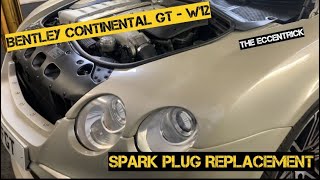
How to confirm: Inspect the spark plugs for wear, fouling, or damage. A diagnostic scan may show misfire counts concentrated on several cylinders. A video of a W12 plug change shows a badly failed plug upon removal. 🎬 Watch: Step-by-step guide to replacing W12 spark plugs.
Typical fix: Replace all 8 (V8) or 12 (W12) spark plugs as a set. It is highly recommended to use OEM-spec plugs from brands like NGK or Bosch.
Est. part cost: $240-$480 - Failing Ignition Coils 🔴 High Probability Ignition coil failure is a very common issue on W12 models due to high heat exposure in the engine bay. The coil-on-plug design is effective but individual coils can fail with age. The 4.0T V8 also experiences coil failures.
How to confirm: A technician can use a scan tool to identify which cylinders are misfiring. Swapping a suspected bad coil with a known good one and seeing if the misfire code follows the coil confirms the failure.
Typical fix: Replace the failed ignition coil(s). It is strongly recommended to replace them as a full set along with the spark plugs, especially on higher-mileage vehicles or if multiple coils have failed.
Est. part cost: $50-$100 per coil - Vacuum Leaks 🟡 Medium Probability The W12 engine bay is notoriously hot and cramped, causing rubber and plastic vacuum hoses to become extremely brittle and crack over time. Common failure points are breather hoses and the plastic vacuum lines located under the intake manifold or over the transmission. A leaking PCV valve diaphragm is also a known cause on related VAG engines.
How to confirm: A smoke test is the most effective way to find the source of a vacuum leak. A technician will fill the intake system with smoke and look for where it escapes. 🎬 See how to perform a smoke test for vacuum leaks. Sometimes a hissing or whistling noise can be heard from the engine bay.
Typical fix: Replace the cracked or broken hose(s). This can be a complex and expensive job depending on the location of the leak. In one documented case on a related 4.0T engine, a failed breather pipe (non-return valve) caused misfires on an entire bank.
Est. part cost: $50-$500 - Poor Fuel Quality / Clogged Injectors ⚪ Low Probability A TSB for the V8 engine explicitly links P0300 to deviations in fuel specifications causing carbon deposits on injectors. The TSB recommends using a fuel additive (Part No. G 001 770 A2) to clean deposits. Direct injection engines are also prone to carbon buildup on injector nozzles, which can disrupt the spray pattern.
How to confirm: This is difficult to confirm directly but may be suspected if the issue appears after refueling. The TSB suggests this as a cause if ignition components are ruled out. Injector issues can also be diagnosed if misfires persist on a cylinder after swapping the plug and coil, and a loose injector connector has been found to be a cause.
Typical fix: Try using a high-quality, top-tier fuel and a bottle of the specified fuel additive (G 001 770 A2). If the problem persists, professional fuel injector cleaning or replacement may be necessary.
Est. part cost: $20-$60 for fuel additive
Rare But Worth Checking
- Clogged or Faulty Fuel Injectors: While less common than ignition issues, a problem with fuel delivery can cause random misfires. This can sometimes be accompanied by loose injector connectors, as noted in one owner's repair story.
- Low Fuel Pressure: A failing fuel pump or clogged fuel filter can starve the engine of fuel, leading to lean conditions and random misfires across all cylinders.
- Faulty Mass Air Flow (MAF) Sensor: A dirty or failing MAF sensor can send incorrect airflow readings to the ECM, upsetting the air/fuel mixture and causing misfires. Broken wiring or a loose connector to the sensor has also been found by owners to be a cause.
- Overfilled Fuel Tank / Charcoal Canister Saturation: A Reddit user reported that after topping off their 2013 W12 GT's fuel tank, they experienced rough running and multiple misfire codes. The suspected cause was flooding the charcoal canister, which can introduce fuel vapor into the intake at the wrong time.
Diagnosis Steps
- Read the fault codes with an OBD-II scanner (like VCDS for VW/Audi group cars) to confirm P0300 and check for any other specific cylinder misfire codes (P0301-P0312) or lean codes (P0171/P0174).
- Analyze live data on the scanner to view misfire counts for each cylinder to help pinpoint the issue. With VCDS, this can be done in Measuring Blocks 014 through 017.
- Perform a thorough visual inspection of the engine bay, looking for obvious issues like cracked vacuum hoses (especially PCV and breather hoses) or broken electrical connectors and wiring, particularly around the MAF sensors and ignition coils.
- If specific cylinders are identified, swap the ignition coil from a misfiring cylinder to a non-misfiring cylinder. Clear the codes and run the engine to see if the misfire follows the coil. If it does, that coil is faulty. Repeat with the spark plug if the misfire remains.
- If ignition components are ruled out, perform a smoke test to check for vacuum leaks. This is a critical step on these engines before condemning more expensive parts.
- Check fuel pressure to ensure the fuel pump and filter are functioning correctly. Low-side pressure should be 400-800 kPa (4-8 bar). High-pressure pumps can reach over 2,500 PSI.
- As per TSB #2041495/1 for the V8, if ignition parts are good, consider fuel quality. Try a tank of high-octane fuel from a reputable source and add the recommended fuel system cleaner (G 001 770 A2).
- If all else fails, testing of the fuel injectors and engine compression may be necessary, which should be performed by a qualified technician.
Parts You'll Likely Need

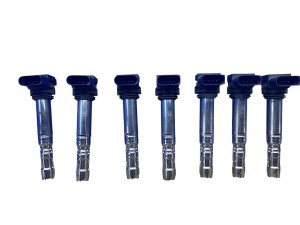
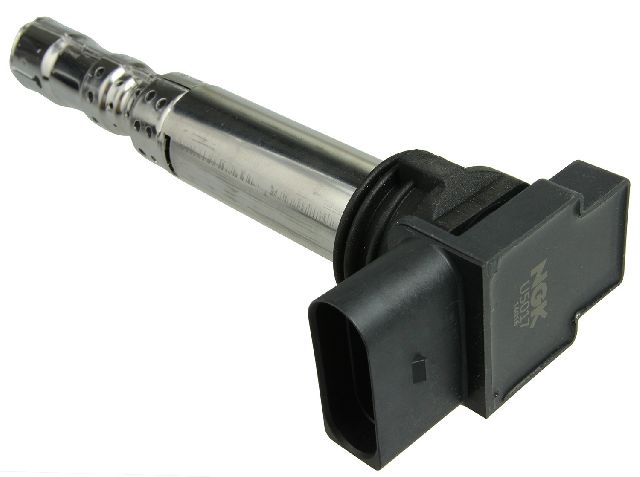
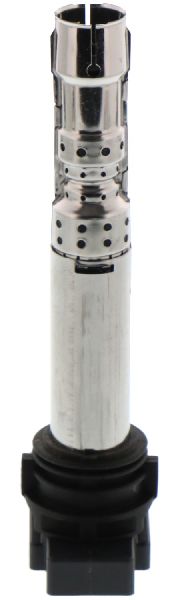
- Ignition Coil
(OEM #07C905715AP (W12, supersedes 07C905715A))— A primary point of failure for misfire codes on the W12 engine. It is highly recommended to replace all 12 at once.
Trusted brands: Bosch, NGK, OEM Bentley
OEM price range: $60-$100 per coil
Aftermarket price range: $40-$70 per coil - Spark Plug
(OEM #07C905600 (W12) / 079905626G (V8))— A crucial wear item that is often the root cause of misfires. They should be replaced as a full set during a major service or when replacing coils.
Trusted brands: NGK, Bosch, OEM Bentley
OEM price range: $20-$40 per plug
Aftermarket price range: $15-$30 per plug
Related Codes That Often Appear With This One
- P0301-P0312 — These codes specify which cylinder is misfiring (e.g., P0301 for cylinder 1, P0312 for cylinder 12). P0300 often appears alongside one or more of these specific codes, helping to narrow down the problem.
- P0171/P0174 — These codes indicate a 'System Too Lean' condition on Bank 1 and Bank 2, respectively. They are often caused by a vacuum leak, which allows unmetered air into the engine and can also trigger a P0300 misfire code.
- P130A — Seen on the related Audi S8 4.0T engine, this code for 'Cylinder Disabling' can appear alongside a P0300 when an entire bank of cylinders is misfiring.
Technical Service Bulletins (TSBs) & Recalls

- Bulletin #2041495/1: Notes that for the V8 engine, P0300 and specific cylinder misfires can be related to country-specific fuel specification deviations causing injector deposits.
- Bulletin #2051187/7: Provides a general diagnostic workflow for technicians to address poor running and misfire conditions on both V8 and W12 engines.
Platform-Specific Known Issues
- TSB #2041495/1 - Fuel Quality on V8: A Technical Service Bulletin exists for the 4.0L V8 engine, noting that P0300 can be caused by deviations in fuel specifications leading to carbon on injectors. The suggested fix is to use fuel additive G 001 770 A2.
- W12 Vacuum Line Brittleness: The extreme heat generated by the W12 engine causes plastic vacuum lines to become brittle and crack. A particularly notorious line is located on top of the transmission, which can require engine and transmission removal to access and replace, making it an exceptionally costly repair for a small part.
- W12 Intake Manifold Removal for Service: Accessing the 12 spark plugs and ignition coils on the W12 engine requires the complete removal of the large intake manifold, a process that takes several hours and requires replacement of single-use gaskets.
- TSB #2051187/7 - General Misfire Diagnosis: This TSB provides a sequential diagnostic procedure for dealers to follow when addressing misfire complaints on both V8 and W12 engines, starting with vehicle history, checking fuel/oil, and then moving to component swapping (coils, plugs, injectors).
Mechanic-Grade Diagnostic Values
- Low-Pressure Fuel System Pressure (at tank outlet) — expected: 400 - 800 kPa (4 - 8 bar). Failure: Pressure is below 400 kPa or does not hold above 400 kPa for at least 10 minutes after engine off.
- High-Pressure Fuel System Pressure — expected: Up to 2,500 PSI or more, varies with engine load. Failure: Significantly lower pressure than specified under load, indicating a failing HPFP.
- Ignition Coil Primary Winding Resistance — expected: Typically 0.4 - 2.0 ohms. Failure: Reading is outside the typical range (open loop or zero resistance).
- Ignition Coil Secondary Winding Resistance — expected: Typically 5 - 15 kOhms (5,000 - 15,000 ohms). Failure: Reading is significantly outside this range.
Scan Tool Commands That Help
- VCDS (VAG-COM) or ODIS: Read Misfire Counters in Measuring Blocks — This is a primary step to diagnose which specific cylinders are misfiring and how frequently. Use groups 014, 015, 016, and 017 to view live counts for cylinders 1-12.
- VCDS (VAG-COM) or ODIS: Reset Misfire Adaptations — On some VAG engines, after a repair or engine replacement, learned misfire values can persist. Clearing engine fault codes three times in a row in under 29 seconds may be required to reset these adaptations.
- VCDS (VAG-COM) or ODIS: Log EGT Sensor Data in Measuring Blocks — To diagnose potential exhaust or turbo-related issues that could cause misfires, log and compare Exhaust Gas Temperature sensors for both banks. In VCDS, this is often in measuring block 112 for each engine bank (ECU 1 and ECU 2). Readings should be similar between banks.
Wiring & Ground Locations
- Engine Ground Strap — Typically a braided metal strap from the cylinder head or engine block to the chassis frame. Common points are the rear of the left-hand cylinder head to the body, or from a starter motor bolt to the frame.. A poor or corroded engine ground can cause a host of phantom electrical issues, including weak spark, which can lead to random misfires across multiple cylinders.
- Ignition Coil Connectors — On top of each ignition coil, connected to the main engine wiring harness.. The plastic connectors and their wiring can become brittle from engine heat, leading to poor connections or broken wires, causing misfires on individual cylinders. A loose connector can mimic a failed coil.
- MAF Sensor Connector — At the Mass Air Flow sensor(s), located on the intake tubing after the air filter box.. A loose or damaged MAF sensor connector can cause incorrect air metering, leading to an improper air/fuel ratio and random misfires. This has been the sole cause of a misfire in a documented repair.
Real Owner Repair Stories
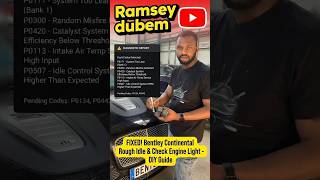
- YouTube channel 'Ramsey Dubem' (Bentley Continental GT (W12 engine)) — Severe misfiring, rough idle, power loss, Check Engine Light with codes P0300, P0305, P0312, P1311, P1314.
❌ Tried (didn't work) Initial diagnosis pointed to multiple issues across ignition and fuel systems.
✅ What actually fixed it A combination of fixes: replaced faulty ignition coils (cylinders 11 & 12), replaced all 12 spark plugs, repaired a loose fuel injector connector (cylinder 5), serviced all injectors, and repaired a broken air (vacuum) hose. - YouTube channel 'Hollywood Mechanic' (Audi RSQ8 (shared 4.0T V8 engine)) — Severe misfires on one bank (P0300, P0305, P0306, P0307, P0308), blinking check engine light, whistling sound from under the hood, and an intake leak code (P2279).
❌ Tried (didn't work) Diagnosis could easily lead to checking the entire intake for leaks via a smoke test, which might not identify this specific failure.
✅ What actually fixed it The internal non-return valve in a small crankcase breather pipe (Part # 0P2103211E for passenger side) had failed, allowing air to flow both ways. Replacing the pipe resolved the issue. - YouTube channel 'Bentley on a Budget' (2005 Bentley Continental GT (first generation, similar W12 engine)) — Engine misfire on cylinder 6.
❌ Tried (didn't work) The owner proceeded with a full spark plug and coil change before discovering the simpler issue.
✅ What actually fixed it After replacing plugs and coils, the owner found the misfire was not fixed. The ultimate root cause was a loose electrical connector on the Mass Airflow (MAF) sensor. Securing the connector with zip ties as a temporary measure resolved the misfire.
"I Checked Everything" — The Actual Cause
- On the 4.0T V8 engine, a P0300 code accompanied by misfires on an entire bank and a whistling noise can be caused by a failed internal non-return valve in a crankcase breather pipe. A standard smoke test may not identify this fault, as the leak is internal to the valve's function. The fix is to replace the affected breather pipe.
OEM Part Supersession History
07C905100, 07C905115C, 07C905115F, 07C905115J, 07C905115K, 07C905115L→07C905715A (and aftermarket equivalent 07C905715AP)— Revisions to improve reliability and performance of the ignition coil.
Heads up: The newest revision is recommended for replacement, and all coils should be replaced as a set to ensure consistent performance.
Model Year Variations Within This Range
- 2012-2014 vs 2015-2016 (W12): For the 2015 model year, the base W12 engine (CKHB) was updated to codes CVAA/CVAB, gaining cylinder deactivation and a power increase from 567hp to 582hp. The 2016 W12 also features this technology. This may affect fuel system and ECU diagnostics slightly between the earlier and later models.
- 2012 vs 2013-2016: The 4.0L twin-turbo V8 engine option was introduced for the 2013 model year. Therefore, 2012 models are exclusively W12. Diagnostic procedures diverge significantly between the V8 and W12 engines.
- 2012-2016 (W12 Speed): The high-output 'Speed' models received progressive power increases: 2012-2013 models (CKHC) had 616hp, 2014 models had 626hp, and 2016 models had 633hp.
Helpful Videos
Used OEM Parts in Stock
New Aftermarket Parts Available


The information in this article is provided for general reference and educational purposes only. Vehicle specifications, procedures, and part compatibility can vary by production date, trim level, and region. Always consult your vehicle's factory service manual and verify part numbers before purchasing or performing repairs. Safety-critical components such as airbags, seat belts, and braking systems should be installed by a qualified professional.
- Bentley CONTINENTAL:
- 🎬 Helpful Videos
- 🛍️ Shop This Part
- What's Unique About the 2012-2016 Bentley CONTINENTAL
- Diagnostic Flowchart
- Symptoms You May Notice
- Most Likely Causes
- Rare But Worth Checking
- Diagnosis Steps
- Parts You'll Likely Need
- Related Codes That Often Appear With This One
- Technical Service Bulletins (TSBs) & Recalls
- Platform-Specific Known Issues
- Mechanic-Grade Diagnostic Values
- Scan Tool Commands That Help
- Wiring & Ground Locations
- Real Owner Repair Stories
- "I Checked Everything" — The Actual Cause
- OEM Part Supersession History
- Model Year Variations Within This Range
- 🎟️ Get 5% Off