

P0299 on 2020-2022 Lincoln Corsair: Turbo Underboost Causes and Fixes
On a 2020-2022 Lincoln Corsair, P0299 is almost always caused by a problem with the turbocharger wastegate actuator, most commonly a missing e-clip that costs only a few dollars. Before any major repair, visually inspect the actuator linkage, as this is a well-documented issue confirmed by multiple Ford/Lincoln Technical Service Bulletins (TSBs).
- For a 2020-2022 Lincoln Corsair, P0299 is very likely caused by a minor mechanical issue with the turbo wastegate linkage.
- Always perform a visual inspection of the wastegate actuator e-clip before authorizing or beginning any expensive repairs.
- If the actuator has failed, a service kit (K2GZ-9G488-B) is available from Lincoln, making it unnecessary to replace the entire turbocharger.
- Driving with this code will result in poor performance and can put additional strain on engine components, so a timely diagnosis is recommended.
What's Unique About the 2020-2022 Lincoln CORSAIR
The 2020-2022 Lincoln Corsair, equipped with the 2.0L or 2.3L EcoBoost engine, is highly prone to a specific failure that causes code P0299. Manufacturer Technical Service Bulletins (TSBs) like SSM 50485 confirm that the electronic wastegate actuator linkage is a known weak point. The small e-clip holding the actuator rod to the wastegate arm can fall off, or the electronic actuator itself can fail internally. This makes the diagnosis far more predictable than on many other turbocharged vehicles, where causes can be more varied.
Diagnostic Flowchart
Tap your situation to follow the diagnostic path that matches what you're seeing on this vehicle.
Symptoms You May Notice
- Illuminated Malfunction Indicator Lamp (Check Engine Light) and/or Wrench Light
- Significant lack of engine power and poor acceleration
- Vehicle may enter 'limp mode' or 'reduced power mode'
- Whistling or hissing noises from the engine bay, indicating a boost leak
- Inability to maintain speed on hills or while cruising
- A metallic rattle on startup near the turbo area has been reported by some owners of related platforms.
- Replacing the entire turbocharger assembly when only the inexpensive e-clip or serviceable actuator was needed. The TSBs specifically advise against this, stating that turbocharger replacement is not necessary for this condition.
Most Likely Causes
- Missing Wastegate Actuator E-Clip 🔴 High Probability This is a well-documented failure point confirmed by multiple Lincoln TSBs (SSM 50485, SSM 50171, SSM 49427) for this specific engine and vehicle platform, including the Corsair. The bulletins were issued specifically because this is a common problem.
How to confirm: Visually inspect the turbocharger wastegate actuator rod where it connects to the wastegate arm. The actuator is an electronic box on the side of the turbo. If the rod is disconnected from the small pin on the turbo housing, the e-clip is missing.
Typical fix: Install a new e-clip to secure the actuator rod. The clip itself is very inexpensive. The OEM part number for the clip is W718420-S439, though some owners have had success with generic e-clips.
Est. part cost: $2-$15 - Failed Turbocharger Wastegate Actuator 🔴 High Probability Also cited in TSBs SSM 50485 and SSM 50171, the electronic actuator can fail internally, either electrically or mechanically. This is the second most common cause after the clip falls off.
How to confirm: If the e-clip is present and the linkage is secure, a diagnostic scan tool can be used to command the actuator to move. If it doesn't respond or makes a loud grinding or servo noise during its self-test on startup, it has likely failed. This failure often triggers code P0243 along with P0299.
Typical fix: Replace the wastegate actuator. Lincoln provides a service kit (Part No. K2GZ-9G488-B) that includes the actuator, rod, and clips, so the entire turbocharger does not need to be replaced. The TSBs explicitly state to use this kit.
Est. part cost: $80-$150 - Charge Air (Boost) Leak 🟡 Medium Probability Common on all turbocharged vehicles, the pressurized hoses and connections between the turbo, intercooler, and throttle body can crack, split, or become loose over time.
How to confirm: Perform a smoke test on the charge air system. Smoke will be visible escaping from any leaks in hoses, clamps, or the intercooler itself. A visual inspection may also reveal cracked or oil-soaked hoses.
Typical fix: Tighten loose clamps or replace the leaking hose or component.
Est. part cost: $20-$200 - Faulty Boost Pressure Sensor (MAP Sensor) ⚪ Low Probability
How to confirm: Use a scan tool to monitor the boost pressure reading with the key on and engine off. It should match the barometric pressure. If the reading is skewed, does not change with engine load, or is erratic, the sensor is likely faulty.
Typical fix: Replace the boost pressure sensor.
Est. part cost: $40-$100
Rare But Worth Checking
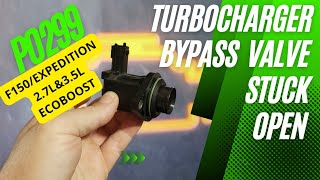
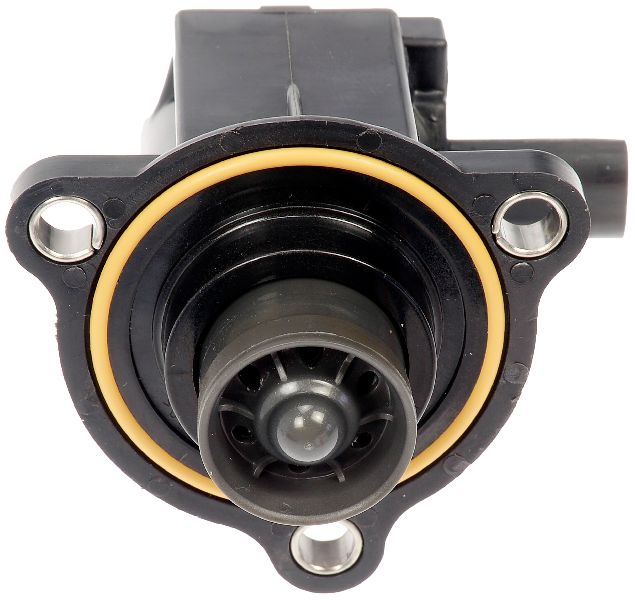
- Failed Turbocharger Bypass/Diverter Valve: This valve can get stuck open, allowing boost pressure to recirculate instead of going to the engine. This type of leak will not be found with a standard smoke test and requires removing the valve for inspection. 🎬 See how a faulty bypass valve causes underboost codes.
- Restricted Exhaust: A clogged catalytic converter can prevent the turbo from spooling up correctly, causing an underboost condition. This is usually accompanied by a more severe and progressive loss of power over time.
- Damaged Turbocharger: In rare cases, the turbocharger itself can fail due to worn bearings or damaged turbine fins. This is usually a last resort diagnosis after all other possibilities have been eliminated. On older EcoBoost models, wear on the internal wastegate linkage pivot point could cause the flapper to not seal, but this is less common on newer models.
- Restricted Air Intake: A severely clogged air filter or an obstruction in the intake tube can starve the turbo for air. On some platform mates like the Ford Explorer, an internal plastic finned insert in the turbo inlet tube has been known to dislodge and block airflow, causing a P0299 code.
Diagnosis Steps
- Scan the PCM for trouble codes. Note all present codes, especially those related to the turbo system like P0243, P02AB, and the P25B- series codes.
- Perform a thorough visual inspection of the turbocharger area. Specifically, locate the electronic wastegate actuator on the side of the turbo. Check if the actuator rod is securely connected to the wastegate arm with an e-clip. This is the most critical first step and the most common failure.
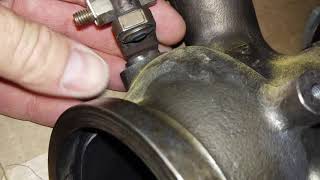
- If the linkage is disconnected, source and install a new e-clip (Motorcraft W718420-S439). Clear codes and test drive. 🎬 Watch: A quick guide to fixing common EcoBoost underboost issues.
- If the linkage is intact, listen for unusual noises (grinding, loud servo sounds) from the actuator when the vehicle is started or shut down. A loud noise indicates a likely internal failure of the actuator.
- If possible, use a bidirectional scan tool to command the wastegate actuator and verify its operation. If it fails to move or reports an out-of-range error, it needs replacement.
- If the actuator and linkage are confirmed to be good, perform a smoke test on the entire charge air system to check for leaks from the turbo outlet to the throttle body, including all hoses, the intercooler, and connections.
- Inspect the air filter and the entire intake tract for obstructions. On platform mates, an internal component of the intake tube has been known to come loose.
- Using a scan tool, monitor live data for requested vs. actual boost pressure while driving under load. A large, persistent discrepancy confirms an underboost condition.
- As a final step, inspect the turbocharger for excessive shaft play or visible damage to the compressor/turbine wheels.
Parts You'll Likely Need
- Turbocharger Wastegate Actuator E-Clip
(OEM #W718420-S439)— This is the single most common failure point leading to P0299 on this vehicle, as documented in multiple TSBs. The clip falls off, disconnecting the actuator from the wastegate.
Trusted brands: Motorcraft
OEM price range: $5-$15
Aftermarket price range: $2-$10 - Turbocharger Wastegate Actuator Service Kit
(OEM #K2GZ-9G488-B)— If the actuator itself has failed electrically or mechanically, this kit allows for its replacement without replacing the entire turbocharger assembly. This is the official Ford-recommended repair if the actuator is faulty.
Trusted brands: Motorcraft
OEM price range: $80-$150
Aftermarket price range: $60-$120
Related Codes That Often Appear With This One
- P0243 — This code indicates an electrical fault in the wastegate actuator circuit, which is often the root cause of the P0299 underboost condition. Both are listed together in TSB SSM 50485.
- P02AB — This is another code related to turbocharger/supercharger boost control and is listed in the same TSBs as P0299 for this vehicle.
- P25B3, P25B4, P2AB7, P2AB8, P2AB9 — These codes are all related to the turbocharger wastegate control and are frequently seen with P0299 due to the common actuator/linkage failure, as noted in TSB SSM 50485.
Technical Service Bulletins (TSBs) & Recalls
- SSM 50485: Affects 2020-2022 Corsair. States that a lack of power with DTC P0299 (and others) may be due to an inoperative wastegate actuator, missing e-clip, or non-visible damage to the actuator rod.
- SSM 50171: Affects 2020-2022 Corsair. Similar to SSM 50485, points to an inoperative wastegate actuator or missing e-clip and provides the service kit part number K2GZ-9G488-B.
- SSM 49427: Affects 2020-2021 Corsair. Specifically calls out a missing wastegate actuator e-clip as the cause for P0299 and other codes.
Platform-Specific Known Issues
- A series of Technical Service Bulletins (SSM 50485, SSM 50171, SSM 49427) were issued by Ford/Lincoln for 2020-2022 Corsair models with the 2.0L/2.3L EcoBoost engine. These bulletins state that a lack of power with DTC P0299 is likely due to a missing wastegate actuator e-clip or an inoperative wastegate actuator. The bulletins specifically note that a service kit (K2GZ-9G488-B) is available and that turbocharger replacement is not necessary for this issue.
Mechanic-Grade Diagnostic Values
- PCM Underboost Threshold — expected: Actual boost pressure must not be 4 psi or more below desired boost pressure for more than 5 consecutive seconds.. Failure: If the actual boost is lower than desired by at least 4 psi for 5 seconds, the PCM will log code P0299.
- Wastegate Actuator Solenoid Resistance — expected: Approximately 10-30 ohms. (Note: This is a general value from a platform-mate, the Ford Edge, and should be used as a reference, not an absolute spec for the Corsair).. Failure: A reading significantly outside this range, or an open/short circuit, indicates a failed actuator solenoid.
Scan Tool Commands That Help
- Ford IDS, FORScan, or other professional bidirectional scanner: Wastegate Actuator Control / Output State Control — After visually confirming the actuator linkage is intact, this command is used to electronically cycle the actuator through its range of motion. It confirms if the actuator motor is responding to PCM commands, or if it is seized, weak, or electrically failed.
Real Owner Repair Stories
- Ranger5G.com forum user (Ford Ranger with 2.3L EcoBoost (shares engine architecture and TSBs with Corsair)) — Vehicle went into limp mode with check engine light on. Codes P0299 and P29AB were stored.
❌ Tried (didn't work) The owner took the vehicle directly to the dealer after researching the TSB.
✅ What actually fixed it The dealer service department confirmed the wastegate actuator rod had popped off the turbo. They reconnected the linkage, which resolved the codes and symptoms. This is a direct real-world example of the failure described in TSBs SSM 50485 and 50171.
"I Checked Everything" — The Actual Cause
- The most common cause for P0299 on this platform—a missing e-clip or failed electronic actuator—will not be found with a smoke test, as it is a mechanical or electronic control failure, not a leak in the charge air path.
- A stuck-open turbocharger bypass (or diverter) valve can cause P0299. This is an internal leak where boost pressure is recirculated back to the turbo inlet instead of being sent to the engine. A smoke test of the charge pipes will appear normal. The valve must be removed for inspection.
- A clogged catalytic converter can restrict exhaust flow, preventing the turbocharger from spooling up to its target speed. This causes an underboost condition that is not related to an intake or charge air leak, so a smoke test will be clean.
OEM Part Supersession History
K2GZ-9B659-B, K2GZ-9B659-D, K2GZ-9B659-G→K2GZ-9B659-H— Revision to improve durability and prevent cracking.
Heads up: This part number is for the air intake resonator/tube on the platform-mate Ford Edge/Lincoln Nautilus. While not the primary cause of P0299, a crack in this tube can allow unmetered air and cause various codes. The latest part number should be used if replacement is needed.
Model Year Variations Within This Range
- 2020: On the platform-mate 2020 Ford Explorer with the 2.3L engine, a PCM software issue was identified as a potential cause for P0299, addressed by TSB 20-2246. While not issued specifically for the Corsair, it indicates that on early models within this range, a software update should be considered if no mechanical faults are found.
Helpful Videos


Used OEM Parts in Stock
New Aftermarket Parts Available


The information in this article is provided for general reference and educational purposes only. Vehicle specifications, procedures, and part compatibility can vary by production date, trim level, and region. Always consult your vehicle's factory service manual and verify part numbers before purchasing or performing repairs. Safety-critical components such as airbags, seat belts, and braking systems should be installed by a qualified professional.
- Lincoln CORSAIR:
- 🎬 Helpful Videos
- 🛍️ Shop This Part
- What's Unique About the 2020-2022 Lincoln CORSAIR
- Diagnostic Flowchart
- Symptoms You May Notice
- Most Likely Causes
- Rare But Worth Checking
- Diagnosis Steps
- Parts You'll Likely Need
- Related Codes That Often Appear With This One
- Technical Service Bulletins (TSBs) & Recalls
- Platform-Specific Known Issues
- Mechanic-Grade Diagnostic Values
- Scan Tool Commands That Help
- Real Owner Repair Stories
- "I Checked Everything" — The Actual Cause
- OEM Part Supersession History
- Model Year Variations Within This Range
- 🎟️ Get 5% Off