

P0299 on 2021-2025 Ford Expedition 3.5L EcoBoost: Underboost Causes and Fixes
P0299 on a 2021-2025 Expedition most often points to a problem with the turbocharger wastegate actuator, which may cause a rattling noise. This is a known issue covered by Ford's Technical Service Bulletin (TSB) SSM 54392. Other common causes include a failed turbocharger bypass (diverter) valve with a torn internal diaphragm or leaks in the charge air piping from loose clamps or cracked components.
- P0299 on a 2021-2025 Expedition is a serious code indicating a loss of turbocharger boost and engine power.
- The most probable cause, especially if accompanied by a rattle, is a faulty turbocharger wastegate actuator, a known issue covered by Ford TSB SSM 54392.
- Before suspecting an expensive turbo failure, always inspect for more common and cheaper issues like a torn turbocharger bypass valve diaphragm or a loose charge pipe.
- Diagnosis can range from a simple visual inspection to requiring a professional smoke test to find hidden leaks.
- Driving with this code is possible but not recommended, as the vehicle will have poor performance and be underpowered for safe merging or towing.
What's Unique About the 2021-2025 Ford EXPEDITION
The 2021-2025 Expedition uses a sophisticated twin-turbo 3.5L EcoBoost engine to produce power. The third generation of this engine, introduced in 2021, features updates like revised turbochargers with rotary electronic wastegates. While powerful, this system has specific known weaknesses. Ford has issued a Technical Service Bulletin (SSM 54392) directly linking P0299 on this vehicle to a faulty wastegate actuator that can also produce a rattling sound, often due to wear in the actuator rod linkage. This makes the wastegate system a primary suspect, distinguishing it from generic underboost issues on other vehicles. The electronic wastegate actuators are controlled by the PCM.
Diagnostic Flowchart
Tap your situation to follow the diagnostic path that matches what you're seeing on this vehicle.
Symptoms You May Notice
- Significant loss of engine power and acceleration
- Check Engine Light is on, sometimes accompanied by a powertrain fault (orange wrench) light.
- Rattling noise from the engine bay, especially during light acceleration, deceleration, or at idle. This is often associated with the wastegate actuator issue.
- Whistling or 'whooshing' sounds from the engine bay that increase with engine RPM, indicating a boost leak.
- Reduced fuel economy.
- Engine hesitation or stumbling under hard acceleration.
- Visible blue or grayish smoke from the exhaust if the turbocharger's internal seals have failed.
- Replacing the boost pressure sensor without testing it first. While it can be the cause, leaks and mechanical wastegate/bypass valve issues are more common.
- Assuming the entire turbocharger has failed without first checking for simpler causes like a torn bypass valve diaphragm or a loose charge pipe clamp.
- Replacing a turbocharger for a wastegate rattle without confirming if a less expensive repair, like replacing a bushing or clip, is possible (though often it is not).
Most Likely Causes
- Faulty Turbocharger Wastegate Actuator or Linkage 🔴 High Probability This is a known issue documented by Ford in TSB SSM 54392 for this specific vehicle and engine combination. The actuator rod or its bushing can wear out, causing excessive play and preventing the wastegate from closing properly to build boost. This wear also produces a distinct rattle. TSBs on prior models also note the actuator rod can become disconnected entirely.
How to confirm: Listen for a distinct rattle from the turbocharger area at idle or on deceleration. A technician can visually inspect the wastegate actuator and linkage for excessive play or disconnection. With the engine cool, you may be able to physically wiggle the actuator rod to feel for looseness. This issue was also noted in TSBs for other Ford models where the actuator rod disconnects entirely.
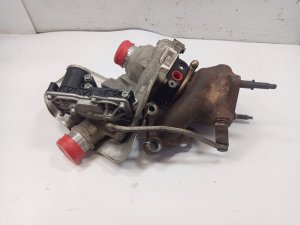
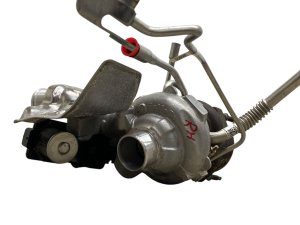
Typical fix: In many cases, the entire turbocharger assembly must be replaced, as the wastegate actuator is often not sold as a separate component from the dealer. The repair involves replacing the affected turbocharger (left or right bank).
Est. part cost: $800-$2000 - Failed Turbocharger Bypass Valve (Diverter/Blow-Off Valve) 🟡 Medium Probability The bypass valve uses a rubber diaphragm that is well-known to tear or a plastic valve body that can stick open. When it fails, it creates an internal boost leak, venting pressure back into the intake system instead of sending it to the engine.
How to confirm: Remove the valve (typically located on the charge air cooler/intercooler) and inspect the orange rubber diaphragm for tears or holes. 🎬 See how to inspect and replace a failed bypass valve A torn diaphragm is a very common finding. Also check if the valve's plunger is stuck in the open position.
Typical fix: Replace the turbocharger bypass valve. This is a relatively simple and inexpensive repair that many owners perform themselves.
Est. part cost: $50-$100 - Boost Pressure Leak (Charge Air System) 🟡 Medium Probability The system uses numerous plastic and rubber components, including charge pipes, couplers, and an intercooler, which can crack, loosen, or get damaged by road debris over time. Hose clamps can also loosen, allowing a coupler to pop off under pressure.
How to confirm: Perform a visual inspection of all hoses and clamps between the turbos, the intercooler, and the throttle body. Look for loose clamps, cracked plastic pipes, or signs of oil residue which can indicate a leak. A smoke test is the most effective way to pinpoint small leaks that aren't visually obvious.
Typical fix: Tighten loose clamps or replace the cracked pipe, hose, or intercooler.
Est. part cost: $20-$500
Rare But Worth Checking
- Faulty Boost Pressure Sensor (MAP Sensor): The sensor that measures boost pressure can fail and send incorrect readings to the PCM, causing the computer to think there is an underboost condition when there isn't one.
- Clogged Catalytic Converters: A restriction in the exhaust system can create backpressure that prevents the turbochargers from spooling up effectively. This can sometimes be accompanied by a P0420 or P0430 code.
- Internal Turbocharger Failure: Severe internal damage, such as a broken turbine shaft or damaged compressor wheel, can occur due to oil starvation from a clogged oil feed screen or simple wear. This is a worst-case scenario and is usually accompanied by significant noise, oil consumption, or smoke.
- Restricted Air Intake: On the related F-150 platform, a deformed upper air deflector has been known to restrict airflow to the turbo, causing a P0299 code. While less documented on the Expedition, checking for a clogged air filter or any intake obstruction is a valid first step.
Diagnosis Steps
- Scan the PCM for any other DTCs. Codes like P0101 (MAF sensor) or P0430 (Catalyst) can provide clues.
- Listen for a rattle from the turbocharger area at idle or on deceleration, which strongly suggests the wastegate issue described in TSB SSM 54392.
- Listen for a 'whoosh' or hissing sound during acceleration, which indicates a boost leak.
- Visually inspect the entire charge air system, from the turbo outlets to the intercooler and up to the throttle body. Pay close attention to hose clamps and the plastic end tanks of the intercooler.
- Remove and inspect the turbocharger bypass valve (blow-off valve) located on the intercooler. Check for a torn orange diaphragm, which is a very common failure.
- If no obvious leaks are found, perform a smoke test on the charge air system to identify hard-to-see leaks.
- If no leaks are present, inspect the turbocharger wastegate actuators and linkage for proper connection and movement. Check for excessive play in the actuator rod. 🎬 Watch this walkthrough of a P0299 diagnosis and repair
- If all mechanical and pneumatic systems are intact, test the boost pressure sensor's output to ensure it is reading correctly.
- As a final step, check for exhaust restrictions, such as a clogged catalytic converter, by checking for excessive backpressure.
Parts You'll Likely Need
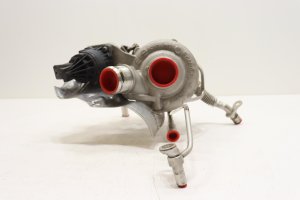
- Turbocharger Assembly
(OEM #ML3Z-6K682-D (Left), ML3Z-6K682-B (Right))— Often required to fix the common wastegate actuator failure, as the actuator is typically integral to the turbocharger housing. The part number may vary slightly by model year.
Trusted brands: Motorcraft, Garrett
OEM price range: $1200-$2000
Aftermarket price range: $800-$1500 - Turbocharger Bypass Valve
(OEM #AA5Z-9U465-A)— A very common failure point where the internal orange diaphragm tears, causing a significant boost leak. It's a relatively inexpensive and easy part to replace.
Trusted brands: Motorcraft, Bosch
OEM price range: $60-$90
Aftermarket price range: $40-$70 - Charge Air Cooler Pipe/Hose — The plastic pipes and rubber couplers can crack or come loose, creating a boost leak. A loose clamp on a coupler is a frequent and simple fix.
Trusted brands: Motorcraft
OEM price range: $100-$300
Aftermarket price range: $70-$200
Related Codes That Often Appear With This One
- P0243-P0250: These codes point to issues with the wastegate solenoid or its circuit, which directly impacts boost control.
- P0235-P0242: These codes indicate a malfunction in the boost pressure sensor circuit, which can cause the PCM to incorrectly report an underboost condition.
Technical Service Bulletins (TSBs) & Recalls
- SSM 54392: Some 2021-2025 F-150/Expedition/Navigator vehicles equipped with a 3.5L EcoBoost engine may exhibit diagnostic trouble code (DTC) P0299 stored in the powertrain control module (PCM) and may also exhibit a rattle noise from the turbocharger. This may be due to the wastegate actuator ro…
Platform-Specific Known Issues
- A known issue documented in TSB SSM 54392 involves the turbocharger wastegate actuator, which can cause both a P0299 code and a rattling noise on 2021-2025 models with the 3.5L EcoBoost engine.
- The electronically controlled bypass valve (blow-off valve) is a frequent failure point, with the internal diaphragm tearing and causing an internal boost leak.
Mechanic-Grade Diagnostic Values
- Exhaust Backpressure — expected: Below 3 PSI at idle, and below 8 PSI at wide-open throttle under load.. Failure: Readings above these specifications indicate a restriction, likely a clogged catalytic converter, preventing the turbo from spooling correctly.
Scan Tool Commands That Help
- Ford IDS (or equivalent professional scan tool): Turbocharger Wastegate Regulating Valve Solenoid Command — To diagnose the electronic control side of the wastegate system. By commanding the solenoid on/open at idle, a technician can verify with a vacuum gauge if the solenoid is functioning and supplying vacuum to the actuator.
Real Owner Repair Stories
- Ford F150 Forum user (2011+ Ford F-150 3.5L EcoBoost (similar system)) — P0299 code, delayed throttle response in stop-and-go traffic.
❌ Tried (didn't work) Initial assumption of a complex turbo issue.
✅ What actually fixed it Replacing the boost pressure relief valve (bypass valve) due to a hole in the diaphragm restored boost pressure.
"I Checked Everything" — The Actual Cause
- A stuck-open electronic blow-off valve (BOV) can cause a P0299. Because the valve is stuck internally, it creates a significant boost leak by recirculating pressurized air back into the intake instead of leaking to the atmosphere. This type of internal leak will not be found by a smoke test performed on the charge air pipes.
OEM Part Supersession History
AA5Z-9U465-A→FL3Z-9U465-B (for F-150, but often used interchangeably)— Updated design/part for a newer model line. The 'AA5Z' part number was originally designed for a 2010 Lincoln MKS, while the 'FL3Z' part is for a 2015+ F-150.
Heads up: While physically similar and often used interchangeably by owners, it is always best to verify the correct part number for the specific vehicle's VIN. Using the wrong revision could lead to fitment or performance issues.
Model Year Variations Within This Range
- 2021-2025: The 2021 model year marked the introduction of the third-generation 3.5L EcoBoost V6. This engine featured several refinements, including a revised turbocharger system with rotary electronic wastegates, which replaced the linear electronic wastegates used in the second generation (2017-2020). This change could affect diagnostic procedures for wastegate-related faults.
Helpful Videos

We Have This Part in Stock




The information in this article is provided for general reference and educational purposes only. Vehicle specifications, procedures, and part compatibility can vary by production date, trim level, and region. Always consult your vehicle's factory service manual and verify part numbers before purchasing or performing repairs. Safety-critical components such as airbags, seat belts, and braking systems should be installed by a qualified professional.
- Ford EXPEDITION:
- 🎬 Helpful Videos
- 🛍️ Shop This Part
- What's Unique About the 2021-2025 Ford EXPEDITION
- Diagnostic Flowchart
- Symptoms You May Notice
- Most Likely Causes
- Rare But Worth Checking
- Diagnosis Steps
- Parts You'll Likely Need
- Related Codes That Often Appear With This One
- Technical Service Bulletins (TSBs) & Recalls
- Platform-Specific Known Issues
- Mechanic-Grade Diagnostic Values
- Scan Tool Commands That Help
- Real Owner Repair Stories
- "I Checked Everything" — The Actual Cause
- OEM Part Supersession History
- Model Year Variations Within This Range
- 🎟️ Get 5% Off