

P0299 on 2016-2018 Cadillac CT6 3.0TT: Turbo Underboost Causes & Fixes
For the 2016-2018 Cadillac CT6 with the 3.0L Twin-Turbo engine, code P0299 is most often addressed by a software update from the manufacturer. Before replacing any parts, check if Technical Service Bulletin #17408 has been performed, as it involves reprogramming the Engine Control Module (ECM) to prevent this code and potential turbo damage. If the code persists, suspect a boost leak (including vacuum lines) or a sticking charge air bypass valve before condemning the turbochargers.
- For a P0299 on a 2016-2018 CT6 3.0TT, your first step should be to check with a dealer about TSB #17408.
- An ECM software update is the most likely and manufacturer-recommended fix, not an immediate hardware replacement.
- If the code persists after the update, standard diagnosis for boost leaks, wastegate issues, or sensor faults is required.
- Do not ignore this code, as it indicates a significant performance loss and can lead to very expensive turbocharger damage if left unaddressed.
What's Unique About the 2016-2018 Cadillac CT6

What makes the Cadillac CT6 with the 3.0L Twin-Turbo V6 unique for this code is a specific factory software issue. General Motors issued Technical Service Bulletin (TSB) #17408 because the original ECM calibration could contribute to conditions that trigger P0299 and potentially lead to turbocharger failure. This was a known area of concern, as GM had previously instituted an engine exchange program (PIP5388A) for early 2016-2017 models to monitor powertrain issues. Unlike many other vehicles where P0299 points directly to a mechanical fault like a boost leak, the primary recommended fix for the CT6 is an ECM reprogram, making a dealer visit a critical first step.
Diagnostic Flowchart

Tap your situation to follow the diagnostic path that matches what you're seeing on this vehicle.
Symptoms You May Notice

- Significant loss of engine power, especially during acceleration.
- Check Engine Light illuminated.
- Vehicle may enter a reduced power "limp mode".
- Poor fuel economy.
- Hissing, whining, or whistling sounds from the engine bay if a boost leak is present.
- Replacing the turbocharger without first getting the TSB-recommended ECM reprogram.
- Replacing boost pressure sensors before performing a smoke test to check for physical air leaks.
- Overlooking a simple disconnected vacuum line to a turbo control solenoid.
Most Likely Causes

- Engine Control Module (ECM) Calibration 🔴 High Probability GM identified a software issue and released TSB #17408 specifically for the 2016-2018 CT6 with the 3.0L Twin-Turbo V6 (LGW) engine to correct this problem.
How to confirm: Contact a Cadillac dealership with your vehicle's VIN to see if Service Update #17408 is open or has been completed.
Typical fix: Reprogram the ECM with the updated calibration provided by GM. This must be done by a dealer or a qualified shop with SPS (Service Programming System) access.
Est. part cost: $0-$200 (Labor for programming) - Charge Air Leaks (Boost Leak) 🟡 Medium Probability The charge air system uses numerous hoses, clamps, and an intercooler. Over time, rubber can crack, and connections can loosen. A simple but overlooked cause can be a vacuum line to a bypass solenoid becoming disconnected.
How to confirm: Perform a visual inspection of all intake plumbing after the turbochargers, paying close attention to vacuum lines. For small, hard-to-see leaks, a smoke test is the most effective diagnostic method.
Typical fix: Tighten loose clamps, reconnect disconnected vacuum lines, or replace the cracked hose or damaged intercooler.
Est. part cost: $20-$400 - Sticking Charge Air Bypass Valve 🟡 Medium Probability While a TSB for a different GM engine (2.0L LSY), PIP5889A highlights that the charge air bypass valve can stick open intermittently, causing a P0299 code. This is a common failure pattern on modern GM turbo engines.
How to confirm: A technician can use a borescope to inspect the bypass valve for a stuck-open position without removing it. Removal can sometimes un-stick the valve, leading to a misdiagnosis. A scan tool like the GM GDS2 may also be used to command the valve and observe its response.
Typical fix: Replace the faulty charge air bypass valve.
Est. part cost: $100-$300 - Faulty Turbocharger Wastegate or Actuator 🟡 Medium Probability
How to confirm: Test the wastegate actuator using a hand-held vacuum/pressure pump to see if it moves freely and holds vacuum/pressure. Visually inspect the linkage for binding or disconnection. On some GM platforms, worn linkage can cause a loss of preload, leading to underboost.
Typical fix: Replace the faulty wastegate actuator. In some cases, the actuator is integral to the turbocharger, requiring a full turbo replacement.
Est. part cost: $150-$800 - Failed Turbocharger ⚪ Low Probability The issue mentioned in TSB #17408 is "potential turbo turbine wheel failure." While the software update is meant to prevent this, prolonged driving with the underboost condition can lead to mechanical failure. A Reddit user also reported this outcome.
How to confirm: Listen for grinding or siren-like whining noises. Remove the intake pipe to the turbo and check for excessive side-to-side or in-and-out shaft play. Inspect for damaged compressor wheel fins.
Typical fix: Replace the entire turbocharger assembly for the affected bank.
Est. part cost: $1000-$2500
Rare But Worth Checking
- Faulty Boost Pressure Sensor: A faulty sensor can report lower-than-actual boost pressure to the ECM, falsely triggering the P0299 code. This is worth checking if no leaks or mechanical faults are found.
- Restricted Air Intake or Exhaust: A severely clogged engine air filter or a blocked catalytic converter can restrict airflow, preventing the turbo from building sufficient boost.
Diagnosis Steps
- Connect an OBD-II scanner and confirm P0299 is the active code. Note any other codes, especially P16E7.
- CRITICAL STEP: Contact a Cadillac dealer with the vehicle's VIN to determine if Service Update #17408 is open. If it is, have the ECM reprogrammed. This is the most likely fix and should be done before further diagnosis.
- If the code returns after the reprogram, perform a thorough visual inspection of the entire charge air system. Look for cracked hoses, loose clamps, or damage to the intercooler. Pay special attention to small vacuum lines for the turbo control solenoids.
- Perform a smoke test on the intake and charge air system to pinpoint any leaks that are not visible.
- Inspect the turbocharger wastegate actuators and charge air bypass valve. Use a vacuum pump to ensure actuators move smoothly and hold vacuum. For the bypass valve, consider using a borescope to check if it is stuck open, as removal may temporarily resolve the issue and lead to a false diagnosis.
- Check the boost pressure sensor data on your scan tool. Compare the reading to the barometric pressure reading with the engine off to ensure it's plausible.
- As a final step, inspect the turbochargers for mechanical failure. Remove the intake boots and check for oil, damaged fins, and excessive shaft play.
Parts You'll Likely Need
- Engine Control Module (ECM) Reprogram — This is the official fix recommended by Cadillac in TSB #17408 to correct the logic that triggers P0299 and prevent potential turbo damage on the 3.0L engine.
Trusted brands: GM/ACDelco Service
OEM price range: $100-$250 (Labor) - Turbocharger Assembly (Right/Bank 1)
(OEM #12696461)— In cases where the underboost condition has been ignored or the software update was not performed in time, the turbocharger itself can fail mechanically.
Trusted brands: ACDelco (GM Genuine), BorgWarner
OEM price range: $1500-$2500
Aftermarket price range: $800-$1600 - Turbocharger Assembly (Left/Bank 2)
(OEM #12696460)— In cases where the underboost condition has been ignored or the software update was not performed in time, the turbocharger itself can fail mechanically.
Trusted brands: ACDelco (GM Genuine), BorgWarner
OEM price range: $1500-$2500
Aftermarket price range: $800-$1600 - Charge Air Hose/Pipe — Cracks or splits in the rubber or plastic charge air hoses are a common source of boost leaks that cause P0299.
Trusted brands: ACDelco, Gates
OEM price range: $150-$300
Aftermarket price range: $75-$150
Related Codes That Often Appear With This One
- P16E7 — This manufacturer-specific code is explicitly mentioned alongside P0299 in TSB #17408 as being related to the same potential turbocharger issue and software calibration fix.
Technical Service Bulletins (TSBs) & Recalls
- Bulletin #17408: Addresses a potential turbo turbine wheel failure and MIL illumination with DTC P0299 or P16E7 on 2016-2018 CT6 models with the 3.0L V6 (LGW). The fix is to reprogram the ECM with a new calibration.
- Bulletin #PIP5889A: While for the 2.0L LSY engine, this TSB is relevant as it details P0299 being caused by a sticking Charge Air Bypass Valve and provides a valuable diagnostic tip using a borescope.
- Bulletin #PIP5388A: An early engine exchange program for the 2016-2017 CT6 with the LGW engine, providing context for GM's focus on this engine's reliability.
Platform-Specific Known Issues
- A known software calibration issue from the factory can cause P0299 and potentially lead to turbocharger damage. This is addressed by GM Service Update #17408.
- During the initial 2016-2017 model years, GM ran an engine exchange program (PIP5388A) for the 3.0L LGW engine, indicating close monitoring for powertrain failures from the vehicle's launch.
Scan Tool Commands That Help
- GM GDS2 (Global Diagnostic System 2): Turbocharger Wastegate Solenoid Valve Control — This bidirectional control allows a technician to command the wastegate actuator solenoid on and off to verify its electrical function and listen for mechanical actuation, helping to isolate a faulty solenoid from a mechanically stuck wastegate.
- GM GDS2 (Global Diagnostic System 2): Charge Air Cooler Bypass Valve Control — This function commands the charge air bypass (diverter) valve to open or close. The technician can monitor scan tool data for a change in boost pressure or listen for the valve's actuation to confirm it is not stuck, which is a common cause of P0299.
- GM GDS2 (Global Diagnostic System 2): Network Communication Status — If multiple seemingly unrelated codes are present with P0299, this function can be used to verify that all control modules on the CAN bus are communicating properly, ruling out a network issue or a bad module corrupting data.
Wiring & Ground Locations
- G101 / G106 — Typically located on the lower front of the engine block or on the front frame cross-rail.. These are primary engine grounds. A loose or corroded ground at this location can affect the Engine Control Module (ECM) and critical sensors like the MAF and boost pressure sensors, leading to inaccurate readings and potentially triggering a false P0299 code.
- G103 — Typically located on the cowl in the rear of the engine compartment, often near the brake booster.. This is a major body and module ground. It often provides the ground path for the Body Control Module (BCM) and the Data Link Connector (DLC). A fault here can cause a wide range of communication and diagnostic issues.
OEM Part Supersession History
12648569, 12672495→12696461— Part has been updated by the manufacturer. This often indicates a revision to improve reliability or address a known failure mode.12652568, 12674053→12692139— Part (Charge Air Bypass Valve) has been updated by the manufacturer, suggesting a potential design improvement.
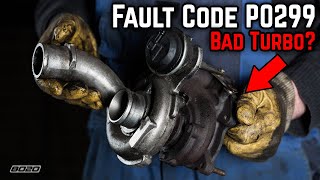
Helpful Videos
Used OEM Parts in Stock




New Aftermarket Parts Available


The information in this article is provided for general reference and educational purposes only. Vehicle specifications, procedures, and part compatibility can vary by production date, trim level, and region. Always consult your vehicle's factory service manual and verify part numbers before purchasing or performing repairs. Safety-critical components such as airbags, seat belts, and braking systems should be installed by a qualified professional.
- Cadillac CT6:
- 🎬 Helpful Videos
- 🛍️ Shop This Part
- What's Unique About the 2016-2018 Cadillac CT6
- Diagnostic Flowchart
- Symptoms You May Notice
- Most Likely Causes
- Rare But Worth Checking
- Diagnosis Steps
- Parts You'll Likely Need
- Related Codes That Often Appear With This One
- Technical Service Bulletins (TSBs) & Recalls
- Platform-Specific Known Issues
- Scan Tool Commands That Help
- Wiring & Ground Locations
- OEM Part Supersession History
- 🎟️ Get 5% Off