

P0299 on 2016-2023 Buick Envision: Turbo Underboost Causes and Fixes
For a 2016-2023 Buick Envision, code P0299 is most often caused by a faulty Charge Air Bypass Valve or a leaking/moisture-contaminated Charge Air Cooler (intercooler), as documented in manufacturer TSBs. Expect to pay $70-$150 for a new bypass valve or $200-$400 for a new charge air cooler, plus labor.
- For the 2016-2023 Buick Envision, P0299 is most likely caused by a faulty Charge Air Bypass Valve or a problem with the Charge Air Cooler, not the turbo itself.
- Always perform a smoke test to check for air leaks in the intake system before replacing expensive components.
- If you live in a cold climate, be aware that ice buildup in the Charge Air Cooler is a known issue documented by GM.
- This code will cause a significant loss of power and should be addressed to restore performance and fuel economy.
What's Unique About the 2016-2023 Buick ENVISION

The Buick Envision, particularly models with the 2.0L turbo engine (LTG and LSY), has well-documented issues leading to code P0299. Manufacturer Technical Service Bulletins (TSBs) point directly to two common culprits: a Charge Air Bypass Valve that gets stuck open (TSB #PIP5889A) and a Charge Air Cooler that accumulates moisture, which can freeze in cold weather and restrict airflow (TSB #21-NA-074). These specific component failures are more common on this platform than a complete turbocharger failure, which is often misdiagnosed.
Diagnostic Flowchart
Tap your situation to follow the diagnostic path that matches what you're seeing on this vehicle.
Generation note: This guide covers the first generation (2016-2020) with the 2.0L LTG engine and the second generation (2021-2023) with the 2.0L LSY engine. The P0299 code applies to both. The primary causes often differ by generation. TSB #21-NA-074 and #18-NA-020 specifically address moisture in the Charge Air Cooler on 2016-2020 models. TSB #PIP5889A points to a faulty Charge Air Bypass Valve on 2021-2023 models.
Symptoms You May Notice
- Check Engine Light is on
- Noticeably reduced engine power and sluggish acceleration
- Limp mode, where speed and RPM are limited
- Hissing or whistling noises from the engine bay, especially under acceleration or when letting off the throttle
- Worse than normal fuel economy
- Hesitation or stumbling during acceleration
- Jerky or inconsistent acceleration
- Replacing the turbocharger immediately without checking for leaks, a stuck bypass valve, or a contaminated charge air cooler. These less expensive parts are far more common failure points for this specific code on the Envision.
- Mistaking normal cracks at the wastegate valve port for a failed turbo. GM bulletin PIP5495 states these are normal and do not affect performance.
Most Likely Causes

- Stuck or Faulty Charge Air Bypass Valve 🔴 High Probability This is a known issue cited in GM Preliminary Information Bulletin #PIP5889A for 2021-2023 models. The valve, also known as a diverter or bypass solenoid, can fail to close properly, causing boost pressure to be recirculated instead of sent to the engine.
How to confirm: A technician can command the valve to open and close with a scan tool. A physical inspection may reveal the valve is stuck or fails to retract properly when tested. A repair case showed desired boost at 137.02 kPa while actual boost was only 35 kPa, pointing to a faulty bypass solenoid.
Typical fix: Replacement of the Charge Air Bypass Valve (solenoid). This is often a straightforward repair accessible from the top of the engine bay.
Est. part cost: $70-$150 - Leaking or Contaminated Charge Air Cooler (CAC) 🔴 High Probability TSB #21-NA-074 and #18-NA-020 specifically call out this issue on 2016-2020 models. Moisture from the PCV system and ambient air can build up inside the cooler. In cold weather (especially below 0°F/-18°C), this can freeze and block airflow, causing P0299. The cooler's end tanks can also develop leaks.
How to confirm: Perform a smoke test on the charge air system to check for leaks. In cases of moisture buildup, removing the cooler may reveal water or oily residue inside. TSB #18-NA-020 advises removing and cleaning the boost pressure sensor, as it may be wet.
Typical fix: If leaking, the charge air cooler must be replaced. If contaminated, it may need draining and cleaning. GM issued updated ECM calibrations and in some cases, grille covers to reduce icing potential in cold climates.
Est. part cost: $200-$400 - Boost Pressure Leaks (Hoses, Clamps, Gaskets) 🟡 Medium Probability The charge air system operates under high pressure. Over time, rubber hoses can crack, clamps can loosen, and plastic pipes can fail, allowing pressurized air to escape. This is a common issue on any turbocharged vehicle.
How to confirm: Visually inspect all intake piping between the turbocharger and the throttle body for cracks, loose connections, or signs of oil mist (which indicates a leak). A smoke test is the most effective way to pinpoint hard-to-see leaks. 🎬 See how to perform a smoke test for boost leaks.
Typical fix: Tighten loose clamps or replace the cracked hose or failed gasket. The charge air cooler outlet tube is a common failure point.
Est. part cost: $20-$100 - Faulty Turbocharger Wastegate or Actuator ⚪ Low Probability While less common than external leaks or valves, the wastegate actuator can fail or the linkage can wear or bind, preventing the wastegate from closing properly and allowing exhaust gas to bypass the turbine.
How to confirm: Inspect the wastegate linkage to ensure it moves freely and is not stuck open. The actuator can be tested using a pressure pump to see if it actuates the wastegate arm within the correct pressure range. GM bulletin PIP5495 provides detailed diagnostic steps to avoid unnecessary turbo replacement.
Typical fix: In some cases, the electronic actuator or vacuum solenoid can be replaced separately. If the wastegate itself (internal to the turbo) is the problem, the entire turbocharger assembly often needs to be replaced.
Est. part cost: $100-$300 for an actuator, $800+ for a turbocharger
Rare But Worth Checking
- Clogged Catalytic Converter: A clogged exhaust creates excessive backpressure, preventing the turbo from spinning up to speed. This would typically be accompanied by a more severe loss of power, especially at high RPM, and potentially other exhaust-related codes. One owner found this to be the root cause after a smoke test for boost leaks came back clean.
- Faulty Boost Pressure Sensor (MAP Sensor): The sensor itself could be sending incorrect low-pressure readings to the ECM. This is less common than a mechanical fault but worth considering if no leaks are found. TSB #18-NA-020 advises cleaning moisture off this sensor during CAC service.
- Worn or Damaged Turbocharger: This is the most expensive repair and should be the last consideration after all other possibilities (leaks, valves, actuators) have been ruled out. A failing turbo might make a whining or grinding noise. GM bulletin PIP5495N exists specifically to reduce the number of no-fault-found turbochargers being replaced under warranty.
Diagnosis Steps

- Read all stored DTCs with an OBD-II scanner to check for related codes like P0300, P2227, or P0101.
- Perform a thorough visual inspection of the entire air intake system, from the air filter to the throttle body. Look for loose clamps, cracked hoses, or disconnected lines.
- Conduct a smoke test on the charge air system to definitively identify any pressure leaks. This is a critical step and often reveals the source of the problem.
- Inspect the Charge Air Bypass Valve. Check if it's stuck or if the solenoid is functioning correctly. Use a scan tool to command it on/off and observe live data for boost pressure changes.
- Inspect the Charge Air Cooler (intercooler) for signs of leaks or moisture/oil contamination inside. Per TSB #18-NA-020, also check and clean the boost pressure sensor.
- Test the turbocharger wastegate actuator and its linkage. Ensure it moves freely and holds pressure. Use a pressure pump to verify it begins to open around 4 PSI and is fully open by 7 PSI.
- If all other tests pass, inspect the turbocharger for excessive shaft play or damage to the turbine wheels, and check the catalytic converter for blockages.
Parts You'll Likely Need
- Charge Air Bypass Valve
(OEM #55499323)— A very common cause for P0299 on this platform, as cited by GM TSB #PIP5889A. It gets stuck open, preventing boost from building.
Trusted brands: ACDelco, GM Genuine Parts
OEM price range: $90-$150
Aftermarket price range: $70-$120 - Charge Air Cooler
(OEM #84634949)— Cited in TSB #21-NA-074 and #18-NA-020 as a source of problems due to moisture collection (which can freeze) or leaks, leading to restricted airflow and underboost.
Trusted brands: ACDelco, Spectra Premium, GM Genuine Parts
OEM price range: $300-$450
Aftermarket price range: $200-$350
Related Codes That Often Appear With This One
- P0300 — Random Misfire. TSB #21-NA-074 and #18-NA-020 note that moisture pulled from the charge air cooler can enter the engine and cause misfires.
- P2227 — Barometric Pressure Sensor Performance. This can also be triggered by the restricted airflow from a frozen or contaminated charge air cooler, as mentioned in TSB #21-NA-074.
- P0234 — Engine Overboost Condition. While it seems contradictory, a faulty or sticky wastegate actuator or solenoid can cause both underboost and overboost conditions at different times.
- P0101 — Mass Air Flow (MAF) Sensor Performance. A large air leak after the MAF sensor but before the turbo can cause the MAF reading to be out of sync with the actual engine airflow, triggering this code alongside P0299.
Technical Service Bulletins (TSBs) & Recalls

- PIP5889A: Communicates the possibility of DTC P0299 due to a stuck open Charge Air Bypass Valve.
- 21NA074: Procedure to replace the charge air cooler due to moisture getting inside of it and causing a malfunction indicator lamp illuminated with DTC P0300 and/or P0299/P2227.
Platform-Specific Known Issues
- TSB #PIP5889A: Specifically identifies a stuck open Charge Air Bypass Valve as a cause for P0299 on 2021-2023 models with the 2.0L LSY engine.
- TSB #21-NA-074: Details how moisture can accumulate inside the Charge Air Cooler on 2016-2020 models, which can freeze in cold weather and cause P0299, P0300, and P2227. The fix may involve replacing the cooler with an updated design and/or reprogramming the ECM.
- TSB #18-NA-020: Also covers the Charge Air Cooler icing issue for 2018-2023 models, recommending ECM updates to alter transmission shift patterns in cold weather to keep engine RPMs higher and reduce the potential for ice buildup.
Mechanic-Grade Diagnostic Values
- Boost Pressure (Live Data) — expected: Actual boost pressure should closely match desired boost pressure under load.. Failure: A significant difference, such as a desired pressure of 137 kPa while actual pressure is only 35 kPa, points to a major leak or faulty bypass/wastegate.
- Wastegate Actuator Function Test — expected: Using a pressure pump on the actuator line, the wastegate arm should begin to move at approximately 4 PSI and be fully open by 7 PSI.. Failure: The arm does not move, moves at a much higher pressure, or does not make a distinct sound when pressure is abruptly released.
Scan Tool Commands That Help

- GDS2 (or similar professional scan tool): Turbocharger Boost Control Test — This is a guided diagnostic function within the GM service information to systematically test the turbocharger system's components, including solenoids and actuators, to pinpoint a fault.
- GDS2 (or similar professional scan tool): Wastegate Actuator Relearn / Calibration — After replacing a turbocharger or electronic wastegate actuator, this function cycles the actuator through its full range of motion, allowing the ECM to learn the new component's minimum and maximum positions. Failure to perform this can result in incorrect boost control and a repeat P0299 code.
Wiring & Ground Locations
- Main Engine Ground — Typically a heavy gauge cable from the negative battery terminal to the engine block or transmission case.. A poor engine ground can cause erratic behavior from all engine sensors and actuators, including the boost pressure sensor, bypass valve solenoid, and wastegate actuator, leading to incorrect readings and fault codes.
- ECM/BCM Grounds — Often located on the cowl in the engine compartment or on the A-pillar behind interior trim panels.. The Engine Control Module (ECM) relies on a clean ground reference to accurately interpret sensor data and control outputs. A faulty ground can cause the ECM to misinterpret boost levels.
- Engine Compartment Fuse Box — Under the hood, typically located next to the battery.. This box contains the fuses and relays that power the ECM and various solenoids in the turbocharger system. A loose connection or corroded terminal here can interrupt power.
Real Owner Repair Stories
- Reko Auto Parts blog (2018 Buick Regal with LFV engine (similar platform to Envision)) — Intermittent check engine light, poor acceleration response, especially on second hard acceleration after letting off the gas.
❌ Tried (didn't work) Initial road test was inconclusive until a specific condition (hard acceleration after coasting) was met.
✅ What actually fixed it Replacement of the turbocharger bypass solenoid. The faulty solenoid was intermittently failing to close, causing boost to recirculate instead of being sent to the engine.
"I Checked Everything" — The Actual Cause
- In one documented case, the entire boost system held pressure during a leak test, indicating no leaks. The actual cause of the P0299 code was a clogged catalytic converter. The exhaust restriction prevented the turbocharger from spooling up effectively, which mimics the symptoms of a boost leak.
OEM Part Supersession History
12653613→55499323— Updated design or manufacturer change for the Charge Air Bypass Valve.
Model Year Variations Within This Range
- 2016-2020: These models use the 2.0L LTG engine, which produces up to 272 hp and around 20 psi of boost. They are more prone to P0299 caused by moisture collecting and freezing in the Charge Air Cooler, as outlined in TSB #18-NA-020.
- 2021-2023: These models use the newer 2.0L LSY engine, which is tuned for refinement and efficiency, producing around 237 hp and a lower 258 lb-ft of torque. The lower torque output was designed to match the limits of the 9T50 9-speed automatic transmission. These model years are more prone to P0299 caused by a faulty Charge Air Bypass Valve, as noted in TSB #PIP5889A.
Helpful Videos

We Have This Part in Stock

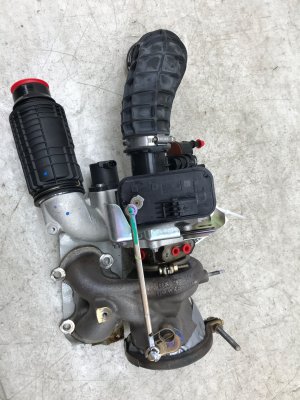



The information in this article is provided for general reference and educational purposes only. Vehicle specifications, procedures, and part compatibility can vary by production date, trim level, and region. Always consult your vehicle's factory service manual and verify part numbers before purchasing or performing repairs. Safety-critical components such as airbags, seat belts, and braking systems should be installed by a qualified professional.
- Buick ENVISION:
- 🎬 Helpful Videos
- 🛍️ Shop This Part
- What's Unique About the 2016-2023 Buick ENVISION
- Diagnostic Flowchart
- Symptoms You May Notice
- Most Likely Causes
- Rare But Worth Checking
- Diagnosis Steps
- Parts You'll Likely Need
- Related Codes That Often Appear With This One
- Technical Service Bulletins (TSBs) & Recalls
- Platform-Specific Known Issues
- Mechanic-Grade Diagnostic Values
- Scan Tool Commands That Help
- Wiring & Ground Locations
- Real Owner Repair Stories
- "I Checked Everything" — The Actual Cause
- OEM Part Supersession History
- Model Year Variations Within This Range
- 🎟️ Get 5% Off