

P0299 on 2020-2024 Audi SQ7: Turbo Underboost Causes and Fixes
P0299 on a 2020-2024 Audi SQ7 indicates a turbocharger underboost condition. This is often caused by a known issue where the water pump leaks coolant into the vacuum lines that control the turbo wastegates. It can also be caused by a faulty diverter valve or a boost leak. This is a complex issue and professional diagnosis is strongly recommended.
- P0299 on an SQ7 means the turbo system is not making enough boost, causing a check engine light and major power loss.
- Before suspecting expensive turbo failure, investigate the known issue of the water pump leaking coolant into the vacuum lines that control the turbos.
- Other common causes include failed diverter valves and leaks in the charge air hoses.
- This is not a simple DIY fix. Accurate diagnosis by a qualified technician is crucial to avoid unnecessarily replacing expensive components like the turbochargers.
What's Unique About the 2020-2024 Audi SQ7

The 4.0L twin-turbo V8 (EA825) in the SQ7 has a unique vulnerability related to this code. A failing water pump or its associated control valve (N649) can leak coolant directly into the engine's vacuum system. This is a widely documented issue covered by Audi TSB 2074303/6. Since the vacuum system is responsible for controlling the turbocharger wastegates, coolant contamination prevents them from operating correctly, leading directly to a P0299 fault. This means a cooling system problem can masquerade as a turbocharger failure, making accurate diagnosis critical to avoid 🎬 Watch: Real-world diagnosis of a P0299 code on a Q7 unnecessary, expensive turbo replacement.
Diagnostic Flowchart

Tap your situation to follow the diagnostic path that matches what you're seeing on this vehicle.
Symptoms You May Notice
- Check Engine Light is on.
- Significant loss of engine power and sluggish acceleration.
- Vehicle may enter "limp mode" to protect the engine.
- Unusual hissing or whistling sounds from the engine bay during acceleration, indicating a boost leak.
- In some cases, an engine overheating warning may accompany the P0299 code if the water pump is the root cause.
- Replacing the turbocharger without first diagnosing the entire boost control system. The issue is often a less expensive component like a vacuum line, water pump, or diverter valve. The known water pump TSB (2074303/6) makes this misdiagnosis particularly costly.
Most Likely Causes


- Leaking Water Pump Contaminating Vacuum System 🔴 High Probability A widely documented issue on the 4.0T EA825 engine involves the switchable mechanical water pump failing internally. This failure allows coolant to be sucked into the vacuum lines that control the turbo wastegates, causing them to malfunction and trigger P0299.
How to confirm: A technician will inspect the vacuum lines, vacuum reservoir, and the N649 valve for the presence of coolant. This is a known issue covered by Audi TSB 2074303/6, which provides a detailed diagnostic procedure. A real-world owner of a 2021 Q8 confirmed this exact diagnosis from a dealer.
Typical fix: Replace the water pump, the N649 control valve, and all contaminated vacuum lines, check valves, and actuators. The vacuum reservoir may also need to be flushed or replaced. This is a significant repair due to the engine's 'hot-V' design.
Est. part cost: $400-$800 - Faulty Turbocharger Diverter Valve 🟡 Medium Probability Diverter valves are a common failure point on many turbocharged Audi engines. The internal diaphragm can tear or the piston can stick, causing boost pressure to leak back into the intake instead of being sent to the engine.
How to confirm: The valve can be removed and inspected for physical damage like a torn diaphragm. A technician can also test the valve's function using a scan tool's output test feature.
Typical fix: Replace the faulty diverter valve. It is often recommended to upgrade to a revised, piston-style valve which is more durable than the original diaphragm type.
Est. part cost: $50-$150 - Boost/Intake Air Leak 🟡 Medium Probability The charge air system consists of many hoses, seals, and connections that can crack, loosen, or fail under pressure and heat cycles. A common failure point can be the seals on the charge air cooler pipes.
How to confirm: A technician will perform a smoke test on the intake and charge air system to identify the source of the leak. This involves pressurizing the system with smoke and looking for where it escapes.
Typical fix: Replace the cracked hose or damaged component and secure all clamps. This could be as simple as replacing a displaced O-ring on a charge pipe.
Est. part cost: $100-$400 - Sticking or Failed Wastegate/Actuator ⚪ Low Probability The wastegate controls turbo speed. If the vacuum-operated actuator fails (diaphragm splits) or the wastegate flap itself has excessive play, it can get stuck open, preventing the turbo from building sufficient boost. Coolant contamination from the water pump is a primary cause of actuator failure on this engine.
How to confirm: A technician will test the wastegate actuator's function using a vacuum pump to ensure it holds vacuum and moves the wastegate arm smoothly. Physical inspection, often requiring removal of the catalytic converter, can reveal excessive play in the wastegate lever.
Typical fix: The actuator can often be replaced separately. However, if the wastegate flap inside the turbo housing is worn, the entire turbocharger assembly must be replaced, which is a very expensive repair.
Est. part cost: $150-$400 for an actuator, $2000+ for a turbocharger
Rare But Worth Checking
- Faulty Boost Pressure Sensor (MAP Sensor): While less common, a faulty sensor can send incorrect boost readings to the ECM, triggering the P0299 code even if the turbo is mechanically sound.
- Clogged Catalytic Converter or Exhaust Restriction: An obstruction in the exhaust system downstream of the turbo can create backpressure that prevents the turbo from spooling up effectively.
Diagnosis Steps
- Scan the vehicle's ECM for P0299 and any other related trouble codes. The fault may appear as P029900 in VAG-specific scan tools.
- Perform a visual inspection of the engine bay, looking for obvious signs of disconnected hoses, cracked pipes, or loose clamps in the charge air system.
- Crucially for the EA825, inspect the vacuum lines connected to the turbo wastegate actuators and the vacuum reservoir for any signs of coolant contamination, per TSB 2074303/6.
- Using a diagnostic tool, monitor specified vs. actual boost pressure while driving the vehicle under load to confirm the underboost condition.
- Perform a smoke test on the entire intake and charge air system to check for leaks that may not be visually apparent.
- Using a scan tool (like VCDS or ODIS), run the Output Diagnostic Test Mode (DTM) for the Wastegate Bypass Regulator Valve (N75) and the Turbocharger Recirculation Valve (N249) to listen for audible clicking, confirming electrical function.
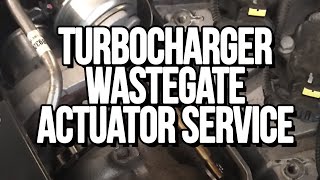
- Test the wastegate actuators using a vacuum pump to ensure they hold vacuum and move the wastegate arm smoothly through 🎬 See how to properly service and test the wastegate actuator its full range of motion.
- If all other components check out, inspect the turbocharger itself for signs of excessive wastegate shaft play or damage to the turbine wheels. This may require partial disassembly (e.g., removing the catalytic converter).
Parts You'll Likely Need
- Engine Water Pump
(OEM #0P2121008J)— This is a primary suspect on the 4.0T engine due to a known issue where it leaks coolant into the vacuum lines that control the turbos, directly causing a P0299 code.
Trusted brands: Audi Genuine, Pierburg
OEM price range: $500-$700
Aftermarket price range: $300-$500 - Turbocharger Diverter Valve
(OEM #06H145710D (example, verify by VIN))— A common failure item on Audi engines that can cause a direct loss of boost pressure when its internal diaphragm ruptures or the valve sticks.
Trusted brands: Pierburg, Bosch, GFB (Go Fast Bits) - for upgrade
OEM price range: $100-$150
Aftermarket price range: $40-$80 - Turbocharger Wastegate Actuator — The actuator controls the wastegate; if its diaphragm fails or it gets contaminated with coolant, it cannot properly regulate the turbo, leading to underboost.
Trusted brands: MaXpeedingRods
OEM price range: $250-$400
Aftermarket price range: $100-$200 - Coolant Changeover Valve
(OEM #N649)— This valve controls the vacuum signal to the water pump. It can fail or become contaminated with coolant, contributing to the P0299 fault. TSB 2074303/6 mentions replacing it.
Trusted brands: Audi Genuine
OEM price range: $80-$120
Aftermarket price range: $50-$90
Technical Service Bulletins (TSBs) & Recalls

- TSB_2079209_2: Provides information for when the exhaust emissions warning lamp is on with P0299.
- TSB_2079209_1: Provides information for when the exhaust emissions warning lamp is on with P0299 specifically for the 4.0L V8 TFSI engine.
- TSB 2074303/6 (and later revisions like /7): This is the key TSB. It explicitly links engine overheating and/or a P0299 code to the switchable water pump leaking coolant into the vacuum system that controls the turbos. It provides the diagnostic path to check for coolant in the vacuum lines and N649 valve.
Platform-Specific Known Issues
- The exhaust emissions warning lamp may illuminate due to P0299 on the 4.0L V8 TFSI engine, as noted by Audi. [TSB_2079209_1, TSB_2079209_2]
- A known failure of the water pump can cause coolant to leak into the vacuum system, which then damages the vacuum-operated components that control the turbochargers, directly causing a P0299 code. This is detailed in Audi TSB 2074303/6.
- A real-world owner complaint for a 2020 SQ7 confirms that the P0299 diagnostic code was the first indicator of an engine problem. [ODI #11676169]
Mechanic-Grade Diagnostic Values
- Vacuum at wastegate actuator lines at idle — expected: ~10-11 inHg. Failure: Significantly lower vacuum suggests a leak in the lines or a faulty vacuum source.
- Vacuum at source (vacuum pump) — expected: ~22-25 inHg. Failure: If source vacuum is low, the vacuum pump itself may be faulty. If source is good but actuator vacuum is low, the leak is in the lines or solenoids.
Hidden / Shadow Codes Worth Checking
- P029900: This is the standard format for this fault code on modern VAG vehicles. The trailing '00' indicates the fault subtype, which for P0299 is typically generic and does not provide additional diagnostic information beyond the base underboost condition. (see via VCDS, ODIS, or other advanced VAG-compatible scan tools.)
Scan Tool Commands That Help
- VCDS or ODIS: Output Test (or Output Diagnostic Test Mode - DTM) — Use this function to individually cycle the 'Wastegate Bypass Regulator Valve (N75)' and 'Turbocharger Recirculation Valve (N249)'. A technician should listen for an audible click from the component, which confirms the ECU can send the signal and the component's solenoid is electrically functional. Lack of a click points to a wiring or solenoid issue.
- VCDS or ODIS: Basic Settings - Group 011 (on older engines) — On some older Audi engines, this function was used to cycle the N75 valve while watching the actuator move. However, on modern ECUs like the one in the SQ7, this specific basic setting may not be available, and Output Tests are the preferred method.
Wiring & Ground Locations
- Boost Pressure Sensor (G31) — Located on the charge air cooler plumbing, near the intake manifold. On the twin-turbo V8, there are two, one for each bank, typically accessible after removing the engine cover and airbox assembly.. This sensor provides the 'actual' boost pressure reading to the ECU. A faulty sensor or damaged wiring can cause the ECU to incorrectly believe there is an underboost condition.
Real Owner Repair Stories
- AudiWorld Forums user (2021 Audi Q8 (4.0T EA825 engine family)) — Check Engine Light, noticeable drop in power, and higher RPMs before shifting.
✅ What actually fixed it The dealer diagnosed an internal water pump leak causing coolant to migrate into the vacuum system. The final repair involved replacing the water pump, solenoid valves, vacuum pump, and vacuum reservoir to fix the P0299 code. - AudiWorld Forums user (Audi Q5 (2.0T engine, demonstrates principle)) — P0299 underboost code and limp mode.
❌ Tried (didn't work) The dealer recommended replacing the entire turbocharger assembly.
✅ What actually fixed it The owner opted to replace only the turbocharger wastegate actuator after cross-referencing the part. This resolved the P0299 code without the expense of a full turbo replacement.
"I Checked Everything" — The Actual Cause
- A standard smoke test is used to find leaks in the charge air system (the 'boost' side). However, the most prevalent cause of P0299 on the SQ7's 4.0T engine is coolant leaking from the water pump into the *vacuum system*. A smoke test on the charge pipes and intercooler will come back clean because the leak is not in that system. The correct diagnostic step is to inspect the vacuum lines for the presence of coolant, as outlined in Audi's TSB.
OEM Part Supersession History
Unknown (older design)→Unknown (newer design)— The original water pump design is prone to internal seal failure, leading to coolant leaking into the vacuum system. A revised water pump with a different pulley design has been released to address this issue.
Heads up: A forum user noted that the revised water pump has a '6 bolt design' on the pulley and requires a matching new pulley, which was on backorder at the time. It is critical to ensure both the new pump and matching pulley are sourced for the repair.
Helpful Videos


The information in this article is provided for general reference and educational purposes only. Vehicle specifications, procedures, and part compatibility can vary by production date, trim level, and region. Always consult your vehicle's factory service manual and verify part numbers before purchasing or performing repairs. Safety-critical components such as airbags, seat belts, and braking systems should be installed by a qualified professional.
- Audi SQ7:
- 🎬 Helpful Videos
- What's Unique About the 2020-2024 Audi SQ7
- Diagnostic Flowchart
- Symptoms You May Notice
- Most Likely Causes
- Rare But Worth Checking
- Diagnosis Steps
- Parts You'll Likely Need
- Technical Service Bulletins (TSBs) & Recalls
- Platform-Specific Known Issues
- Mechanic-Grade Diagnostic Values
- Hidden / Shadow Codes Worth Checking
- Scan Tool Commands That Help
- Wiring & Ground Locations
- Real Owner Repair Stories
- "I Checked Everything" — The Actual Cause
- OEM Part Supersession History
- 🎟️ Get 5% Off