

P0299 on 2009-2013 Audi A5: Turbo Underboost Causes and Fixes
For the 2009-2013 Audi A5 with the 2.0T engine, code P0299 is most often caused by a failed turbocharger diverter valve, which is a relatively inexpensive and easy part to replace. However, it can also indicate a worn turbocharger wastegate, a more complex and costly repair that may require turbo replacement. A failed PCV valve is another common culprit.
- P0299 on a 2009-2013 Audi A5 almost always points to a loss of boost pressure.
- The first and easiest part to check is the turbocharger diverter valve; replacing a torn original-style valve often solves the problem for under $150.
- If the diverter valve is good, the next most likely cause is a worn-out wastegate flap on the turbocharger itself, which is a more expensive repair.
- Always perform a smoke test to rule out simpler issues like cracked hoses or a bad PCV valve before condemning the turbo.
- When replacing the diverter valve, ensure you buy the updated piston-style part (Rev D) to prevent future failures.
What's Unique About the 2009-2013 Audi A5

The 2.0T TFSI (EA888 Gen 1/2) engine in this generation of Audi A5 is well-known for a few specific weak points in its boost control system. The original factory-installed diverter valve uses a rubber diaphragm that is prone to tearing, making it a very common failure point that triggers a P0299 code. Additionally, Audi has issued a Technical Service Bulletin (TSB 2031245/5) acknowledging that excessive wear in the turbocharger's wastegate flap and linkage can cause boost to escape, directly leading to this code. The PCV valve is another known weak point that frequently fails and can cause boost-related issues.
Diagnostic Flowchart

Tap your situation to follow the diagnostic path that matches what you're seeing on this vehicle.
Symptoms You May Notice

- Significant loss of engine power and sluggish acceleration.
- Illuminated Check Engine Light.
- Increased turbo lag or a feeling that the turbo isn't working at all, especially at lower RPMs.
- Audible whooshing, hissing, or air surging sound from the engine bay during acceleration or when letting off the throttle.
- A rattling noise from the turbo area, which points towards a loose wastegate flap.
- In some cases, a whistling or squealing noise at idle, which can indicate a failed PCV valve.
- Replacing the entire turbocharger when the problem was a simple, inexpensive diverter valve.
- Replacing boost sensors before performing a thorough visual inspection and smoke test for physical leaks.
- Assuming a turbo replacement is needed without first checking the PCV valve, which can present similar symptoms.
Most Likely Causes

- Failed Turbocharger Diverter Valve (DV) 🔴 High Probability The original OEM diverter valve (Rev C and earlier) uses a rubber diaphragm that is notorious for tearing over time, creating a direct boost leak. This is one of the most common failures on the 2.0T engine. An updated piston-style valve is the recommended replacement.
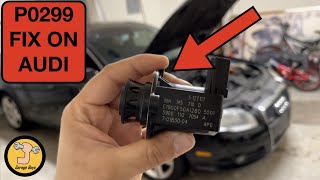
How to confirm: Remove the valve from the turbocharger (located underneath the car, held by three T30 Torx bolts) and visually 🎬 Watch: How to inspect and replace a failed diverter valve. inspect the rubber diaphragm for rips or tears. If the old-style valve falls apart upon removal, it has failed. The part is often black and located on the underside of the turbo.
Typical fix: Replace the old diaphragm-style valve with the updated piston-style OEM valve (often called 'Rev D') or a robust aftermarket alternative like the GFB DV+.
Est. part cost: $50-$150 - Worn Turbocharger Wastegate Flap/Actuator 🔴 High Probability As cited in Audi TSB #2031245/5, the wastegate linkage and flap can develop excessive play where the arm pivots, preventing it from sealing properly and allowing boost pressure to escape. The hole in the lever arm can become oval-shaped from wear.
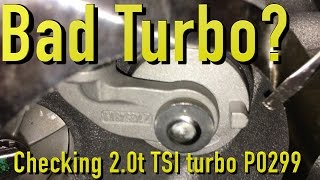
How to confirm: With the engine off, reach under the car to the turbo and attempt to wiggle the wastegate actuator arm. If there is significant looseness or rattling, the wastegate is worn. A more thorough check involves removing the downpipe or using a borescope to visually inspect the flap inside the turbine housing for a poor seal.
Typical fix: The official dealer fix is to replace the entire turbocharger assembly, as the wastegate is an integral part. Some aftermarket repair kits with new bushings and arms are available, but this requires grinding, welding, and careful alignment. A common DIY fix involves using a special clip to reduce play or carefully bending the actuator rod to increase tension on the worn flap.
Est. part cost: $650-$1500 for a turbo; $30-$100 for a repair kit. - Leaking PCV Valve / Crankcase Breather 🟡 Medium Probability The PCV (Positive Crankcase Ventilation) system, also called the oil separator, on the 2.0T engine is another known failure point. The internal diaphragm can fail, causing a massive vacuum leak which the ECU can interpret as an underboost condition.
How to confirm: Perform a smoke test on the intake system. Leaks from the PCV valve housing or its associated hoses will become visible. A simple test is to try and remove the oil cap while the engine is running; if there is extreme suction holding it down, the PCV has likely failed. A loud whistling or howling sound from the engine bay at idle is also a strong indicator.
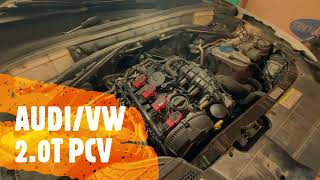
Typical fix: Replace the entire PCV valve assembly. It is located on top of the valve cover. 🎬 Watch: Step-by-step guide to replacing the PCV valve assembly.
Est. part cost: $100-$200 - Boost/Vacuum Leak 🟡 Medium Probability Over time, plastic and rubber hoses in the engine bay can become brittle and crack, and clamps can loosen. The charge pipes, intercooler, and various vacuum lines are all potential leak points.
How to confirm: Perform a smoke test on the entire intake and boost system from the airbox to the throttle body. Listen for audible hissing and look for smoke. Check for leaks at the intercooler and all connecting pipes. A leak may not be visible and only present under pressure.
Typical fix: Replace the cracked hose, leaking intercooler, or tighten the loose clamp.
Est. part cost: $20-$500
Rare But Worth Checking
- Faulty Boost Pressure Sensor (MAP/N75): While less common than mechanical failures, a sensor providing incorrect data to the ECM can falsely trigger an underboost code. The N75 valve (wastegate frequency control valve, part number 06F906283F) specifically can be a point of failure.
- Clogged Catalytic Converter: A severe exhaust restriction can prevent the turbo from spooling up effectively, leading to an underboost condition. This is usually accompanied by a more severe loss of power, especially at high RPM, and may be preceded by other exhaust-related codes.
Diagnosis Steps
- Read the fault codes with an OBD-II scanner to confirm P0299 is present. Note any other codes like P2279 or P0171, which point towards a vacuum/boost leak.
- Start the engine and listen for unusual noises. A loud whistling or howling at idle points to a bad PCV valve. Test it by trying to remove the oil cap; strong suction confirms failure.
- Visually inspect all accessible boost hoses and vacuum lines for obvious cracks, disconnections, or loose clamps. Pay attention to charge pipes and intercooler connections.
- Inspect the turbocharger diverter valve. It is located on the turbocharger housing, accessible from under the vehicle. Check if it is the old diaphragm style and inspect for tears. If it's the original part, it's a prime suspect.
- If the DV is okay, perform a smoke test on the intake system to check for leaks from the PCV valve, intercooler, or charge pipes.
- If no leaks are found, inspect the turbocharger wastegate actuator rod for excessive play. With the engine cool, reach up to the turbo and wiggle the arm. If it rattles or has significant side-to-side movement, the wastegate bushing is worn. 🎬 See this video to identify a rattling wastegate flap.
- If the wastegate is loose, the turbocharger assembly will likely need replacement or repair.
Parts You'll Likely Need
- Turbocharger Diverter Valve (Piston Style)
(OEM #06H145710D)— This is the most common failure point for P0299 on this engine. The original diaphragm version tears, and this updated piston design is the permanent fix.
Trusted brands: Pierburg (OEM), Bosch, GFB (Go Fast Bits) DV+ T9351
OEM price range: $100-$150
Aftermarket price range: $50-$130 - Turbocharger Assembly
(OEM #06H145702L / 06H145702S (verify by VIN))— Required if the integrated wastegate flap is worn and leaking boost, as confirmed by a TSB and numerous mechanic reports.
Trusted brands: BorgWarner / IHI (OEM), Aftermarket remanufactured
OEM price range: $1000-$1500
Aftermarket price range: $650-$900 - PCV Valve / Oil Separator
(OEM #06H103495AH (or latest revision))— A common failure on the 2.0T engine that can cause boost leaks and other running issues, including P0299. It's crucial to get the latest OEM revision.
Trusted brands: Audi (OEM), Vaico, Febi
OEM price range: $150-$200
Aftermarket price range: $80-$120
Related Codes That Often Appear With This One
- P2279 - Intake Air System Leak
- P0171 - System Too Lean (Bank 1)
- P0300, P0301, P0302, P0303, P0304 - Random or Specific Cylinder Misfire
Technical Service Bulletins (TSBs) & Recalls
- NHTSA TSB #131420312455 / Audi TSB 2031245/5: Mentions that excessive wear on the wastegate flap leads to escaping boost and sets DTC P0299.
Platform-Specific Known Issues
- The original diaphragm-style diverter valve is a known weak point and a primary cause of P0299.
- The 2.0T TFSI engine from this era can also be prone to timing chain tensioner failure, which is a separate but critical issue owners should be aware of.
- Dealers often default to recommending a full turbo replacement for P0299 without thoroughly diagnosing simpler causes like the diverter valve or PCV valve.
Mechanic-Grade Diagnostic Values
- VCDS Live Data: Specified vs. Actual Boost Pressure — expected: Actual boost should closely track specified boost under load.. Failure: A deviation where actual boost is more than 2.1 PSI (150 hPa) below specified for several seconds will trigger the P0299 code.
- MAP (Boost Pressure) Sensor Voltage, Key On Engine Off — expected: ~4.5 Volts. Failure: A significantly different voltage indicates a faulty sensor or wiring issue. This reading reflects atmospheric pressure.
- MAP (Boost Pressure) Sensor Voltage, Engine Idling — expected: ~1.0 - 1.2 Volts. Failure: A significantly higher voltage at idle (e.g., >1.8V) suggests a vacuum leak or a faulty sensor, as high vacuum should produce a low voltage.
- N75 (Wastegate Control) Valve Solenoid Resistance — expected: 15 - 17 Ohms. Failure: A reading far outside this range suggests the internal coil is faulty and the valve needs replacement.
- Wastegate Lever to Turbo Housing Clearance — expected: Approximately 3.0mm. Failure: Significantly more or less clearance, or a seized lever, indicates a fault in the wastegate assembly as per a VW Tech Tip.
Hidden / Shadow Codes Worth Checking
- 16683 / 000665: This is the manufacturer-specific fault code that corresponds to P0299, meaning "Boost Pressure Regulation: Control Range Not Reached". (see via VCDS (VAG-COM), OBDeleven, or other professional VW/Audi diagnostic scan tools.)
Scan Tool Commands That Help
- VCDS / OBDeleven: Output Diagnostic Test Mode (DTM) for N75 Valve — This command actively cycles the N75 solenoid, allowing a technician to hear it click and verify its electrical operation, helping to distinguish between a mechanical and electrical failure of the valve.
- VCDS / OBDeleven: Log Measuring Values: 'Boost pressure; specified value' & 'Boost pressure; actual value' — This is the primary diagnostic step to confirm the underboost condition. Logging these values during a test drive under load will show the exact deviation between what the ECU is requesting and what the turbo is producing.
- Mityvac (Hand Vacuum Pump): Test Wastegate Actuator Diaphragm — This is a manual test, not a scan tool command. Applying vacuum directly to the wastegate actuator nipple confirms if the diaphragm holds vacuum. If it doesn't, the actuator is leaking and must be replaced.
Wiring & Ground Locations
- Ground Point 12 — In the engine compartment on the left side, typically on the frame rail or strut tower area.. A poor engine ground can cause incorrect readings from critical sensors like the MAP sensor and N75 valve, leading to false codes or improper boost control.
- Jump Start Terminals — Under the plastic cowl cover near the windshield, there are dedicated positive (+) and negative (-) posts for jump-starting.. These serve as the main power and ground distribution points for the engine bay. Ensuring these connections are clean and tight is a crucial first step in any electrical diagnosis.
Real Owner Repair Stories
- HumbleMechanic YouTube comment section (VW MK6 GTI (uses similar 2.0T TSI engine)) — P0299 code and lack of performance.
❌ Tried (didn't work) Checking for boost leaks, Checking the wastegate rod for play, Replacing the entire turbocharger assembly
✅ What actually fixed it The P0299 code persisted after a new turbo. The actual cause was a clogged catalytic converter, which was diagnosed using a borescope inserted into the pre-cat oxygen sensor port. Replacing the downpipe resolved the issue. - Reddit r/AskMechanics (2012 Audi A4 Avant 2.0T with 170k miles) — P0299 underboost code.
❌ Tried (didn't work) Checking the wastegate for looseness (no play was felt)
✅ What actually fixed it Upon closer inspection, the owner discovered a physical crack in the cast iron exhaust housing of the turbocharger, which was causing the boost leak. The fix required a new turbocharger. - YouTube video by 'NaptownTuner' (Audi/VW 2.0T with K03 turbo) — P0299 code, rattling noise from turbo area.
❌ Tried (didn't work) Replacing Diverter Valve, Replacing N75 Valve
✅ What actually fixed it The wastegate linkage was extremely loose. The fix was to install a small, aftermarket metal clip (wastegate rattle clip) onto the actuator arm pivot point, which removed the excess play and allowed the wastegate flap to seal properly.
"I Checked Everything" — The Actual Cause
- A clogged catalytic converter can cause P0299. The intake and boost pipes will pass a smoke test perfectly, but the exhaust restriction prevents the turbo from spinning fast enough to generate the requested boost. This is often diagnosed last, after all boost-side components have been checked.
- A cracked hot-side (exhaust housing) of the turbocharger will not be found with a standard smoke test performed on the cold-side intake tract. The leak only becomes apparent under heat and exhaust pressure.
- A faulty N75 wastegate control valve that is mechanically sticking or has an internal electrical failure may not cause a physical leak that a smoke test can find, but it will fail to properly regulate the wastegate actuator, leading to underboost.
When the Usual Fixes Don't Work
- While the most common fixes for P0299 are the diverter valve and addressing wastegate wear, there are documented cases where these repairs do not solve the problem. In one instance, a vehicle received a brand new turbocharger, but the underboost code returned immediately. The ultimate cause was found to be a clogged catalytic converter, which created so much exhaust backpressure that the new turbo could not spool effectively. This highlights the importance of considering the entire system, including exhaust flow, when diagnosing boost-related fault codes, especially if initial, common repairs fail to resolve the issue.
OEM Part Supersession History
06F145710B, 06F145710C, 06F145710G→06H145710D— The original diverter valves used a rubber diaphragm that was prone to tearing. The updated 'Rev D' part uses a more durable piston-style design to prevent this common failure.06H103495A, 06H103495E→06H103495AC, 06H103495AE, 06H103495AH, 06H103495AJ— The original PCV valve (oil separator) had a weak internal diaphragm that would rupture, causing a large vacuum leak. Multiple revisions were released to improve durability.
Heads up: It is critical to use the latest revision available, as earlier versions are known to fail prematurely.
Model Year Variations Within This Range
- 2009-2013: While the B8 platform was facelifted to the B8.5 in 2013, the core 2.0T TFSI engine and its primary failure points for P0299 (Diverter Valve, Wastegate, PCV) are consistent across this entire model year range. The most significant variations are the running updates to part numbers (e.g., Diverter Valve, PCV Valve) which should be checked by VIN, rather than being tied to a specific model year.
Helpful Videos


Used OEM Parts in Stock

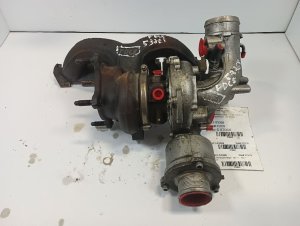

New Aftermarket Parts Available


The information in this article is provided for general reference and educational purposes only. Vehicle specifications, procedures, and part compatibility can vary by production date, trim level, and region. Always consult your vehicle's factory service manual and verify part numbers before purchasing or performing repairs. Safety-critical components such as airbags, seat belts, and braking systems should be installed by a qualified professional.
- Audi A5:
- 🎬 Helpful Videos
- 🛍️ Shop This Part
- What's Unique About the 2009-2013 Audi A5
- Diagnostic Flowchart
- Symptoms You May Notice
- Most Likely Causes
- Rare But Worth Checking
- Diagnosis Steps
- Parts You'll Likely Need
- Related Codes That Often Appear With This One
- Technical Service Bulletins (TSBs) & Recalls
- Platform-Specific Known Issues
- Mechanic-Grade Diagnostic Values
- Hidden / Shadow Codes Worth Checking
- Scan Tool Commands That Help
- Wiring & Ground Locations
- Real Owner Repair Stories
- "I Checked Everything" — The Actual Cause
- When the Usual Fixes Don't Work
- OEM Part Supersession History
- Model Year Variations Within This Range
- 🎟️ Get 5% Off