

P0281 on 2017-2018 GMC Sierra 3500: Cylinder 7 Contribution Fault Causes & Fixes
P0281 on a 2017-2018 Sierra 3500 with the 6.6L Duramax L5P engine indicates a performance issue with cylinder #7. The most common causes are a faulty fuel injector connector or the fuel injector itself. Diagnosis involves checking injector balance rates and inspecting the connector for looseness or corrosion before replacing parts.
- P0281 means cylinder #7 isn't producing enough power on your 6.6L Duramax.
- The most likely culprit is a bad fuel injector for cylinder 7.
- Use a scanner to check injector balance rates; a high positive number on cylinder 7 points to the problem.
- Always replace the high-pressure fuel line when replacing an injector.
- In rare cases, the issue could be wiring or an ECM software glitch that a dealer needs to address.
What's Unique About the 2017-2018 Gmc SIERRA 3500
For the 2017-2018 Sierra 3500, this code almost always points to the 6.6L Duramax L5P V8 diesel engine. Unlike the earlier LML Duramax generation known for catastrophic CP4 fuel pump failures, the L5P (introduced in 2017) features a more robust Denso HP4 high-pressure common rail fuel system. While individual injector failures are still a primary cause for this code, a very common point of failure on the L5P is the injector's electrical connector, which can lose pin tension from vibration, causing an intermittent electrical fault. The provided NHTSA TSBs also indicate that in some cases, an ECM software anomaly or even a charge air cooler leak could be the root cause, requiring a dealer reflash or mechanical inspection rather than an injector replacement. [Bulletin #17-NA-171, Bulletin #PIP5468F]
Diagnostic Flowchart
Tap your situation to follow the diagnostic path that matches what you're seeing on this vehicle.
Symptoms You May Notice
- Check Engine Light is on
- Rough or shaking idle
- Noticeable loss of engine power and acceleration
- Engine may enter a reduced power or 'limp mode'
- Increased engine vibration, especially under load
- Changes in exhaust sound or a ticking noise
- Raw diesel smell from the exhaust or engine bay if the injector is leaking.
- Replacing spark plugs (Diesel engines do not have spark plugs)
- Replacing the fuel filter without diagnosing the specific cylinder fault (while good maintenance, it won't fix a single bad injector or connector)
- Replacing the fuel injector when only the electrical connector pigtail is faulty.
Most Likely Causes
- Faulty Cylinder 7 Fuel Injector 🔴 High Probability Modern high-pressure common rail diesel injectors operate under extreme pressures (over 30,000 PSI) and can fail internally or become clogged over time, especially with contaminated fuel.
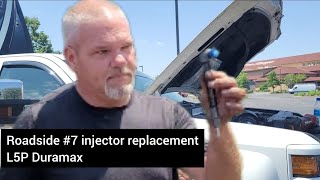
How to confirm: Use a capable OBD-II scanner to monitor injector balance rates. A high positive value for cylinder 7 (e.g., over +4.0 mm³) indicates the ECM is adding extra fuel to compensate for a weak cylinder, pointing to a bad injector. Swapping the suspect injector with one from another cylinder (e.g., cylinder 5) and seeing if the fault code follows the injector is a definitive test. A YouTube user documented replacing a #7 injector on his L5P with nearly 400,000 miles after getting a related code. 🎬 See a full walkthrough of the L5P injector replacement process.
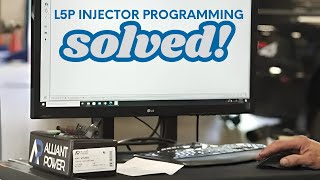
Typical fix: Replace the cylinder 7 fuel injector and the single-use high-pressure fuel line. After installation, the new injector's flow rate code (IQA/IMA code) must be programmed into the ECM using a compatible scan tool. 🎬 Learn how to program injector trim codes using a scan tool.
Est. part cost: $300-$500 - Injector Wiring Harness or Connector Issue 🔴 High Probability Engine vibrations and heat cycles cause the female pins in the injector connector to spread, losing tension. This creates a poor connection, high resistance, and intermittent misfires. This is a widely documented issue on the L5P, with some sources claiming the #4 cylinder connector is most prone, but it affects all cylinders. Fretting corrosion, visible as a black powder residue, is a clear sign of this failure.
How to confirm: Visually inspect the wiring harness leading to the #7 injector. Disconnect it and check for corrosion, spread pins, or black dust. A common DIY fix is to 'ice pick' the connector by carefully re-tensioning the female pins. A user on Reddit reported having the #7 injector and harness replaced by a dealer, highlighting it as a known failure point.
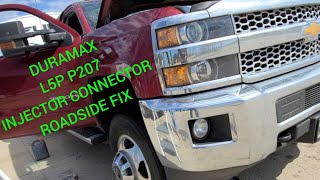
Typical fix: Repair the connection by re-tensioning the pins or, more reliably, by replacing the injector pigtail connector. A YouTube video shows this repair being done in a parking lot for a P0207 code on cylinder 7. 🎬 Watch this quick roadside repair of the cylinder 7 connector. GM recommends applying dielectric grease to all injector connectors during service.
Est. part cost: $20-$100 - Engine Control Module (ECM) Software Anomaly ⚪ Low Probability TSB #17-NA-171 specifically states that an "anomaly in the Engine Control Module (ECM) and the Transmission Control Module (TCM)" can cause a group of codes, including all eight cylinder contribution faults (P0263-P0284), to set.
How to confirm: This is a diagnosis of exclusion. If the injector, wiring, and engine mechanicals all test good, the issue may be software-related. A GM dealer can check if a more recent software calibration is available for the ECM and TCM.
Typical fix: Reprogram both the ECM and TCM with the latest software update at a GM dealership. The TSB notes that not updating both modules may result in other performance issues.
Est. part cost: $0-$200
Rare But Worth Checking
- Low Compression in Cylinder 7: While less common than fuel system issues, a mechanical problem like worn piston rings, a failing valve, or a bad lifter can cause a lack of power in one cylinder. A compression test is needed to verify this after ruling out fuel and electrical causes.
- Charge Air Cooler (CAC) System Leak: TSB #PIP5468F indicates that a large group of DTCs, including P0281, can be set due to loose connections or leaks in the charge air cooler ductwork. A visual inspection may not be enough; the leak may only appear under load when the engine moves. This should be checked before condemning expensive fuel system components.
- Contaminated Fuel: Poor quality diesel fuel with water or debris can damage high-pressure fuel system components, including injectors. If multiple injector codes appear simultaneously, this could be a contributing factor.
Diagnosis Steps
- Connect a professional-grade OBD-II scanner capable of reading manufacturer-specific data like injector balance rates.
- Check for any other accompanying trouble codes, especially P0207 (injector circuit open) which points to an electrical issue.
- Access the live data stream and monitor the 'Injector Balance Rates' for all 8 cylinders at idle when the engine is warm. The L5P cylinder layout is: Passenger side (front to back) is 1-3-5-7; Driver side (front to back) is 2-4-6-8.
- Look for a high positive reading on cylinder 7. A reading consistently above +4.0 mm³ strongly suggests a problem with that cylinder.
- Per TSB #PIP5468F, inspect all charge air cooler ductwork for loose clamps or leaks, as this can trigger contribution codes.
- If balance rates are high, inspect the wiring and connector for the #7 fuel injector. Cylinder 7 is the rearmost cylinder on the passenger side, accessed through the passenger-side wheel well. Look for signs of fretting (black dust) or loose pins.
- If the wiring appears intact, consider swapping the cylinder 7 injector with another cylinder (e.g., cylinder 5, which is just forward of #7). Clear the codes and run the engine to see if the high balance rate and fault code move to cylinder 5. If they do, the injector is faulty.
- If the fault remains on cylinder 7 after the swap, the problem is in the wiring harness or the ECM's injector driver.
- If the injector and wiring test good, perform a compression test on cylinder 7 to rule out mechanical engine problems.
- If all tests pass, consult a GM dealer about potential ECM/TCM software updates as mentioned in TSB #17-NA-171.
Parts You'll Likely Need
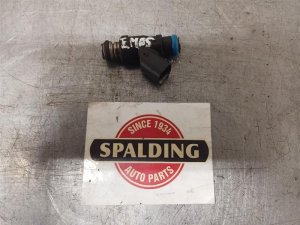
- Cylinder 7 Fuel Injector
(OEM #12698552)— This is a frequent cause of a P0281 code if the injector has failed internally. Note: Other OEM part numbers like 12678992 may also apply.
Trusted brands: ACDelco, GM Genuine
OEM price range: $400-$550
Aftermarket price range: $250-$450 - High-Pressure Fuel Injector Line (Cylinders 2/4/5/7)
(OEM #12685923)— These lines are considered one-time use. Once loosened, they must be replaced to ensure a proper seal under the fuel rail's extreme pressure. The same part number is used for cylinders 2, 4, 5, and 7.
Trusted brands: ACDelco, GM Genuine
OEM price range: $40-$60
Aftermarket price range: $30-$50 - Fuel Injector Connector Pigtail
(OEM #19368140)— Often the root cause of electrical injector codes due to vibration and lost pin tension. Replacing the pigtail is a more permanent fix than re-tensioning the pins.
Trusted brands: ACDelco
OEM price range: $40-$60
Aftermarket price range: $20-$40
Related Codes That Often Appear With This One
- P0207 — This code means "Injector Circuit/Open - Cylinder 7". If it appears with P0281, it strongly points to an electrical problem like a bad injector coil, a loose connector, or a wiring harness issue, rather than a purely mechanical injector failure.
- P0307 — This is a generic "Cylinder 7 Misfire Detected" code. It often accompanies P0281 as the contribution fault is the underlying cause of the misfire.
- P0263, P0266, P0269, P0272, P0275, P0278, P0284 — These are the contribution/balance codes for the other 7 cylinders. The TSBs show them appearing in a group, which could point towards a widespread issue like an ECM software problem (per TSB 17-NA-171) or a major charge air cooler leak (per TSB PIP5468F).
Technical Service Bulletins (TSBs) & Recalls
- 17-NA-171: Mentions a possible ECM/TCM software anomaly causing P0281 and other codes, fixed by reprogramming.
- PIP5468F: Lists P0281 among many other codes that can be caused by charge air cooler system leaks.
- PIP5468D: An earlier version of PIP5468F with similar information.
Platform-Specific Known Issues
- TSB #17-NA-171 notes that an ECM/TCM software anomaly can cause this code, along with many others, requiring a dealer re-flash of both modules to fix.
- TSB #PIP5468F lists P0281 in a large group of potential codes that can be caused by leaks in the charge air cooler system, advising technicians to check for loose ductwork before proceeding with other diagnostics.
- Injector connector fretting and loss of pin tension is a well-documented weakness on the L5P platform, often causing electrical codes like P0207 and contribution codes like P0281.
Mechanic-Grade Diagnostic Values
- Fuel Injector Coil Resistance — expected: ~0.8 Ohms. Failure: A reading significantly higher than 0.8 Ohms when measured directly at the injector, or a reading of 3.0 Ohms or more when measuring through the harness, indicates high resistance in the circuit, likely at the connector.
- High-Pressure Fuel Rail Pressure — expected: System is capable of up to 29,000 PSI (2,000 bar).. Failure: A scan tool showing fuel rail pressure significantly below the desired or commanded pressure, especially during cranking or under load, can indicate an issue. A single injector with excessive return flow is a common cause of low rail pressure.
Scan Tool Commands That Help
- GM GDS2: Injector Flow Rate Programming — This function is mandatory after replacing a fuel injector to write the new injector's unique calibration code (IQA code) to the Engine Control Module (ECM). The path is typically: ECM > Module Diagnostics > Control Functions > Configuration Reset > Injector Flow Rate Programming.
- Aftermarket (e.g., Snap-on, Autel): Injector Rate Programming / Injector Coding — Used for the same purpose as the GDS2 command. For L5P engines, it is critical to know that some aftermarket tools require you to manually add "F7" as a prefix to the IQA code for the ECM to accept it.
- GM GDS2: Cylinder Power Balance — This test graphically displays the contribution of each cylinder, allowing a technician to visually confirm that cylinder #7 is underperforming compared to the others. The data is often displayed as 'Injector Balance Rates'.
Wiring & Ground Locations
- Injector Connector at Cylinder 7 — Rearmost cylinder on the passenger side of the engine. Accessed by removing the passenger side front wheel and wheel well liner.. This is the most common failure point. The connector pins lose tension due to engine vibration, causing high resistance and intermittent open circuits, triggering P0281 and P0207.
- ECM Connector X2 — The rearmost of the large electrical connectors on the Engine Control Module (ECM).. The injector wiring runs directly from this connector to the injector. In rare cases, a pin can become loose at the ECM side rather than the injector side, causing the same symptoms. Testing continuity from the pins on this connector can isolate a harness break from a connector issue.
- G110 / G114 — G110 is a body harness ground; G114 is an engine harness ground. Exact locations can vary but are typically on the frame or engine block.. A GM document notes that loose connections at these primary grounds on related trucks can cause a wide range of difficult-to-diagnose electrical issues. While not specific to P0281, a poor engine or ECM ground can cause erratic sensor readings and module behavior.
Real Owner Repair Stories
- YouTube channel 'C Farmer' (2018 GMC Sierra 2500, 27,000 miles) — Dead engine miss, check engine light with code P0207 (Cylinder 7 Injector Circuit).
❌ Tried (didn't work) The owner went straight to the most likely fix based on community knowledge.
✅ What actually fixed it The owner replaced the #7 injector electrical pigtail connector (GM Part #19368140). The fix was confirmed to be working three months later. - YouTube channel 'C Farmer' (follow-up video) (Same 2018 GMC Sierra 2500, at a later date.) — Truck died while driving, complete loss of power.
❌ Tried (didn't work) The electrical connector pigtail had already been replaced in a previous repair.
✅ What actually fixed it The #7 fuel injector itself had failed. The owner performed a roadside replacement of the injector and its high-pressure line, then used an Autel scan tool to program the new injector's flow rate code into the ECM to complete the repair.
OEM Part Supersession History
12678992, 12696966, 12674615, 12686812→12698552— Standard part evolution and updates by the manufacturer (Denso/GM).
Heads up: No incompatibility noted. 12698552 is the current and correct replacement for all 2017-2018 models.
Helpful Videos
Used OEM Parts in Stock
New Aftermarket Parts Available


The information in this article is provided for general reference and educational purposes only. Vehicle specifications, procedures, and part compatibility can vary by production date, trim level, and region. Always consult your vehicle's factory service manual and verify part numbers before purchasing or performing repairs. Safety-critical components such as airbags, seat belts, and braking systems should be installed by a qualified professional.
- Gmc SIERRA 3500:
- 🎬 Helpful Videos
- 🛍️ Shop This Part
- What's Unique About the 2017-2018 Gmc SIERRA 3500
- Diagnostic Flowchart
- Symptoms You May Notice
- Most Likely Causes
- Rare But Worth Checking
- Diagnosis Steps
- Parts You'll Likely Need
- Related Codes That Often Appear With This One
- Technical Service Bulletins (TSBs) & Recalls
- Platform-Specific Known Issues
- Mechanic-Grade Diagnostic Values
- Scan Tool Commands That Help
- Wiring & Ground Locations
- Real Owner Repair Stories
- OEM Part Supersession History
- 🎟️ Get 5% Off