

P0275 on 2017-2018 Chevrolet Silverado 2500: Cylinder 5 Imbalance Causes & Fixes
This code indicates a performance issue with cylinder #5 on your 6.6L Duramax engine. The most common cause is a failing fuel injector in cylinder #5. Other possibilities include a wiring issue to the injector or, less commonly, a software anomaly in the Engine Control Module (ECM).
- P0275 on a 2017-2018 Silverado 2500 means the ECM detects a power imbalance from cylinder #5.
- The most probable cause is a failing fuel injector for cylinder #5.
- Diagnosis should start with checking injector balance rates using a professional scan tool.
- A faulty electrical connector at the injector is another common cause and should be inspected.
- Replacing an injector on this engine is a job for a professional, as the new part must be electronically calibrated to the ECM.
What's Unique About the 2017-2018 Chevrolet SILVERADO 2500
The 2017-2018 Silverado 2500 with the 6.6L L5P Duramax engine uses a high-pressure common-rail fuel system with Denso piezoelectric injectors that is extremely precise, operating at up to 29,000 psi. This precision makes it sensitive to issues like injector wear, fuel quality, and even electrical connection integrity. GM has issued technical service bulletins (TSBs) that group P0275 with many other codes, pointing to potential causes ranging from loose charge air cooler ducts to ECM software anomalies that require reprogramming by a dealer.
Diagnostic Flowchart
Tap your situation to follow the diagnostic path that matches what you're seeing on this vehicle.
Symptoms You May Notice
- Rough or uneven idle
- Noticeable loss of power and slower acceleration
- Engine hesitation or stumbling
- Increased fuel consumption
- Black or white smoke from the exhaust, especially at idle
- Check Engine Light is on
- Raw diesel fuel smell
- Replacing only the fuel filter without diagnosing the injector.
- Replacing the ECM without first ruling out injector, wiring, and mechanical issues.
- Assuming any smoke from the exhaust is a DPF or turbo issue without first checking injector balance rates.
- Condemning an injector based on a circuit code (P0205) when the actual fault is the connector pigtail.
Most Likely Causes
- Faulty Cylinder 5 Fuel Injector 🔴 High Probability High-pressure injectors in modern diesels operate under immense stress and can wear out or become clogged over time. The tight tolerances of the L5P's Denso solenoid injectors make them susceptible to contamination and internal wear.
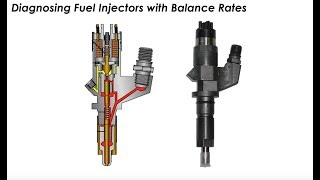
How to confirm: Use a professional scan tool to monitor injector balance rates at idle 🎬 Watch: How to monitor and interpret injector balance rates. when the engine is at full operating temperature. A reading for cylinder 5 that is significantly higher or lower than the others (e.g., beyond +/- 4 mm³) indicates a problem. The definitive test is to swap the injector with another cylinder (e.g., cylinder #3) and see if the fault code changes to P0269 (Cylinder 3) and the high balance rate moves to that cylinder.
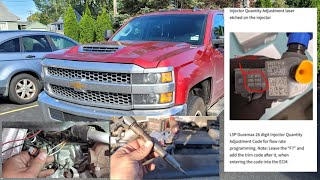
Typical fix: Replace the cylinder 5 fuel injector, its one-time-use high-pressure fuel line, and program the new injector's trim code into the ECM.
Est. part cost: $280-$500 - Injector Wiring/Connector Issue 🟡 Medium Probability The engine bay environment (heat, vibration) can cause the female pins in the injector connector to lose tension, leading to a poor electrical connection. This is a known common failure point on the L5P. Some technicians report seeing this issue frequently on specific cylinders like #4, possibly due to water intrusion from the wheel well or chafing against the steering shaft.
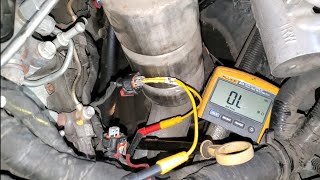
How to confirm: With the engine running, carefully wiggle the wiring harness and connector for the #5 injector. If the idle smooths out or changes, a connection issue is likely. A technician can also measure resistance through the circuit while wiggling the connector; a fluctuating reading or open circuit confirms the issue. Normal resistance should be around 0.8 ohms, while a failing connector can show 3.8 ohms or more. Be aware that the ECM may disable the injector circuit as soon as a glitch is detected, requiring a key cycle to re-test.
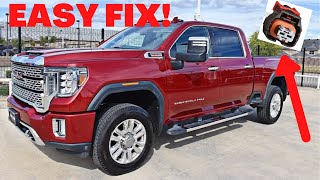
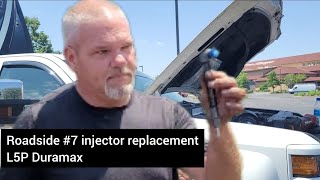
Typical fix: Replace the injector pigtail connector. 🎬 See this walkthrough on replacing a faulty injector pigtail. This involves cutting the old connector off and splicing the new one in using heat-sealable butt connectors. Simply applying dielectric grease is usually not a permanent fix if the pin tension is lost.
Est. part cost: $20-$60 - Engine Control Module (ECM) Software Anomaly ⚪ Low Probability TSB 17-NA-171 specifically notes that various drivability issues, including a list of over 20 DTCs including the entire P0263-P0284 cylinder balance set, may be caused by an anomaly in the ECM and/or TCM software.
How to confirm: This is a diagnosis of exclusion. If the injector, wiring, and mechanical engine health are all confirmed to be good, the ECM software is the next logical step. A GM dealer can check if the vehicle's ECM and TCM have the latest software calibrations by connecting to the GM TIS2Web service.
Typical fix: Reprogram the ECM and TCM to the latest available software version at a GM dealership. The TSB emphasizes that both modules must be updated together.
Est. part cost: $0 (if under warranty) - $250 (dealer labor) - Loose Charge Air Cooler (CAC) Ductwork ⚪ Low Probability TSB PIP5468F suggests that boost leaks from loose CAC piping can cause a wide array of engine performance codes, including the cylinder balance set. The bulletin notes that a leak may not be visible with a static inspection and can manifest under engine torque/roll.
How to confirm: Inspect all charge air cooler pipe connections for tightness and proper seating, especially at the throttle body. A smoke test of the intake system is the most effective way to find leaks.
Typical fix: Tighten loose clamps or properly reseat the CAC pipes. Replace any damaged seals or pipes. The TSB provides a specific labor operation (4081668) for this repair.
Est. part cost: $0-$100
Rare But Worth Checking
- Mechanical Engine Issue: While rare, a loss of compression in cylinder #5 due to a bad valve, worn piston rings, or a failing lifter/cam lobe can also cause a contribution code. A relative compression test using an oscilloscope (as described in GM TSB 19-NA-232) or a traditional compression test can help diagnose this without a full teardown.
- Contaminated Fuel: Water or debris in the fuel can damage the tight tolerances of high-pressure injectors, leading to failure. Using a fuel additive like Stanadyne is sometimes recommended by owners to help clean and lubricate the system.
- Cracked High-Pressure Fuel Line: Though very uncommon, a crack in the specific high-pressure fuel line feeding the #5 injector could cause a pressure drop to that cylinder, leading to a contribution fault. These lines are one-time use and must be replaced if removed.
Diagnosis Steps
- Read all stored DTCs with a quality OBD-II scanner.
- Use a scan tool capable of reading GM-specific data to monitor live injector balance rates for all 8 cylinders. The engine must be at full operating temperature (coolant > 170°F) and idling in Park or Neutral with no accessories on.
- Note the reading for cylinder #5. A value outside the +/- 4 mm³ range points towards an issue with that cylinder. A large positive number means the ECM is adding fuel (weak cylinder), while a large negative number means it's removing fuel (over-fueling/leaking injector).
- Visually inspect the wiring harness and electrical connector at the #5 fuel injector. On the L5P, the passenger side of the engine has cylinders 1, 3, 5, and 7, from front to back. Cylinder #5 is the third one back on the passenger side. Check for any signs of damage, corrosion, or looseness.
- Perform a 'wiggle test' on the #5 injector connector with the engine idling. If the engine sound changes or the balance rate for cylinder 5 stabilizes, the connector pigtail is faulty and needs replacement.
- If a high balance rate is observed and the wiring seems okay, the most definitive test is to swap the #5 injector with another cylinder (e.g., #3). This is labor-intensive. Clear codes and re-run the balance rate test. If the fault code changes to P0269 (Cylinder 3) and the high balance rate moves to cylinder #3, the injector is faulty.
- If the fault stays with cylinder #5 after the swap, the problem is likely in the wiring to that cylinder or a mechanical engine issue.
- Perform a relative compression test to check for base engine mechanical problems. This can identify a weak cylinder without major disassembly.
- If all other tests pass, consult a GM dealer to check for and apply any available ECM/TCM software updates as per TSB 17-NA-171.
Parts You'll Likely Need
- Fuel Injector
(OEM #12688993 (also listed as 12698552, 12678992, 12696966))— This is the most common failure part that causes a P0275 code due to internal wear or clogging. The L5P uses Denso injectors.
Trusted brands: ACDelco (GM OE), Denso (OEM), Alliant Power (Reman)
OEM price range: $400-$500
Aftermarket price range: $280-$400 - Fuel Injector Connector Pigtail
(OEM #19368140)— If the fault is a poor connection, replacing the connector is the only reliable fix. These are known to fail from lost pin tension.
Trusted brands: ACDelco (GM OE), Fleece Performance (FPE-HAR-L5P-INJ-PT), BD Diesel (1050458)
OEM price range: $40-$60
Aftermarket price range: $20-$40 - High Pressure Fuel Injector Line — These lines are considered one-time use by GM. Any time an injector is replaced, the corresponding high-pressure line must also be replaced to ensure a proper seal.
Trusted brands: ACDelco (GM OE)
OEM price range: $30-$50
Related Codes That Often Appear With This One
- P0263, P0266, P0269, P0272, P0278, P0281, P0284 — These are the corresponding contribution/balance codes for the other cylinders. Seeing them together with P0275 could indicate a widespread issue like fuel contamination, a major air intake leak, or an ECM software issue per TSB 17-NA-171.
- P0101, P0299 — These codes relate to the MAF sensor and turbo underboost. TSB PIP5468F links them to loose charge air cooler ductwork, which can also trigger P0275.
- P0205 — This is the injector circuit malfunction code for cylinder 5. If you see P0205 alongside P0275, it strongly points to an electrical problem (wiring, connector, or injector coil) rather than a purely mechanical injector issue.
Technical Service Bulletins (TSBs) & Recalls
- PIP5468F: Mentions P0275 in a list of codes that can be caused by loose charge air cooler ductwork.
- 17-NA-171: Lists P0275 as a potential code caused by an ECM/TCM software anomaly, requiring a reflash.
- PIP5468D: An earlier version of PIP5468F, also linking P0275 to potential charge air cooler leaks.
Platform-Specific Known Issues
- TSB 17-NA-171 indicates that P0275, along with a host of other codes and drivability complaints, can be caused by a software anomaly in the Engine Control Module (ECM) and/or Transmission Control Module (TCM). The fix is to reprogram both modules to the latest software version.
- TSB PIP5468F points out that leaks in the charge air cooler (CAC) system can cause a wide variety of codes, including P0275. The bulletin stresses that leaks may only occur under load (engine torque) and not be apparent during a static visual inspection.
Mechanic-Grade Diagnostic Values
- Injector Connector Resistance — expected: ~0.8 ohms. Failure: Resistance climbing to 3.8 ohms or higher, often intermittently. This indicates poor pin tension or corrosion in the connector.
- Fuel Rail Pressure (Desired vs. Actual) — expected: Actual pressure should closely track desired pressure shown on a scan tool. At idle, this is typically around 4,000-5,000 PSI (27-34 MPa).. Failure: A significant deviation between actual and desired pressure can indicate a leak, a failing pump, or a sensor issue.
- Injector Balance Rate Test (Pressure Drop) — expected: When performing a manual injector balance test, the pressure drop for each injector should be within 1.5 PSI of the average drop across all cylinders.. Failure: An injector that causes a pressure drop significantly more or less than the others is faulty.
Scan Tool Commands That Help
- GDS2 (GM Dealer Tool): Fuel Injector Balance Test — This is an automated test to diagnose injector performance. The tool commands each injector to fire and measures the resulting drop in fuel rail pressure, providing data to identify a weak or over-fueling injector.
- GDS2 (GM Dealer Tool): Cylinder Power Balance — This function allows the technician to view the contribution of each cylinder in real-time, often displayed as a graph. It's the primary screen for viewing the balance rates that lead to a P0275 code.
- GDS2 (GM Dealer Tool): Injector Kill — This bidirectional command allows a technician to disable one cylinder at a time. When cylinder #5 is disabled, if there is little to no change in engine idle smoothness, it confirms that cylinder was not contributing properly.
Wiring & Ground Locations
- ECM Connector X2, Pin 49 — On the Engine Control Module (ECM), which is located on the driver's side of the engine bay.. This specific pin is the control circuit for the cylinder 5 fuel injector (Fuel Injector F). A fault in the wiring to this pin can cause P0275 and P0205.
- Engine Block Ground — There are multiple grounds on the engine block. A key ground strap runs from the rear of the engine on the driver's side to the firewall. Another important ground is on the passenger side of the block, visible from the wheel well.. A poor engine ground can cause a host of electrical issues, including erratic sensor readings and injector performance, potentially leading to contribution codes.
- Cylinder 5 Injector Connector — On the passenger side of the engine, the third injector from the front. It is accessible by removing the passenger side inner fender liner and a plastic heat shield.. This is the most common point of electrical failure for the injector circuit. The connector itself or the pigtail wiring is prone to failure from heat and vibration.
Real Owner Repair Stories
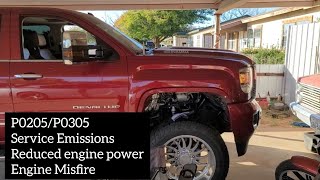
- YouTube user C Farmer (2018 GMC Denali L5P) — Dead miss, reduced engine power, service emissions system message, codes P0205 and P0305.
❌ Tried (didn't work) Wiggling the wire initially did not clear up the miss.
✅ What actually fixed it The problem was a faulty cylinder 5 injector pigtail connector. The fix was to remove the passenger side inner fender liner, access the injector, cut off the old connector, and splice in a new pigtail. The owner noted that cylinder 5 is one of the easier ones to access. - YouTube user C Farmer (2019 L5P Duramax) — Misfire, codes for cylinder #3.
❌ Tried (didn't work) Initially inspecting the connector which did not show obvious signs of burning.
✅ What actually fixed it Despite the connector looking okay, the owner decided to replace both the #3 fuel injector and the pigtail connector as a precaution. The repair was successful. He notes the two wires on the pigtail are not polarity sensitive.
OEM Part Supersession History
GM 12678239→GM 12698552 / ACDelco 217-3490— This is a common supersession for the L5P fuel injector. The reasons for supersession are not officially published but often involve minor improvements in manufacturing or materials.GM 19368140→ACDelco PT3739— Part number update for the injector pigtail connector kit.
Model Year Variations Within This Range
- 2017-2019 vs 2020+: While the core engine is the same, some minor differences exist between the early L5P (2017-2019) and the later versions (2020+), such as a different turbo actuator plug and a different coolant line to the turbo. However, for the purposes of code P0275, the fuel injectors, connectors, and common causes are identical for the 2017 and 2018 model years.
Helpful Videos

Used OEM Parts in Stock
New Aftermarket Parts Available


The information in this article is provided for general reference and educational purposes only. Vehicle specifications, procedures, and part compatibility can vary by production date, trim level, and region. Always consult your vehicle's factory service manual and verify part numbers before purchasing or performing repairs. Safety-critical components such as airbags, seat belts, and braking systems should be installed by a qualified professional.
- Chevrolet SILVERADO 2500:
- 🎬 Helpful Videos
- 🛍️ Shop This Part
- What's Unique About the 2017-2018 Chevrolet SILVERADO 2500
- Diagnostic Flowchart
- Symptoms You May Notice
- Most Likely Causes
- Rare But Worth Checking
- Diagnosis Steps
- Parts You'll Likely Need
- Related Codes That Often Appear With This One
- Technical Service Bulletins (TSBs) & Recalls
- Platform-Specific Known Issues
- Mechanic-Grade Diagnostic Values
- Scan Tool Commands That Help
- Wiring & Ground Locations
- Real Owner Repair Stories
- OEM Part Supersession History
- Model Year Variations Within This Range
- 🎟️ Get 5% Off