

P0270 on 2009-2014 GMC Acadia: Cylinder 4 Injector Circuit Low Causes and Fixes
On a 2009-2014 GMC Acadia, code P0270 is most often caused by a damaged fuel injector wiring harness, a known issue cited in GM Technical Service Bulletin #PIP4924D. Before replacing the injector, thoroughly inspect the wiring for chafing or breaks, especially near the front corner of the left-hand cylinder head and the drive belt idler pulley bracket. A DIY repair is possible and could cost under $150.
- P0270 on a 2009-2014 Acadia indicates an electrical problem with the cylinder 4 fuel injector, not a spark or coil issue.
- The most probable cause is a damaged wiring harness, a known issue documented by a GM TSB. Check for chafing near the cylinder head and brackets.
- Always inspect the wiring harness for damage before spending money on a new fuel injector.
- Cylinder 4 is on the front bank of the engine, making it significantly easier to access and diagnose than the rear bank.
What's Unique About the 2009-2014 Gmc ACADIA
The GMC Acadia and its platform siblings (Buick Enclave, Chevy Traverse, Saturn Outlook) with the 3.6L V6 are specifically noted for having issues with the fuel injector wiring harness. GM issued a Technical Service Bulletin (PIP4924D) advising technicians to inspect this harness for damage when injector circuit codes like P0270 appear. Common chafing points include the front corner of the left-hand cylinder head, the drive belt idler pulley bracket, and the oil dipstick bracket. Fortunately for this specific code, cylinder 4 is located on the front bank of the engine (Bank 2), making the injector and its wiring much more accessible for diagnosis and repair than the rear cylinders, which require removing the intake manifold.
Diagnostic Flowchart
Tap your situation to follow the diagnostic path that matches what you're seeing on this vehicle.
Symptoms You May Notice
- Check Engine Light is on
- Rough or shaking idle
- Engine hesitation or stumbling during acceleration
- Reduced engine power
- Poor fuel economy
- A noticeable fuel smell from the exhaust
- Replacing the cylinder 4 spark plug or ignition coil. While these can cause a misfire (P0304), they will not cause an injector circuit code like P0270. The code P0270 specifically points to an electrical issue in the fuel injector's circuit.
Most Likely Causes
- Damaged Fuel Injector Wiring Harness or Connector 🔴 High Probability As documented in GM TSB #PIP4924D, the fuel injector wiring harness is a known weak point on this platform. Wires can chafe against engine components like the cylinder head or brackets, or connectors can become corroded or loose, causing a low voltage condition or short to ground. Forum users on acadiaforum.net have shared experiences of finding broken wires in the harness leading to the front bank of injectors, which resolved P0270 and related codes.
How to confirm: Visually inspect the wiring harness leading to the cylinder 4 fuel injector. Look for any signs of chafing, melting, exposed wires, or corrosion on the connector pins. Pay special attention to where the harness passes the corner of the cylinder head and other brackets. Use a multimeter to check for continuity and shorts to ground between the ECM and the injector connector.
Typical fix: Repair the damaged section of wire or replace the connector pigtail. Secure the harness away from sharp edges or hot surfaces using zip ties or protective conduit to prevent future damage.
Est. part cost: $15-$40 - Faulty Cylinder 4 Fuel Injector 🟡 Medium Probability The 3.6L LLT engine uses direct injection (SIDI), and its injectors operate under high pressure. An internal electrical failure (a short or open in the coil) can cause this code.
How to confirm: After confirming the wiring is good, disconnect the injector and measure its resistance with a multimeter. 🎬 Watch: How to test injector resistance and circuit waveforms. Compare the reading to the manufacturer's specification. While the exact spec for the OEM injector (12638530) is not published for consumers, typical high-pressure injectors have a low resistance, often between 1-2 ohms. Some sources cite a higher resistance of 11-14 ohms for other injector types, so comparison with a known-good injector on the same engine is the best method.
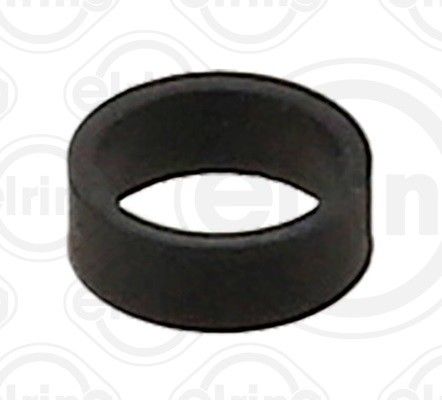
Typical fix: Replace the cylinder 4 fuel injector. Since it's a direct injector, this is more involved than a port injector and requires relieving fuel pressure and replacing the Teflon seal. 🎬 See this guide on active fuel testing and injector removal. It may require special tools.
Est. part cost: $50-$120 - Faulty Engine Control Module (ECM) ⚪ Low Probability
How to confirm: This should only be considered after the wiring and fuel injector have been definitively ruled out. A specialized scan tool can be used to monitor the injector driver output from the ECM. If the ECM is not sending the correct signal despite good wiring and a good injector, it is likely faulty. A professional diagnosis is recommended.
Typical fix: Replace and reprogram the Engine Control Module. This typically requires a professional shop with the correct programming tools.
Est. part cost: $200-$500
Diagnosis Steps
- Read the trouble codes with an OBD-II scanner and confirm P0270 is present. Note any other codes, especially P0304 or other injector codes.
- Locate cylinder 4. On the 3.6L V6, it is the middle cylinder on the front bank (Bank 2), closest to the radiator. 🎬 Watch: Step-by-step walkthrough for replacing Acadia fuel injectors and plugs.
- Perform a thorough visual inspection of the wiring harness and connector for cylinder 4. Look for chafing, melting, corrosion, or loose pins. Pay close attention to where the harness may rub against the cylinder head, dipstick tube, and accessory brackets.
- If the visual inspection is inconclusive, disconnect the injector and use a "noid light" to test for a signal from the ECM while the engine is cranked. A flashing light indicates the ECM and wiring are likely sending a pulse.
- With the injector disconnected and the engine off, use a multimeter to measure the resistance across the two terminals of the fuel injector. Compare the reading to a known-good injector on the same engine. A significant deviation, open circuit, or short indicates a bad injector.
- If the injector tests good but the noid light test failed, check the wiring for continuity from the ECM connector to the injector connector. Repair any open or shorted wires. One owner on a forum found the issue was a poor connection at the fuse box, which supplied power to the entire bank of injectors.
- If the wiring and injector are confirmed to be good, the fault may lie with the ECM's injector driver circuit, though this is uncommon.
Parts You'll Likely Need
- Fuel Injector
(OEM #12638530)— If the injector's internal coil has failed (shorted or open), it must be replaced. This is the second most likely cause after wiring issues. This part number may be superseded by 12669384.
Trusted brands: ACDelco, Bosch, Hitachi
OEM price range: $80-$120
Aftermarket price range: $50-$90 - Fuel Injector Connector Pigtail
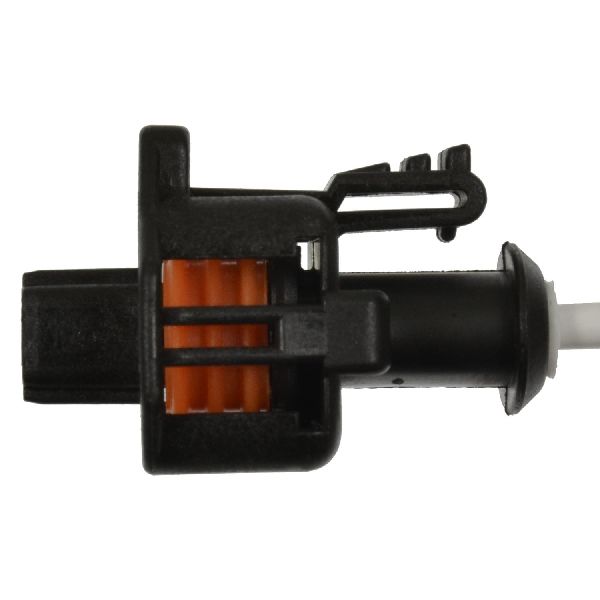
(OEM #PT2160 (ACDelco))— If the connector or the wires immediately leading to it are damaged or corroded, replacing the pigtail is the most effective repair. This is a common failure point due to engine vibration and heat.
Trusted brands: Dorman (e.g., 645-595), ACDelco, Standard Motor Products (e.g., HP3945)
OEM price range: $25-$40
Aftermarket price range: $15-$25
Related Codes That Often Appear With This One
- P0304 — P0304 means "Cylinder 4 Misfire Detected." P0270 is the cause (the injector circuit is failing), and P0304 is the effect (the cylinder is misfiring as a result).
- P0261, P0264, P0267, P0273, P0276 — These are injector circuit low codes for other cylinders. If they appear with P0270, it strongly points to a widespread issue with the main fuel injector wiring harness, as described in TSB #PIP4924D.
Technical Service Bulletins (TSBs) & Recalls
- PIP4924D: Addresses multiple diagnostic trouble codes for the fuel injector circuits (P0261, P0264, P0267, P0270, etc.), advising technicians to inspect the fuel injector wiring harness for chafing and shorts.
Platform-Specific Known Issues
- GM Technical Service Bulletin #PIP4924D explicitly calls out a range of fuel injector codes, including P0270, on these vehicles. The bulletin directs technicians to inspect the fuel injector wiring harness for damage, confirming this is a recognized pattern failure. Specific inspection points are the front corner of the left-hand cylinder head, the drive belt idler pulley bracket, and the oil dipstick bracket.
- Owner Experience: Intermittent Misfire Resolved by Reflashing PCM: In a complex case on the ScannerDanner forum involving a 2011 Acadia with persistent misfires on cylinders 4 and 6 after replacing injectors and checking wiring, the ultimate solution was reflashing the PCM with the latest calibration. This should be considered a last resort after all physical components and wiring have been verified.
Mechanic-Grade Diagnostic Values
- Fuel Injector Coil Resistance — expected: 11-14 ohms (for 2009-2011 LLT engines) or 1.5-2.5 ohms. There is conflicting data; the most reliable test is to compare with a known-good injector on the same vehicle.. Failure: A reading near zero ohms (short), infinite/OL (open), or significantly outside the expected range for the specific part.
- High-Pressure Fuel Rail Pressure (Scan Tool, Idle) — expected: 1.9-5.0 MPa (276-725 PSI).. Failure: Pressure that does not meet the desired pressure value commanded by the ECM, or is erratic.
- Low-Pressure Fuel System Pressure (Scan Tool or Gauge) — expected: 320-580 kPa (46-84 PSI) with pump running.. Failure: Pressure below specification, which can starve the high-pressure pump.
- Injector Pressure Drop Variance (Injector Balance Test) — expected: An individual injector's pressure drop should not vary from the average of the other injectors by more than 20%.. Failure: A pressure drop value for one injector that is significantly higher or lower than the others, indicating a flow issue.
Scan Tool Commands That Help
- GDS2 (GM) or equivalent professional scan tool: Fuel Injector Balance Test — This is a crucial functional test to perform after verifying the electrical circuit is intact. It commands each injector to fire for a specific duration and measures the resulting drop in fuel rail pressure. It can identify a mechanically sticking or clogged injector that is not showing an electrical fault.
Wiring & Ground Locations
- G112 — Rear of the engine, mounted to the rear of the cylinder head.. This is a primary engine ground. A poor connection here can cause unstable sensor readings and intermittent electrical faults across multiple systems, including the fuel injectors.
- ECM (Engine Control Module) — Left side of the engine compartment.. This is the source of the control signal for the injector. Knowing its location is essential for testing continuity on the injector circuit wires back to their source.
- Underhood Fuse Block Ground Stud — The main ground lug near the underhood fuse block used for jump-starting.. One owner discovered that the threads on this stud were painted from the factory, leading to an intermittent ground connection for the entire vehicle. Cleaning the paint off to ensure a solid metal-to-metal contact can resolve difficult-to-trace electrical issues.
Real Owner Repair Stories
- Reddit user in r/MechanicAdvice (2009 Acadia 3.6L) — P0201 (Cylinder 1 Injector Circuit) and a corresponding misfire.
❌ Tried (didn't work) Checked for injector pulse with a noid light and found none on the affected cylinder, but pulse was present on other cylinders on the same bank., Tested wiring continuity from the injector connector to the ECM connector and confirmed the wires were good (no opens or shorts).
✅ What actually fixed it The problem was diagnosed as a failed injector driver within the Engine Control Module (ECM). Replacing the ECM would be the required fix. - Reddit user in r/MechanicAdvice (2009 GMC Acadia) — Crank-no-start, randomly died while running. Code U0100 (Lost Communication with ECM).
❌ Tried (didn't work) Initial diagnosis by a mechanic incorrectly blamed a stripped fuse box.
✅ What actually fixed it The owner found the 'ECM1' fuse was blown. Replacing it allowed the engine to crank, but the fuse would blow again after a few seconds. This indicated a dead short to ground on a circuit powered by that fuse, which is responsible for powering the ECM and its outputs, including the fuel injector circuits. The next step was to trace the wires from that fuse to find the short.
OEM Part Supersession History
12638530→12669384— Standard part revision by the manufacturer.
Heads up: While the OEM parts are interchangeable, some aftermarket suppliers warn against mixing new aftermarket injectors with remaining original OEM injectors, as differences in flow rate and atomization could cause subtle performance imbalances.
Model Year Variations Within This Range
- 2009-2014: While other GM 3.6L platforms switched to the LFX engine around 2012, the GMC Acadia continued to use the LLT V6 engine through the 2016 model year. This is important as some diagnostic information (like injector resistance) may be incorrectly cited for the LFX engine when looking at generic 2012+ GM data.
Helpful Videos
Used OEM Parts in Stock
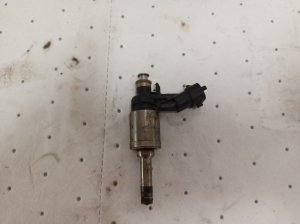
New Aftermarket Parts Available



The information in this article is provided for general reference and educational purposes only. Vehicle specifications, procedures, and part compatibility can vary by production date, trim level, and region. Always consult your vehicle's factory service manual and verify part numbers before purchasing or performing repairs. Safety-critical components such as airbags, seat belts, and braking systems should be installed by a qualified professional.
- Gmc ACADIA:
- 🎬 Helpful Videos
- 🛍️ Shop This Part
- What's Unique About the 2009-2014 Gmc ACADIA
- Diagnostic Flowchart
- Symptoms You May Notice
- Most Likely Causes
- Diagnosis Steps
- Parts You'll Likely Need
- Related Codes That Often Appear With This One
- Technical Service Bulletins (TSBs) & Recalls
- Platform-Specific Known Issues
- Mechanic-Grade Diagnostic Values
- Scan Tool Commands That Help
- Wiring & Ground Locations
- Real Owner Repair Stories
- OEM Part Supersession History
- Model Year Variations Within This Range
- 🎟️ Get 5% Off