

P0244 on 2017-2021 Alfa Romeo Giulia: Wastegate Solenoid Causes and Fixes
This code indicates a performance issue with the turbo wastegate solenoid. On the 2.0T Giulia, this is often caused by a worn wastegate actuator rod, leading to incorrect boost levels. An upgraded aftermarket rod is a common fix, costing around $150. If the code appears immediately after a turbo replacement, the PCM itself likely needs to be replaced per a manufacturer TSB.
- P0244 on a 2.0T Giulia most often points to a mechanical issue with the wastegate actuator rod, not an electronic failure.
- Before considering an expensive turbo replacement, inspect the wastegate actuator rod for excessive play. An upgraded aftermarket rod costs around $150 and is a common, permanent fix.
- Symptoms typically include a check engine light, reduced power, and sometimes a distinct rattle from the engine bay.
- If you replace the entire turbocharger assembly and still get code P0244, you may need to replace the PCM per Alfa Romeo's TSB S2018000012.
What's Unique About the 2017-2021 Alfa Romeo GIULIA

On the 2.0L Giulia platform, the P0244 code is frequently linked to a specific mechanical failure point: the wastegate actuator rod. The original rod is made of plated mild steel, and the pivot points can wear out prematurely, causing excessive play. This looseness, which creates a visible 'ovaling' of the pivot holes, prevents the wastegate from being controlled accurately. This leads the PCM to believe there is a performance fault with the control solenoid, even if the electronic parts are working correctly. This issue is so common that several aftermarket companies have engineered more durable titanium replacement rods with integrated ball bearings to provide a permanent, friction-free solution.
🎬 See how this $200 fix saves you from a $5,000 repair.Diagnostic Flowchart

Tap your situation to follow the diagnostic path that matches what you're seeing on this vehicle.
Symptoms You May Notice

- Check Engine Light is on
- Reduced engine power or sluggish acceleration
- Engine goes into "limp mode"
- Erratic or inconsistent turbo boost
- Audible rattling or ticking from the engine bay, especially at idle or low RPMs.
- High-pitched squeal from the engine bay under acceleration, especially around 3,000 RPM.
- Replacing the entire turbocharger when only the actuator rod is worn. Alfa Romeo does not sell the rod separately, leading dealers to recommend a full turbo replacement at a very high cost, sometimes quoted as high as $5,000.
Most Likely Causes

- Worn Wastegate Actuator Rod 🔴 High Probability The original equipment rod's pivot points are made of soft, plated mild steel that wears out from metal-on-metal friction, creating excessive play. The holes become elongated or 'ovaled,' which prevents precise wastegate movement.
How to confirm: With the engine off and cool, manually wiggle the wastegate actuator arm. If there is significant up-and-down play or a rattling sound, the rod is worn. DIY videos clearly show this play and the visible wear on the removed part.
Typical fix: Replace the original rod with an upgraded aftermarket version made of titanium with ball-bearing ends. This is a common and permanent fix that restores proper wastegate function.
Est. part cost: $150-$200 - Faulty Wastegate Solenoid / Actuator 🟡 Medium Probability The electronic solenoid or the vacuum diaphragm within the actuator can fail. This is a known issue with remanufactured turbochargers, which may come with a faulty actuator that needs to be swapped with the original known-good part.
How to confirm: Use a diagnostic scan tool to command the solenoid to activate. Test the actuator with a vacuum pump to see if it holds vacuum and moves the wastegate arm smoothly. Check for correct voltage and resistance at the solenoid connector per the service manual.
Typical fix: Replace the wastegate solenoid/actuator assembly. This part is often integrated with the turbocharger, but can sometimes be sourced separately aftermarket.
Est. part cost: $95-$250 - Vacuum Leak ⚪ Low Probability
How to confirm: Visually inspect all vacuum lines connected to the turbocharger and wastegate solenoid for cracks, brittleness, or loose connections. A smoke test can also be performed to find hard-to-see leaks.
Typical fix: Replace the damaged vacuum line(s).
Est. part cost: $10-$50
Rare But Worth Checking
- Faulty Powertrain Control Module (PCM): This is a very rare but critical issue documented in TSB S2018000012. If code P0244 appears immediately after replacing the turbocharger assembly, the PCM itself must be replaced. Older PCMs may have hardware limitations that are incompatible with the newer turbo/actuator components, and simple reprogramming is not sufficient.
- Binding Wastegate Valve: Carbon buildup inside the turbo housing can cause the wastegate valve itself to stick, preventing the actuator from moving it properly. This usually requires turbocharger replacement or professional cleaning.
- Defective Vacuum Pump: A failing vacuum pump can cause a variety of issues, including improper wastegate control. In a documented case on a platform-mate Alfa Romeo Stelvio, a defective vacuum pump that was drawing in air was the root cause of a persistent P0244 code.
Diagnosis Steps
- Read the fault codes with an OBD-II scanner.
- Inspect the engine bay for any obvious issues like disconnected vacuum lines or loose wiring near the turbocharger.
- With the engine cool, physically check the wastegate actuator rod for excessive up-and-down play or looseness. This is the most common point of failure.
- If the rod is tight, inspect the vacuum lines running to the wastegate actuator for any cracks or leaks. A smoke test may be necessary.
- Test the vacuum pump for proper operation, as a failure here can cause boost control issues.
- Use a vacuum pump to test the diaphragm in the wastegate actuator to ensure it holds vacuum.
- Check the wiring and connector at the wastegate control solenoid for damage or corrosion. Test for power, ground, and continuity back to the PCM.
- If all mechanical and vacuum systems are intact, use an advanced scan tool to monitor requested vs. actual wastegate position and to command the solenoid on and off to verify its electronic function.
- CRITICAL: If a new turbocharger or actuator has been installed and the code P0244 appears immediately, consult TSB S2018000012. PCM replacement is likely required.
Parts You'll Likely Need
- Upgraded Wastegate Actuator Rod — This is the most frequent failure point on the 2.0T engine causing P0244 and/or P0299. The OEM part is not sold separately from the turbo, so an aftermarket part made of superior materials (titanium with ball bearings) is the go-to solution.
Trusted brands: Centerline, Archertuned
OEM price range: N/A
Aftermarket price range: $150-$200 - Turbocharger Wastegate Actuator — If the actuator's internal diaphragm fails and can no longer hold a vacuum, or the electronic solenoid fails, the entire unit must be replaced. This can also be a fault point on remanufactured turbos.
Trusted brands: Mopar (OEM, typically part of turbo assembly), Various Aftermarket
OEM price range: $200-$300 (if found separately)
Aftermarket price range: $95-$200
Related Codes That Often Appear With This One
- P0299 — P0299 (Turbocharger Underboost) is very common with a worn wastegate rod. The excessive play in the rod prevents the wastegate from closing properly, leading to a loss of boost pressure. Many owners report fixing P0299 by replacing the rod.
Technical Service Bulletins (TSBs) & Recalls
- S2018000012: Explicitly states that if P0244 sets after turbocharger replacement, the PCM must be replaced, not just reprogrammed. This TSB also applies to other Stellantis vehicles with the 2.0L engine, like the Jeep Wrangler.
- 18-027-20: Lists P0244 as one of several possible fault codes that may be addressed by a PCM software update, though this is separate from the hardware replacement issue in the other TSB.
Platform-Specific Known Issues
- A known issue, documented in TSB S2018000012, states that if code P0244 appears after replacing the turbocharger assembly, the Powertrain Control Module (PCM) must also be replaced. Reprogramming the old PCM is not a solution, as it may lack the hardware capabilities to support the newer turbo components.
Mechanic-Grade Diagnostic Values
- Wastegate Solenoid Resistance — expected: 12-18 Ohms. Failure: A reading outside this range (open or shorted) indicates a faulty solenoid coil.
- Wastegate Actuator Bench Calibration (Voltage) — expected: ~3.5 Volts. Failure: Inability to adjust the actuator rod to achieve the target voltage when the wastegate flapper is held closed indicates a faulty position sensor within the actuator.
Scan Tool Commands That Help
- MultiECUScan / AlfaOBD / wiTECH: Proxy Alignment Procedure — This is a mandatory procedure after replacing the PCM or other major electronic modules. It synchronizes all ECUs on the CAN bus to ensure they communicate correctly. Failure to perform this will result in a flashing odometer and multiple system faults.
- Chrysler wiTECH (Dealer Tool): BCM Secret Key Transfer to ECM — This security function is required when a new PCM (ECM) is installed. It transfers a cryptographic key from the Body Control Module to the new PCM, authorizing it to work with the vehicle's security system.
- MultiECUScan: Actuator Test (e.g., Wastegate Solenoid) — Found in the 'Actuators' tab for a specific module, this allows a technician to manually command the solenoid to cycle on and off. This directly tests the solenoid's electrical function and can help isolate a faulty component from a wiring or PCM driver issue.
Wiring & Ground Locations
- Turbo Heat Shield Bolts — On the 2.0T engine, a heat shield covers the turbocharger and wastegate actuator. It is secured by four 10mm bolts that must be removed to access the actuator rod.. Access to the most common failure point (the actuator rod) and the actuator itself is impossible without removing this shield.
- Main Ground Stud — A primary grounding stud is located on the passenger side shock tower in the engine bay.. While not exclusively for the wastegate circuit, this is a known grounding point for multiple engine bay components. A poor ground here could cause a variety of difficult-to-diagnose electrical issues, including sensor range/performance codes.
- Wastegate Actuator Connector — The electrical connector is located directly on the electronic wastegate actuator, which is attached to the side of the turbocharger assembly, under the heat shield.. This is the primary connection point for testing voltage, resistance, and signal from the actuator's internal position sensor.
Real Owner Repair Stories
- Autel Consultancy YouTube Channel (2017 Alfa Romeo Giulia) — Persistent P0244 code immediately after the turbocharger and wastegate assembly were replaced.
❌ Tried (didn't work) Reprogramming the original PCM.
✅ What actually fixed it The Powertrain Control Module (PCM) was replaced, as directed by TSB S2018000012. The fix required using Chrysler's wiTECH software to flash the new PCM, perform a Proxy Alignment, and execute a 'BCM Secret Key Transfer' to authorize the new module. - RonDiyMods YouTube Channel (2018 Alfa Romeo Stelvio (platform-mate with same 2.0T engine)) — Preventative maintenance due to known issue, but symptoms for others include P0299 (underboost) and audible rattling from a loose wastegate actuator arm.
✅ What actually fixed it Replaced the OEM wastegate actuator rod with an upgraded aftermarket version. The technician dropped the original rear e-clip and had to source a replacement from a Dorman 13325 assortment pack. The aftermarket arm's hole was slightly too small and had to be drilled out slightly to fit onto the wastegate post. The final result was a tight, rattle-free connection.
When the Usual Fixes Don't Work
- In a case documented on Reddit, a user with a 2017 Giulia Veloce experienced code P0244 and a high-pitched squeal after installing a remanufactured turbo. Swapping the wastegate solenoid from the original, known-good turbo onto the new unit fixed the squeal but the P0244 code returned shortly after. This scenario strongly supports the TSB and case studies which state that when P0244 appears after a turbo replacement, the fault often lies with the PCM's incompatibility, not the new hardware itself.
Helpful Videos

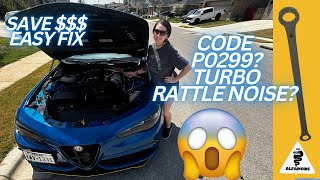
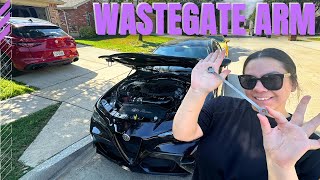
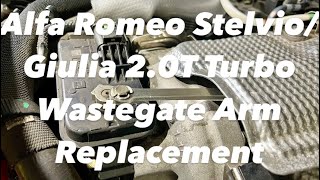
We Have This Part in Stock


The information in this article is provided for general reference and educational purposes only. Vehicle specifications, procedures, and part compatibility can vary by production date, trim level, and region. Always consult your vehicle's factory service manual and verify part numbers before purchasing or performing repairs. Safety-critical components such as airbags, seat belts, and braking systems should be installed by a qualified professional.
- Alfa Romeo GIULIA:
- 🎬 Helpful Videos
- 🛍️ Shop This Part
- What's Unique About the 2017-2021 Alfa Romeo GIULIA
- Diagnostic Flowchart
- Symptoms You May Notice
- Most Likely Causes
- Rare But Worth Checking
- Diagnosis Steps
- Parts You'll Likely Need
- Related Codes That Often Appear With This One
- Technical Service Bulletins (TSBs) & Recalls
- Platform-Specific Known Issues
- Mechanic-Grade Diagnostic Values
- Scan Tool Commands That Help
- Wiring & Ground Locations
- Real Owner Repair Stories
- When the Usual Fixes Don't Work
- 🎟️ Get 5% Off