

P0234 on 2009-2012 Audi A5 Cabriolet: Turbo Overboost Causes and Fixes
On the 2.0T TFSI CAEB engine, code P0234 is most often caused by a faulty N75 boost control solenoid or a failing/torn diverter valve. Replacing the N75 valve (Part No. 06F906283F) is a common, relatively inexpensive DIY fix that often resolves the issue. A stuck wastegate actuator is another significant possibility.
- P0234 on your Audi A5 means the turbo is creating too much pressure, and the car is protecting itself by cutting power.
- Before assuming the expensive turbo has failed, inspect the two most common culprits: the N75 boost control solenoid and the diverter valve.
- A faulty N75 valve is the most probable cause and is a relatively inexpensive and straightforward part to replace for a DIYer.
- Check all vacuum lines connected to the turbo system for cracks or leaks, as this can also cause a loss of boost control.
- If the N75 and diverter valve are good, the next step is to check for a physically sticking wastegate actuator arm on the turbo itself.
What's Unique About the 2009-2012 Audi A5 CABRIOLET
The 2.0T TFSI engine (engine code CAEB) used in this generation of Audi A5 is well-known for issues within its boost control system. While the turbo itself can fail, the more frequent culprits for a P0234 code are the supporting components like the N75 boost control solenoid and the diverter valve, which are known failure points on this platform. A Technical Service Bulletin (TSB 2027082/5) was issued specifically for P0234 on this engine, noting it can be set inadvertently by the software, but also acknowledging it can be caused by a legitimate charge pressure control issue. 🎬 Watch this step-by-step guide on repairing VAG overboost faults. This highlights the sensitivity of the boost control system.
Diagnostic Flowchart
Tap your situation to follow the diagnostic path that matches what you're seeing on this vehicle.
Symptoms You May Notice
- Check Engine Light is on
- Significant loss of engine power as the car enters 'limp mode'
- Erratic or surging acceleration
- Audible hissing or whistling sounds from the engine bay, especially when letting off the throttle if the diverter valve is torn.
- Rough idle
- Car feels fine under normal driving but goes into limp mode under hard acceleration (WOT).
- Replacing the entire turbocharger when only a less expensive component like the N75 valve, diverter valve, or a vacuum hose has failed.
Most Likely Causes
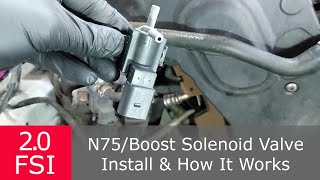
- Faulty N75 Wastegate Control Valve (Boost Solenoid) 🔴 High Probability This Pierburg-made solenoid is a very common failure point on 2.0T TFSI engines. It's an electronic component that can fail internally or get stuck, preventing it from correctly regulating the vacuum sent to the wastegate actuator, causing the wastegate to remain closed.
How to confirm: Test the valve with a multimeter for correct resistance (typically 25-35 ohms when cool). A more definitive test involves using a scan tool like VCDS to perform an output test on the N75 valve while observing its function or using a hand-held vacuum pump to check if it holds and releases vacuum when 12V is applied.
Typical fix: Replace the N75 valve. It is mounted on the front of the turbocharger assembly and is accessible for a DIY replacement, though space is tight. A forum user on AudiWorld confirmed replacing the N75 valve fixed their P0234 code.
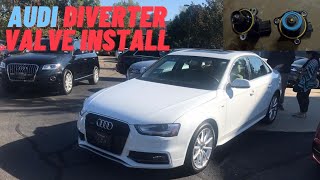
Est. part cost: $40-$80 - Failed Diverter Valve (DV) 🟡 Medium Probability The original diverter valves on early 2.0T engines used a rubber diaphragm that is prone to tearing with heat and age. A tear creates a boost leak that can confuse the boost control system. While more commonly associated with underboost (P0299), it can also contribute to overboost codes.
How to confirm: Remove the diverter valve from the turbocharger housing (usually held by three 5mm Allen bolts) and visually inspect the diaphragm for tears or damage. If the part number is not the latest revision (e.g., ending in 'D' or later), it's suspect.
Typical fix: Replace the diverter valve with the updated piston-style version (OEM part number 06H145710D). Many owners opt for aftermarket upgrades like the GFB DV+, which replaces the failure-prone plastic valve parts with metal components for improved reliability and throttle response.
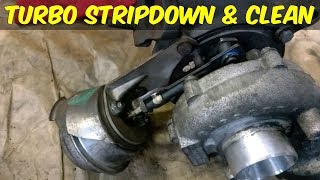
Est. part cost: $60-$150 - Sticking or Seized Turbocharger Wastegate Actuator 🟡 Medium Probability The mechanical arm that opens the wastegate can become stuck due to carbon buildup or wear. If it's stuck in the closed position, it cannot bleed off excess exhaust pressure, causing the turbo to over-spin and create excessive boost.
How to confirm: With the engine off and cool, attempt to move the wastegate actuator arm by hand. It should move freely through its range of motion. A more effective method is to apply vacuum with a hand-held pump to the actuator's vacuum port; the rod should retract smoothly and hold vacuum. If it is seized, sticky, or doesn't hold vacuum, it is faulty.
Typical fix: In some cases, the actuator can be freed up by cleaning. More often, the wastegate actuator requires replacement. On the IHI turbo used in the CAEB engine, the actuator is often considered part of the turbocharger assembly, but some specialists may be able to replace just the actuator.
Est. part cost: $100-$300 for actuator, $800-$2000+ for turbo assembly - Leaking or Disconnected Vacuum Hoses ⚪ Low Probability The rubber vacuum lines that control the N75 valve and wastegate actuator can become brittle, cracked, or disconnected over time, leading to a loss of control over the wastegate. If the hose to the wastegate actuator is disconnected or broken, the wastegate will not open, causing overboost.
How to confirm: Visually inspect all vacuum lines connected to the N75 valve, wastegate, and intake manifold for cracks, brittleness, or loose connections. A smoke test can also be used to find hidden leaks.
Typical fix: Replace the damaged sections of vacuum hose.
Est. part cost: $10-$30
Rare But Worth Checking
- Faulty Boost Pressure Sensor (MAP Sensor): A faulty MAP sensor (VW calls it G31) can send incorrect (artificially high) boost pressure readings to the ECM, causing it to believe the system is overboosting when it is not. This is less common than control valve failures but worth checking if other components are confirmed to be working.
- Clogged Catalytic Converter: A severe exhaust restriction can cause pressure to back up, affecting turbocharger operation and potentially leading to an overboost condition. This would typically be accompanied by other symptoms like a severe loss of power, a rotten egg smell, and possibly other fault codes.
- Incorrectly Adjusted Wastegate Rod: If the turbocharger has been replaced or repaired, the wastegate actuator rod may have been adjusted incorrectly. An improperly shortened rod can prevent the wastegate from opening fully, leading to overboost.
Diagnosis Steps
- Read the fault codes with an OBD-II scanner (like VCDS/VAG-COM) and note any other codes present.
- Log requested vs. actual boost pressure using a capable scan tool. In VCDS, this can be done in Measuring Block 115. A sustained spike in actual boost far above the requested value under load confirms a real overboost condition.
- Visually inspect all vacuum lines connected to the turbocharger system, especially those going to the N75 valve and wastegate actuator, for any signs of cracking, disconnection, or wear.
- Inspect the diverter valve (DV). Remove it from the turbocharger (three 5mm Allen bolts) and check its diaphragm for tears. If it's the original diaphragm style, consider replacing it preventatively.
- Test the N75 boost control solenoid. Check its electrical resistance and use a scan tool or vacuum pump to verify it is actuating correctly.
- Check the movement of the turbocharger wastegate actuator arm. It should move smoothly without binding. Use a hand-held vacuum pump to apply vacuum to the actuator and confirm the arm retracts fully and holds vacuum.
- If all control components and lines are functioning correctly, investigate the boost pressure sensor (MAP) for correct readings and check for exhaust restrictions like a clogged catalytic converter.
Parts You'll Likely Need
- Turbocharger Boost Solenoid (N75 Valve)
(OEM #06F906283F)— This is the most common failure point for boost control issues on the 2.0T engine, directly causing the P0234 code by failing to regulate the wastegate. It is a known high-failure item.
Trusted brands: Pierburg (OEM), Bosch, Hitachi
OEM price range: $60-$100
Aftermarket price range: $40-$80 - Turbocharger Diverter Valve (DV)
(OEM #06H145710D)— The original diaphragm-style valve is prone to tearing, which can cause various boost-related fault codes, including P0234. Replacing it with the updated piston design is a common and preventative repair.
Trusted brands: Pierburg (OEM), GFB (Go Fast Bits) DV+ T9351
OEM price range: $80-$120
Aftermarket price range: $60-$150
Related Codes That Often Appear With This One
- P0299 — This code for 'Turbocharger Underboost' can sometimes appear alongside or intermittently with P0234 if the wastegate or its control system is behaving erratically, sometimes sticking open (underboost) and sometimes sticking closed (overboost).
- P2015 — Intake Manifold Runner Position Sensor/Switch Circuit Range/Performance. An AudiWorld forum user reported P2015 appearing with P0234. While not directly causal, the control solenoids for both systems (N316 for the runner flaps and N75 for the wastegate) share a common 12v power supply, suggesting a potential wiring issue in rare cases.
Technical Service Bulletins (TSBs) & Recalls
- 01133020270825 (also cited as 2027082/5): Mentions DTC P0234 (Turbo/Super Charger Overboost Condition) can be stored alone and may be caused by a software issue, but also by legitimate hardware faults.
Platform-Specific Known Issues
- The NHTSA-cited Technical Service Bulletin #2027082/5 confirms that DTC P0234 can be stored without any perceptible running issues, pointing towards potential software sensitivity in the Engine Control Module, J623.
Mechanic-Grade Diagnostic Values
- N75 Wastegate Control Valve Resistance — expected: 14-20 Ohms (for some variants, check part spec), or 25-35 Ohms as a general VAG guideline.. Failure: A reading significantly outside the expected range or an open/short circuit indicates a faulty solenoid coil.
- MAP/Boost Pressure Sensor (G31) Voltage at KOEO (Key On, Engine Off) — expected: ~0.5V at atmospheric pressure.. Failure: Voltage significantly different from ~0.5V, or a reading that doesn't change with pressure, points to a faulty sensor or wiring issue.
- MAP/Boost Pressure Sensor (G31) Voltage under Boost — expected: 2.0V - 4.7V. Voltage should increase proportionally with boost pressure.. Failure: Voltage that is stuck, erratic, or does not correspond to the actual boost level being produced.
- VCDS Measuring Block 115 - Requested vs. Actual Boost — expected: Actual boost should closely track requested boost, typically within 100-200 mbar under load.. Failure: A large, sustained deviation where 'Actual' significantly exceeds 'Requested' by more than ~200 mbar (2.9 psi) will trigger the P0234 fault.
Scan Tool Commands That Help
- VCDS (VAG-COM): [01-Engine] -> [Output Tests - 03] -> Solenoid Valve for Boost Pressure Control (N75) — This test will cycle the N75 valve on and off, allowing you to listen for an audible click from the solenoid. This confirms the ECU can command the valve and that the solenoid's coil is activating. It helps distinguish a failed valve from a wiring problem.
- VCDS (VAG-COM): [01-Engine] -> [Basic Settings - 04] -> Charge Pressure Control — This function cycles the wastegate actuator through its full range of motion. It's used to verify the actuator arm is not sticking or seized and can help in setting the wastegate rod length after a turbo or actuator replacement.
Wiring & Ground Locations
- N75 Valve Connector — On the turbocharger assembly, typically mounted to a bracket.. This is the electrical connection for the valve that directly controls boost. On some VAG models, Pin 3 is the 12V supply (often a blue/black wire) and Pin 5 is the signal wire going to the ECU (often lilac/white). Verifying 12V with ignition on and checking continuity of the signal wire to the ECU are critical steps in diagnosing a non-responsive valve.
- MAP Sensor (G31) Connector — On the charge pipe leading to the throttle body.. This sensor provides the 'actual' boost reading. A bad connection here can cause the ECU to receive incorrect data, leading to the P0234 code. On a typical 4-pin sensor: Pin 1 is ground, Pin 3 is the 5V reference from the ECU, and Pin 4 is the pressure signal wire. Checking for 5V reference and good ground is essential.
Real Owner Repair Stories
- Ross-Tech Forums user 'sweenrace' (2012 Audi A4 Quattro (B8 platform, same CAEB engine family)) — EPC light and limp mode on freeway under hard acceleration, P0234 code stored.
❌ Tried (didn't work) Replaced the N75 valve (initially seemed to work, but the code returned).
✅ What actually fixed it The user logged requested vs. actual boost and found a significant overboost condition. The discussion pointed towards a mechanical wastegate issue, where the turbo was producing ~1750 mbar of pressure when only ~1400 mbar was requested, indicating the wastegate was not bleeding off pressure correctly. The implied fix is a mechanical adjustment or repair of the wastegate/actuator system.
OEM Part Supersession History
06F906283D→06F906283F— Revision and update by the manufacturer (Pierburg) for improved reliability or slight design change.
Heads up: The parts are interchangeable. Using the latest 'F' revision is recommended for any replacement.
Helpful Videos
We Have This Part in Stock



The information in this article is provided for general reference and educational purposes only. Vehicle specifications, procedures, and part compatibility can vary by production date, trim level, and region. Always consult your vehicle's factory service manual and verify part numbers before purchasing or performing repairs. Safety-critical components such as airbags, seat belts, and braking systems should be installed by a qualified professional.
- Audi A5 CABRIOLET:
- 🎬 Helpful Videos
- 🛍️ Shop This Part
- What's Unique About the 2009-2012 Audi A5 CABRIOLET
- Diagnostic Flowchart
- Symptoms You May Notice
- Most Likely Causes
- Rare But Worth Checking
- Diagnosis Steps
- Parts You'll Likely Need
- Related Codes That Often Appear With This One
- Technical Service Bulletins (TSBs) & Recalls
- Platform-Specific Known Issues
- Mechanic-Grade Diagnostic Values
- Scan Tool Commands That Help
- Wiring & Ground Locations
- Real Owner Repair Stories
- OEM Part Supersession History
- 🎟️ Get 5% Off