

OBD-II Code P0217: Engine Overheat Condition
What P0217 means, why it triggers, and how to fix it
- P0217 indicates critical engine overheating, requiring you to pull over immediately to prevent a $3,000+ engine replacement.
- Over 70% of P0217 codes stem from low coolant levels or a stuck thermostat, which cost under $350 to fix.
- Begin diagnosis by visually checking the coolant reservoir level and confirming the radiator fans engage when the A/C is turned on.
- Ford 2.7L EcoBoost engines (2018-2024) frequently trigger a false P0217 code due to a faulty ECT sensor, requiring a $450 TSB repair rather than a mechanical fix.
What Does P0217 Mean?

The P0217 code indicates the Powertrain Control Module (PCM) detects engine coolant temperature exceeding the safe limit, typically 220-230°F (104-110°C). Your engine is overheating. This critical warning requires immediate attention to prevent catastrophic engine failure.
Technical definition: The official SAE/ISO definition for P0217 is "Engine Coolant Over Temperature Condition." This code sets when the PCM detects the engine coolant temperature exceeds a calibrated maximum value for a specific duration. Modern vehicles enter a 'limp mode' or 'engine protection mode,' reducing power to prevent catastrophic damage.
Can I Drive With P0217?
No — Do Not Drive. Pull over and turn off the engine immediately. Driving with an active P0217 code risks severe, permanent engine damage, such as warped cylinder heads or complete engine seizure. Continuing to drive turns a moderate repair into a $4,000+ engine replacement.
Common Causes

- Low Engine Coolant / Coolant Leak (Very Common) — Leaks in hoses, the radiator, water pump, thermostat housing, or heater core prevent the system from maintaining pressure and cooling the engine.
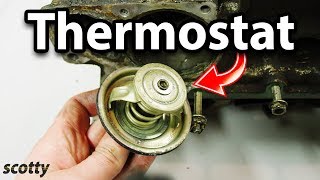
- Faulty Thermostat (Common) — A thermostat stuck closed blocks coolant from flowing to the radiator. The engine temperature rises quickly while the lower radiator hose remains cool.
- Radiator Fan Malfunction (Common) — The cooling fan pulls air through the radiator at low speeds. If the fan, relay, or control module fails, the coolant overheats in stop-and-go traffic.
- Faulty Engine Coolant Temperature (ECT) Sensor or Wiring (Common) — A malfunctioning ECT sensor or damaged wiring sends false high-temperature signals to the PCM, triggering a P0217 code even if the engine operates at normal temperatures.
- Failing Water Pump (Less Common) — A failing water pump with a worn impeller, a weep hole leak, or a broken drive belt fails to circulate enough coolant, leading to a rapid overheat.
- Clogged or Restricted Radiator (Less Common) — Internal corrosion or external debris (like leaves or dirt) blocks the radiator tubes, reducing its ability to transfer heat from the coolant to the air.
- Faulty Radiator Cap (Rare) — A weak radiator cap fails to hold the specified pressure, allowing coolant to boil at a lower temperature and escape into the overflow reservoir. 🎬 Learn how to replace your thermostat and radiator cap.
- Blown Head Gasket (Rare) — A failed gasket between the cylinder head and engine block allows hot exhaust gases to enter the cooling system, overwhelming it and causing rapid overheating.
- Towing or Heavy Load (Rare) — Exceeding the vehicle's towing capacity or climbing steep grades in hot weather overwhelms a marginally effective cooling system.
Symptoms

- Engine Temperature Gauge in Red — The dashboard temperature gauge climbs into the red zone, or a digital warning light illuminates.
- Steam and Sweet Smell from Under the Hood — Boiling coolant produces steam (resembling white smoke) from the engine bay, accompanied by a distinct sweet, syrupy smell.
- Reduced Engine Power or "Limp Mode" — The vehicle automatically reduces engine power to prevent catastrophic damage.
- Coolant Leak Under Vehicle — Puddles of green, orange, or pink fluid under the vehicle indicate an active coolant leak.
- Loud Boiling or Gurgling Sounds — Loud boiling or gurgling sounds from the engine bay indicate the coolant is turning to steam.
- Air Conditioning Stops Working — The PCM disables the A/C compressor to reduce load on the overheating engine.
Diagnostic Flowchart

Tap your situation to follow the diagnostic path that matches what you're seeing on this code.
Common Fixes & Costs
- Diagnostic Check — Parts: $0, Labor: $150-$200, ~1.5 hr book time (Professional)
- Replacing the Thermostat — Parts: $30-$80, Labor: $150-$350, ~2.5 hr book time (DIY)
- Replacing Engine Coolant Temperature (ECT) Sensor — Parts: $25-$80, Labor: $75-$200, ~1 hr book time (DIY)
- Replacing Radiator Fan Assembly/Motor — Parts: $150-$450, Labor: $150-$400, ~2.5 hr book time (Intermediate)
- Replacing the Water Pump — Parts: $150-$500, Labor: $450-$1000+, ~5.5 hr book time (Professional)
- Replacing the Radiator — Parts: $200-$500, Labor: $400-$900, ~3.5 hr book time (Intermediate)
- Replacing a Blown Head Gasket — Parts: $200-$600, Labor: $1,500-$3,500+, ~15 hr book time (Professional)
Used vs. New Parts: Buying Guide
When a used part is worth it: For major components like a radiator or fan assembly, a used part from a low-mileage vehicle offers significant savings. Never buy used wear items like water pumps or thermostats.
Donor-vehicle mileage cap: roughly under 60000 miles for the part to have meaningful remaining life.
Donor quality checklist:
- Verify the donor vehicle was not scrapped due to engine or cooling system failure.
- For radiators, inspect fins for damage and tanks for cracks or discoloration.
- Match part numbers exactly, as similar-looking parts have different flow rates or sensor ports.
Decision logic:
- If The part is a known wear item like a water pump, thermostat, or ECT sensor → Always buy new. The cost of repeat labor far outweighs the savings on a used part.
- If The part is a radiator or fan assembly and the vehicle is over 100K miles → A quality used part is a reasonable choice if the budget is tight, but expect a shorter lifespan.
- If The part is electronic, like a fan control module → Favor new or a remanufactured unit with a warranty, as internal corrosion on used parts is a risk.
Warranty tradeoff: Used parts typically offer a 30-90 day warranty on the part only. New aftermarket parts carry a 1-year to limited lifetime warranty. New OEM parts offer a 1-2 year warranty.
Worst-case if a used part fails: $500-$1500 if a major used part like a radiator fails, requiring repeat labor and another part.
What Happens If You Wait — Timeline
- 0-10 minutes of overheating: Coolant boils and escapes through the pressure cap. Temp gauge spikes, warning lights activate, and limp mode engages. No permanent damage if the engine is shut off immediately. (MPG impact: 0%% · Added cost: $0)
- 10-20 minutes of continued driving: Significant coolant is lost. The cylinder head temperature exceeds 250°F, increasing the risk of warping the aluminum cylinder head and blowing the head gasket. (MPG impact: 5-15%% · Added cost: $1,500-$3,000 (Head gasket replacement or cylinder head resurfacing))
- 20-30 minutes of continued driving: Most coolant is gone. Piston and cylinder head temperatures exceed 400°F. Aluminum pistons expand and score the steel cylinder walls. Engine oil degrades rapidly. (MPG impact: 15-25%% · Added cost: $3,500-$6,000 (Engine rebuild or used engine replacement))
- 30+ minutes (catastrophic failure): Complete engine seizure. The heat becomes so intense that internal metal parts fuse together. Connecting rods break and puncture the engine block. The engine is a total loss. (MPG impact: 100% (Engine will not run)% · Added cost: $4,000-$10,000+ (Remanufactured or new engine replacement))
Cost of Not Fixing It
- Immediately (minutes to hours): Risk of warped cylinder head, blown head gasket, or coolant hoses bursting from extreme pressure and heat. (Added cost: $1,500-$4,500+)
- Short-Term (days to weeks): Repeated overheating cycles cause piston and cylinder wall scoring, damage to engine bearings, and complete failure of the water pump and thermostat. (Added cost: $2,500-$7,000)
- Long-Term (catastrophic failure): Complete engine seizure, where internal components weld themselves together. This is a total loss of the engine. (Added cost: $4,000-$10,000+)
Diagnosis Steps

- Safely Stop and Let Engine Cool
Pull over to a safe location and shut off the engine immediately. Do NOT open the radiator cap while hot. Allow it to cool for 30-60 minutes to avoid severe burns.
Tools: None (Beginner) - Check Coolant Level and Look for Leaks
Once cool, check the coolant level in the plastic reservoir and radiator. Visually inspect all hoses, the radiator, and the water pump area for leaks, cracks, or wet spots.
Tools: Flashlight (Beginner) - Inspect Radiator Fan Operation
Start the cool engine and turn on the air conditioning to command the fans on. Watch the electric cooling fans behind the radiator. If they fail to spin, the fan motor, relay, or fuse is faulty.
Tools: None (Intermediate) - Check for a Stuck Thermostat
Start the cool engine and carefully feel the upper radiator hose. It starts cool. As the engine reaches operating temperature, the hose suddenly becomes hot. If it remains cool while the engine overheats, the thermostat is stuck closed.
Tools: Mechanic's Gloves (Intermediate) - Analyze Live Data with a Scan Tool
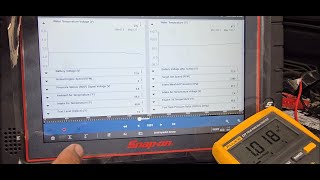
Connect an OBD-II scanner to view live data PIDs. Monitor the 'ECT' (Engine Coolant Temperature) value. A reading that jumps to an extreme value (e.g., 280°F) instantly on a cold start points to a sensor or wiring fault, not a real overheat.
Tools: OBD-II Scan Tool with Live Data (Advanced) - Perform a Cooling System Pressure Test
Attach a hand-pump tester to the radiator or reservoir neck. Pressurize the system to the PSI rating printed on the radiator cap (typically 13-16 PSI). A pressure drop over 20 minutes indicates a hidden leak.
Tools: Cooling System Pressure Tester (Intermediate) - Test Radiator Cap Pressure
Using an adapter from the pressure tester kit, pump the radiator cap to its rated pressure. If it fails to hold pressure, it lowers the coolant's boiling point and causes overheating.
Tools: Cooling System Pressure Tester with cap adapter (Intermediate) - Test ECT Sensor and Wiring with a Multimeter
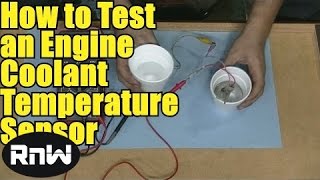
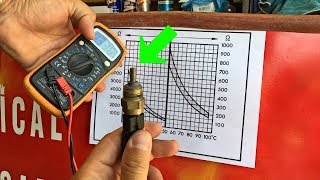
With the engine cold, measure the resistance across the ECT sensor's pins; it reads high (2,000-3,500 Ohms at ~70°F/21°C). As the engine warms, resistance drops smoothly. An erratic reading indicates a bad sensor.
Tools: Multimeter, Back-probe kit (Advanced) - Perform Infrared (IR) Thermometer Test on Radiator
Scan the surface of the fully warmed-up radiator with an IR thermometer. Significant cold spots (a difference of 30°F / 17°C or more) indicate an internal blockage preventing proper coolant flow.
Tools: Infrared Thermometer (Advanced) - Perform a Chemical Block Test
If no external leaks exist, use a chemical block tester. The fluid changes color from blue to yellow or green if exhaust gases (CO2) are present in the coolant, confirming a blown head gasket.
Tools: Block Tester Kit (Advanced)
When This Code Triggers (Freeze-Frame Conditions)
- Engine Coolant Temp: 240-260°F (115-127°C) (Significantly above the normal operating range, triggering the code.)
- RPM: 2000-3500 (Occurs under heavy load, such as climbing grades or towing, which generates excess heat.)
- Engine Load: 40-80% (Higher engine load demands more power and creates more heat, stressing the cooling system.)
- Vehicle Speed: 0-25 mph or 55+ mph (Triggers in stop-and-go traffic (fan failure) or at highway speeds (insufficient coolant flow).)
Related Codes
- P0128 — P0128 (Coolant Temperature Below Thermostat Regulating Temperature) is the opposite of P0217. It means the thermostat is stuck open, preventing the engine from reaching operating temperature.
- P0480 / P0481 / P0482 — These codes point to a specific fault in the cooling fan control circuit. If present alongside P0217, the fan circuit is the confirmed cause of the overheat. Diagnose the P048x code first.
- P0117 / P0118 — P0117 (ECT Circuit Low) and P0118 (ECT Circuit High) point directly to an electrical fault with the ECT sensor or wiring. A failing sensor triggers a false P0217 before setting a P0117/P0118.
- P0483 — P0483 (Cooling Fan Rationality Check Malfunction) sets when the PCM commands the fan to run, but detects incorrect fan speed. This is a performance issue and a direct cause for overheating.
Climate & Environmental Factors
- Hot Climate: High ambient temperatures reduce the cooling system's efficiency. A marginally effective system triggers a P0217 code on a hot day, especially in stop-and-go traffic.
- High Altitude: Less dense air at high altitudes reduces the radiator's ability to dissipate heat. The boiling point of coolant decreases, making the system susceptible to boiling over if the pressure cap is weak.
- Heavy Towing / Load: Towing a trailer or climbing a steep mountain pass generates significantly more heat, overwhelming a cooling system that is not in perfect condition.
How to Talk to a Mechanic About This Code
Say this: "My vehicle has a P0217 code and the temperature gauge reads high. Please perform a step-by-step diagnosis starting with coolant levels, fan operation, and the thermostat before quoting major parts."
This requests a logical, least-to-most expensive diagnosis, preventing a shop from immediately jumping to a costly and potentially unnecessary repair like replacing the water pump.
Avoid saying:
- 'My car is overheating, just fix it.'
- 'My check engine light is on, can you look at it?'
- 'A friend said it's probably the water pump, can you give me a price for that?'
Questions to ask before authorizing the repair:
- Did you perform a cooling system pressure test? Did it hold pressure?
- Did you verify if the cooling fans engage when commanded?
- What were the results of the thermostat test?
- Can you show me the leaking part or the pressure test results?
- What is the warranty on this specific repair, including parts and labor?
Where to Take It: Dealer vs Independent vs Chain
- Dealer:
Necessary for TSBs and complex electronic cooling systems; otherwise, it is the most expensive option.
Best for: Vehicles under warranty., Known manufacturer-specific issues covered by a Technical Service Bulletin (TSB), like the Ford 2.7L EcoBoost ECT sensor problem., Complex modern vehicles with electronic water pumps (e.g., BMW, Audi).
Downsides: Highest labor rates, often $200+ per hour., Recommends replacing entire assemblies instead of smaller components. (Typical cost: +50% vs. baseline) - Independent Shop:
Best overall fit for most P0217 situations. A good independent shop handles the vast majority of overheating causes cost-effectively.
Best for: Out-of-warranty vehicles., Diagnosing and repairing common causes like leaks, thermostats, and belt-driven water pumps., Building a long-term relationship with a trusted mechanic.
Downsides: Quality varies widely; vetting through reviews and ASE certifications is crucial., Lacks expensive, manufacturer-specific diagnostic tools for the newest models. (Typical cost: +0% vs. baseline) - Chain Shop:
Use with caution. Acceptable for a simple, confirmed part replacement, but AVOID for initial diagnosis of an unknown overheating problem.
Best for: Simple, visually obvious repairs like a leaking radiator hose on an older vehicle.
Downsides: Technician skill and diagnostic ability are inconsistent., High pressure to upsell unnecessary services like full cooling system flushes., Not equipped for complex diagnoses. (Typical cost: -10% vs. baseline)
When to Walk Away From the Repair
If the repair cost exceeds 50% of the car's private-party value, sell or trade in the vehicle.
- Car worth $4000, fix is $2200: Walk away. The repair cost is 55% of the car's value. A blown head gasket on a car this age is rarely a good investment.
- Car worth $12000, fix is $800: Fix it. The repair (e.g., a new water pump) is only 7% of the vehicle's value, well below the threshold.
- Car worth $2500, fix is $450: Fix it. A new radiator and hoses at this price is 18% of the car's value and provides significant remaining life.
What Scan Tool You Need for This Code
Minimum: OBD-II reader with live data streaming for Engine Coolant Temperature (ECT).
A basic code reader only confirms the P0217 code. You need live ECT sensor data to determine if the engine is truly overheating or if a bad sensor is sending a false signal.
Budget: BlueDriver Pro (~$100) — Connects to your smartphone and provides live data graphing for the ECT sensor, allowing you to watch the temperature rise and identify erratic sensor behavior.
Mid-range: Innova 5610 (~$320) — Offers bidirectional control to command the radiator fans on, instantly confirming if the fan motor and circuit work.
Professional: Autel MaxiCOM MK808S (~$500) — Provides full bidirectional control, advanced live data graphing, and access to manufacturer-specific codes essential for diagnosing complex electronic water pumps or fan modules.
Rent vs buy: For a one-time diagnosis, major auto parts stores like O'Reilly Auto Parts and AutoZone offer a fully refundable loaner tool program.
How to Clear the Code After You Fix It
- Use an OBD-II scan tool to clear the P0217 code and related fault codes.
- Refill and bleed the cooling system of air pockets according to the manufacturer's procedure.
- Perform a complete drive cycle to allow the ECU to reset its readiness monitors.
Drive cycle (~20 minutes): Start the engine cold. Idle for 2-3 minutes. Drive in mixed city/highway conditions for 15-20 minutes, including steady cruising and stop-and-go. Allow the engine to reach full operating temperature. Let the vehicle cool down completely.
Readiness monitors affected: Comprehensive Component Monitor, Catalyst Monitor, Evaporative System Monitor
Before emissions retest: drive at least 50 miles to fully set monitors.
Watch out for:
- Clearing the code without fixing the root cause results in the code returning immediately.
- Failing to properly bleed air from the cooling system causes a new overheating event.
- Taking the vehicle for an emissions test before the readiness monitors set results in a failure.
Will This Fail Emissions / State Inspection?
Yes — this code typically fails an OBD-II emissions inspection.
- California: An active P0217 code causes an automatic failure of the smog check. All readiness monitors must be set to 'Ready' to pass, requiring a complete drive cycle after repairs.
- New York: Any active Check Engine Light results in an automatic failure of the emissions inspection portion of the NY State Inspection.
- Texas: In the 17 counties requiring emissions testing, an active P0217 code causes the vehicle to fail the On-Board Diagnostic (OBDII) test.
Most Commonly Affected Vehicles
- Ford F-150 (2.7L EcoBoost) (2018-2024) — Highly prone to false P0217 codes due to a faulty ECT sensor or wiring. Ford issued Technical Service Bulletins (TSB 21-2168, SSM 48991) to relocate the sensor with a new heater hose and jumper harness.
- Chevrolet / GMC Silverado, Sierra, Tahoe, Suburban (2007-2018) — Susceptible to P0217 caused by water pump failures, thermostat issues, or leaks from aging plastic radiator end tanks. The fan clutch is also a common failure point.
- Dodge / Ram Ram 1500/2500/3500 (2004-2018) — Commonly affected by failures of the electronically controlled fan clutch, leading to overheating under load. Water pumps and thermostats are frequent culprits.
- Hyundai / Kia Sonata, Santa Fe, Optima, Sorento (2004-2015) — Experience P0217 due to failing radiator fan assemblies, clogged radiators, or thermostat failures. The plastic thermostat housing becomes brittle and leaks.
- Nissan Pathfinder, Xterra, Frontier (2003-2012) — Issues link to low coolant levels from hidden leaks, thermostat failures, or ECT sensor faults. Coolant leaking into the transmission cooler is a known issue on automatic models.
- Volkswagen / Audi Golf, Jetta, Passat, A4, Tiguan (2003-2017) — Known for leaks from brittle plastic cooling system components, including the thermostat housing, water pump assembly, and flanges, leading to coolant loss.
- BMW 3 Series, 5 Series, X3, X5 (2000-2015) — Experience P0217 codes related to electric water pump failures. These pumps fail suddenly without warning, causing a rapid overheat. Plastic coolant pipes are common leak points.
- Subaru Outback, Forester, Impreza (2005-2015) — Suffer from head gasket issues causing P0217, as well as stuck thermostats, failing water pumps, and cracked plastic radiator end tanks.
Manufacturer-Specific Notes
- Ford: On 2.7L EcoBoost engines (2018-2024), P0217 is often a 'phantom' code caused by a faulty ECT sensor or wiring, not actual overheating. Ford issued TSB 21-2168 to fix this by relocating the sensor.
- General Motors (GM): GM vehicles display an 'Engine Hot - A/C Off' message and enter a protection mode that limits engine power, eventually shutting the engine down to prevent damage when a P0217 triggers.
- BMW: Modern BMWs use an electric water pump that fails suddenly and completely without prior noise or visible leaks, leading to a very rapid overheat condition and P0217 code.
- Hyundai / Kia: When an overheat is detected, Hyundai and Kia vehicles enter an aggressive 'Engine Protection Mode' that severely limits engine RPM and vehicle speed to force the driver to stop.
Real Owner Stories
2019 Ford F-150 2.7L EcoBoost at 75K miles
Check Engine Light and 'Engine Coolant Over Temperature' warning appeared during highway driving. Temperature gauge remained normal. No steam or loss of power was observed.
What they tried:
- Owner pulled over and let the truck cool, but the warning returned shortly after restarting.
- A local shop quoted a new thermostat and water pump for over $1,200.
- Owner researched online forums and found Ford TSB 21-2168 for a false P0217 code.
Outcome: Took the truck to a Ford dealer who confirmed the TSB applied. They installed a heater hose assembly with a relocated ECT sensor and a new jumper harness. Total cost was $450. The code did not return.
Lesson: On certain vehicles, P0217 is a 'phantom' code from a bad sensor, not a real overheat. Always check for TSBs related to your specific make and model before approving expensive part replacements.
2010 BMW 328i (E90) at 85K miles
Yellow then red overheat warnings appeared on the dash, and the car went into limp mode. The radiator fan was running at maximum speed.
What they tried:
- Owner pulled over immediately. After cooling, checked coolant level, which was full.
- Attempted to run the electric water pump's bleed procedure with the engine off; heard no sound from the pump.
- Scanned for codes and found 2E83 and 2E85 related to the electric coolant pump.
Outcome: Diagnosed a failed electric water pump. Replaced both the water pump and the thermostat as a preventative measure. DIY cost was around $450 for parts; shop estimates were $1,100-$1,500.
Lesson: On modern BMWs, the electric water pump fails suddenly without prior leaks or noise. If you get an overheat warning, listen for the pump during the bleed cycle; silence is a strong indicator of failure.
2003 Nissan Xterra at 110K miles
Service Engine Soon light came on with code P0217. The temperature gauge started climbing while sitting in traffic.
What they tried:
- Pulled over and let the engine cool down.
- Inspected the coolant overflow reservoir and found it completely empty. The radiator was also low.
Outcome: Topped off the radiator and filled the overflow tank. Drove the vehicle for 15 minutes, and the temperature gauge remained normal. Owner was advised to have the system pressure tested to find the source of the coolant loss.
Lesson: Always check the basics first. Confirm the coolant level is correct before suspecting complex part failures. A top-off resolves the immediate overheating, but a pressure test is necessary to find the underlying leak.
How to Prevent This Code From Triggering
- Perform a coolant flush (drain and fill) (Every 30,000 to 100,000 miles, or 3-5 years) — Coolant's anti-corrosive additives break down over time, causing rust and scale to build up. This clogs the radiator and heater core, reducing cooling efficiency.
- Inspect coolant hoses and radiator cap (Every 15,000 miles or annually) — Hoses become brittle and crack, while radiator caps lose their ability to hold pressure. Replacing a hose or cap is cheap insurance against a major failure.
- Replace the thermostat as preventative maintenance (Every 60,000 to 100,000 miles, or when replacing the water pump) — Thermostats are wear items that fail by sticking closed, causing a rapid overheat. Replacing them proactively during other cooling system service is cost-effective.
- Keep the front of the radiator and A/C condenser clean (Annually, especially before summer) — Debris like leaves and bugs block airflow through the radiator fins, severely reducing its ability to dissipate heat. Gently hosing it out restores cooling performance.
- Use only the manufacturer-specified type and color of coolant (Every time you top off or flush the system) — Mixing coolant types causes it to gel, creating sludge that clogs the entire system and leads to overheating. Always use distilled water for dilution.
Frequently Asked Questions
Can I just add water to my coolant to fix this?
Adding distilled water helps in an emergency to reach a safe location, but it is not a permanent fix. Modern systems require a precise 50/50 mix of antifreeze and distilled water to prevent boiling and corrosion.
Will clearing the P0217 code make the problem go away?
No. Clearing the code only erases the dashboard warning. The underlying mechanical or electrical failure remains and will trigger the code again, risking severe engine damage.
Why did my car overheat even though the coolant level is full?
A full coolant reservoir indicates a circulation or heat transfer failure. This points directly to a stuck thermostat, failing water pump, broken radiator fan, or clogged radiator.
Could a bad sensor cause a P0217 code without the engine actually overheating?
Yes. A faulty Engine Coolant Temperature (ECT) sensor sends an incorrect high-temperature signal to the computer, triggering a false P0217 code and limp mode. Always correlate the code with physical signs of overheating before replacing major parts.
Can a bad radiator cap cause P0217?
Yes. The cooling system pressurizes to raise the coolant's boiling point. A faulty radiator cap failing to hold its rated pressure allows coolant to boil prematurely, triggering code P0217.
What are common mistakes when diagnosing a P0217 code?
A frequent mistake is replacing the ECT sensor or thermostat without verifying if the engine is truly overheating. Another error is fixing an obvious leak but skipping a pressure test, leaving smaller hidden leaks unresolved.
Will a P0217 code cause my car to fail an emissions test?
Yes. An active Check Engine Light for a P0217 code results in an automatic failure of any state emissions or smog test.
Key Takeaways
- P0217 indicates critical engine overheating, requiring you to pull over immediately to prevent a $3,000+ engine replacement.
- Over 70% of P0217 codes stem from low coolant levels or a stuck thermostat, which cost under $350 to fix.
- Begin diagnosis by visually checking the coolant reservoir level and confirming the radiator fans engage when the A/C is turned on.
- Ford 2.7L EcoBoost engines (2018-2024) frequently trigger a false P0217 code due to a faulty ECT sensor, requiring a $450 TSB repair rather than a mechanical fix.
Helpful Videos

The information in this article is provided for general reference and educational purposes only. Vehicle specifications, procedures, and part compatibility can vary by production date, trim level, and region. Always consult your vehicle's factory service manual and verify part numbers before purchasing or performing repairs. Safety-critical components such as airbags, seat belts, and braking systems should be installed by a qualified professional.
- 🎬 Helpful Videos
- What Does P0217 Mean?
- Can I Drive With P0217?
- Common Causes
- Symptoms
- Diagnostic Flowchart
- Common Fixes & Costs
- Used vs. New Parts: Buying Guide
- What Happens If You Wait — Timeline
- Cost of Not Fixing It
- Diagnosis Steps
- When This Code Triggers (Freeze-Frame Conditions)
- Related Codes
- Climate & Environmental Factors
- How to Talk to a Mechanic About This Code
- Where to Take It: Dealer vs Independent vs Chain
- When to Walk Away From the Repair
- What Scan Tool You Need for This Code
- How to Clear the Code After You Fix It
- Will This Fail Emissions / State Inspection?
- Most Commonly Affected Vehicles
- Manufacturer-Specific Notes
- Real Owner Stories
- 2019 Ford F-150 2.7L EcoBoost at 75K miles
- 2010 BMW 328i (E90) at 85K miles
- 2003 Nissan Xterra at 110K miles
- How to Prevent This Code From Triggering
- Frequently Asked Questions
- Can I just add water to my coolant to fix this?
- Will clearing the P0217 code make the problem go away?
- Why did my car overheat even though the coolant level is full?
- Could a bad sensor cause a P0217 code without the engine actually overheating?
- Can a bad radiator cap cause P0217?
- What are common mistakes when diagnosing a P0217 code?
- Will a P0217 code cause my car to fail an emissions test?
- Key Takeaways
- 🎟️ Get 5% Off