

OBD-II Code P0212: Cylinder 12 Injector Circuit Low
The Definitive Guide to Diagnosing and Fixing P0212
- P0212 indicates a low-voltage electrical fault in the cylinder 12 fuel injector circuit, ruling out mechanical fuel pressure issues.
- Internal injector coil shorts and melted wiring harnesses account for over 80% of P0212 failures.
- Driving more than 50 miles with an active P0212 dumps raw fuel into the exhaust, risking a $2,500+ catalytic converter replacement.
- Testing injector resistance (typically 10-16 ohms) and verifying the PCM ground pulse with a noid light definitively isolates the faulty component.
- Swapping the cylinder 12 injector with cylinder 11 immediately confirms if the injector is dead (code changes to P0211) or if the wiring is at fault (code remains P0212).
What Does P0212 Mean?
P0212 indicates the Powertrain Control Module (PCM) detected abnormally low voltage in the cylinder 12 fuel injector circuit. The PCM expects near-battery voltage when the injector is closed and near-zero voltage when commanded open. A constant low voltage means a short circuit or internal coil failure is preventing the injector from firing.
Technical definition: Injector Circuit Malfunction - Cylinder 12. The Powertrain Control Module (PCM) registered a voltage or resistance reading in the cylinder 12 fuel injector circuit below the specified threshold. The PCM uses internal transistors to ground each injector. If it cannot control the cylinder 12 injector due to this low-voltage condition, it sets P0212 and disables the cylinder to protect the engine.
Can I Drive With P0212?
No — Do Not Drive. Do not drive the vehicle. The engine suffers a severe misfire, dumping unburned fuel directly into the exhaust. Driving even a few miles overheats and melts the catalytic converter. This turns a $300 electrical repair into a catastrophic $2,500 to $4,500+ exhaust system replacement.
Common Causes
- Faulty Cylinder 12 Fuel Injector (Very Common) — An internal short circuit within the injector's solenoid coil drops the resistance below specification, triggering the 'circuit low' code.
- Wiring Harness Short or Damage (Common) — Compromised insulation from heat, vibration, or rodent damage allows the control wire to touch a metal engine component. This creates a direct short to ground, permanently pulling the circuit voltage low.
- Corroded or Loose Connector (Common) — Green copper corrosion, bent pins, or a broken locking tab at the injector connector creates high resistance and severe voltage drops.
- Faulty Powertrain Control Module (PCM) (Less Common) — The internal transistor driver within the PCM dedicated to cylinder 12 fails, permanently grounding the circuit or failing to send the signal.
- Blown Fuse or Faulty Relay (Uncommon) — While a blown main injector fuse typically affects multiple cylinders, a failing relay or high resistance in the fuse block occasionally causes an intermittent low-voltage condition on a single circuit.
Symptoms
- Severe Engine Misfire and Rough Idle — With cylinder 12 dead, the V12 engine becomes unbalanced. You will feel a noticeable shake at idle and hear sputtering or popping from the exhaust during acceleration.
- Significant Loss of Power — The vehicle accelerates poorly and feels sluggish, operating on an 8% power reduction from the dead cylinder.
- Raw Fuel Smell — Unburned gasoline exits the tailpipe, creating a strong fuel odor around the vehicle.
- Engine Stalling or Hard Starting — The engine struggles to maintain idle and stalls when coming to a stop, requiring extended cranking to restart.
- Flashing Check Engine Light (also visible on scanner) — The Malfunction Indicator Lamp (MIL) flashes continuously, warning of a severe, catalyst-damaging misfire.
Diagnostic Flowchart
Tap your situation to follow the diagnostic path that matches what you're seeing on this code.
Common Fixes & Costs
- Replace Cylinder 12 Fuel Injector
— Parts: $150-$600, Labor: $300-$800, ~4.0 hr book time
(Intermediate)
: OEM
: OEM - Repair Wiring Harness or Connector
— Parts: $20-$100, Labor: $150-$400, ~2.5 hr book time
(Intermediate)
: OEM - Clean Corroded Electrical Connectors — Parts: $5-$20, Labor: $80-$150, ~0.8 hr book time (DIY)
- Replace Powertrain Control Module (PCM) — Parts: $800-$2,500, Labor: $200-$400, ~2.5 hr book time (Professional)
Used vs. New Parts: Buying Guide
When a used part is worth it: Used injectors only make sense on older, high-mileage vehicles where the part is easily accessible. For V12 engines requiring intake manifold removal, the labor cost makes installing a used part too risky.
Donor-vehicle mileage cap: roughly under 80000 miles for the part to have meaningful remaining life.
Donor quality checklist:
- Purchase from a seller who flow-tests and resistance-tests their parts.
- Verify the part is 'remanufactured' (new internal seals/filters) rather than just 'used'.
- Match the OEM part number exactly.
Decision logic:
- If Labor for replacement exceeds 3 hours → Buy new. The risk of paying labor twice for a failed used part outweighs the savings.
- If Vehicle is >150K miles AND new part cost is over $400 → A tested, remanufactured part from a reputable supplier is an acceptable risk.
- If New OEM or quality aftermarket part is available for <$150 → Buy new. The minimal savings aren't worth the risk of a used part failing.
Warranty tradeoff: Used parts typically offer a 30-90 day warranty. New aftermarket parts offer 1-year to limited lifetime warranties. New OEM parts carry a 1-2 year manufacturer warranty.
Worst-case if a used part fails: $500-$1500 if a used injector fails, requiring repeat labor costs and a new replacement part.
What Happens If You Wait — Timeline
- 0-50 miles: Code P0212 sets, and the Check Engine Light flashes. Severe rough idle and poor acceleration occur. Unburned fuel is pumped directly into the exhaust. (MPG impact: 8-15%% · Added cost: $0)
- 50-200 miles: The catalytic converter overheats from the raw fuel, which acts like a blowtorch on the internal ceramic honeycomb. (MPG impact: 10-20%% · Added cost: $100-$250 in wasted fuel)
- 200-500 miles: The catalytic converter's internal substrate melts and collapses, creating a partial exhaust blockage. Engine power drops dramatically. (MPG impact: 20-40%% · Added cost: $2,500-$4,500 (V12 catalytic converter replacement))
- 500+ miles: Catastrophic failure. The converter is completely blocked, causing extreme backpressure that stalls the engine and damages exhaust valves. (MPG impact: 40-100% (vehicle may be undrivable)% · Added cost: $3,000-$6,000+)
Cost of Not Fixing It
- 0-1 month: Severe engine misfire, poor performance, and a flashing check engine light indicating raw fuel is entering the exhaust. (Added cost: $50-$150 in wasted fuel)
- 1-6 months: Unburned fuel overheats and melts the internal ceramic honeycomb of the catalytic converter, causing permanent failure and exhaust blockage. (Added cost: $2500-$4500+)
- 6+ months: Catastrophic catalytic converter failure causes extreme exhaust backpressure, leading to engine stalling, damaged oxygen sensors, and potential cylinder wall scoring. (Added cost: $3000-$6000+)
Diagnosis Steps
- Scan for Codes and Review Data
Use an advanced OBD-II scanner to confirm P0212. Check Mode $06 data for misfire counts to verify the issue is isolated to cylinder 12. Ignore secondary misfire codes (P0312) until the electrical circuit is fixed.
Tools: Advanced OBD-II Scanner (Beginner) - Thorough Visual Inspection
Locate the cylinder 12 fuel injector (typically the rear-most cylinder on the driver's side bank). Inspect the wiring harness for melted insulation, chafing, or rodent damage. Unplug the connector and check for green corrosion or pushed-out pins.
Tools: Flashlight, Inspection Mirror (Beginner) - Check Injector Resistance
Disconnect the injector. Set a digital multimeter to Ohms (Ω) and measure across the two injector terminals. High-impedance injectors must read 10-16 ohms. A reading of 1-2 ohms confirms an internal short, requiring replacement.
Tools: Digital Multimeter (Intermediate) - Verify Power Supply Voltage
Turn the key to the 'On' position (engine off). Probe the power supply wire on the disconnected harness connector. It must read battery voltage (12.0V+). A reading below 10V indicates a blown fuse, bad relay, or broken power wire.
Tools: Digital Multimeter (Intermediate) - Test for Injector Pulse with a Noid Light
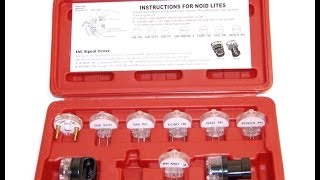
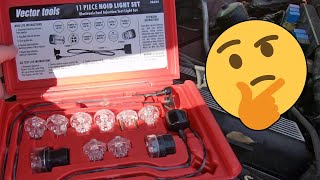
Insert a noid light into the harness connector. Crank the engine. A steadily flashing light confirms the PCM is sending the ground signal. If it does not flash, the control wire is broken or the PCM driver is dead.
Tools: Noid Light Set (Intermediate) - Swap the Injector
If resistance and pulse test normal, swap the cylinder 12 injector with cylinder 11. Clear codes and run the engine. If P0211 appears, the injector is mechanically failed. If P0212 returns, the wiring or PCM is at fault.
Tools: Basic Hand Tools (Advanced) - Perform a Voltage Drop Test on the Ground Circuit
Connect the multimeter's red lead to the ground-side pin of the injector connector and the black lead to the negative battery terminal. Crank the engine. The reading must stay under 0.5 volts. Higher readings indicate excessive resistance in the ground path.
Tools: Digital Multimeter (Advanced) - Analyze the Injector Waveform
Back-probe the control wire with an oscilloscope. A healthy waveform shows battery voltage, a sharp drop to zero when grounded, a 'pintle hump' as it opens, and a 60-80V inductive kick when de-energized. A missing inductive kick confirms a shorted injector coil.
Tools: Automotive Oscilloscope (Advanced)
When This Code Triggers (Freeze-Frame Conditions)
- Engine Coolant Temp: 180-200°F (Fully warmed up)
- RPM: 1500-2500 (Cruise / steady throttle)
- Engine Load: 30-60% (Moderate load during cruise or light acceleration)
- Vehicle Speed: 45-65 mph (Highway driving)
Related Codes
- P0312 — Cylinder 12 Misfire Detected. This is the direct physical consequence of the electrical fault identified by P0212. Resolving the P0212 circuit issue automatically fixes the P0312 misfire.
- P0200 — Injector Circuit Malfunction. If P0200 appears alongside P0212, it indicates a systemic problem affecting all injectors, such as a blown main power fuse or a failing fuel injection relay.
- P0211 — Injector Circuit Low - Cylinder 11. Seeing this with P0212 indicates a melted wiring harness affecting adjacent cylinders. It also appears if you swap a bad injector from cylinder 12 to 11 during diagnosis.
- P0300 — Random/Multiple Cylinder Misfire Detected. A severe single-cylinder misfire on a V12 is sometimes misinterpreted by the PCM on startup, triggering this general code alongside P0212.
Climate & Environmental Factors
- High Humidity / Coastal Regions: Salty, humid air accelerates green copper corrosion on electrical pins. This creates high resistance and intermittent voltage drops, triggering P0212.
- Road Salt (Winter Climates): Corrosive salt spray compromises wiring insulation and rapidly degrades connector terminals, leading to shorts to ground.
- Extreme Temperature Cycles: Repeated cycling from a hot V12 engine bay to freezing ambient temperatures makes plastic wiring insulation brittle. The insulation cracks, exposing copper wire and creating shorts.
How to Talk to a Mechanic About This Code
Say this: "I have a P0212 code for the cylinder 12 injector circuit. I need a diagnostic to confirm the cause. Please test the injector's resistance, check for 12-volt power at the connector, and verify the PCM pulse with a noid light before recommending a part replacement."
This proves you understand P0212 is an electrical code requiring methodical diagnosis. It prevents a shop from immediately replacing the expensive V12 injector without checking the wiring first.
Avoid saying:
- 'My check engine light is on, can you look at it?'
- 'My car is misfiring, I think I need a new injector.'
- 'Just fix whatever's wrong.'
Questions to ask before authorizing the repair:
- What was the exact resistance reading of the fuel injector?
- Did you confirm there is a steady flashing signal with a noid light?
- If the wiring is bad, can you show me the damaged section?
- What is the warranty on the parts and labor for this repair?
Where to Take It: Dealer vs Independent vs Chain
- Dealer:
Best for: Vehicles still under powertrain warranty., High-end V12 models (Ferrari, Aston Martin) requiring proprietary diagnostic software., Complex electrical issues requiring PCM replacement and immobilizer programming.
Downsides: Significantly higher labor rates and parts costs., More likely to replace an entire $1,000 wiring harness rather than repair a single broken wire. (Typical cost: +50% vs. baseline) - Independent Shop:
Best fit for older vehicles. For modern V12 supercars, a marque-specialist independent shop or the dealer is mandatory.
Best for: Out-of-warranty vehicles where cost is a factor., Getting a second opinion on a dealership's expensive quote.
Downsides: May lack the specialized tools required to remove intake manifolds on modern V12 engines. (Typical cost: +0% vs. baseline) - Chain Shop:
AVOID for this code. P0212 requires specific electrical diagnostic skills that general service chains lack.
Best for: Simple, routine maintenance like oil changes or tire rotations.
Downsides: Technicians lack the advanced electrical diagnostic skills required for circuit codes., High risk of misdiagnosis and unnecessary part replacements. (Typical cost: -10% vs. baseline)
When to Walk Away From the Repair
If the estimated repair cost exceeds 50% of the car's private-party value, sell or trade it in. For vehicles over 150,000 miles, drop this threshold to 40%.
- Car worth $15000, fix is $1200: Fix it. The repair cost is well below the threshold.
- Car worth $5000, fix is $2200: Borderline. The cost is approaching 50% of the car's value. Get a second opinion before authorizing the repair.
- Car worth $3000, fix is $2500: Walk away. The repair cost is over 75% of the car's value and doesn't make financial sense.
What Scan Tool You Need for This Code
Minimum: A tool that reads codes, clears codes, and displays live data streams to confirm misfire counts.
A basic $20 reader only displays the P0212 code. It cannot show live data to verify PCM commands, nor can it perform active tests to isolate the circuit.
Budget: BlueDriver Pro (~$120) — Reads and clears codes, provides freeze frame data, and graphs live data on your smartphone. Excellent for DIY diagnosis.
Mid-range: Foxwell NT510 Elite (~$200) — Provides dealer-level diagnostics and bidirectional control. You can actively command the injector on and off to test the PCM driver and wiring.
Professional: Autel MaxiCOM MK808S (~$450) — Offers full bidirectional control for 'injector buzz tests', comprehensive live data, and advanced service functions like injector coding.
Rent vs buy: Auto parts stores read codes for free. Buy a scanner if you plan to perform your own diagnostics and repairs more than once a year.
How to Clear the Code After You Fix It
- Use OBD-II scan tool to clear codes
- Perform a complete OBD-II drive cycle
Drive cycle (~30 minutes): Cold start the engine after sitting 8+ hours. Idle for 3 minutes. Drive at a steady 55-60 mph for 10 minutes. Perform 15 minutes of mixed city driving with multiple stops. Allow the vehicle to cool down completely.
Readiness monitors affected: Catalyst Monitor, Oxygen (O2) Sensor Monitor, Fuel System Monitor
Before emissions retest: drive at least 100 miles to fully set monitors.
Watch out for:
- Disconnecting the battery clears the code but resets all readiness monitors, guaranteeing an emissions test failure.
- The code returns immediately upon startup if the electrical short is not properly repaired.
- Failing to keep the fuel tank between 1/4 and 3/4 full prevents the EVAP monitor from running during the drive cycle.
Will This Fail Emissions / State Inspection?
Yes — this code typically fails an OBD-II emissions inspection.
- California: An illuminated Check Engine Light is an automatic failure. After repair, a drive cycle must be completed. For 2001+ gas vehicles, only one monitor is allowed to be 'incomplete'.
- New York: An active P0212 code and illuminated MIL results in an automatic OBD-II inspection failure.
- Texas: In the 17 counties requiring emissions testing, an illuminated Check Engine Light is an automatic fail. Safety inspections for non-commercial vehicles were eliminated in 2025, but emissions testing remains.
Most Commonly Affected Vehicles
- Aston Martin DB11, Vanquish, DBS (2017-2024) — These V12 models are highly susceptible. Diagnostics alone cost $250-$550, and general electrical faults range from $400-$1500 to repair.
- BMW 760i, M760i, 8 Series (2003-2022) — N73 and N74 V12 engines log this code. Accessing the rear cylinders near the firewall requires intake manifold removal, drastically increasing labor costs.
- Ferrari 812 Superfast, GTC4Lusso (2018-2026) — Due to extreme complexity and $200+/hour labor rates, a simple injector or wiring repair becomes very expensive.
- Lamborghini Aventador, Revuelto (2012-2026) — The complexity of the engine management system leads to injector circuit faults. Labor costs are the primary driver of high repair bills.
- Mercedes-Benz S600, Maybach S 680, SL 65 AMG (2015-2026) — M277 and M279 V12 engines trigger this code. Accessing components is time-consuming and requires XENTRY diagnostic software.
- Rolls-Royce Phantom, Ghost, Cullinan (2018-2026) — These use a BMW-sourced 6.75-liter twin-turbo V12 (N74B68). Repair procedures and costs mirror BMW V12s.
- Jaguar XJS, XJ12 (1993-1997) — Older 6.0L V12 models suffer from brittle wiring harnesses due to extreme engine bay heat, frequently causing injector circuit shorts.
Manufacturer-Specific Notes
- BMW: On N74 V12 models, the intake manifolds must be removed to access the fuel injectors. Technicians strongly recommend replacing all injectors on that bank simultaneously to avoid paying the massive labor cost twice.
- Mercedes-Benz: Mercedes requires technicians to use their proprietary XENTRY diagnostic tool to run specific automated test plans for the injector driver in the ECU. Deviating from this software tree leads to misdiagnosis.
- Aston Martin: Wiring harnesses on older V12 models are notorious for degrading due to extreme engine bay heat. A P0212 is more likely to be a crumbled wire harness shorting to the block than a failed injector.
Real Owner Stories
BMW 760Li (V12) with 95k miles
P0212 code appeared alongside a P0312 misfire code. The engine shook violently at idle and lost significant power on the highway.
Outcome: The owner swapped the cylinder 12 injector with cylinder 11. The code changed to P0211, confirming the injector had an internal short. They replaced the faulty Bosch injector, resolving the issue.
Lesson: Swapping a suspected component with a known-good one is a definitive diagnostic technique. It proves the part is faulty before you spend money on replacements.
Mercedes S600 (V12) in a humid climate
An intermittent P0212 code appeared exclusively on damp or rainy days. The car occasionally stumbled during heavy acceleration.
Outcome: The technician cleaned the connector thoroughly with contact cleaner and applied dielectric grease to the weather seal. The resistance dropped back to normal, and the code never returned.
Lesson: Never underestimate environmental factors. Moisture intrusion causes severe corrosion and voltage drops. A $10 can of contact cleaner often prevents a $1,000 repair bill.
How to Prevent This Code From Triggering
- Apply dielectric grease to injector connectors (During any tune-up or when connectors are exposed) — Dielectric grease seals the connector from moisture, preventing the copper corrosion that leads to intermittent connections and voltage drops.
- Secure and protect wiring harnesses (Once, or when working in the engine bay) — Using high-temperature Tesa tape protects wires from chafing against engine components and melting on hot exhaust manifolds.
- Address engine oil and coolant leaks promptly (As soon as they are detected) — Hot engine oil and coolant degrade plastic wiring insulation over time, making it brittle and prone to cracking, which exposes the wire and causes shorts.
Frequently Asked Questions
What does the 'Low' in P0212 specifically mean?
The 'Low' means the voltage in the injector's electrical circuit is lower than the PCM expects. This indicates a short circuit to ground or an injector coil with abnormally low resistance.
What is the most common mistake when diagnosing P0212?
The most common mistake is replacing the fuel injector without testing the wiring first. Always verify power, ground pulse, and injector resistance before condemning the part.
Can a vacuum leak cause a P0212 code?
No. P0212 is a purely electrical fault code related to the injector circuit. A vacuum leak causes lean codes (P0171) or misfire codes (P0312), but never a circuit low code.
Is it expensive to fix a P0212 code?
Diagnostic fees average $150-$250. Simple wiring repairs cost $250-$550, while replacing a V12 fuel injector ranges from $700 to over $1,500 due to difficult access. PCM replacements are the most expensive, often exceeding $2,500.
Can I use a fuel injector cleaner to fix this code?
No. Fuel injector cleaner removes carbon deposits from inside the injector. It cannot fix electrical problems like a shorted coil or a broken wire.
Where is cylinder 12 located?
On most V12 engines, cylinder 12 is the rear-most cylinder on the driver's side (Bank 2). Always consult your specific vehicle's service manual to confirm the exact firing order and layout.
What's the difference between P0212 and a misfire code like P0312?
P0212 is an electrical fault code indicating a problem within the injector's control circuit. P0312 is a performance code indicating cylinder 12 is misfiring. P0212 is the root cause, and fixing the circuit fault automatically resolves the P0312 misfire.
Can a weak battery cause a P0212 code?
It is highly unlikely. A weak battery triggers multiple random codes or a general system voltage code. However, a severely corroded main engine ground strap creates isolated voltage drops under load.
Key Takeaways
- P0212 indicates a low-voltage electrical fault in the cylinder 12 fuel injector circuit, ruling out mechanical fuel pressure issues.
- Internal injector coil shorts and melted wiring harnesses account for over 80% of P0212 failures.
- Driving more than 50 miles with an active P0212 dumps raw fuel into the exhaust, risking a $2,500+ catalytic converter replacement.
- Testing injector resistance (typically 10-16 ohms) and verifying the PCM ground pulse with a noid light definitively isolates the faulty component.
- Swapping the cylinder 12 injector with cylinder 11 immediately confirms if the injector is dead (code changes to P0211) or if the wiring is at fault (code remains P0212).
Helpful Videos

The information in this article is provided for general reference and educational purposes only. Vehicle specifications, procedures, and part compatibility can vary by production date, trim level, and region. Always consult your vehicle's factory service manual and verify part numbers before purchasing or performing repairs. Safety-critical components such as airbags, seat belts, and braking systems should be installed by a qualified professional.
- 🎬 Helpful Videos
- What Does P0212 Mean?
- Can I Drive With P0212?
- Common Causes
- Symptoms
- Diagnostic Flowchart
- Common Fixes & Costs
- Used vs. New Parts: Buying Guide
- What Happens If You Wait — Timeline
- Cost of Not Fixing It
- Diagnosis Steps
- When This Code Triggers (Freeze-Frame Conditions)
- Related Codes
- Climate & Environmental Factors
- How to Talk to a Mechanic About This Code
- Where to Take It: Dealer vs Independent vs Chain
- When to Walk Away From the Repair
- What Scan Tool You Need for This Code
- How to Clear the Code After You Fix It
- Will This Fail Emissions / State Inspection?
- Most Commonly Affected Vehicles
- Manufacturer-Specific Notes
- Real Owner Stories
- BMW 760Li (V12) with 95k miles
- Mercedes S600 (V12) in a humid climate
- How to Prevent This Code From Triggering
- Frequently Asked Questions
- What does the 'Low' in P0212 specifically mean?
- What is the most common mistake when diagnosing P0212?
- Can a vacuum leak cause a P0212 code?
- Is it expensive to fix a P0212 code?
- Can I use a fuel injector cleaner to fix this code?
- Where is cylinder 12 located?
- What's the difference between P0212 and a misfire code like P0312?
- Can a weak battery cause a P0212 code?
- Key Takeaways
- 🎟️ Get 5% Off