

OBD-II Code P0208: Injector Circuit/Open - Cylinder 8
The Ultimate 2026 Guide to Diagnosing and Fixing P0208
- P0208 indicates a complete electrical open circuit in the cylinder 8 fuel injector, preventing any fuel delivery to that cylinder.
- Expect a severe engine shake, a 15-25% drop in fuel economy, and a flashing Check Engine Light within 50 miles of the fault.
- Diagnose the issue for $0 by swapping the cylinder 8 injector with cylinder 6; if the code changes to P0206, the injector is the confirmed culprit.
- Driving with a flashing Check Engine Light dumps raw fuel into the exhaust, destroying a $1,200+ catalytic converter in under 100 miles.
What Does P0208 Mean?
P0208 means the Powertrain Control Module (PCM) detects a broken electrical connection to the cylinder 8 fuel injector. Like an unplugged lamp, the electrical signal cannot reach the injector, completely halting fuel delivery to that specific cylinder.
Technical definition: The SAE/OBD-II definition is 'Injector Circuit/Open - Cylinder 8.' The PCM uses a driver transistor to rapidly pulse the injector's ground connection. When commanded on, the PCM monitors the circuit for an 'inductive kick' voltage spike. If this spike is missing, the PCM confirms an open circuit and immediately sets code P0208.
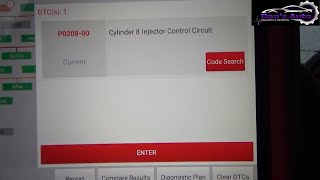
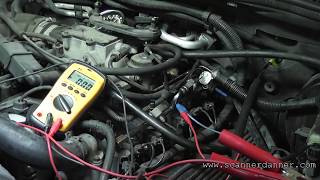
🎬 Watch: A quick overview of P0208 causes and common fixes.Can I Drive With P0208?
no_recommended. Driving is not recommended. The engine runs on seven cylinders, causing severe imbalance and extreme stress on engine mounts. A flashing check engine light means unburned fuel is dumping directly into the exhaust, which destroys the catalytic converter in 50-100 miles and adds $1,200 to $2,800 to your repair bill.
Common Causes
- Faulty Cylinder 8 Fuel Injector (Very Common) — The internal electrical coil inside the fuel injector fails from heat and vibration, creating a permanent open circuit. This is the most frequent cause of a P0208 code.
- Damaged Injector Wiring Harness (Very Common) — Wires leading to the injector are physically broken, melted, or chewed by rodents. This also includes wires that show continuity but are internally corroded and unable to carry the necessary amperage.
- Corroded Injector Electrical Connector (Common) — The plastic connector plugging into the fuel injector has corroded pins from moisture or is improperly seated, breaking the electrical connection.
- Poor Ground Connection (Less Common) — The ground circuit for the injector bank is loose or corroded. A bad ground prevents the circuit from completing, effectively creating an open.
- Faulty Auto Shutdown (ASD) Relay or TIPM (Rare) — On Dodge, Chrysler, and Jeep vehicles, the ASD relay or Totally Integrated Power Module (TIPM) supplies power to the injectors. A fault here cuts power, triggering the code.
- Faulty Powertrain Control Module (PCM) (Very Rare) — The internal driver circuit controlling the #8 injector fails. Consider this only after exhaustively testing the injector, wiring, and connectors.
Symptoms
- Check Engine Light On or Flashing — A solid light is guaranteed. A flashing light indicates a severe, catalyst-damaging misfire requiring immediate engine shutdown.
- Severe Engine Misfire and Shaking — The engine runs exceptionally rough, shaking violently at idle and during acceleration because one cylinder is completely dead.
- Engine Stalling or Hard Starting — The engine stumbles, hesitates, or stalls completely under load, and requires extended cranking to start.
- Drastically Reduced Fuel Economy — Fuel efficiency drops 15-25% as the engine runs inefficiently and the PCM incorrectly adjusts fuel trims on other cylinders.
- Significant Power Loss and Limp Mode (also visible on scanner) — The vehicle feels sluggish and weak. Some models enter a failsafe 'limp mode,' restricting engine RPM and capping speed at 35 mph.
Diagnostic Flowchart
Tap your situation to follow the diagnostic path that matches what you're seeing on this code.
Common Fixes & Costs
- Initial Professional Diagnosis — Parts: $0, Labor: $125-$185, ~1.0 hr book time (Professional)
- Replace Cylinder 8 Fuel Injector — Parts: $50-$750, Labor: $110-$450, ~1.5 hr book time (Intermediate)
- Replace Injector Connector Pigtail — Parts: $15-$40, Labor: $80-$160, ~1.0 hr book time (DIY)
- Repair Wiring Harness — Parts: $10-$50, Labor: $100-$350, ~2.0 hr book time (Advanced)
- Replace Powertrain Control Module (PCM) — Parts: $600-$2000, Labor: $150-$300, ~2.0 hr book time (Professional)
Used vs. New Parts: Buying Guide
When a used part is worth it: Only for vehicles over 15 years old where new parts are prohibitively expensive and the owner accepts the risk of repeating the labor.
Donor-vehicle mileage cap: roughly under 80000 miles for the part to have meaningful remaining life.
Donor quality checklist:
- Buy from sellers providing exact resistance readings.
- Match part numbers, color bands, and connector types perfectly.
- Avoid injectors from engines scrapped for internal failure.
Decision logic:
- If Vehicle is under 10 years old or has under 100k miles → Buy a new OEM or high-quality aftermarket injector. Used parts carry too much risk.
- If Labor to access the injector exceeds 2 hours → Buy new to avoid paying double labor when a used part fails.
- If Vehicle is over 15 years old and budget is extremely tight → A professionally remanufactured or tested used injector is an acceptable last resort.
Warranty tradeoff: Used parts offer 30-90 day warranties that exclude labor. New aftermarket parts offer 1-year to lifetime warranties. New OEM parts offer 1-2 year warranties.
Worst-case if a used part fails: 400-800
What Happens If You Wait — Timeline
- Immediate (0-50 miles): Code P0208 sets. Severe engine vibration, drastic power loss, and a solid or flashing Check Engine Light. (MPG impact: 10-25%% · Added cost: $0)
- Short Term (50-200 miles): Unburned fuel superheats the catalytic converter. The internal ceramic substrate begins melting and breaking apart. (MPG impact: 15-30%% · Added cost: $1200-$2800)
- Medium Term (200-500 miles): Catalytic converter clogs, causing severe exhaust backpressure. Engine struggles to rev past 2500 RPM and stalls frequently. (MPG impact: 25-40%% · Added cost: $1500-$3200)
- Long Term (500+ miles): Persistent violent vibration destroys engine and transmission mounts. Vehicle becomes undrivable. (MPG impact: 30-50%+% · Added cost: $2000-$4500+)
Cost of Not Fixing It
- Immediate (0-100 miles): Severe engine vibration, power loss, and unburned fuel actively dumping into the exhaust system. (Added cost: 0)
- Short Term (100-500 miles): Catastrophic failure of the Bank 2 catalytic converter. Raw fuel superheats and melts the catalyst substrate. (Added cost: 1200-2800)
- Long Term (500+ miles): Severe engine imbalance destroys engine and transmission mounts. Fouled oxygen sensors require replacement. (Added cost: 300-900)
Diagnosis Steps
- Visual Inspection
Locate cylinder #8 (usually the rearmost cylinder on the passenger side for American V8s). Inspect the wiring harness and connector for melted wires, rodent chew marks, or green/white corrosion on the pins.
Tools: Flashlight, Mirror (Beginner) - Swap the Injector
Swap the cylinder 8 fuel injector with an adjacent cylinder (like cylinder 6). Clear the codes and drive. If the code changes to P0206, the injector is definitively bad. If P0208 returns, the issue is in the wiring or PCM.
Tools: Basic hand tools (sockets, wrenches) (Intermediate) - Check Injector Resistance
Unplug the injector connector. Set a multimeter to Ohms (Ω). Probe the two metal pins on the injector. A healthy high-impedance injector reads 11-18 Ohms. An 'OL' (Open Loop) reading confirms internal coil failure.
Tools: Multimeter (Beginner) - Test the Circuit with a Noid Light
Plug a noid light into the engine harness connector for the injector. Start the engine. Rapid flashing confirms the PCM and wiring are delivering the signal. No flash indicates a wiring or PCM fault. A solid light indicates a short to ground.
Tools: Noid light set (Intermediate) - Check for Power and Ground
Turn the ignition 'On' (engine off). Set a multimeter to DC Volts. Ground the black probe and probe both connector pins with the red probe. One pin must show battery voltage (~12.6V). No voltage means a power supply issue. If power exists, the fault is on the ground/control side.
Tools: Multimeter (Intermediate) - Perform a Voltage Drop Test
Set the multimeter to DC Volts. Connect the red probe to the ground pin at the injector connector and the black probe to the negative battery terminal. Have a helper crank the engine. A reading above 0.5 volts (500mV) proves high resistance in the ground wire or PCM driver.
Tools: Multimeter, Helper (Intermediate) - Check Wiring Continuity to PCM
Disconnect the PCM and injector connectors. Set the multimeter to Ohms. Test continuity between the injector control pin and the corresponding PCM pin. An 'OL' reading confirms a broken wire. If continuity testing requires removing the intake manifold, tow the vehicle to a shop.
Tools: Multimeter, Vehicle-specific wiring diagram (Advanced) - Analyze the Waveform with an Oscilloscope
Back-probe the control wire at the injector with the engine running. Look for a square waveform dropping to near zero, followed by a sharp 35-65+ volt 'inductive kick' spike. Missing the spike while the rest of the waveform exists confirms an open inside the injector.
Tools: Oscilloscope, Back-probe pins (Advanced) - Monitor Live Data PIDs
Use an advanced scan tool to monitor Short Term Fuel Trim (STFT) and Long Term Fuel Trim (LTFT) for Bank 2. Expect high positive fuel trims (e.g., +25%) as the PCM compensates for the dead cylinder's unburned oxygen. Verify high misfire counts on cylinder 8 in Mode $06 data.
Tools: Advanced OBD-II Scan Tool (Advanced)
When This Code Triggers (Freeze-Frame Conditions)
- Engine Coolant Temp: 180-210°F (Electrical faults trigger at any temperature, but freeze frames usually capture data after the engine reaches full operating temperature.)
- RPM: 700-2500 RPM (The open circuit fault is continuously monitored and triggers at idle or during steady-state cruising when the PCM runs active diagnostics.)
- Engine Load: 20-60% (Sets under light to moderate load, such as maintaining speed on a level road, providing stable conditions for circuit integrity verification.)
- Vehicle Speed: 0-65 mph (Captures the exact moment the fault confirms, whether at startup (0 mph) or highway speeds.)
Related Codes
- P0308 — Cylinder 8 Misfire Detected. P0208 guarantees a P0308 because no fuel equals a misfire. Diagnose the P0208 electrical fault first.
- P0200 — Injector Circuit Malfunction. A general fault suggesting a shared problem like a blown fuse, failing relay, or bad PCM.
- P0171 / P0174 — System Too Lean. The oxygen sensor detects unburned oxygen from the dead cylinder and incorrectly reports a lean condition.
- P0201 - P0207 — Injector codes for other cylinders. Multiple simultaneous codes indicate a shared power/ground failure, not multiple failed injectors.
Climate & Environmental Factors
- Rodent Infestation: Rodents chew the soy-based wire insulation used in modern cars, creating open circuits. This is highly common in rural areas or during winter and is rarely covered by warranty.
- High Humidity and Road Salt: Moisture and salt spray accelerate corrosion inside electrical connectors, creating high resistance or complete open circuits.
- Extreme Engine Heat: Prolonged high temperatures make plastic wiring insulation brittle. Engine vibration then cracks the insulation, leading to broken wires.
How to Talk to a Mechanic About This Code
Say this: "I have a P0208 code for cylinder 8. I need a diagnostic to determine if the cause is the injector, the wiring, or the PCM. Please test the injector resistance and check the connector signal with a noid light before recommending parts."
Proves you understand logical electrical diagnostics. Prevents shops from quoting expensive parts without proving they are the root cause, saving you money on unnecessary labor.
Avoid saying:
- 'My check engine light is on, can you look at it?'
- 'Just fix whatever's wrong'
- 'My car is shaking, I think it needs a tune-up'
Questions to ask before authorizing the repair:
- What was the exact ohm reading on the cylinder 8 injector?
- Did the noid light flash on the connector, or was it solid/off?
- If recommending a wiring repair, can you physically show me the break or corrosion?
- What is the warranty on the recommended part and labor?
Where to Take It: Dealer vs Independent vs Chain
- Dealer:
Best for: Vehicles under powertrain or emissions warranty., Known manufacturer quirks like Dodge TIPM failures., Complex electrical issues on high-end European brands.
Downsides: Significantly higher labor rates and parts costs., Quick to replace entire harnesses rather than attempting targeted wiring repairs. (Typical cost: +40% vs. baseline) - Independent Shop:
Best fit. A reputable independent shop with strong electrical diagnostic skills is the ideal choice for a P0208 code.
Best for: Out-of-warranty vehicles where cost is a factor., Diagnosing common electrical faults like P0208., Performing cost-effective wiring or connector pigtail repairs.
Downsides: Diagnostic skill varies. Requires finding a shop with ASE-certified electrical specialists. (Typical cost: +0% vs. baseline) - Chain Shop:
Avoid for diagnosis. They lack the specialized skills to find the root cause of electrical open circuits.
Best for: Routine maintenance like oil changes, tires, and brakes.
Downsides: Inconsistent technician skill for complex electrical diagnosis., High pressure to upsell unnecessary parts. (Typical cost: -10% vs. baseline)
When to Walk Away From the Repair
If the total estimated repair cost exceeds 50% of your car's private-party market value, seriously consider selling or trading it in.
- Car worth $4000, fix is $2200: Walk away. The repair cost exceeds 50% of the car's value.
- Car worth $15000, fix is $800: Fix it. The repair cost is well below the threshold and restores drivability.
- Car worth $3000, fix is $1600: Borderline. Get a second opinion, but prepare to sell.
What Scan Tool You Need for This Code
Minimum: A tool that reads/clears codes and displays live data streams and freeze frame data to monitor misfires and fuel trims.
A $20 reader only provides the code. It lacks freeze frame data and live fuel trims, which are crucial clues for diagnosing electrical faults.
Budget: BlueDriver Pro (~$100) — Reads/clears P0208, shows detailed freeze frame data, and provides live data graphing on your smartphone to monitor misfires.
Mid-range: Foxwell NT510 Elite (~$180) — Includes BlueDriver functions plus limited bidirectional controls for active component testing.
Professional: Autel MaxiCOM MK808S (~$450) — Offers full-system diagnostics, extensive live data, and strong bidirectional control, including injector coding for advanced repairs.
Rent vs buy: AutoZone reads codes for free, but won't clear them or provide live data. Buying a tool like BlueDriver is a mandatory investment for DIY diagnosis.
How to Clear the Code After You Fix It
- Use an OBD-II scan tool to clear P0208 and related codes (like P0308) from the PCM.
- Turn the ignition off and wait 10 seconds.
- Start the engine. If the Check Engine Light stays off, proceed to the drive cycle.
Drive cycle (~30 minutes): Start with a cold engine. Idle for 3 minutes. Drive at a steady 55 mph for 10 minutes. Perform 10 minutes of stop-and-go city driving. Allow the vehicle to cool completely.
Readiness monitors affected: Misfire Monitor, Fuel System Monitor, Catalyst Monitor, O2 Sensor Monitor
Before emissions retest: drive at least 50 miles to fully set monitors.
Watch out for:
- Disconnecting the battery clears the code but resets all readiness monitors to 'Not Ready', causing an automatic emissions failure.
- The code returns immediately if the underlying electrical fault remains unfixed.
- Failing to complete the specific drive cycle leaves monitors incomplete, blocking emissions testing.
Will This Fail Emissions / State Inspection?
Yes — this code typically fails an OBD-II emissions inspection.
- California: Automatic smog check failure. All readiness monitors must be 'Ready' to pass the re-test, requiring 50-100 miles of driving.
- New York: An illuminated Check Engine Light fails the NYS inspection. Clearing the code right before testing fails the vehicle due to unset readiness monitors.
- Texas: Fails the OBD-II scan in the 17 counties requiring emissions testing for registration renewal.
Most Commonly Affected Vehicles
- Dodge / Ram 1500/2500 with 5.7L HEMI V8 (2003-2018) — Highly susceptible to wiring harness rub-through near the intake manifold and Auto Shutdown (ASD) relay failures inside the TIPM.
- Ford F-150 / Mustang GT with 4.6L or 5.0L V8 (1999-2017) — Wiring harnesses resting on the intake manifold become brittle from heat, breaking easily during maintenance or from engine vibration.
- Chevrolet / GMC Silverado / Sierra / Tahoe with V8 engines (2000-2015) — Harness routing causes rubbing against firewall brackets or cylinder heads, severing the injector wire.
- Jeep Grand Cherokee with 5.7L HEMI V8 (2005-2018) — Shares the Dodge/Ram wiring architecture, suffering identical harness rub-through and TIPM issues.
- Toyota Tundra / Sequoia with 4.7L or 5.7L V8 (2007-2021) — Soy-based wiring attracts rodents. Accessing cylinder 8 on the passenger rear is exceptionally tight against the firewall.
- BMW Models with N62/N63 V8 engines (2002-2016) — Leaking coolant expansion tanks drip directly onto rear cylinder injectors, corroding the connectors and triggering the code.
Manufacturer-Specific Notes
- Dodge / Chrysler / Jeep: A failing Totally Integrated Power Module (TIPM) or Auto Shutdown (ASD) relay mimics a P0208 code. Test the ASD relay output before condemning the PCM.
- General Motors (GM): GM bulletins advise against PCM replacement unless all diagnostics fail. Vortec V8 main harnesses frequently rub through behind the intake manifold.
- Ford: Injector wiring harnesses resting on the intake manifold become extremely brittle. Moving them during unrelated repairs often breaks the internal wires.
- Toyota / Honda: High incidence of rodent damage due to soy-based wiring insulation. Honda offers specialized capsaicin-infused rodent-deterrent tape (Part # 4019-2317).
Real Owner Stories
1999 Dodge Ram 1500 5.9L at 316K miles
Truck threw P0208 and died. Engine cranked but ran with a horrible idle.
What they tried:
- Replaced original injectors with new Bosch units.
- Code bizarrely changed to P0202 (Cylinder 2).
- Sent the PCM to an electronics repair service.
Outcome: The repair service re-soldered loose internal PCM components. The jumping code indicated a failing PCM rather than multiple bad injectors.
Lesson: If a fault code mysteriously jumps to a different cylinder after replacing a part, suspect a failing PCM or a widespread wiring harness issue.
2018 Chevy Silverado 1500
Check Engine Light illuminated, truck ran poorly with P0208.
What they tried:
- Identified injectors were buried under the intake manifold.
- Tested the circuit directly at the ECM connector to avoid major disassembly.
Outcome: ECM testing confirmed an open circuit. The intake manifold was removed to access and repair the severed harness wire.
Lesson: Always test circuits from the easiest access point (like the main computer connector) before beginning a time-consuming engine teardown.
2014 Ram 1500 5.7L HEMI
Violent shaking, flashing check engine light, codes P0208 and P0308.
What they tried:
- Swapped the cylinder 8 injector to cylinder 6.
- Cleared codes; new codes were P0206 and P0306.
Outcome: The fault moved with the injector, proving the injector failed. Replaced the single injector and resolved the issue.
Lesson: The injector swap test is the most reliable DIY method to confirm a bad injector before spending money on parts.
BMW with N63 V8 Engine
P0208 code appeared alongside frequent coolant top-offs.
What they tried:
- Initial wiring and resistance checks were inconclusive.
- Discovered the coolant expansion tank was leaking directly above the cylinder bank.
Outcome: Coolant dripped onto the cylinder 8 connector, causing corrosion. Replaced the connector pigtail and the leaking tank.
Lesson: Look for secondary issues. Fluid leaks dripping onto sensitive wiring frequently cause electrical open circuits.
How to Prevent This Code From Triggering
- Apply Dielectric Grease to Connectors (During any repair involving unplugging connectors.) — Creates a waterproof barrier, preventing moisture and road salt from corroding the metal pins and causing open circuits.
- Install Rodent-Deterrent Tape (Once, if parking outdoors in high-risk areas.) — Wrapping vulnerable harness sections with capsaicin-infused tape (Honda Part # 4019-2317) stops rodents from chewing soy-based insulation.
- Regularly Clean the Engine Bay (Annually, especially after winter in Salt Belt regions.) — Removes accumulated road salt and grime that trap moisture against electrical components and accelerate corrosion.
- Secure Wiring Harnesses (During any engine service.) — Ensures harnesses do not rub against hot exhaust manifolds or sharp brackets, preventing vibration-induced wire chafing.
Frequently Asked Questions
How do I find cylinder 8?
Search online for your specific engine's cylinder layout. On most American V8s, cylinder 8 is the rearmost cylinder on the passenger side.
Can a bad spark plug or ignition coil cause a P0208 code?
No. Ignition failures cause misfire codes (P0308). P0208 is strictly an electrical fault in the fuel injector circuit.
Can fuel injector cleaner fix a P0208 code?
Absolutely not. Cleaners remove carbon deposits from working injectors but cannot fix broken wires, bad connectors, or failed internal coils.
What is the most common misdiagnosis for P0208?
Replacing the Powertrain Control Module (PCM) prematurely. Technicians must rule out the injector, connector, and wiring harness before considering the PCM.
Can a bad ground cause P0208?
Yes. The PCM controls the injector by pulsing its ground. A broken ground wire prevents circuit completion, triggering the code.
Will P0208 cause my car to go into limp mode?
Yes, many modern vehicles enter limp mode to limit engine power and speed, preventing catastrophic damage to the catalytic converter.
What does the 'A' mean in 'Injector A Circuit'?
The 'A' is a generic OBD-II placeholder. For passenger vehicles with one injector per cylinder, 'Circuit/Open' and 'Circuit A/Open' mean the exact same thing.
Is it expensive to fix code P0208?
Costs range from $150 for a simple wiring repair to $800+ for a high-pressure injector replacement. A professional diagnosis averages $150 and prevents wasting money on unnecessary parts. Replacing a PCM is the most expensive, often exceeding $1,500, but is rarely the actual cause.
Key Takeaways
- P0208 indicates a complete electrical open circuit in the cylinder 8 fuel injector, preventing any fuel delivery to that cylinder.
- Expect a severe engine shake, a 15-25% drop in fuel economy, and a flashing Check Engine Light within 50 miles of the fault.
- Diagnose the issue for $0 by swapping the cylinder 8 injector with cylinder 6; if the code changes to P0206, the injector is the confirmed culprit.
- Driving with a flashing Check Engine Light dumps raw fuel into the exhaust, destroying a $1,200+ catalytic converter in under 100 miles.
Helpful Videos

The information in this article is provided for general reference and educational purposes only. Vehicle specifications, procedures, and part compatibility can vary by production date, trim level, and region. Always consult your vehicle's factory service manual and verify part numbers before purchasing or performing repairs. Safety-critical components such as airbags, seat belts, and braking systems should be installed by a qualified professional.
- 🎬 Helpful Videos
- What Does P0208 Mean?
- Can I Drive With P0208?
- Common Causes
- Symptoms
- Diagnostic Flowchart
- Common Fixes & Costs
- Used vs. New Parts: Buying Guide
- What Happens If You Wait — Timeline
- Cost of Not Fixing It
- Diagnosis Steps
- When This Code Triggers (Freeze-Frame Conditions)
- Related Codes
- Climate & Environmental Factors
- How to Talk to a Mechanic About This Code
- Where to Take It: Dealer vs Independent vs Chain
- When to Walk Away From the Repair
- What Scan Tool You Need for This Code
- How to Clear the Code After You Fix It
- Will This Fail Emissions / State Inspection?
- Most Commonly Affected Vehicles
- Manufacturer-Specific Notes
- Real Owner Stories
- 1999 Dodge Ram 1500 5.9L at 316K miles
- 2018 Chevy Silverado 1500
- 2014 Ram 1500 5.7L HEMI
- BMW with N63 V8 Engine
- How to Prevent This Code From Triggering
- Frequently Asked Questions
- How do I find cylinder 8?
- Can a bad spark plug or ignition coil cause a P0208 code?
- Can fuel injector cleaner fix a P0208 code?
- What is the most common misdiagnosis for P0208?
- Can a bad ground cause P0208?
- Will P0208 cause my car to go into limp mode?
- What does the 'A' mean in 'Injector A Circuit'?
- Is it expensive to fix code P0208?
- Key Takeaways
- 🎟️ Get 5% Off