

P0206 on 2010-2014 Cadillac CTS: Injector Circuit Malfunction Causes and Fixes
P0206 on a 2010-2014 Cadillac CTS indicates an electrical fault with the cylinder 6 fuel injector. The most common cause is a damaged wiring harness chafing against the engine or other components, as noted in GM TSB PIP4924D. A failed fuel injector is the second most likely cause. A thorough wiring inspection is critical before replacing parts. Expect to pay $250-$600 for a shop repair, depending on whether it's a simple wiring fix or a more involved injector replacement.
- P0206 on your CTS means there's an electrical problem with the cylinder 6 injector circuit.
- The most likely cause is a chafed wire in the engine harness, a known issue covered by a GM service bulletin. Inspect wiring thoroughly before buying parts.
- A failed fuel injector is the second most likely cause. Confirm by testing resistance (1.2-1.8 ohms for 3.6L, ~12 ohms for 3.0L) or swapping injectors.
- Driving with this code can damage your catalytic converter, leading to a much more expensive repair.
- Do not immediately blame the spark plug or coil; P0206 is an injector circuit code, not an ignition code.
What's Unique About the 2010-2014 Cadillac CTS
For this generation of Cadillac CTS, particularly with the popular 3.6L V6 engine, a known and documented issue is the fuel injector wiring harness. General Motors issued a Technical Service Bulletin (TSB #PIP4924D) that specifically mentions code P0206. The bulletin directs technicians to inspect the harness for damage where it can rub against the intake plenum, valve cover bolts, fuel lines, or the side of the cylinder head. This means that while a failed injector is possible, the wiring itself is a primary suspect and should be meticulously checked before replacing the injector.
Diagnostic Flowchart
Tap your situation to follow the diagnostic path that matches what you're seeing on this vehicle.
Generation note: The 2010-2014 range covers the end of the second generation (2008-2014 for coupe/wagon) and the start of the third generation (2014 sedan). However, the V6 engines like the 3.0L (LF1) and 3.6L (LLT, LFX) were used across these models, and the causes and fixes for P0206 are consistent for all V6 and V8 engines in this year range, with the wiring issue being most prominent on the V6s.
Symptoms You May Notice
- Check Engine Light is on
- Engine runs rough, especially at idle
- Noticeable engine misfire or hesitation
- Reduced engine power and poor acceleration
- Decreased fuel economy
- Engine may stall in severe cases
- Replacing the spark plug or ignition coil for cylinder 6. While these parts can cause a misfire code (P0306), they will not cause an injector circuit code (P0206). The P0206 code is specifically electrical and related to the fuel injector circuit, not the ignition system. 🎬 Watch: Understanding the P0206 code and its common causes.
Most Likely Causes
- Damaged Fuel Injector Wiring Harness 🔴 High Probability GM TSB #PIP4924D specifically identifies this as a common failure. The bulletin highlights several potential chafe points: against the intake plenum, at valve cover bolts, against the fuel line, and on the side of the head under the plenum.
How to confirm: With the engine off, carefully inspect the entire length of the wiring going to the cylinder 6 injector and the main harness it joins. Look for shiny, rubbed-through spots, brittle insulation, or exposed copper wire at the locations mentioned in the TSB. Perform a 'wiggle test' on the harness with the engine running to see if it causes the misfire to change or disappear.
Typical fix: Repair the damaged section of wire using solder and heat-shrink tubing. If the damage is at the connector, replace it with a new pigtail (e.g., ACDelco PT2160).
Est. part cost: $15-$50 - Faulty Fuel Injector (Cylinder 6) 🟡 Medium Probability Injectors are wear items that can fail electrically (internal coil shorts/opens) or mechanically.
How to confirm: Use a multimeter to test the resistance across the two terminals of the injector. For the 3.6L LFX V6, it should be between 1.2 and 1.8 ohms. For the 3.0L LF1 and 3.6L LLT V6, it should be around 11-15 ohms. A reading of 0 ohms indicates a short, and an infinite reading (OL) indicates an open. A more definitive test is to swap the cylinder 6 injector with another one (e.g., cylinder 4). If the trouble code changes to P0204, the injector is confirmed bad.
Typical fix: Replace the fuel injector. On the V6 engines, this requires removing the upper intake manifold to access the fuel rail. It is often recommended to replace all injectors on that bank, or all six, if they are high mileage.
Est. part cost: $70-$170 - Bad Injector Connector ⚪ Low Probability The connector lock can become brittle with heat cycles and break, or pins can corrode.
How to confirm: Visually inspect the connector for corrosion, spread or bent pins, or a loose fit. Check for a consistent electrical pulse at the connector using a noid light. If the noid light flashes steadily, the connector and wiring to that point are likely good.
Typical fix: Clean the connector terminals with electrical contact cleaner. If damaged, replace the connector with a new pigtail.
Est. part cost: $15-$40
Rare But Worth Checking
- Faulty Powertrain Control Module (PCM): This is the least likely cause. The internal driver circuit for the injector can fail. All other possibilities, especially wiring and the injector itself, should be exhaustively ruled out before considering PCM replacement. A shop can perform advanced diagnostics to confirm a bad driver.
Diagnosis Steps
- Verify the code with an OBD-II scanner.
- Locate cylinder 6. On the V6 engines, it is on the driver's side (Bank 2), closest to the firewall.
- Carefully inspect the wiring harness leading to the cylinder 6 injector. Per TSB PIP4924D, pay close attention to where the harness might rub against the intake plenum, valve cover bolts, fuel lines, and the side of the cylinder head.
- Disconnect the injector and plug a 'noid light' into the harness connector. Crank the engine. The light should flash. If it flashes, the PCM is sending a signal. If it's off or stays on solid, there is a wiring or PCM problem.
- If the noid light test passes, test the fuel injector itself. Measure the resistance between its two electrical pins with a multimeter. For a 3.6L LFX engine, expect 1.2-1.8 ohms. For a 3.0L or 3.6L LLT engine, expect ~11-15 ohms. An OL reading means an open circuit; near 0 ohms means a short.
- As a final confirmation, consider swapping the cylinder 6 injector with an adjacent one, like cylinder 4. Clear the codes and run the engine. If the code returns as P0204, the injector is faulty. If P0206 returns, the problem is in the wiring or PCM.
- If the noid light does not flash, check for a wiring fault between the PCM and the injector. A professional technique involves disconnecting the main engine harness connectors at the rear of the intake (X116 or X117) to isolate and test the circuit for continuity and shorts back to the PCM.
Parts You'll Likely Need
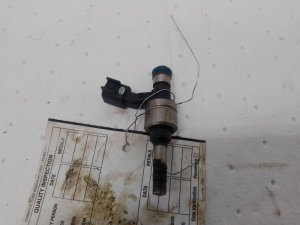
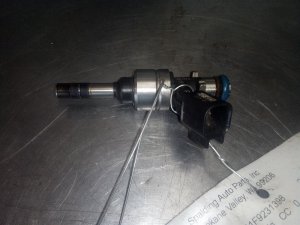
- Fuel Injector
(OEM #12669384 (for 3.6L V6))— This is the part that fails if the internal coil shorts out or breaks. It's the second most likely cause after wiring. This part number supersedes 12638530. The 3.0L and 6.2L engines use different part numbers. Always verify with VIN.
Trusted brands: ACDelco (GM Genuine), Bosch
OEM price range: $110-$170
Aftermarket price range: $50-$120 - Fuel Injector Connector Pigtail
(OEM #ACDelco PT2160)— Needed if the wiring is damaged right at the connector, or if the connector itself is broken or corroded. This is a common repair part.
Trusted brands: ACDelco, Dorman, Standard Motor Products
OEM price range: $25-$40
Aftermarket price range: $15-$25
Related Codes That Often Appear With This One
- P0306 — P0306 means "Cylinder 6 Misfire Detected." Since a P0206 fault prevents the injector from delivering fuel, the cylinder will not fire correctly, which the PCM detects as a misfire. This is the most common accompanying code.
- P0201, P0202, P0203, P0204, P0205 — The TSB #PIP4924D lists all injector codes together. If multiple injector codes are present, it strongly points to a widespread wiring harness issue, a problem with the main harness connectors (X116/X117), or a power/ground issue common to the injectors.
Technical Service Bulletins (TSBs) & Recalls
- PIP4924D: Recommends inspecting the fuel injector wiring harness for rubbing or internal wire opens when encountering codes P0201 through P0206. Specifies chafe points against the intake, valve covers, and fuel lines. [⭐]
- PI0631: Referenced by TSB PIP4924D as a source for other potential under-hood wire chafe locations.
Platform-Specific Known Issues
- GM Technical Service Bulletin #PIP4924D points to a known issue with the fuel injector wiring harness becoming damaged. Specific inspection points are: chafing against the intake plenum, rubbing on valve cover bolts, contact with the fuel line, and rubbing on the side of the cylinder head under the plenum.
- The TSB also references another bulletin, PI0631, for other potential under-hood wire chafe locations, indicating harness routing is a general area of concern on these platforms.
Mechanic-Grade Diagnostic Values
- Fuel Injector Resistance (3.6L LFX V6, 2012-2014) — expected: 1.2 - 1.8 Ohms. Failure: A reading outside this narrow range, OL (open), or near 0 (short) indicates a failed injector.
- Fuel Injector Resistance (3.0L LF1 & 3.6L LLT V6, 2010-2011) — expected: ~11 - 15 Ohms. Failure: A significant deviation from this range, OL (open), or near 0 (short) indicates a failed injector.
- Injector Pulse Width (at idle, warm engine) — expected: 2 - 4 milliseconds (ms). Failure: A value of 0 ms on cylinder 6 while other cylinders show normal pulse width points to the PCM not commanding the injector or a complete circuit failure.
- Injector Circuit Voltage (Key On, Engine Off) — expected: ~12V (Battery Voltage). Failure: Low or no voltage at the injector connector's power supply wire indicates a problem in the wiring or fuse block upstream of the injector.
- Low-Side Fuel Pressure (In-tank pump) — expected: 345-690 kPa (50-100 psi) with pump commanded on; 300-400 kPa (43-58 psi) at idle.. Failure: Pressure outside these ranges indicates a problem with the in-tank fuel pump or fuel pump control module, not the injector circuit itself, but is a foundational check.
Scan Tool Commands That Help
- GDS2 / Tech 2: Fuel Injector Balance Test — This test is used after confirming the electrical circuit is intact. The tool commands each injector to fire for a precise duration and measures the corresponding drop in fuel rail pressure. An injector that causes a significantly different pressure drop than the others is mechanically faulty (clogged or leaking). This can definitively condemn an injector that passes a resistance test.
- GDS2 / Tech 2: Injector Control Circuit Test Status — While wiggling harnesses with the engine running, this parameter can be monitored. It will change from 'OK' or 'Not Run' to 'Fault' the instant an intermittent open or short occurs in the injector circuit, helping to pinpoint the location of a wiring issue.
- GDS2 / Tech 2: Cylinder Power Balance — This function disables one cylinder at a time and measures the drop in RPM. A cylinder with a non-functioning injector (due to P0206) will produce little to no change in RPM when disabled, confirming it is not contributing power.
Wiring & Ground Locations
- G106 — Right rear of the engine compartment.. This is a primary ground for the Engine Control Module (ECM) and its related sensors. A loose or corroded connection here can cause erratic ECM behavior, unstable voltage, and intermittent circuit codes for injectors and other components.
- X116 / X117 — Multi-way harness connectors located at the rear of the intake manifold.. These are the main pass-through connectors for the engine harness, including the injector circuits. The service manual procedure for isolating a wiring fault between the PCM and injector involves disconnecting these connectors to test each side of the circuit independently.
- ECM Connector C1, Pin 64 — On the Engine Control Module (ECM). For the 2006 model year, this is a YE/BK (Yellow/Black) wire.. This is the specific control circuit pin for the cylinder 6 injector at the ECM. A technician would test for continuity from this pin to the injector connector to verify the wire is not broken. (Note: Pinout is for a 2006 model but demonstrates the level of detail available in service manuals).
OEM Part Supersession History
12638530→12669384— Standard part evolution for improved reliability or manufacturing process. This injector is used on the 3.0L LF1 and 3.6L LLT engines.
Heads up: This part (and its predecessors 12611545, 12632255) is a high-impedance injector (~11-15 ohms) and is NOT compatible with the 2012+ 3.6L LFX engine, which uses a low-impedance injector.12634126→12669384 (Note: some parts catalogs show this as a valid supersession, while others maintain separate numbers. Verification is critical)— Part consolidation or update.
Heads up: This is the low-impedance (~1.2-1.8 ohm) injector for the 3.6L LFX engine (2012-2014). It is NOT compatible with the earlier LLT or LF1 engines, as it can damage the injector driver in the ECM.12629927→ACDelco 217-3449, GM 12642021— Standard part evolution for the 3.0L V6 engine.
Heads up: This is a high-impedance injector specific to the 3.0L LF1 engine found in 2010-2011 models.
Model Year Variations Within This Range
- 2010-2011: Models primarily used the 3.0L LF1 or 3.6L LLT V6 engines. Both use high-impedance fuel injectors (~11-15 ohms, e.g., PN 12638530). The LLT engine has an aluminum intake manifold and uses a Bosch ECM.
- 2012-2014: The primary V6 was the updated 3.6L LFX. This engine uses low-impedance fuel injectors (~1.2-1.8 ohms, e.g., PN 12634126), a composite intake manifold, and a Delphi ECM. Using the wrong injector type between LLT and LFX will cause immediate running problems and can damage the ECM's injector driver circuits.
Helpful Videos
Used OEM Parts in Stock

New Aftermarket Parts Available


The information in this article is provided for general reference and educational purposes only. Vehicle specifications, procedures, and part compatibility can vary by production date, trim level, and region. Always consult your vehicle's factory service manual and verify part numbers before purchasing or performing repairs. Safety-critical components such as airbags, seat belts, and braking systems should be installed by a qualified professional.
- Cadillac CTS:
- 🎬 Helpful Videos
- 🛍️ Shop This Part
- What's Unique About the 2010-2014 Cadillac CTS
- Diagnostic Flowchart
- Symptoms You May Notice
- Most Likely Causes
- Rare But Worth Checking
- Diagnosis Steps
- Parts You'll Likely Need
- Related Codes That Often Appear With This One
- Technical Service Bulletins (TSBs) & Recalls
- Platform-Specific Known Issues
- Mechanic-Grade Diagnostic Values
- Scan Tool Commands That Help
- Wiring & Ground Locations
- OEM Part Supersession History
- Model Year Variations Within This Range
- 🎟️ Get 5% Off