

P0203 on 2010-2014 GMC Terrain: Injector Circuit Malfunction Causes and Fixes
P0203 on a 2010-2014 GMC Terrain means there's an electrical fault with the cylinder 3 fuel injector circuit. The most common fix is replacing the faulty fuel injector itself. Expect to pay $60-$140 for an OEM part and consider inspecting the wiring harness for damage before replacement. This issue is also common on the platform-mate Chevrolet Equinox.
- P0203 on your GMC Terrain points directly to an electrical issue with the cylinder 3 fuel injector circuit.
- The most probable cause is a failed fuel injector, followed by damaged wiring or a bad connector.
- Do not immediately assume you need a new spark plug; this code is specific to the fuel system.
- Driving with this code active can cause expensive damage to your catalytic converter.
- A simple way to test the injector is to swap it with one from another cylinder and see if the code follows it.
What's Unique About the 2010-2014 Gmc TERRAIN
On the first-generation GMC Terrain and its sibling, the Chevrolet Equinox, this code is straightforward and typically points to a component failure rather than a systemic design flaw. Both the 2.4L I4 and the V6 engines (3.0L/3.6L) use direct injection, which operates at very high pressures. While the code is electrical, the harsh operating environment of heat and vibration can contribute to the failure of the injector's internal coil or the external wiring connector over time. A GM Technical Service Bulletin (TSB #PIP4924D) from the era acknowledges that a group of injector circuit codes, including P0203, can be associated with engine misfires.
Diagnostic Flowchart
Tap your situation to follow the diagnostic path that matches what you're seeing on this vehicle.
Symptoms You May Notice
- Check Engine Light is on
- Engine runs rough or vibrates (misfire).
- Rough, unstable idle, sometimes shaking the steering wheel.
- Reduced engine power and poor acceleration.
- Hesitation or a "jerking" sensation during acceleration.
- Decreased fuel economy.
- Difficulty starting the engine.
- Engine may stall.
- Replacing the spark plug or ignition coil for cylinder 3. While these parts can cause a misfire (P0303), they will not cause an injector circuit code (P0203). The P0203 code specifically points to an electrical fault in the fuel injector's control circuit, not the ignition system.
Most Likely Causes
- Faulty Cylinder 3 Fuel Injector 🔴 High Probability Direct injectors operate under high stress and can fail internally over time, causing an open or shorted electrical coil. This is the most common point of failure for this code.
How to confirm: Measure the injector's resistance with a multimeter; it should be within the manufacturer's specified range (check a service manual for exact specs). A simpler method is to swap the cylinder 3 injector with one from another cylinder (e.g., cylinder 1). Clear the codes and run the engine. If the trouble code changes to P0201, the injector is confirmed bad.
Typical fix: Replace the faulty fuel injector. It is often recommended to replace all injectors at the same time, especially on higher mileage vehicles, as they have been subjected to the same wear.
Est. part cost: $60-$140 - Damaged Wiring or Connector 🟡 Medium Probability The engine wiring harness is exposed to constant heat and vibration, which can cause wires to fray, break, or short circuit. The plastic connector at the injector can also become brittle, and the terminal pins inside can corrode or break.
How to confirm: Visually inspect the wiring harness leading to the cylinder 3 injector for any signs of chafing, melting, or breaks. Wiggle the connector and harness with the engine running to see if it affects the idle. Check that the connector is securely plugged in and free of corrosion. Use a noid light to verify that the connector is receiving a pulse signal from the PCM; a steady light or no light indicates a wiring or PCM issue.
Typical fix: Repair the damaged section of wire or replace the injector connector pigtail. Pigtail connectors like the ACDelco PT2160 or Standard Motor Products HP3945 are readily available. Ensure the harness is properly routed away from sharp edges or hot surfaces.
Est. part cost: $15-$40 - Blown Fuse ⚪ Low Probability
How to confirm: Check the fuse box for any fuses related to the fuel injectors or engine control circuits. A video guide can help locate the specific fuses for a Terrain. A short in the injector circuit can cause the related fuse to blow.
Typical fix: Replace the blown fuse. If the fuse blows again immediately, it indicates a short circuit in the system that must be found and repaired.
Est. part cost: $1-$5
Rare But Worth Checking
- Faulty Powertrain Control Module (PCM): This is the least likely cause. The internal driver circuit in the PCM that controls the injector can fail. All other possibilities, especially the injector and wiring, must be exhaustively ruled out before condemning the PCM. A noid light test that shows no pulse at the connector, combined with a continuity test confirming the wiring is intact, would point towards a faulty PCM.
Diagnosis Steps
- Scan the vehicle for all stored trouble codes. Note if P0303 is also present.
- Visually inspect the wiring and connector for the cylinder 3 fuel injector. Look for any obvious damage, loose connections, or corrosion. Wiggle the harness to check for intermittent connections.
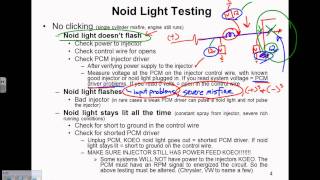
- Disconnect the injector and plug in a 'noid light'. Crank the engine and check if the light flashes, indicating the PCM is sending a signal. If it does not flash, there is a problem in the wiring or PCM.
- If the noid light flashes, the problem is likely the injector itself. If it does not flash, the problem is in the wiring or PCM.
- To confirm a bad injector, turn the engine off and use a multimeter to test the resistance across the two pins of the fuel injector. Compare the reading to the manufacturer's specification or to another injector on the engine. A reading that is significantly different or shows an open circuit (infinite resistance) indicates a bad injector.
- A definitive test is to swap the cylinder 3 injector with an injector from another cylinder (e.g., cylinder 1). Clear the codes, run the engine, and see if the code moves to P0201. If it does, the injector is faulty. If P0203 returns, the issue is in the wiring or PCM.
- If the injector tests good but the noid light doesn't flash, perform a continuity test on the two wires from the injector connector back to the PCM to check for a break or short in the wire.
- If all wiring and the injector are confirmed to be good, the fault may lie with the PCM, which is rare.
Parts You'll Likely Need
- Fuel Injector (2.4L I4)
(OEM #12633789)— This is the most common failure point for a P0203 code. The internal coil windings can break, causing an open circuit.
Trusted brands: ACDelco, Standard Motor Products, Hitachi
OEM price range: $110-$140
Aftermarket price range: $50-$90 - Fuel Injector (3.0L/3.6L V6)
(OEM #12634126)— This is the most common failure point for a P0203 code on V6 models. The internal coil windings can fail, leading to an electrical fault.
Trusted brands: ACDelco, Bosch
OEM price range: $100-$130
Aftermarket price range: $50-$80 - Fuel Injector Connector Pigtail
(OEM #ACDelco PT2160)— The connector itself can become brittle from heat cycles, or the wires can fray, causing an intermittent or permanent open in the circuit. Replacing the pigtail is a common repair.
Trusted brands: ACDelco, Standard Motor Products (HP3945), Dorman
OEM price range: $25-$40
Aftermarket price range: $10-$20
Related Codes That Often Appear With This One
- P0303 — P0303 means 'Cylinder 3 Misfire Detected.' Since the P0203 code indicates a problem with fueling cylinder 3, a misfire is the direct result. The P0203 is the cause, and P0303 is the effect.
- P0200 — P0200 stands for 'Injector Circuit Malfunction' and is a general code indicating a fault in the overall injector control circuit, which could be triggered alongside the more specific P0203.
Technical Service Bulletins (TSBs) & Recalls
- Bulletin #PIP4924D: Mentions that DTCs P0201-P0206 can be set on these vehicles in relation to an engine misfire condition. The TSB guides technicians through standard diagnostic procedures for these injector circuit codes but does not point to a single defective part, suggesting case-by-case diagnosis of the injector, wiring, and PCM.
Platform-Specific Known Issues
- Cylinder Location on V6 Engines: On the 3.0L and 3.6L V6 engines, cylinder 3 is on the front bank (the bank closer to the radiator), in the middle position. This makes it relatively accessible compared to the rear bank cylinders.
Mechanic-Grade Diagnostic Values
- Fuel Injector Coil Resistance (2.4L I4 LAF engine) — expected: 11 - 14 Ohms. Failure: A reading near zero (short) or infinite/OL (open) indicates a failed injector.
- Fuel Injector Coil Resistance (3.0L V6 LF1 engine) — expected: Approximately 12 Ohms. Failure: A significant deviation, or an open/short reading, points to a failed injector.
- Fuel Injector Coil Resistance (3.6L V6 LFX engine) — expected: 1.2 - 1.8 Ohms. Failure: A reading of 0 Ohms (short) or infinite/OL (open) indicates a failed injector. Note the much lower resistance compared to the 2.4L port-injected engine.
- Injector Pulse Width (at idle, all engines) — expected: 2 - 4 milliseconds (ms). Failure: A value of 0 ms for cylinder 3 indicates the PCM is not commanding the injector. A significantly different value from other cylinders can indicate a compensation for a mechanical issue.
- Injector Power Wire Voltage (Key On, Engine Off) — expected: ~12 Volts (Battery Voltage). Failure: Low or no voltage indicates a problem in the power supply circuit, such as a blown fuse or wiring issue before the injector.
Scan Tool Commands That Help
- GDS2 (GM Factory Tool) or high-end aftermarket: Fuel Injector Balance Test — This automated test is used to identify a mechanically weak or clogged injector that may not have an electrical fault. The tool commands each injector to fire and measures the corresponding drop in fuel rail pressure. GM specifies the pressure drop should not vary more than 20% between injectors. This helps differentiate between an electrical P0203 and a flow issue that might cause similar symptoms.
Wiring & Ground Locations
- Cylinder 3 Injector Control Wire (2.4L) — Pin 32 (Light Green/Black wire) on the ECM's 73-way connector (J2/X2).. This is the specific wire that the PCM uses to ground and fire the cylinder 3 injector. Continuity and short-to-ground/voltage tests should be performed on this wire between the ECM and the injector connector if a wiring fault is suspected.
- G110 / G112 — G110 is on the right rear of the engine. G112 is on the lower left front of the 2.4L engine or the left rear of the V6 engines.. These are primary engine grounds. A loose or corroded ground at these locations can cause a host of electrical issues, including intermittent injector circuit faults. The ECM and its sensors require a stable ground reference to operate correctly.
- G105 — On the rear of the engine for the 2.4L, and the left rear for the 3.0L V6.. This is another critical engine ground point. Verifying that this ground is clean and tight is a crucial step when diagnosing any electrical fault, including P0203.
Real Owner Repair Stories
- YouTube video by 'quick automotive diagnostics' (GMC vehicle with similar architecture (engine replacement)) — No start, no communication with PCM, Service Stabilitrak message.
❌ Tried (didn't work) Initial diagnosis pointed towards a bad PCM due to no communication.
✅ What actually fixed it A loose main ground bolt for the PCM and transmission was found hidden between the A/C compressor and alternator. Tightening this bolt restored communication and fixed the no-start condition. This highlights the importance of checking major grounds, especially after major engine work, as a loose ground can cause seemingly unrelated and severe electrical faults.
OEM Part Supersession History
12638530→Not explicitly superseded but is specific to the LF1 engine.— Engine change.
Heads up: This fuel injector is for the 3.0L LF1 V6 (2010-2012) and is NOT compatible with the 3.6L LFX V6 (2013-2014), which uses part number 12634126.N/A→12634126— Engine introduction.
Heads up: This fuel injector is for the 3.6L LFX V6 (2013-2014). It is not backward compatible with the 3.0L LF1 engine. Several compatible part numbers are listed for it, including 12642128 and FJ1157.
Model Year Variations Within This Range
- 2010-2012 vs 2013-2014 (V6 Models): The V6 engine option changed in 2013. 2010-2012 models used the 3.0L LF1 V6. 2013-2014 models used the 3.6L LFX V6. These engines use different fuel injectors (PN 12638530 for LF1, 12634126 for LFX) and have different resistance specifications. While TSB #PIP4924D applies to both, the diagnosis must account for the correct part and specs.
Helpful Videos



Used OEM Parts in Stock
New Aftermarket Parts Available



The information in this article is provided for general reference and educational purposes only. Vehicle specifications, procedures, and part compatibility can vary by production date, trim level, and region. Always consult your vehicle's factory service manual and verify part numbers before purchasing or performing repairs. Safety-critical components such as airbags, seat belts, and braking systems should be installed by a qualified professional.
- Gmc TERRAIN:
- 🎬 Helpful Videos
- 🛍️ Shop This Part
- What's Unique About the 2010-2014 Gmc TERRAIN
- Diagnostic Flowchart
- Symptoms You May Notice
- Most Likely Causes
- Rare But Worth Checking
- Diagnosis Steps
- Parts You'll Likely Need
- Related Codes That Often Appear With This One
- Technical Service Bulletins (TSBs) & Recalls
- Platform-Specific Known Issues
- Mechanic-Grade Diagnostic Values
- Scan Tool Commands That Help
- Wiring & Ground Locations
- Real Owner Repair Stories
- OEM Part Supersession History
- Model Year Variations Within This Range
- 🎟️ Get 5% Off