

P0202 on 1998-2003 Dodge RAM 1500: Injector Circuit Fixes & Causes
P0202 on a 1998-2003 Dodge Ram 1500 indicates a problem with the cylinder 2 fuel injector circuit. The most common cause is not a bad injector, but a faulty wiring harness, especially the section that passes through the valve cover gasket on Magnum engines. Inspect the wiring for brittleness, chafing, and damage at the connector before replacing the injector.
- P0202 points to an electrical circuit problem for the cylinder 2 fuel injector, not necessarily a bad injector.
- Always inspect the wiring harness for damage, especially near the valve cover and exhaust, before buying parts. This is the most common fix.
- Use a multimeter to check injector resistance or swap injectors between cylinders to confirm if the injector itself is faulty.
- Ignoring this code can lead to poor performance, bad fuel economy, and potential damage to your catalytic converter.
What's Unique About the 1998-2003 Dodge RAM 1500

For this generation of Dodge Ram, particularly the 1998-2001 models with 5.2L and 5.9L Magnum engines, a known weak point is the injector wiring harness where it passes through the valve cover. A Technical Service Bulletin (TSB) from the manufacturer specifically warns technicians to check the wiring loom and connector at the valve cover gasket before replacing any injectors. [⭐ MANUFACTURER TSB #9002688] The wiring in this area is subjected to intense heat cycles, causing it to become brittle and crack, leading to an open or short in the circuit. This design makes wiring failures a more common cause for a P0202 code on these trucks than the fuel injector itself.
Diagnostic Flowchart
Tap your situation to follow the diagnostic path that matches what you're seeing on this vehicle.
Generation note: This range covers two generations: the 2nd Gen (1998-2001) and the 3rd Gen (2002-2003). The 2nd Gen primarily used the 3.9L, 5.2L, and 5.9L Magnum engines. The 3rd Gen introduced the 4.7L PowerTech V8. The TSB regarding the valve cover gasket wiring is most relevant to the earlier Magnum engines. While wiring is a common cause on all, the specific failure point at the gasket is a known issue on the 2nd Gen trucks. The 4.7L engines have a more conventional harness layout, but are still prone to heat damage at the injector connectors. The PCM also changed from the JTEC controller in earlier models to the NGC (Next Generation Controller) in 2003, which can affect diagnostics and parts compatibility.
Symptoms You May Notice
- Check Engine Light is on
- Rough or unstable idle
- Engine misfiring, sometimes felt as a shake or stumble
- Hesitation or loss of power during acceleration
- Decreased fuel economy
- Strong smell of unburned fuel from the exhaust
- Engine may be hard to start
- Replacing the fuel injector without checking the wiring first. The TSB and numerous forum discussions strongly indicate that the wiring harness is a more frequent point of failure on these trucks, especially on the Magnum engines. [⭐ MANUFACTURER TSB #9002688]
Most Likely Causes

- Damaged or Corroded Injector Wiring Harness 🔴 High Probability The wiring harness is exposed to extreme engine heat and vibration, causing wires to become brittle, chafe, or melt over time. A manufacturer TSB specifically highlights the wiring loom and connector at the valve cover gasket as a common failure point on Magnum engines. [⭐ MANUFACTURER TSB #9002688] The plastic connector itself can also become brittle and fail to make a secure connection.
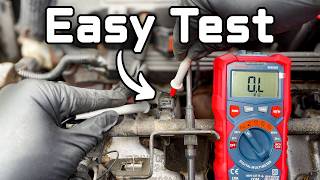
How to confirm: Visually inspect the wiring harness leading to the cylinder 2 injector. Pay close attention to the connector and the section of the harness near the valve cover and exhaust manifold. Perform a 'wiggle test' by gently moving the harness with the engine running to see if the idle quality changes. 🎬 Watch: 5 simple DIY methods to check and test injectors. Use a multimeter to check for continuity (less than 5 ohms) from the PCM connector to the injector connector and check for shorts to ground.
Typical fix: Repair the damaged section of wire or replace the injector connector pigtail. If the failure is where the harness passes through the valve cover on a Magnum engine, the entire valve cover gasket/harness assembly must be replaced.
Est. part cost: $15 - $50 for a pigtail, $50 - $100 for a valve cover gasket/harness assembly - Faulty Fuel Injector 🟡 Medium Probability
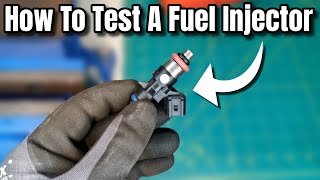
How to confirm: Use a multimeter to check the resistance of the injector. For 1998-2000 5.2L/5.9L Magnum and 4.7L engines, the resistance should be between 10.8 and 13.2 ohms. For earlier 1998 models, it could be 13.3-15.7 ohms. A reading of infinity indicates an open coil, while a reading near zero indicates a short. 🎬 See this guide on testing fuel injectors with a multimeter. Another method is to swap the cylinder 2 injector with an injector from another cylinder (e.g., cylinder 4). If the code changes to P0204, the injector is bad.
Typical fix: Replace the fuel injector for cylinder 2. It is often recommended to replace all injectors as a set on high-mileage vehicles.
Est. part cost: $40 - $90 per injector - Dirty or Clogged Fuel Injector ⚪ Low Probability
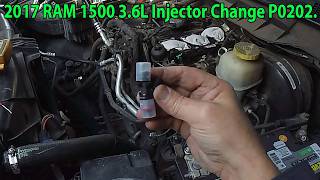
How to confirm: This is difficult to confirm without specialized equipment. A 'circuit' code like P0202 points to an electrical fault, not a flow problem. However, 🎬 Watch: How to diagnose a fuel injector circuit malfunction. if electrical tests pass, a severely clogged injector could potentially cause an electrical anomaly, but it's unlikely. A cylinder balance test may show cylinder 2 is weak.
Typical fix: Professional fuel injector cleaning service or replacement of the injector.
Est. part cost: $40 - $90
Rare But Worth Checking
- Faulty Powertrain Control Module (PCM): This is the least likely cause. The PCM's internal injector driver can fail, but you should exhaust all other possibilities (wiring and injector) before condemning the PCM. This is often misdiagnosed when the real problem is a wiring short that wasn't found. A key diagnostic step is to check for a consistent pulsed ground signal from the PCM at the injector connector using a noid light. If the signal is absent and the wiring from the PCM to the injector is confirmed to be good, a failed driver in the PCM is likely.
Diagnosis Steps

- Retrieve all stored DTCs with an OBD-II scanner. Note if P0302 is also present.
- Locate cylinder #2. On the 5.2L and 5.9L V8 Magnum engines, the cylinders are numbered front-to-back with odd numbers on the driver's side (1-3-5-7) and even numbers on the passenger side (2-4-6-8). Cylinder #2 is the front-most cylinder on the passenger side.
- Visually inspect the wiring harness and connector for the cylinder 2 fuel injector. Look for any signs of melting, chafing, corrosion, or loose pins. On Magnum engines, pay special attention to the area where the harness passes through the valve cover gasket. [⭐ MANUFACTURER TSB #9002688]
- If the wiring looks okay, perform a 'wiggle test'. With the engine idling, gently move the injector connector and surrounding wires. If the engine stumbles or the idle changes, a wiring fault is highly likely.
- Use a 'noid light' to test the injector signal. Disconnect the injector and plug the noid light into the connector. Start the engine; the light should flash steadily. If it's off, dim, or stays on continuously, there is a problem with the wiring or the PCM driver.
- If the noid light flashes correctly, the problem is likely the injector itself. Turn off the engine.
- Use a multimeter set to Ohms to measure the resistance across the two terminals of the fuel injector. The reading should be between 11-14 Ohms for a stock injector. An infinite reading (OL) means it's open, and a very low reading (under 5 Ohms) means it's shorted.
- As a final confirmation, you can swap the cylinder 2 injector with one from another cylinder (cylinder 4 is usually accessible). Clear the codes and run the engine. If the fault code moves to P0204, the injector is confirmed to be faulty.
- If all wiring and the injector test good, and the noid light test failed, the issue could be a rare failure in the PCM's injector driver circuit.
Parts You'll Likely Need

- Fuel Injector Connector Pigtail
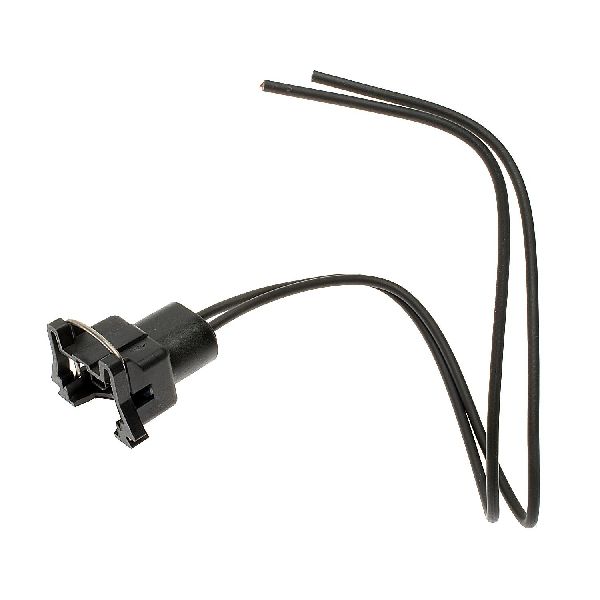
(OEM #68353382AA (replaces 5013856AA))— The connector itself or the wires leading to it are a common failure point due to heat and vibration, often being the true cause of the 'circuit malfunction'. This is the fix if the damage is at the connector end.
Trusted brands: Mopar, Standard Motor Products (S-558), Dorman (645-208)
OEM price range: $25-$40
Aftermarket price range: $15-$30 - Fuel Injector
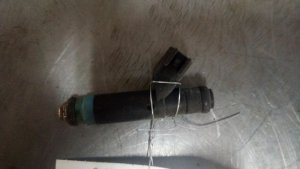
(OEM #53030778 (For 5.2L/5.9L Magnum))— If the injector's internal coil has failed (tested via resistance check), it will need to be replaced.
Trusted brands: Bosch (0280155972 - popular 4-hole upgrade), Standard Motor Products (FJ320), Mopar
OEM price range: $70-$120
Aftermarket price range: $40-$90 - Valve Cover Gasket with Injector Harness
(OEM #53020758AA (Passenger Side for V8))— On 5.2L/5.9L Magnum engines, the injector wiring is integrated into the passenger-side valve cover gasket. Per TSB #9002688, this assembly is a primary suspect for the fault. If the wiring is brittle or broken where it passes through the gasket, this entire part must be replaced. [⭐ MANUFACTURER TSB #9002688, 4]
Trusted brands: Mopar, Fel-Pro (VS50458R)
OEM price range: $80-$150
Aftermarket price range: $50-$100
Related Codes That Often Appear With This One
- P0302 — P0302 means 'Cylinder 2 Misfire Detected'. Since the P0202 code indicates a problem with fueling cylinder 2, it's very common for the PCM to also detect a misfire on that same cylinder.
Technical Service Bulletins (TSBs) & Recalls
- 9002688: Advises checking the wiring loom and connector integrated into the valve cover gasket before replacing injectors for P0201-P0208 codes on Magnum engines. This is an NHTSA reference number for
Platform-Specific Known Issues
- Magnum Engine Valve Cover Harness Failure: A known issue, documented in TSB #9002688, points to the wiring loom and/or connector in the valve cover gasket as a primary cause for injector circuit codes (P0201-P0208) on 5.2L and 5.9L Magnum engines. The passenger side gasket contains the harness for cylinders 2, 4, 6, and 8. Heat from the engine bakes the wiring over time, causing it to become brittle and crack, leading to an open circuit. [⭐ MANUFACTURER TSB #9002688]
Mechanic-Grade Diagnostic Values
- Fuel Injector Resistance (5.2L/5.9L Magnum, 1998-2000) — expected: 10.8 - 13.2 Ohms. Failure: A reading of infinity (OL) indicates an open coil; a reading near zero indicates a shorted coil.
- Fuel Injector Resistance (4.7L, 1998-2000) — expected: 10.8 - 13.2 Ohms. Failure: A reading of infinity (OL) indicates an open coil; a reading near zero indicates a shorted coil.
- Fuel Injector Resistance (5.2L/5.9L Magnum, pre-1998 spec) — expected: 13.3 - 15.7 Ohms. Failure: A reading of infinity (OL) indicates an open coil; a reading near zero indicates a shorted coil. This applies to early models in the range.
- Injector Power Wire Voltage (Key On) — expected: Battery Voltage (approx. 12V). Failure: No voltage suggests a problem with the ASD (Auto Shutdown) relay, its fuse, or the power feed wire.
- Injector Control Circuit Continuity (PCM to Injector) — expected: Less than 5.0 Ohms, ideally less than 1.0 Ohm.. Failure: Resistance higher than 5.0 Ohms points to excessive resistance or an open in the wiring harness.
- Fuel Pressure (Key On, Engine Off) — expected: 44-54 PSI. Failure: Low fuel pressure will not cause a P0202 circuit code but can cause similar symptoms like misfiring.
Scan Tool Commands That Help
- DRB III: Injector Kill / Cylinder Balance Test — The DRB III, the OEM scan tool for this era, can individually disable injectors. This helps confirm if cylinder 2 is contributing to the engine's operation. When injector #2 is disabled, there should be a noticeable drop in RPM; if there is no change, it confirms that cylinder was not firing correctly.
- DRB III: Actuator Test - Fuel Pump Relay — To verify the fuel pump and ASD relay circuits are functioning correctly, which supply power to the injectors. This can be used to energize the fuel pump to check pressure without starting the engine.
Wiring & Ground Locations

- Injector #2 PCM Driver Pin (JTEC PCM) — On JTEC (pre-2003) PCMs, this is typically Pin 17 on the C1 connector (a 40-pin connector). The wire is often Tan (TN).. This is the specific pin that the PCM uses to ground and fire the cylinder 2 injector. Testing for a pulsed ground signal here or checking continuity from this pin to the injector connector is a definitive way to test the control circuit and isolate a wiring fault from a PCM fault.
- Injector Power Feed (All Injectors) — A Dark Green/Orange wire at the injector connector on many models.. This wire provides 12V power from the Auto Shutdown (ASD) relay to all fuel injectors. A lack of voltage here would affect multiple cylinders, but damage to this specific wire near the #2 injector could cause an isolated fault.
- G102 - Engine Ground — Typically located at the left rear of the engine block.. This is a primary ground for multiple engine components. While a bad ground here would likely cause more widespread issues than just a single injector code, poor grounding can lead to unpredictable electrical problems and should be checked for corrosion and tightness.
- PCM Grounds (JTEC) — On the 60-pin PCM, Pins 11 and 12 (both Black/Tan wires) are common chassis grounds for the computer.. The PCM requires a solid ground reference to accurately control the injector drivers. A fault at these pins could cause erratic behavior, though it would likely trigger multiple codes, not just P0202.
Real Owner Repair Stories
- DodgeForum.com user 'Scuba Sam' (1999 Ram 1500, 5.9L gas) — No power to #6 injector (P0206, but same diagnostic principle), engine running rough.
❌ Tried (didn't work) Confirmed wiring from injector to PCM was intact., Checked ASD relay and its wiring for continuity., Verified other injectors were firing correctly with a noid light.
✅ What actually fixed it The user's diagnostic process pointed directly to a failed injector driver within the PCM. After confirming all external wiring was good but still having no pulsed ground signal at the PCM connector for that specific cylinder, the conclusion was that the PCM itself was faulty and needed replacement.
OEM Part Supersession History
53030778→Multiple aftermarket options, including Bosch 0280155934 and upgraded 4-hole designs like Bosch 0280155784.— Original single-pintle injectors are often replaced with four-hole or multi-hole injectors for better fuel atomization, potentially leading to a smoother idle and better throttle response.
Heads up: When upgrading, ensure the new injectors have the correct electrical connector (EV1 for early models, EV6 for later models) and impedance (high impedance, ~12 Ohms). Using injectors with incorrect impedance can damage the PCM.
Model Year Variations Within This Range
- 1998-2002: These models typically use the JTEC or JTEC+ Powertrain Control Module. The wiring harness design, especially on 5.2L/5.9L Magnum engines, includes the problematic harness-through-valve-cover design.
- 2003: The 2003 model year (and some late 2002s) transitioned to the Next Generation Controller (NGC) PCM. This is a physically different computer with different connectors and pinouts than the earlier JTEC models. While the root causes of P0202 are similar, diagnostic procedures involving PCM pin testing require a different diagram for NGC-equipped trucks.
- 2000-2003 vs 1998-1999: The electrical connector style on the injector itself can vary. Earlier models in this range typically use an EV1 (Minitimer/Jetronic) style connector, while later models may use an EV6 (USCAR) style connector. A visual check is necessary before ordering replacement pigtails or injectors.
Helpful Videos

Used OEM Parts in Stock

New Aftermarket Parts Available


The information in this article is provided for general reference and educational purposes only. Vehicle specifications, procedures, and part compatibility can vary by production date, trim level, and region. Always consult your vehicle's factory service manual and verify part numbers before purchasing or performing repairs. Safety-critical components such as airbags, seat belts, and braking systems should be installed by a qualified professional.
- Dodge RAM 1500:
- 🎬 Helpful Videos
- 🛍️ Shop This Part
- What's Unique About the 1998-2003 Dodge RAM 1500
- Diagnostic Flowchart
- Symptoms You May Notice
- Most Likely Causes
- Rare But Worth Checking
- Diagnosis Steps
- Parts You'll Likely Need
- Related Codes That Often Appear With This One
- Technical Service Bulletins (TSBs) & Recalls
- Platform-Specific Known Issues
- Mechanic-Grade Diagnostic Values
- Scan Tool Commands That Help
- Wiring & Ground Locations
- Real Owner Repair Stories
- OEM Part Supersession History
- Model Year Variations Within This Range
- 🎟️ Get 5% Off